
The pursuit of high-performance power transmission in applications such as high-speed trains, marine propulsion, helicopters, megawatt-class wind turbines, and automotive drivetrains demands gears with exceptional dynamic behavior, low noise, and high reliability. For these high-end spur gears, profile modification has become an indispensable component of the design process. Appropriate modification can significantly reduce dynamic loads, minimize vibration and noise, and enhance transmission accuracy and gear strength. Since Walker’s initial discourse on involute gear tooth correction in 1938, research in this field has continuously evolved. While early studies primarily focused on compensating for elastic tooth deflection, modern approaches incorporate a multitude of factors including thermal deformation, system deflections, manufacturing errors, and multi-objective optimizations for three-dimensional tooth flank corrections.
However, a critical influence has been conspicuously absent from all existing gear modification methodologies: the effect of lubrication. High-performance spur gears in the aforementioned applications typically operate under Elastohydrodynamic Lubrication (EHL) conditions. Research has conclusively demonstrated that the EHL film separating the contacting tooth surfaces possesses significant stiffness and damping characteristics. Studies indicate that under EHL conditions, the contact stiffness of a friction pair can be substantially lower—by a factor of 2 to 4—than the classical Hertzian contact stiffness calculated without considering the lubricant film. This dramatic change in contact stiffness directly implies a significant alteration in the contact deformation between mating teeth. Consequently, ignoring the EHL effect when calculating modification amounts, which are fundamentally intended to compensate for elastic deformations, leads to a theoretical oversight. This paper addresses this gap by proposing, for the first time, a novel spur gear profile modification method that incorporates the influence of EHL.
The core innovation of this research lies in replacing the traditional gear meshing stiffness with the meshing stiffness of the gear EHL friction pair for calculating the maximum profile modification amount. A tribo-dynamic coupling model for a line-contact EHL friction pair is established, the stiffness is identified, and a new modification methodology is formulated. Dynamic simulations and comparisons with practical engineering cases confirm the superiority of the proposed method over the standard ISO approach.
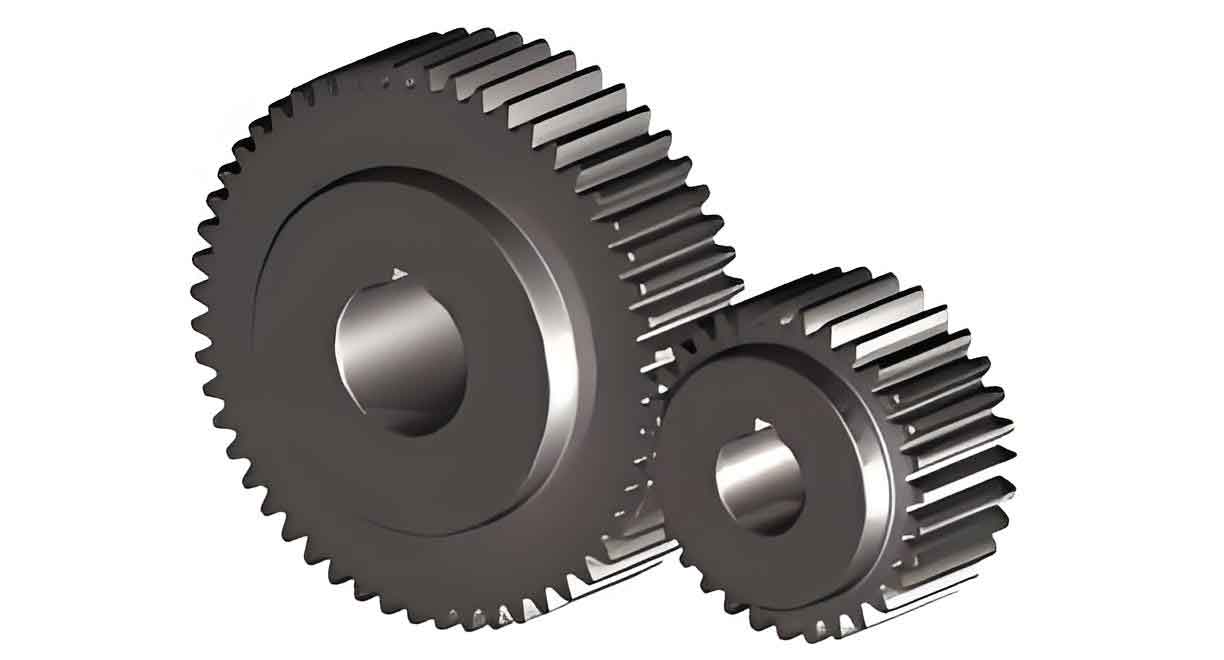
1. Stiffness of the Line-Contact EHL Friction Pair
1.1 Tribo-Dynamic Coupling Model
To quantify the stiffness introduced by the lubricant film between contacting spur gear teeth, we model the contact at any meshing instant as an equivalent line-contact EHL problem. The EHL film is represented as a linearized spring-damper element connecting the two elastic bodies.
1.1.1 Governing Equations for EHL
The isothermal line-contact EHL problem is governed by the following set of equations:
Reynolds Equation:
$$ \frac{\partial}{\partial x}\left( \frac{\rho h^3}{\eta} \frac{\partial p}{\partial x} \right) = 12u \frac{\partial (\rho h)}{\partial x} + 12 \frac{\partial (\rho h)}{\partial t} $$
with boundary conditions \( p(x_{in}, t) = p(x_{out}, t) = 0 \) and \( p(x, t) \ge 0 \) for \( x_{in} < x < x_{out} \).
Film Thickness Equation:
$$ h(x, t) = h_{00}(t) + \frac{x^2}{2R} – \frac{2}{\pi E’} \int_{x_{in}}^{x_{out}} p(x’, t) \ln |x – x’| \, dx’ $$
Density-Pressure Relation (Dowson-Higginson):
$$ \rho = \rho_0 \left( \frac{1 + 0.6 \times 10^{-9}p}{1 + 1.7 \times 10^{-9}p} \right) $$
Viscosity-Pressure Relation (Roelands):
$$ \eta = \eta_0 \exp\left\{ (\ln \eta_0 + 9.67) \left[ (1 + 5.1 \times 10^{-9}p)^{z} – 1 \right] \right\} $$
Load Balance Equation:
$$ \int_{x_{in}}^{x_{out}} p(x, t) \, dx = w $$
where \(u\) is the entrainment velocity, \(\rho\) and \(\eta\) are the lubricant density and viscosity, \(p\) is pressure, \(h\) is film thickness, \(R\) is the effective radius of curvature, \(E’\) is the effective elastic modulus, and \(w\) is the load per unit length.
1.1.2 Dynamics and Coupling
The equation of motion for the equivalent friction pair model, derived from Newton’s second law, is:
$$ m \frac{d^2 \delta}{dt^2} + f_{film} = q(t) $$
where \(m\) is the equivalent mass, \(\delta\) is the elastic approach, \(f_{film}\) is the oil film force, and \(q(t)\) is the external load. The coupling between tribology and dynamics is completed by defining the oil film force and the elastic approach:
$$ f_{film} = l \int_{x_{in}}^{x_{out}} p(x, t) \, dx $$
$$ \delta = -h_{00} + c_0 $$
where \(l\) is the effective contact length and \(c_0\) is a constant.
1.2 Dimensionless Form and Stiffness Identification
The system of equations is rendered dimensionless using characteristic parameters based on Hertzian contact conditions (half-width \(b\), maximum Hertz pressure \(p_H\)). For example, the dimensionless Reynolds equation becomes:
$$ \frac{\partial}{\partial X}\left( \bar{\rho} \frac{H^3}{\bar{\eta} \lambda} \frac{\partial P}{\partial X} \right) = \frac{\partial (\bar{\rho} H)}{\partial X} + \frac{\partial (\bar{\rho} H)}{\partial T} $$
where \(X=x/b\), \(H=Rh/b^2\), \(P=p/p_H\), \(\lambda = 3\pi^2 U / (4W^2)\), \(U=\eta_0 u/(E’R)\), and \(W=w/(E’R)\).
The oil film force \(f_{film}(\delta)\) is linearized about the static equilibrium point \(\delta_0\):
$$ f_{film}(\delta) \approx f_{film}(\delta_0) + k(\delta – \delta_0) + c\dot{\delta} $$
where \(k\) and \(c\) are the identified stiffness and damping of the EHL friction pair.
The stiffness \(k\) is identified by analyzing the system’s response to a harmonic excitation, \(q = q_0[1 + c_w \sin(\omega_e t)]\). The numerical solution of the coupled system yields a hysteresis loop (damping ring) in the force-displacement plane over one excitation cycle. The slope of the major axis of this elliptical loop corresponds to the dimensionless stiffness \(K\). The conversion to physical stiffness \(k\) is straightforward given the scaling parameters.
Numerical Example: For a line contact with \(E’=206\) GPa, \(\eta_0=0.0272\) Pa·s, \(u=3\) m/s, \(R=0.021\) m, and a harmonic load (\(q_0=2500\) N, \(c_w=0.1\), \(f=500\) Hz), the identified physical stiffness is \(k = 3.27 \times 10^9\) N/m. This value is significantly lower than the corresponding Hertzian contact stiffness, confirming the substantial softening effect of the EHL film.
2. Gear Meshing Stiffness vs. EHL Friction Pair Meshing Stiffness
The traditional approach for spur gears uses the gear meshing stiffness \(C_{\gamma}\), defined in ISO 6336 as the average total mesh stiffness per unit face width over one engagement cycle. It is calculated as:
$$ C_{\gamma} = \frac{1}{n} \sum_{i=1}^{n} \frac{K_i}{b} $$
where \(K_i = F_n / \delta_i\) is the stiffness at discrete contact point \(i\), \(F_n\) is the normal force, \(\delta_i\) is the total elastic deflection (calculable using formulas like Ishikawa’s), \(b\) is the face width, and \(n\) is the number of points.
In this study, we define the EHL Friction Pair Meshing Stiffness, \(C_{EHL}\), by analogy:
$$ C_{EHL} = \frac{1}{n} \sum_{i=1}^{n} \frac{K_{i(EHL)}}{b} $$
Here, \(K_{i(EHL)}\) is the stiffness of the EHL friction pair (as identified in Section 1) at meshing point \(i\), which incorporates the compliance of both the gear teeth and the intervening lubricant film. A comparison for a sample spur gear pair shows that \(C_{EHL}\) is consistently lower than \(C_{\gamma}\).
| Parameter | Symbol | Value | Units |
|---|---|---|---|
| Traditional Gear Meshing Stiffness | \(C_{\gamma}\) | 19.35 | N/(mm·µm) |
| EHL Friction Pair Meshing Stiffness | \(C_{EHL}\) | 12.32 | N/(mm·µm) |
| ISO-Based Max. Modification | \(\Delta_{max(ISO)}\) | 21.13 | µm |
| EHL-Based Max. Modification | \(\Delta_{max(EHL)}\) | 33.18 | µm |
3. Profile Modification Methodology
3.1 ISO Standard Method
The three key elements for spur gear profile modification are the maximum modification amount \(\Delta_{max}\), the modification length \(L_a\), and the modification curve (e.g., linear, parabolic). The ISO-recommended formula for maximum linear tip relief is:
$$ \Delta_{max(ISO)} = \frac{K_A \cdot (F_t / b)}{C_{\gamma} \cdot \varepsilon_{\alpha}} $$
where \(K_A\) is the application factor, \(F_t/b\) is the tangential load per unit face width, and \(\varepsilon_{\alpha}\) is the transverse contact ratio. The modification length for long relief is often taken as \(L = P_{bt}(\varepsilon_{\alpha} – 1)\), where \(P_{bt}\) is the transverse base pitch.
3.2 Proposed EHL-Based Method
The proposed new method simply substitutes the EHL friction pair meshing stiffness \(C_{EHL}\) into the modification formula:
$$ \Delta_{max(EHL)} = \frac{K_A \cdot (F_t / b)}{C_{EHL} \cdot \varepsilon_{\alpha}} $$
The modification length \(L\) can be determined similarly. The modification curve (e.g., linear: \(\Delta(x) = \Delta_{max} (x / L)\)) remains unchanged in form, but is applied with the new, larger \(\Delta_{max(EHL)}\). As seen in the table above, for the example case, considering EHL effects increases the calculated maximum modification by approximately 57%.
4. Dynamic Simulation and Performance Comparison
To validate the proposed method, a case study was performed on a mining spur gear pair. Three models were created: an unmodified standard gear pair, a gear pair modified using the ISO-based \(\Delta_{max(ISO)}=21.13 \mu m\), and a gear pair modified using the EHL-based \(\Delta_{max(EHL)}=33.18 \mu m\). Dynamic simulations were conducted using Adams (for dynamic mesh force and angular acceleration) and Romax (for transmission error).
4.1 Adams Dynamics Simulation Results
The dynamic mesh force and output gear angular acceleration were analyzed. The results clearly demonstrate the improvement offered by the EHL-based modification.
| Spur Gear Pair Type | Max. Mesh Force (N) | Mean Mesh Force (N) | Reduction vs. Std. | Max. Angular Acc. (°/s²) | Mean Angular Acc. (°/s²) | Reduction vs. Std. |
|---|---|---|---|---|---|---|
| Standard (Unmodified) | 1,565,100 | 79,501 | – | 724,340 | 53,320 | – |
| ISO-Modified | 1,182,600 | 74,400 | 6.4% | 542,950 | 50,645 | 5.0% |
| EHL-Based Modified | 1,142,700 | 62,390 | 21.5% | 528,310 | 44,667 | 16.2% |
4.2 Romax Transmission Error Analysis
Transmission Error (TE), a key excitations source for noise and vibration, was evaluated. A lower TE amplitude indicates smoother transmission.
| Spur Gear Pair Type | Max. Modification (µm) | Peak-to-Peak TE (µm) | Reduction vs. Std. Gear |
|---|---|---|---|
| Standard (Unmodified) | 0 | 8.17 | – |
| ISO-Modified | 21.13 | 6.60 | 19.2% |
| EHL-Based Modified | 33.18 | 4.73 | 42.1% |
The results are unequivocal: spur gears modified using the proposed EHL-based method exhibit superior dynamic performance. The reductions in mean mesh force, mean angular acceleration, and transmission error are significantly greater than those achieved with the ISO-based method.
5. Validation Against Engineering Practice
To further ground the research, the calculated modification amounts from both methods were compared against the actual, empirically-determined modification values used for various spur gear pairs documented in engineering literature. These real-world gears had undergone testing and optimization to confirm their good modification performance.
| Case Ref. | ISO Calc. \(\Delta_{max(ISO)}\) (µm) | EHL-Based Calc. \(\Delta_{max(EHL)}\) (µm) | Actual Practical \(\Delta_{max}\) (µm) | Error of ISO Method | Error of EHL Method |
|---|---|---|---|---|---|
| 1 | 1.7 | 3.8 | 4.2 | 59.5% | 9.5% |
| 2 | 13.6 | 35.2 | 40.0 | 66.0% | 12.0% |
| 3 | 12.3 | 38.5 | 49.1 | 75.0% | 21.6% |
| 4 | 21.0 | 40.0 | 44.0 | 52.3% | 9.1% |
| 5 | 70.0 | 111.0 | 120.0 | 41.7% | 7.5% |
| 6 | 88.0 | 109.0 | 120.0 | 26.7% | 9.2% |
This comparison reveals a critical insight: the modification amounts calculated by the traditional ISO method show a large and systematic deviation from practical values, often underestimating them by 40-75%. In contrast, the modification amounts derived from the proposed EHL-based method are consistently much closer to the actual values used by engineers, with errors typically around 10%. This strongly suggests that experienced designers implicitly account for lubrication effects (among other factors) through testing, and that the proposed method provides a more accurate theoretical foundation for determining spur gear modification.
6. Conclusion
This study establishes a fundamental link between elastohydrodynamic lubrication and spur gear profile modification. By introducing and calculating the meshing stiffness of the gear EHL friction pair, a new methodology for determining the maximum profile modification amount is proposed. The key findings are:
- EHL Effect on Stiffness: The presence of an elastohydrodynamic lubricant film significantly reduces the effective stiffness of the contacting spur gear teeth compared to the dry Hertzian contact assumption.
- Increased Modification Requirement: This reduction in stiffness directly leads to a larger calculated maximum profile modification amount, often on the order of 50% greater than the ISO-based calculation.
- Superior Dynamic Performance: Spur gears modified using the EHL-based method demonstrate markedly better performance than those modified using the ISO method, with greater reductions in dynamic mesh force, angular acceleration, and transmission error.
- Alignment with Engineering Practice: The theoretically calculated modification amounts from the EHL-based method show remarkably good agreement with the actual modification values used in proven engineering designs for spur gears, unlike the ISO method which shows large discrepancies.
Therefore, incorporating elastohydrodynamic lubrication effects into the spur gear modification design process is not only necessary from a theoretical standpoint but also leads to more effective, performance-optimized gears that align with best engineering practices. This research provides a new, more physically accurate tool for the design of high-performance spur gear transmissions.