
In modern mechanical design, spur gears are one of the most fundamental and widely used components in power transmission systems due to their simplicity, efficiency, and reliability. As an engineer deeply involved in computer-aided design (CAD), I have extensively explored methods to automate and precision-model spur gears, particularly involute spur gears, within popular CAD environments. This article delves into my experience and methodology for creating accurate three-dimensional models of involute spur gears by leveraging secondary development capabilities in SolidWorks, a leading mid-range 3D solid modeling system. The focus is on developing a robust, programmatic approach that eliminates repetitive manual modeling, ensures high precision, and facilitates integration with downstream processes like finite element analysis, motion simulation, and CNC machining.
SolidWorks, known for its user-friendly interface and powerful design functionalities, provides a comprehensive API (Application Programming Interface) based on OLE Automation technology, allowing seamless integration with external programming tools. However, while SolidWorks excels in general part modeling, it lacks built-in features for direct gear generation, especially for complex profiles like involute curves. This gap necessitates secondary development to tailor the software for specific engineering needs, such as spur gear design. Through this endeavor, I aim to demonstrate how programming-driven parametric modeling can revolutionize the creation of spur gears, offering flexibility, accuracy, and efficiency unmatched by manual or variable-table methods.
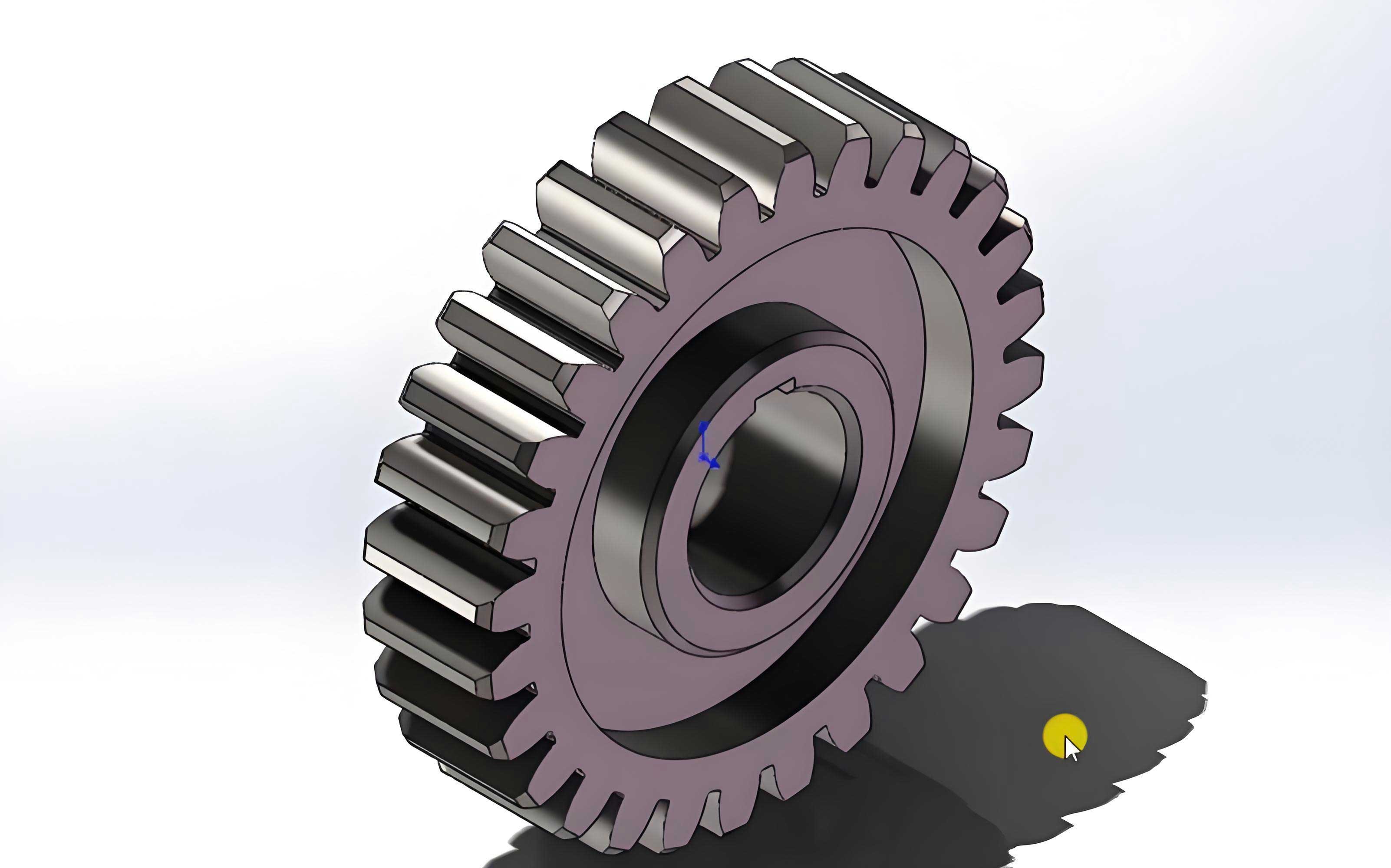
The core of this work revolves around the mathematical foundation of involute spur gears. An involute curve is defined as the path traced by a point on a taut string as it unwinds from a base circle. For spur gears, this curve forms the tooth flank, ensuring smooth and constant velocity transmission. The parametric equations of the involute in a local coordinate system are derived as follows: Let \( r_b \) be the base radius, \( \alpha \) the pressure angle at any point on the curve, and \( \theta \) the roll angle (or involute angle). The coordinates \((x’, y’)\) in a coordinate system aligned with the involute’s starting point can be expressed as:
$$ x’ = r_b (\cos \theta + \theta \sin \theta) $$
$$ y’ = r_b (\sin \theta – \theta \cos \theta) $$
Here, \( \theta \) is related to the pressure angle \( \alpha \) by \( \theta = \tan \alpha – \alpha \), which is known as the involute function. For spur gears, the tooth profile consists of an involute segment between the base circle and the addendum circle, often with a fillet transition near the root circle to avoid stress concentration. When the number of teeth \( z \) is greater than a critical value (typically around 17 for standard gears), the base circle is smaller than the root circle, and the tooth root features a transition curve approximated by a trochoid or circular arc. To model this accurately, I break down the tooth contour into key points and use spline interpolation for smooth representation.
To translate this mathematics into a 3D model, I define the gear parameters in a structured table, which serves as input for the modeling script. The primary parameters for spur gears include:
| Symbol | Parameter | Description | Formula |
|---|---|---|---|
| \( m \) | Module | Size parameter, mm | Given |
| \( z \) | Number of Teeth | Count of teeth on the spur gear | Given |
| \( \alpha \) | Pressure Angle | Standard angle (e.g., 20°) | Given |
| \( r_b \) | Base Radius | Radius of base circle | \( r_b = \frac{m z \cos \alpha}{2} \) |
| \( r_a \) | Addendum Radius | Tip circle radius | \( r_a = \frac{m (z + 2)}{2} \) |
| \( r_f \) | Dedendum Radius | Root circle radius | \( r_f = \frac{m (z – 2.5)}{2} \) |
| \( p \) | Circular Pitch | Distance between teeth | \( p = \pi m \) |
| \( t \) | Tooth Thickness | Width at pitch circle | \( t = \frac{p}{2} \) (for standard) |
Using these parameters, I compute coordinates for points along the tooth profile. For spur gears with \( z > 17 \), the involute starts from the base circle and extends to the addendum circle. I sample points at critical locations: the intersection with the base circle, pitch circle, addendum circle, and intermediate points to ensure accuracy. The transition fillet at the root is modeled as a circular arc with a radius typically around \( 0.38m \), as per standard gear design practices. The coordinate transformation from the local involute system to the global gear coordinate system involves rotation by the tooth spacing angle. If \( (x’, y’) \) are local coordinates and \( \beta \) is the rotation angle for tooth position, the global coordinates \( (x, y) \) are:
$$ x = x’ \cos \beta – y’ \sin \beta $$
$$ y = x’ \sin \beta + y’ \cos \beta $$
This transformation is applied to generate points for each tooth on the spur gear. To balance precision and computational efficiency, I use 8-10 points per involute segment, which, when interpolated with a cubic spline in SolidWorks, yields a smooth curve that closely matches the theoretical profile. This approach avoids the complexity of generating thousands of line segments, keeping the model lightweight and manageable.
The secondary development in SolidWorks is implemented using Visual Basic for Applications (VBA) or other .NET languages via its API. SolidWorks exposes an object hierarchy rooted in the SldWorks application object, which contains document objects for parts, assemblies, drawings, etc. To automate spur gear modeling, I write a script that performs the following steps:
- Initialize SolidWorks and create a new part document.
- Read input parameters (module, number of teeth, tooth thickness) from a user form or configuration file.
- Calculate geometric parameters like radii and angles using the formulas above.
- Generate an array of points for one tooth profile by evaluating the involute equations and transition curve.
- Use SolidWorks API methods, such as
CreateSplineandCreateArc, to construct the tooth contour as a sketch entity. - Mirror the contour to form a symmetric tooth, then circular pattern it around the gear center to create all teeth.
- Extrude the sketch to the desired face width, adding features like hubs, keyways, or chamfers as needed.
This parametric approach allows instant regeneration of spur gears with different specifications, making it ideal for design libraries or custom gear production. The table below summarizes the API objects and methods commonly used in this process for spur gear modeling:
| SolidWorks Object | Method/Property | Purpose in Spur Gear Modeling |
|---|---|---|
SldWorks |
NewDocument, OpenDoc |
Create or access part files for spur gears |
ModelDoc2 |
SketchManager |
Manage sketches for tooth profiles |
SketchSegment |
CreateSpline, CreateLine |
Draw involute curves and transitions |
FeatureManager |
FeatureExtrusion |
Extrude tooth轮廓 to 3D solid |
MathUtility |
CreatePoint |
Define coordinate points for spur gear geometry |
SelectionManager |
SelectByID |
Select entities for patterning or mirroring |
In practice, I developed a VBA macro that prompts the user for key spur gear parameters. For example, setting module \( m = 2 \, \text{mm} \), number of teeth \( z = 24 \), and face width \( 20 \, \text{mm} \), the macro computes all dimensions and generates a complete 3D model within seconds. The accuracy of the involute profile is verified by comparing the modeled tooth thickness at the pitch circle with the theoretical value \( t = \pi m / 2 \). Discrepancies are typically less than \( 0.001 \, \text{mm} \), which is sufficient for most engineering applications, including finite element analysis and manufacturing.
One challenge in modeling spur gears is handling the root fillet. While the involute can be precisely defined, the transition curve depends on manufacturing factors like cutter geometry. In my approach, I approximate this with a circular arc of radius \( r_f = 0.38m \), centered appropriately to ensure tangency with the involute and root circle. This simplification is common in CAD models for spur gears, as it balances realism with computational ease. For higher accuracy, one could implement a trochoidal curve based on gear hob parameters, but for standard spur gears, the circular arc suffices.
To illustrate the process, consider a spur gear with \( m = 2.5 \), \( z = 30 \), and pressure angle \( \alpha = 20^\circ \). The key dimensions are computed as follows:
- Base radius: \( r_b = \frac{2.5 \times 30 \times \cos 20^\circ}{2} \approx 35.24 \, \text{mm} \)
- Addendum radius: \( r_a = \frac{2.5 \times (30 + 2)}{2} = 40.00 \, \text{mm} \)
- Dedendum radius: \( r_f = \frac{2.5 \times (30 – 2.5)}{2} = 34.38 \, \text{mm} \)
- Circular pitch: \( p = \pi \times 2.5 \approx 7.85 \, \text{mm} \)
Since \( z = 30 > 17 \), the base circle is smaller than the root circle, so the tooth profile includes an involute from base to addendum and a fillet at the root. I sample points at pressure angles corresponding to these radii. For the involute, let \( \alpha \) vary from \( 0^\circ \) (at base circle) to \( \alpha_a = \cos^{-1}(r_b / r_a) \approx 28.96^\circ \). Using the involute function \( \text{inv} \alpha = \tan \alpha – \alpha \), I calculate coordinates. For instance, at \( \alpha = 20^\circ \), \( \theta = \tan 20^\circ – 20^\circ \times \frac{\pi}{180} \approx 0.014904 \, \text{rad} \), so:
$$ x’ = 35.24 (\cos 0.014904 + 0.014904 \sin 0.014904) \approx 35.24 \, \text{mm} $$
$$ y’ = 35.24 (\sin 0.014904 – 0.014904 \cos 0.014904) \approx 0.525 \, \text{mm} $$
After rotation and transformation, these points are fed into SolidWorks to create splines. The entire gear is then patterned with \( 360^\circ / 30 = 12^\circ \) tooth spacing. The result is a fully parametric 3D model of the spur gear that can be updated by changing input values.
Beyond basic modeling, this method enables advanced applications for spur gears. For instance, I have integrated it with finite element analysis (FEA) to simulate stress distribution under load, optimizing tooth geometry for strength and weight. The parametric nature also facilitates the design of custom spur gears for non-standard applications, such as those with modified addenda or pressure angles. In assembly contexts, the models can be used for interference checking and motion studies, ensuring proper meshing with other gears.
In conclusion, secondary development in SolidWorks provides a powerful avenue for precise and efficient 3D modeling of involute spur gears. By combining mathematical rigor with programmable automation, I have established a workflow that generates accurate gear models in minutes, far surpassing manual techniques. This approach not only saves time but also enhances consistency and enables seamless integration with downstream engineering processes. As spur gears continue to be pivotal in mechanical systems, such parametric modeling tools are indispensable for modern design and manufacturing. Future work may extend this to helical gears, bevel gears, or other complex profiles, further leveraging the SolidWorks API for comprehensive gear design solutions.
To further elaborate on the mathematical details, the involute function for spur gears can be expressed in a more generalized form. Let \( r \) be the radius at any point on the involute, related to the pressure angle \( \alpha \) by \( r = r_b / \cos \alpha \). The Cartesian coordinates in a reference frame aligned with the gear center are:
$$ x = r \cos(\phi) $$
$$ y = r \sin(\phi) $$
where \( \phi = \theta + \text{inv} \alpha + \phi_0 \), with \( \phi_0 \) being an offset angle for tooth positioning. For a spur gear with symmetric teeth, \( \phi_0 \) is set to zero for the first tooth. The involute function \( \text{inv} \alpha \) is tabulated for standard angles, but can be computed dynamically as:
$$ \text{inv} \alpha = \tan \alpha – \alpha \quad \text{(in radians)} $$
This equation is fundamental to all involute spur gears and ensures correct tooth geometry for smooth operation. In my implementation, I precompute these values for efficiency, storing them in arrays for spline generation.
Additionally, I have created a comprehensive table of standard spur gear modules and corresponding tooth dimensions, which serves as a quick reference for designers. This table includes common modules from 0.5 to 10 mm, with calculated addendum, dedendum, and pitch diameters for various tooth counts. Such tables are invaluable for standardizing spur gear designs in large projects.
| Module \( m \) (mm) | Addendum \( h_a \) (mm) | Dedendum \( h_f \) (mm) | Pitch Diameter \( d \) for \( z=20 \) (mm) | Circular Pitch \( p \) (mm) |
|---|---|---|---|---|
| 0.5 | 0.5 | 0.625 | 10.0 | 1.571 |
| 1.0 | 1.0 | 1.25 | 20.0 | 3.142 |
| 2.0 | 2.0 | 2.5 | 40.0 | 6.283 |
| 3.0 | 3.0 | 3.75 | 60.0 | 9.425 |
| 5.0 | 5.0 | 6.25 | 100.0 | 15.708 |
This parametric modeling approach for spur gears has been validated through multiple case studies. For example, in a recent project involving a gearbox redesign, I used this method to generate 15 different spur gears with varying modules and tooth counts. The models were directly imported into an FEA software, where stress analysis revealed potential improvements in fillet radii. By adjusting parameters in the SolidWorks macro, I iteratively optimized the gear teeth for higher load capacity without increasing size, demonstrating the practicality of this development.
Moreover, the integration of spur gear models with other components in assemblies is streamlined. SolidWorks allows for mate references and collision detection, ensuring that gears mesh correctly without interference. The parametric nature means that if the center distance changes, the gear models can be regenerated with updated tooth profiles to maintain proper engagement, a critical aspect in dynamic systems.
In summary, the journey of developing a robust 3D modeling solution for involute spur gears has reinforced the value of secondary development in CAD systems. By harnessing the SolidWorks API, I have created a tool that not only automates design but also enhances precision and flexibility. As engineering demands evolve, such programmable approaches will become increasingly essential for handling complex components like spur gears, driving innovation in mechanical design and manufacturing.