
In modern mechanical transmission systems, spur gears are widely used due to their high efficiency, durability, and straightforward design. They are critical components in applications ranging from aerospace and automotive industries to wind turbines and marine propulsion. However, the dynamic behavior of multi-stage spur gear systems, particularly those connected by intermediate shafts, is complex and influenced by various factors, with shaft stiffness being a key parameter. In this article, I explore the dynamic characteristics of a two-stage spur gear transmission system, focusing on how changes in intermediate shaft stiffness affect system performance. Using a lumped-parameter model based on Newtonian dynamics, I analyze natural frequencies, mode shapes, and dynamic responses, incorporating time-varying mesh stiffness and damping effects. The goal is to provide insights into optimizing spur gear designs for reduced vibration and enhanced reliability, with an emphasis on the role of intermediate shaft connections.
The analysis is based on a test bench featuring a two-stage spur gear system, where the first and second stages are coupled via an intermediate shaft. This shaft not only transmits torque but also introduces stiffness that can significantly impact dynamic interactions between stages. I begin by developing a translational-torsional dynamic model with six degrees of freedom, considering the masses, moments of inertia, and stiffness elements of all components. The model includes spur gear pairs at both stages, with the intermediate shaft modeled as a combination of translational and torsional springs. The equations of motion are derived using Newton’s second law, and solutions are obtained to examine natural frequencies, mode shapes, and forced responses under operational conditions. Key parameters, such as gear geometry and material properties, are summarized in tables, while stiffness calculations are detailed using analytical and finite element methods. Throughout, I highlight the importance of spur gears in transmission systems and how their design parameters, including shaft stiffness, influence overall dynamics.
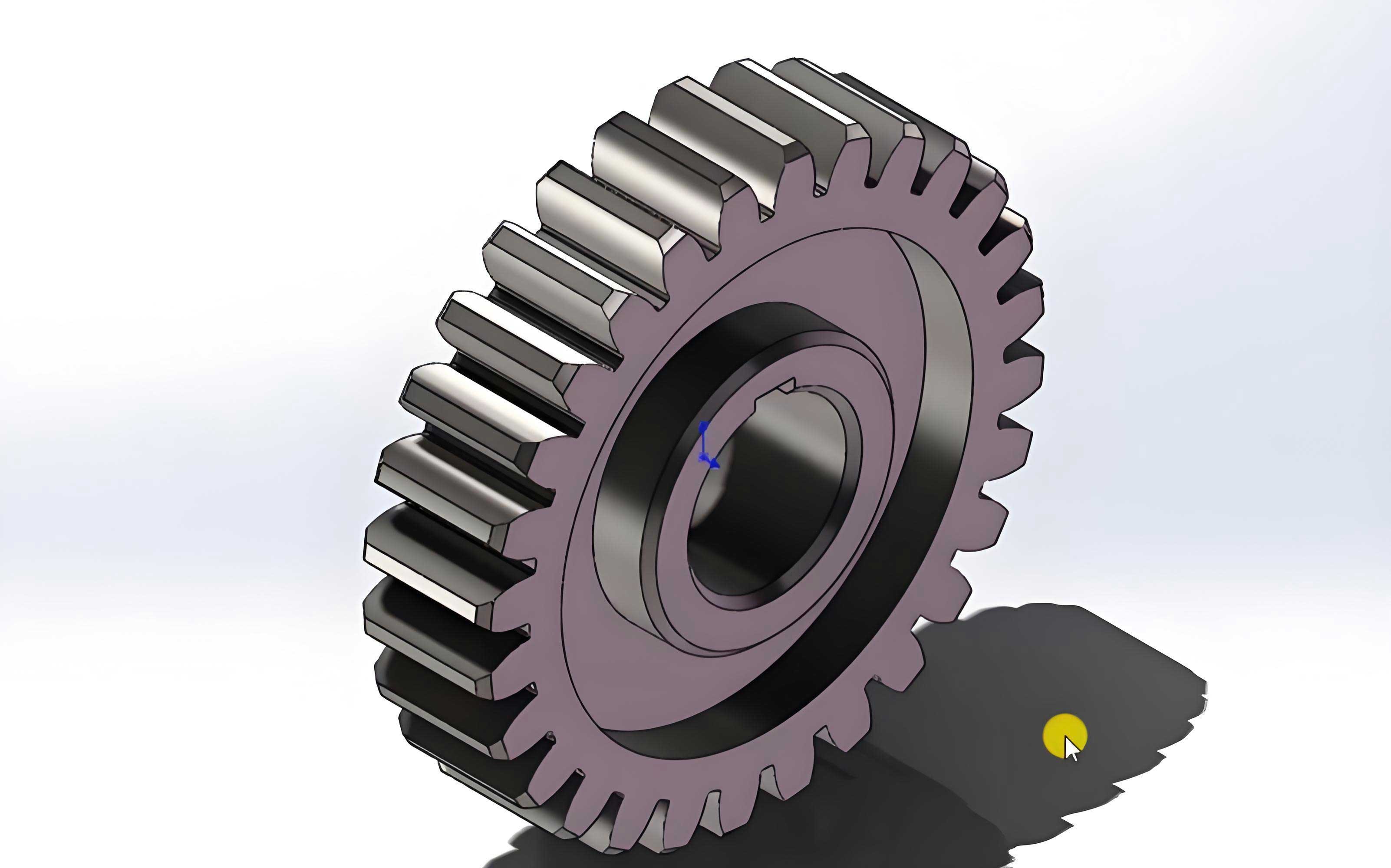
The dynamic model of the two-stage spur gear system is constructed using a lumped-parameter approach, where each gear is treated as a concentrated mass with associated translational and rotational degrees of freedom. For spur gears, the teeth engage along the line of action, and the meshing force is modeled as a linear spring-damper element that accounts for time-varying stiffness due to alternating single- and double-tooth contact. The system has six degrees of freedom: translational motions in the Y-direction for the first-stage pinion (P1), first-stage gear (G1), second-stage pinion (P2), and second-stage gear (G2), along with torsional rotations for G1 and P2. The X-direction is aligned horizontally, and the origin is set at the center of P1. The intermediate shaft connects G1 and P2, providing coupling through both translational and torsional stiffness. The generalized displacement vector is defined as:
$$ \mathbf{X} = [y_{p1}, \theta_{g1}, y_{g1}, y_{p2}, \theta_{p2}, y_{g2}]^T $$
where \( y \) denotes translational displacement and \( \theta \) denotes angular displacement. The equations of motion are derived from force and moment balances, leading to a matrix form:
$$ \mathbf{M}\ddot{\mathbf{X}} + \mathbf{C}\dot{\mathbf{X}} + \mathbf{K}\mathbf{X} = \mathbf{P} $$
Here, \( \mathbf{M} \) is the mass matrix, \( \mathbf{C} \) is the damping matrix, \( \mathbf{K} \) is the stiffness matrix, and \( \mathbf{P} \) is the external excitation vector due to mesh errors and applied torques. The mass matrix includes the masses and moments of inertia of all spur gears, calculated from geometric parameters. For example, the mass of a spur gear is derived from its volume and material density, while the moment of inertia considers the gear’s radius and mass distribution. The stiffness matrix incorporates several components: mesh stiffness for each spur gear pair, support stiffness from bearings, and the intermediate shaft stiffness. The mesh stiffness for spur gears is time-varying, as it changes with the number of teeth in contact during rotation. I compute this using a finite element approach, where the spur gear teeth are analyzed under load to determine elastic deformation and stiffness variation over a meshing cycle. The damping matrix is proportional to stiffness, with damping coefficients estimated based on material properties and operational conditions.
The detailed equations for each degree of freedom are as follows. For the first-stage pinion (P1):
$$ m_{p1} \ddot{y}_{p1} + C_{p1} \dot{y}_{p1} – C_{p1g1} (\dot{y}_{p1g1} – \dot{y}_{p1} + \dot{y}_{g1}) + K_{p1} y_{p1} – K_{p1g1} (y_{p1g1} – y_{p1} + y_{g1}) = -K_{p1g1} e_{p1g1} – C_{p1g1} \dot{e}_{p1g1} $$
For the first-stage gear (G1):
$$ m_{g1} \ddot{y}_{g1} + C_{g1} \dot{y}_{g1} – C_{p1g1} (\dot{y}_{p1g1} – \dot{y}_{p1} + \dot{y}_{g1}) + K_{g1} y_{g1} – K_{p1g1} (y_{p1g1} – y_{p1} + y_{g1}) + K_s (y_{g1} – y_{p2}) + C_s (\dot{y}_{g1} – \dot{y}_{p2}) + K_{\theta} (\theta_{g1} – \theta_{p2}) + C_{\theta} (\dot{\theta}_{g1} – \dot{\theta}_{p2}) = K_{p1g1} e_{p1g1} + C_{p1g1} \dot{e}_{p1g1} $$
For the second-stage pinion (P2):
$$ m_{p2} \ddot{y}_{p2} + C_{p2} \dot{y}_{p2} – C_{p2g2} (\dot{y}_{p2g2} – \dot{y}_{p2} + \dot{y}_{g2}) + K_{p2} y_{p2} – K_{p2g2} (y_{p2g2} – y_{p2} + y_{g2}) – K_s (y_{g1} – y_{p2}) – C_s (\dot{y}_{g1} – \dot{y}_{p2}) – K_{\theta} (\theta_{g1} – \theta_{p2}) – C_{\theta} (\dot{\theta}_{g1} – \dot{\theta}_{p2}) = -K_{p2g2} e_{p2g2} – C_{p2g2} \dot{e}_{p2g2} $$
For the second-stage gear (G2):
$$ m_{g2} \ddot{y}_{g2} + C_{g2} \dot{y}_{g2} – C_{p2g2} (\dot{y}_{p2g2} – \dot{y}_{p2} + \dot{y}_{g2}) + K_{g2} y_{g2} – K_{p2g2} (y_{p2g2} – y_{p2} + y_{g2}) = K_{p2g2} e_{p2g2} + C_{p2g2} \dot{e}_{p2g2} $$
Additionally, auxiliary equations for mesh displacements are included to account for relative motions between spur gears. In these equations, \( m \) represents mass, \( C \) denotes damping coefficients, \( K \) denotes stiffness coefficients, \( e \) represents transmission errors, and subscripts indicate components (e.g., \( p1g1 \) for the mesh between P1 and G1). The intermediate shaft stiffness appears as \( K_s \) (translational) and \( K_{\theta} \) (torsional), coupling the motions of G1 and P2. This model captures the essential dynamics of spur gear systems, including nonlinearities from time-varying mesh stiffness and manufacturing errors.
To quantify stiffness parameters, I perform calculations for mesh stiffness, intermediate shaft stiffness, and bearing support stiffness. For spur gears, the mesh stiffness varies periodically due to changes in the number of contacting teeth. Using finite element analysis, I model a spur gear pair under torque loading and compute stiffness over a meshing cycle. The results show that stiffness is higher during double-tooth contact compared to single-tooth contact, leading to a periodic pattern that can excite vibrations. The mesh stiffness function \( K_m(t) \) for a spur gear pair can be approximated as:
$$ K_m(t) = K_{avg} + \Delta K \sin(2\pi f_m t + \phi) $$
where \( K_{avg} \) is the average mesh stiffness, \( \Delta K \) is the amplitude of variation, \( f_m \) is the mesh frequency, and \( \phi \) is a phase angle. For the spur gears in this study, with parameters listed in Table 1, the mesh stiffness ranges from approximately \( 1.0 \times 10^8 \, \text{N/m} \) to \( 2.5 \times 10^8 \, \text{N/m} \) over a cycle. The intermediate shaft stiffness is derived from beam theory, considering both translational and torsional components. For a solid cylindrical shaft, the translational stiffness \( K_s \) is given by:
$$ K_s = \frac{3EI}{L^3} $$
and the torsional stiffness \( K_{\theta} \) is:
$$ K_{\theta} = \frac{GJ}{L} $$
where \( E \) is Young’s modulus, \( G \) is shear modulus, \( I \) is the area moment of inertia, \( J \) is the polar moment of inertia, and \( L \) is the shaft length. For the default configuration, \( K_s = 1.22 \times 10^9 \, \text{N/m} \) and \( K_{\theta} = 1.04 \times 10^9 \, \text{N/m} \). Bearing support stiffness is calculated based on radial load and contact deformation, resulting in \( K_b = 6.23 \times 10^7 \, \text{N/m} \) for the rolling bearings used. These stiffness values are critical in determining the natural frequencies and dynamic responses of the spur gear system.
| Parameter | Pinion 1 (P1) | Gear 1 (G1) | Pinion 2 (P2) | Gear 2 (G2) |
|---|---|---|---|---|
| Number of Teeth | 36 | 90 | 29 | 100 |
| Module (mm) | 1.5 | 1.5 | 1.5 | 1.5 |
| Face Width (mm) | 21 | 21 | 24 | 24 |
| Pressure Angle (°) | 20 | 20 | 20 | 20 |
| Mass (kg) | 0.22 | 1.6105 | 0.107 | 1.926 |
| Moment of Inertia (kg·m²) | 8.9e-5 | 3.26e-3 | 3.2e-5 | 4.866e-3 |
The natural frequencies and mode shapes of the spur gear system are determined by solving the eigenvalue problem derived from the homogeneous equation of motion. Setting damping and external forces to zero, the equation reduces to:
$$ (\mathbf{K} – \omega_i^2 \mathbf{M}) \phi_i = 0 $$
where \( \omega_i \) is the natural frequency in rad/s, and \( \phi_i \) is the corresponding mode shape vector. For the default system with intermediate shaft stiffness at nominal values, the natural frequencies are computed as shown in Table 2. These frequencies represent the system’s inherent vibrational characteristics, which are crucial for avoiding resonance during operation. The mode shapes illustrate how each component moves at these frequencies. For instance, the first mode primarily involves translational motion of the second-stage pinion, while higher modes involve combinations of translational and torsional motions of the spur gears. Understanding these modes helps in identifying critical frequencies that may lead to excessive vibrations in spur gear transmissions.
| Mode Number | Natural Frequency (Hz) |
|---|---|
| 1 | 485 |
| 2 | 1555 |
| 3 | 3891 |
| 4 | 4208 |
| 5 | 4525 |
| 6 | 17918 |
To analyze dynamic responses, I simulate the system under a rotational speed of 120 rad/s, corresponding to typical operational conditions for spur gears. The time-domain response of the mesh force for the first-stage spur gear pair shows a beating pattern, with an average force of 4800 N and fluctuations due to stiffness variations. The Fourier transform reveals frequency components at the mesh frequencies and their harmonics. For the first-stage spur gears, the mesh frequency \( f_{m1} \) is dominant, while for the second-stage spur gears, \( f_{m2} \) appears with lower amplitude due to the coupling through the intermediate shaft. The mesh frequencies are calculated as:
$$ f_{m1} = \frac{N_{p1} \omega}{2\pi} $$
$$ f_{m2} = \frac{N_{p2} \omega}{2\pi} $$
where \( N_{p1} \) and \( N_{p2} \) are the tooth numbers of the pinions, and \( \omega \) is the rotational speed. At 120 rad/s, \( f_{m1} \approx 687 \, \text{Hz} \) and \( f_{m2} \approx 554 \, \text{Hz} \). The presence of harmonics indicates nonlinear interactions, which are common in spur gear systems due to periodic meshing.
I further investigate the effect of varying rotational speed on dynamic mesh forces. As speed increases, resonance peaks occur when mesh frequencies or their multiples align with natural frequencies. For example, at speeds of 45, 85, 135, and 275 rad/s, significant amplitude increases are observed in both spur gear stages. This is because at these speeds, the mesh frequencies approach the system’s natural frequencies, leading to resonant vibrations. Such resonances can cause noise, wear, and even failure in spur gear transmissions, highlighting the importance of stiffness design in avoiding critical speeds.
The intermediate shaft stiffness plays a pivotal role in modulating dynamic behavior. I analyze cases where the shaft stiffness is varied from 0.25 to 4 times its nominal value. The results show that changes in stiffness significantly affect the dynamic loads on the spur gears connected by the shaft, namely G1 and P2. As stiffness increases, the mean dynamic load on G1 decreases, and the fluctuation frequency alters. For instance, at 0.25 times nominal stiffness, the mean load on G1 is -453 N (negative indicating direction), with slow oscillations. At nominal stiffness, the mean load reduces to -100 N with faster fluctuations, and at 4 times stiffness, it further drops to -25 N with stabilized oscillations. This trend suggests that higher intermediate shaft stiffness can mitigate dynamic loads in spur gear systems, potentially reducing stress and improving longevity.
Frequency-domain analysis under varying shaft stiffness reveals that the energy at mesh frequencies and their harmonics decreases linearly with stiffness up to a point, then stabilizes. For example, the amplitude at \( f_{m2} \) drops sharply as stiffness increases from 0.25 to 0.5 times nominal, then levels off. This is because stiffer shafts provide better coupling between spur gear stages, reducing relative motions and dampening vibrations. Additionally, the second harmonic of \( f_{m2} \) (around 443 Hz) closely matches the first natural frequency (439 Hz at low stiffness), causing resonance effects that diminish with higher stiffness. These findings underscore the importance of optimizing intermediate shaft stiffness to control frequency content in spur gear dynamics.
The impact of intermediate shaft stiffness on natural frequencies and mode shapes is also profound. As stiffness increases, natural frequencies generally rise, with higher modes showing larger shifts. For example, at 0.25 times nominal stiffness, the natural frequencies are lower, and mode shapes exhibit different patterns compared to nominal stiffness. Notably, mode transitions occur, where the order of modes changes with stiffness variations. This is illustrated in Table 3, which compares natural frequencies for different stiffness multipliers. At 0.25 times stiffness, the third and fourth modes are close in frequency, but at higher stiffness, the fourth and fifth modes become proximate, indicating modal switching. Such transitions can alter vibration paths in spur gear systems, affecting noise and performance.
| Mode Number | 0.25× Stiffness (Hz) | 1× Stiffness (Hz) | 4× Stiffness (Hz) |
|---|---|---|---|
| 1 | 439 | 485 | 459 |
| 2 | 1340 | 1555 | 1627 |
| 3 | 2268 | 3891 | 4274 |
| 4 | 2363 | 4208 | 8206 |
| 5 | 4482 | 4525 | 8764 |
| 6 | 10432 | 17918 | 34240 |
Mode shapes also evolve with stiffness. At low stiffness, the first mode involves translational motion of the second-stage pinion, similar to nominal conditions, but higher modes show increased participation of torsional motions. At high stiffness, mode shapes shift, with the second mode transitioning to dominant translation of the first-stage pinion, and the third mode involving torsion of the second stage. These changes imply that stiffness adjustments can redistribute vibrational energy among spur gear components, which is crucial for design optimizations aimed at reducing specific vibrations.
In practical applications, spur gear systems often operate under varying loads and speeds, making dynamic analysis essential. The intermediate shaft, as a coupling element, can be designed with tailored stiffness to enhance performance. For instance, in wind turbine gearboxes, where spur gears are used for power transmission, intermediate shaft stiffness can be tuned to avoid resonances at operational speeds, thus minimizing maintenance costs. Similarly, in automotive transmissions, optimizing shaft stiffness can lead to quieter and more efficient spur gear operation. The insights from this study provide a framework for such designs, emphasizing the interplay between stiffness and dynamics.
To further elaborate, I derive the mesh stiffness for spur gears using the finite element method. The process involves modeling tooth contact as a series of springs representing bending, shear, and compressive deformations. The total mesh stiffness \( K_{mesh} \) for a spur gear pair is the sum of individual tooth stiffnesses, varying with contact position. For a pair of spur gears with contact ratio \( \varepsilon \), the stiffness alternates between \( K_{single} \) and \( K_{double} \) as teeth engage and disengage. This time-varying stiffness introduces parametric excitations, which are a major source of vibrations in spur gear systems. The stiffness function can be expressed as a Fourier series:
$$ K_{mesh}(t) = K_0 + \sum_{n=1}^{\infty} K_n \cos(2\pi n f_m t + \psi_n) $$
where \( K_0 \) is the mean stiffness, and \( K_n \) are harmonics related to the tooth profile and contact conditions. For the spur gears in this analysis, the stiffness variation is approximately 20-30% of the mean, which is significant enough to cause dynamic effects.
Damping in spur gear systems arises from material hysteresis, lubricant films, and structural losses. I estimate damping coefficients using empirical relations, such as proportional damping, where the damping matrix \( \mathbf{C} \) is a linear combination of mass and stiffness matrices:
$$ \mathbf{C} = \alpha \mathbf{M} + \beta \mathbf{K} $$
with \( \alpha \) and \( \beta \) chosen based on modal damping ratios, typically 0.01-0.05 for spur gears. This approach simplifies analysis while capturing essential energy dissipation.
The external excitations in the model include transmission errors due to manufacturing inaccuracies in spur gears. These errors are modeled as sinusoidal functions with amplitudes on the order of micrometers, contributing to dynamic loads. For example, the error term \( e_{p1g1}(t) \) for the first-stage spur gears is:
$$ e_{p1g1}(t) = e_0 \sin(2\pi f_m t + \delta) $$
where \( e_0 \) is the error amplitude. Such errors exacerbate vibrations, especially when combined with stiffness variations.
In conclusion, the dynamic characteristics of two-stage spur gear systems are highly sensitive to intermediate shaft stiffness. Through a comprehensive model, I demonstrate that increasing shaft stiffness reduces dynamic loads on connected spur gears and alters frequency content, with linear decreases in harmonic energies up to a saturation point. Natural frequencies and mode shapes undergo transitions, indicating modal switching that can impact vibration behavior. These findings highlight the importance of considering shaft stiffness in the design of spur gear transmissions to mitigate vibrations and enhance reliability. Future work could explore nonlinear effects, such as tooth separations and backlash, which are common in spur gear systems under light loads. Additionally, experimental validation on test rigs with instrumented spur gears would further refine the model. Overall, this analysis provides valuable insights for engineers working on spur gear applications, from industrial machinery to renewable energy systems, where efficient and quiet operation is paramount.
To summarize key equations, the dynamics of spur gear systems are governed by matrices that include mass, damping, and stiffness terms. The stiffness matrix for the two-stage system with intermediate shaft coupling can be partitioned as:
$$ \mathbf{K} = \begin{bmatrix}
K_{p1} + K_{p1g1} & -K_{p1g1} & 0 & 0 & 0 & 0 \\
-K_{p1g1} & K_{g1} + K_{p1g1} + K_s & 0 & -K_s & -K_{\theta} & 0 \\
0 & 0 & K_{p2} + K_{p2g2} + K_s & -K_{p2g2} & K_{\theta} & 0 \\
0 & -K_s & -K_{p2g2} & K_{g2} + K_{p2g2} & 0 & 0 \\
0 & -K_{\theta} & K_{\theta} & 0 & 0 & 0 \\
0 & 0 & 0 & 0 & 0 & 0
\end{bmatrix} $$
This matrix reflects the coupling between spur gears through mesh and shaft stiffness. The natural frequencies \( f_i \) in Hz are related to the eigenvalues \( \lambda_i \) by \( f_i = \frac{\sqrt{\lambda_i}}{2\pi} \). For spur gear systems, avoiding resonances requires ensuring that operational speeds do not align mesh frequencies with these natural frequencies.
In terms of design implications, for spur gears operating in multi-stage configurations, the intermediate shaft should be stiff enough to reduce dynamic loads but not so stiff as to introduce high-frequency vibrations. A balanced approach, considering material properties and operational ranges, is essential. This study underscores the critical role of stiffness in the dynamic performance of spur gear systems, offering a pathway to optimized designs for various engineering applications.