
Gear transmission stands as one of the most widely utilized forms of mechanical drive, prized for its high transmission accuracy, broad power transmission range, reliability, long service life, high efficiency, and capability for parallel and intersecting shaft arrangements. The performance of gear drives can be broadly categorized into two operational modes: one focuses on transmitting force and torque, such as in various types of speed reducers; the other is dedicated to transmitting motion, as seen in the gear trains of measuring instruments, indexing mechanisms in machine tools, and position feedback systems in control units. For the latter, transmission accuracy is paramount. This accuracy primarily refers to the kinematic fidelity or correctness of the gear transmission.
Due to inherent manufacturing and assembly errors in the components of a gear transmission system—including the spur gears themselves, shafts, and bearings—as well as deformations induced by thermal loads and mechanical forces during operation, the output shaft’s angular position invariably deviates from its theoretical value. For a gear transmission assembly, this deviation is predominantly characterized by two key parameters: transmission error and backlash.
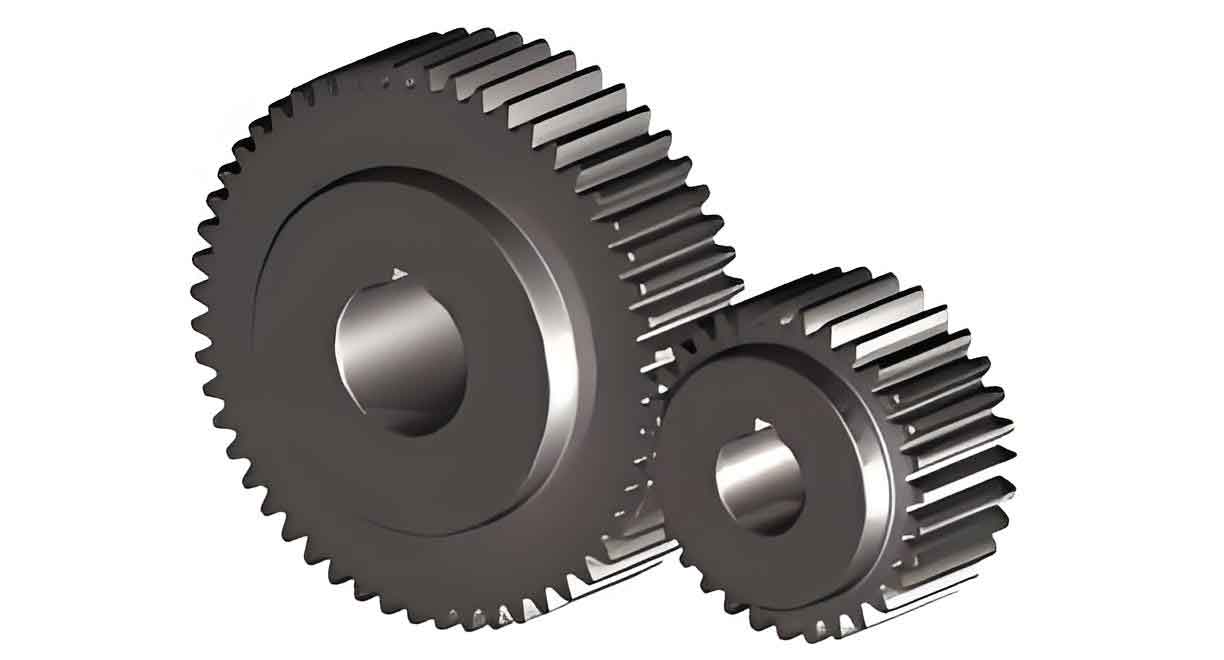
Position feedback devices in launching systems, often employing fine-pitch spur gear trains to relay angular position data to controllers, demand exceptionally high transmission accuracy. Therefore, accurately predicting this accuracy during the design phase is crucial. While significant research exists on the transmission accuracy of fine-pitch spur gears, a common oversight in many studies is the influence of the gearbox housing’s geometric tolerances. Typically, calculations account for errors from gear manufacturing, shaft-gear fits, bearing runout, and elastic/thermal effects, but not the deviations in the housing’s form and position. This omission can lead to an overly optimistic accuracy prediction. If the design margin is insufficient, the manufactured spur gear assembly may fail to meet the stringent system requirements.
Conditions for Incorporating Geometric Tolerances in Accuracy Analysis
Geometric tolerances define the permissible variation in a feature’s form (shape) or its location/orientation relative to a datum. According to standards like ISO 1101, these tolerances are categorized into form, orientation, location, and runout tolerances. The interaction between dimensional size and geometric tolerances is governed by tolerance principles, primarily the Independent Principle and the Dependency Principle (which includes the Envelope Requirement and Maximum Material Requirement). The treatment of geometric tolerances in spur gear transmission accuracy analysis depends directly on the principle applied to the part.
When the Envelope Requirement (ER) is invoked—denoted by the symbol Ⓜ following the size tolerance—it dictates that the actual feature shall not violate the maximum material boundary. In essence, the size tolerance also controls the geometric form. For a gearbox housing designed with the Envelope Requirement, the geometric errors are contained within the size tolerance limits. Consequently, these geometric tolerances do not introduce additional variation beyond the size tolerance and can be neglected when calculating the transmission error of the spur gear system. The analysis would focus solely on gear errors, assembly fits, etc.
Conversely, the Independent Principle states that dimensional and geometric specifications are separate and must be satisfied independently. This is the default principle unless otherwise specified. Under this principle, the actual size is controlled only by the size tolerance, and the geometric deviation is controlled only by the geometric tolerance; they are unrelated. Therefore, for a gearbox designed following the Independent Principle, the analysis of spur gear transmission accuracy must account for contributions from both the dimensional tolerances and the specified geometric tolerances of the housing features.
Transmission Error Components in Spur Gear Systems
Fundamental Definitions and Formulas
The concept of transmission error (TE) was formally introduced as the difference between the theoretical and actual positions of the output gear, assuming a perfectly accurate and rigid input. The total kinematic error in a spur gear train comprises both transmission error (often referring to the error under load in a single direction) and backlash or lost motion.
Standard calculation methods for fine-pitch spur gear trains provide formulas for the system’s total lost motion or backlash. A simplified approach, focusing on the geometric and assembly errors (excluding temperature and elastic effects for this analysis), defines the following:
The single-direction transmission error for a gear pair, originating from the gear’s own manufacturing errors, can be estimated as:
$$ \Delta\phi = 4.8 \frac{F_i”}{m z} $$
where:
$\Delta\phi$ is the transmission error in arc-minutes,
$F_i”$ is the tangential composite deviation of the gear (in µm),
$m$ is the module (in mm),
$z$ is the number of teeth.
The maximum circumferential backlash $j_{tmax}$ at the pitch circle of a spur gear pair is a primary source of lost motion. It is influenced by gear tooth thickness tolerances, center distance variation, and radial play. The simplified formula is:
$$ j_{tmax} = 2 \tan(\alpha_n) \left[ |E_{am1}| + |E_{am2}| + \sqrt{ (E_{a1}/2)^2 + (E_{a2}/2)^2 + 4f_a^2 + X_1^2 + X_2^2 + S_1^2 + S_2^2 } \right] $$
where:
$\alpha_n$ is the normal pressure angle,
$E_{am1}, E_{am2}$ are the mean tooth thickness deviations for gear 1 and 2,
$E_{a1}, E_{a2}$ are the tooth thickness tolerances ($E_{as} – E_{ai}$),
$f_a$ is the center distance tolerance,
$X_1, X_2$ are the radial clearances from the shaft-gear fits (e.g., H7/h6),
$S_1, S_2$ are the radial runouts at the gear mounting locations on the shaft.
The corresponding angular lost motion (backlash) $\Delta\phi’$ for that gear pair is:
$$ \Delta\phi’ = 6.88 \frac{j_{tmax}}{m z} $$
For a multi-stage spur gear train, the cumulative transmission error $\Delta\phi_T$ and cumulative lost motion $\Delta\phi’_T$ referred to the output shaft are calculated by reflecting each stage’s error through the gear ratios:
$$ \Delta\phi_T = \frac{\Delta\phi_1}{i_{1-2n}} + \frac{\Delta\phi_2 + \Delta\phi_3}{i_{3-2n}} + \dots + \frac{\Delta\phi_{2n-2} + \Delta\phi_{2n-1}}{i_{(2n-1)-2n}} + \Delta\phi_{2n} $$
$$ \Delta\phi’_T = \frac{\Delta\phi’_1}{i_{1-2n}} + \frac{\Delta\phi’_3}{i_{3-2n}} + \dots + \frac{\Delta\phi’_{2n-1}}{i_{(2n-1)-2n}} $$
The total maximum reversal error $\Phi$ (often considered the peak-to-peak error in bidirectional motion) is then:
$$ \Phi = \Delta\phi_T + \Delta\phi’_T $$
The Impact of Housing Geometric Tolerances on Spur Gear System Accuracy
In the design of fine-pitch spur gear systems, the Independent Principle is commonly applied to housing drawings to precisely control machining and assembly quality. Geometric tolerances such as parallelism, coaxiality (or position), and runout are routinely specified for bearing bore axes. These tolerances directly influence the effective center distance and alignment of the spur gear pairs.
1. Influence of Housing Parallelism Tolerance on Center Distance
The parallelism tolerance between two axes controls the allowable tilt of one axis relative to the other. In the worst-case scenario under the Independent Principle, this tilt can cause a projection error that effectively increases or decreases the center distance. The configuration of the gear axes—whether one-dimensional or two-dimensional—affects the calculation.
For a one-dimensional layout (axes offset only in X or Y direction), the maximum additional center distance variation $\Delta D$ due to parallelism tolerance $IT_{par}$ is simply:
$$ \Delta D = IT_{par} $$
For a two-dimensional layout (axes offset in both X and Y), the effect is vectorial. Given offsets $D_{x2}, D_{y2}$ and parallelism tolerances $\Delta D’_{x2}, \Delta D’_{y2}$ for Gear 2 relative to Gear 1, the angles are:
$$ \varphi_1 = \tan^{-1}\left(\frac{D_{y2}}{D_{x2}}\right), \quad \varphi_2 = \tan^{-1}\left(\frac{\Delta D’_{y2}}{\Delta D’_{x2}}\right) $$
The maximum effective center distance increase is:
$$ \Delta D = \cos(\varphi_2 – \varphi_1) \sqrt{ (\Delta D’_{x2})^2 + (\Delta D’_{y2})^2 } $$
Note that when one of the tolerance components is zero, this formula reduces to the one-dimensional case. Therefore, it serves as the general expression for the influence of parallelism on center distance in spur gear housings.
2. Influence of Housing Coaxiality/Position Tolerance on Center Distance
Coaxiality or position tolerance between two bores ensures they share a common axis. A deviation introduces an angular misalignment between the shaft and the housing’s transverse plane, which translates into a center distance error at the gear’s location. For a housing of width $L$, with the gear mounted at a distance $L_1$ from one side, and a coaxiality tolerance of $D_{co}$ (considered as a diameter, so its radial effect is half), the induced center distance error $\Delta D’_{co}$ is:
$$ \Delta D’_{co} = \frac{L_1}{L} \cdot \frac{D_{co}}{2} $$
This error must be added to the nominal center distance tolerance.
3. Influence of Housing Bore Runout Tolerance on Gear Runout
The circular runout tolerance of a housing bore directly affects the radial runout of the shaft assembly mounted within it. For worst-case (extreme) analysis, this contribution can be considered additive. Since runout is a radial tolerance zone, half of its value contributes to the radial eccentricity. The effective radial runout $S’_1$ at the gear location becomes:
$$ S’_1 = S_1 + \frac{S_T}{2} $$
where $S_T$ is the housing bore’s circular runout tolerance value, and $S_1$ is the shaft assembly’s inherent runout.
4. Modified Backlash Calculation Incorporating Geometric Tolerances
Considering the above effects under the Independent Principle, the formula for the maximum circumferential backlash $j’_{tmax}$ in a spur gear pair must be updated to include contributions from housing geometric errors:
$$ j’_{tmax} = 2 \tan(\alpha_n) \left[ |E_{am1}| + |E_{am2}| + \sqrt{ (E_{a1}/2)^2 + (E_{a2}/2)^2 + 4f’_a^{\ 2} + X_1^2 + X_2^2 + S’_1^{\ 2} + S’_2^{\ 2} } \right] $$
where the modified effective center distance tolerance $f’_a$ and runouts $S’_1, S’_2$ are:
$$ f’_a = f_a + \Delta D + \Delta D’_{co} $$
$$ S’_1 = S_1 + \frac{S_{T1}}{2}, \quad S’_2 = S_2 + \frac{S_{T2}}{2} $$
These modified values are then used in the system-wide accuracy calculation ($\Delta\phi’_T$ and $\Phi$), providing a more comprehensive and realistic prediction of the spur gear transmission system’s performance.
Engineering Case Study: A Fine-Pitch Spur Gear Feedback Mechanism
To illustrate the practical necessity of this methodology, consider a fine-pitch spur gear transmission system within a position feedback device. A spur gear ($Z_0$, m=0.5, z=18) meshes with a drive mechanism, followed by a two-stage reduction spur gear train. The final output gear ($Z_4$) has a 1:1 ratio with the input. An encoder is coupled to the output shaft (Shaft III). The axis layout is one-dimensional. The housing geometric tolerances (parallelism, runout, coaxiality between bearing bores) are specified at a standard Grade 6. Key spur gear transmission parameters are as follows:
| Stage | Component | Module (m) | Teeth (z) | Accuracy Grade | Center Distance (mm) |
|---|---|---|---|---|---|
| 1 | Gear 1 (Z1) | 0.5 | 36 | 7f | 33 ±0.016 |
| Gear 2 (Z2) | 0.5 | 96 | 7f | ||
| 2 | Gear 3 (Z3) | 0.5 | 54 | 6g | 49.5 ±0.011 |
| Gear 4 (Z4) | 0.5 | 144 | 6g |
Shaft-gear fits are H7/h6 and H6/h5. The housing width between shaft centers is 100 mm, with gears located 50 mm from the inner wall. Relevant tolerance values extracted from standards are:
| Feature | Parameter Range | Tolerance Value (IT) |
|---|---|---|
| Parallelism | 40 mm < D ≤ 63 mm | 20 |
| Circular Runout | 40 mm < D ≤ 63 mm | 20 |
| Coaxiality | 40 mm < D ≤ 63 mm | 20 (∅) |
| Gear | Eas | Eai | Hole Dev. | Shaft Dev. | X | S | Fi” (µm) |
|---|---|---|---|---|---|---|---|
| 1 | -7 | -42 | +15/0 | 0/-9 | 24 | 10 | 21 |
| 2 | -11 | -51 | +15/0 | 0/-9 | 24 | 10 | 26 |
| 3 | -6 | -33 | +9/0 | 0/-6 | 15 | 6 | 19 |
| 4 | -8 | -38 | +9/0 | 0/-6 | 15 | 6 | 23 |
Calculations:
First, the single-direction transmission error $\Delta\phi$ for each spur gear is calculated using its $F_i”$ value.
Next, the maximum backlash $\Delta\phi’$ for each pair is calculated twice: once using the conventional formula (ignoring housing geometric tolerances) and once using the modified formula.
For Pair Z1-Z2 (Stage 1):
Conventional: $f_a = 0.016$ mm. $\Delta D = 0.020$ mm, $\Delta D’_{co} = (50/100)*(0.020/2) = 0.005$ mm.
Modified $f’_a = 0.016 + 0.020 + 0.005 = 0.041$ mm.
Modified $S’_1 = 10 + (20/2) = 20$ µm, similarly $S’_2 = 20$ µm.
For Pair Z3-Z4 (Stage 2):
Conventional: $f_a = 0.011$ mm.
Applying similar modifications yields a larger $f’_a$ and $S’$ values.
The calculated results for angular lost motion per pair are:
| Gear Pair | $\Delta\phi’$ (Conventional) | $\Delta\phi’$ (With Housing Tolerances) |
|---|---|---|
| Z1-Z2 | 11.96 arc-min | 17.68 arc-min |
| Z3-Z4 | 6.89 arc-min | 10.79 arc-min |
Finally, the cumulative errors referred to the output shaft (Shaft III/Z4) are calculated:
| Method | Cumulative Lost Motion $\Delta\phi’_T$ | Total Reversal Error $\Phi$ |
|---|---|---|
| Conventional (No Housing Tolerances) | 17.9 arc-min | ~ [Calculated Value] arc-min |
| Including Housing Geometric Tolerances | 22.73 arc-min | ~ [Calculated Value] arc-min |
The results clearly show that neglecting the housing’s geometric tolerances leads to an underestimation of the total lost motion by over 20% in this case. For a spur gear transmission system where the calculated accuracy is close to the design limit, this oversight could result in a non-compliant final product. The analysis dictates that to meet the target accuracy, the designer must either tighten the geometric tolerance grades for the housing (e.g., from Grade 6 to Grade 5) or select spur gears with tighter manufacturing tolerances to compensate for the additional error introduced by the housing.
Conclusion
This study systematically analyzed the influence of gearbox housing geometric tolerances—specifically parallelism, coaxiality, and runout—on the transmission accuracy of fine-pitch spur gear systems. By clarifying the application of tolerance principles, it was established that under the commonly used Independent Principle, these geometric deviations constitute independent error sources that directly impact the effective center distance and alignment of spur gear pairs.
A modified analytical method using the worst-case approach was proposed, integrating the effects of housing geometric tolerances into the classic formulas for spur gear transmission error and backlash calculation. A practical engineering case demonstrated that omitting these factors can lead to a significant (greater than 20%) underestimation of the total system lost motion. This underscores the critical need to incorporate housing geometric tolerance analysis during the design phase of high-precision spur gear trains. When predicted accuracy margins are slim, designers must either allocate stricter geometric tolerances for the housing or specify higher-precision spur gear components to ensure the final assembly meets its kinematic performance requirements. This comprehensive approach provides a more reliable foundation for designing and predicting the behavior of precision spur gear transmission systems.