
The dynamic behavior and vibro-acoustic signature of any geared power transmission system are fundamentally governed by the stiffness of the gear mesh. For spur gears, this stiffness is not constant but varies with time as the number of teeth in contact changes and the contact point moves along the tooth profile. This parameter, known as Time-Varying Mesh Stiffness (TVMS), is a critical excitation source for gear dynamics and a primary carrier of information about the health state of the gear teeth. Any local defect on a gear tooth, such as a crack, spall, or breakage, directly alters the local compliance of the tooth, thereby modulating the TVMS. Consequently, analyzing the effect of various gear faults on TVMS is paramount for developing accurate dynamic models and effective condition monitoring strategies. This article presents a detailed analytical investigation, from a first-person research perspective, into quantifying the TVMS of spur gear pairs under different fault conditions using the potential energy method.
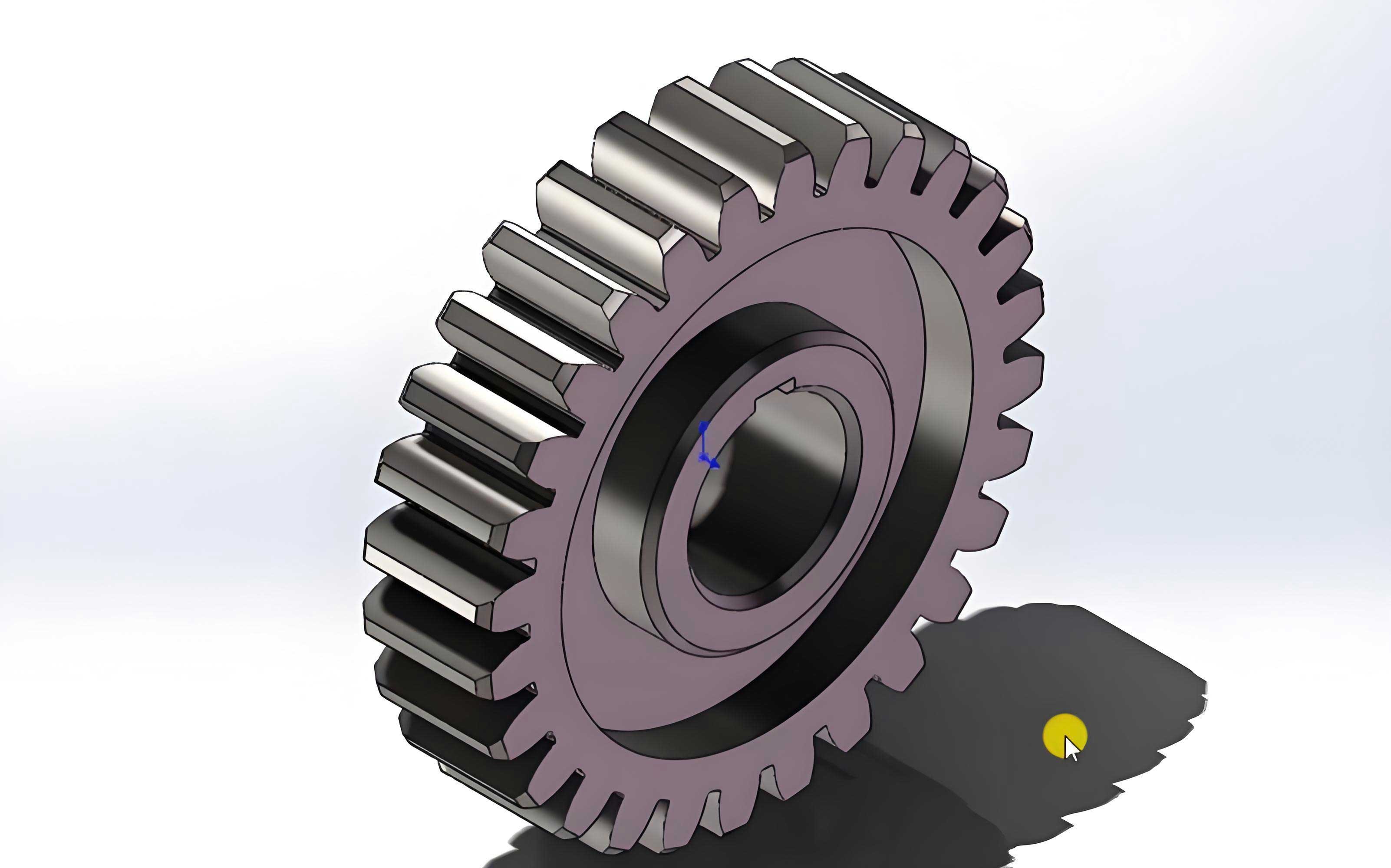
The potential energy method, an established analytical approach, models the gear tooth as a non-uniform cantilever beam. The total elastic energy stored in the meshing teeth is considered to consist of four primary components: Hertzian contact energy, bending energy, shear energy, and axial compressive energy. The effective mesh stiffness is then derived from the reciprocal of the total compliance, which is the sum of compliances from each energy component for both mating teeth. For a single tooth pair in contact, the effective mesh stiffness \( k_t \) is given by:
$$
k_t = \frac{1}{\frac{1}{k_h} + \frac{1}{k_{b1}} + \frac{1}{k_{s1}} + \frac{1}{k_{a1}} + \frac{1}{k_{b2}} + \frac{1}{k_{s2}} + \frac{1}{k_{a2}}}
$$
where the subscripts \(1\) and \(2\) denote the driving and driven spur gears, respectively. The individual stiffness components are calculated as follows:
Hertzian Contact Stiffness (\(k_h\)): This accounts for the local deformation at the contact point.
$$
k_h = \frac{\pi E L}{4(1 – \nu^2)}
$$
Bending Stiffness (\(k_b\)): This is derived from the strain energy due to bending moments.
$$
\frac{1}{k_b} = \int_{-\alpha_1}^{\alpha_2} \frac{ \left\{ 1 + \cos(\alpha_1) [ (\alpha_2 – \alpha) \sin \alpha – \cos \alpha ] \right\}^2 (\alpha_2 – \alpha) \cos \alpha }{ 2 E I_{\alpha} } d\alpha
$$
where \( I_{\alpha} = \frac{1}{12} L h_x^3 \) is the area moment of inertia of the tooth section at angle \( \alpha \).
Shear Stiffness (\(k_s\)): This accounts for the strain energy due to shear forces.
$$
\frac{1}{k_s} = \int_{-\alpha_1}^{\alpha_2} \frac{ 1.2 (1+\nu) (\alpha_2 – \alpha) \cos \alpha \cos^2 \alpha_1 }{ E A_{\alpha} } d\alpha
$$
where \( A_{\alpha} = L h_x \) is the cross-sectional area.
Axial Compressive Stiffness (\(k_a\)): This accounts for the strain energy due to axial compressive forces.
$$
\frac{1}{k_a} = \int_{-\alpha_1}^{\alpha_2} \frac{ (\alpha_2 – \alpha) \cos \alpha \sin^2 \alpha_1 }{ E A_{\alpha} } d\alpha
$$
In these equations, \(E\) is Young’s modulus, \(\nu\) is Poisson’s ratio, \(L\) is the face width, \(\alpha\) is the integration variable representing the angular position, \(\alpha_1\) is the pressure angle at the load application point, \(\alpha_2\) is half of the base circle tooth angle, and \(h_x\) is the variable tooth thickness. During double-tooth contact, the total effective mesh stiffness is the sum of the stiffnesses of the two engaged tooth pairs. The parameters for a standard spur gear pair used in this study are summarized in Table 1.
| Parameter | Symbol | Value | Units |
|---|---|---|---|
| Young’s Modulus | \(E\) | \(2.068 \times 10^{11}\) | Pa |
| Poisson’s Ratio | \(\nu\) | 0.3 | – |
| Pressure Angle | \(\phi\) | 20 | ° |
| Face Width | \(L\) | 0.016 | m |
| Number of Teeth (Pinion) | \(N_1\) | 19 | – |
| Number of Teeth (Gear) | \(N_2\) | 48 | – |
| Base Circle Radius (Pinion) | \(R_{b1}\) | 0.02834 | m |
| Base Circle Radius (Gear) | \(R_{b2}\) | 0.0716 | m |
When a root crack propagates in a tooth of the pinion (the smaller spur gear, typically more susceptible to failure), it significantly reduces the effective area moment of inertia and shear area along the crack path. This leads to a reduction in the bending stiffness \(k_b\) and shear stiffness \(k_s\) of the faulty tooth. The modified compliances for a tooth with a crack of length \(q\) propagating at an angle \(\upsilon\) from the tooth centerline are:
$$
\frac{1}{k_{b\_crack}} = \int_{-\alpha_1}^{\alpha_2} \frac{ \left\{ 1 + \cos(\alpha_1) [ (\alpha_2 – \alpha) \sin \alpha – \cos \alpha ] \right\}^2 (\alpha_2 – \alpha) \cos \alpha }{ E I_{\alpha, crack} } d\alpha
$$
$$
\frac{1}{k_{s\_crack}} = \int_{-\alpha_1}^{\alpha_2} \frac{ 1.2 (1+\nu) (\alpha_2 – \alpha) \cos \alpha \cos^2 \alpha_1 }{ E A_{\alpha, crack} } d\alpha
$$
where \( I_{\alpha, crack} \) and \( A_{\alpha, crack} \) are the modified moment of inertia and area considering the reduced tooth section due to the crack. For simplicity, a linear crack propagation path is often assumed. The effective mesh stiffness for a pair with a cracked pinion tooth then becomes:
$$
k_{t\_crack} = \frac{1}{\frac{1}{k_h} + \frac{1}{k_{b\_crack}} + \frac{1}{k_{s\_crack}} + \frac{1}{k_{a1}} + \frac{1}{k_{b2}} + \frac{1}{k_{s2}} + \frac{1}{k_{a2}}}
$$
The impact of the crack is profound and global over the entire mesh cycle. As the crack length increases, the stiffness reduction becomes more severe. This is not a localized drop but a continuous attenuation of the stiffness profile throughout the engagement period of the faulty tooth, affecting both the single and double contact regions. The stiffness reduction is most pronounced when the cracked section of the tooth is under maximum bending stress, typically near the root during the end of the engagement. Table 2 summarizes the effect of increasing crack length on the average mesh stiffness over one engagement cycle for the modeled spur gear pair.
| Crack Condition | Crack Length (m) | Avg. TVMS (N/m) | Reduction vs. Healthy |
|---|---|---|---|
| Healthy Gear | 0 | \(1.92 \times 10^8\) | 0% |
| Minor Crack | 0.0014 | \(1.81 \times 10^8\) | -5.7% |
| Moderate Crack | 0.0031 | \(1.65 \times 10^8\) | -14.1% |
| Severe Crack | 0.0039 | \(1.52 \times 10^8\) | -20.8% |
A tooth breakage or a large chip represents a more drastic form of failure. In this model, it is assumed that a portion of the tooth tip or flank is completely missing. This failure has two main effects. First, the contact line length \(L\) is effectively reduced for the portion of the mesh cycle where the broken part would normally be in contact. The Hertzian contact stiffness becomes a function of the effective contact length \(L_{eff}\), which varies as the contact traverses the broken zone: \(k_{h\_chip} = \frac{\pi E L_{eff}}{4(1 – \nu^2)}\). Second, the bending, shear, and axial stiffness contributions from the missing material are effectively zero when the breakage is in the loaded zone. The stiffness calculation must therefore only integrate over the remaining healthy portion of the tooth profile.
The result is a highly localized and abrupt drop in the TVMS profile. The stiffness remains at the healthy level until the moment the contact point reaches the edge of the broken area. At that instant, the stiffness plunges dramatically because the load path is severely compromised. This creates a sharp impulse in the stiffness function, which is a strong source of vibration excitation. The severity of the drop depends on the size (both width and depth) of the broken area. A larger breakage causes a deeper and wider stiffness drop over the rotational angle. The effect is summarized in Table 3 for different breakage widths at a fixed depth.
| Breakage Condition | Breakage Width (mm) | Min. TVMS during Fault (N/m) | Impulse Depth vs. Healthy Peak |
|---|---|---|---|
| Healthy Gear | 0 | \(2.15 \times 10^8\) (min) | N/A |
| Small Chip | 8 | \(1.05 \times 10^8\) | -51% |
| Medium Chip | 10 | \(0.82 \times 10^8\) | -62% |
| Large Breakage | 12 | \(0.61 \times 10^8\) | -72% |
Surface pitting and spalling are contact fatigue failures. A spall is a cavity on the contact surface that disrupts the smooth line of contact. The primary effect of a spall on a spur gear tooth is to locally eliminate contact. When the mating tooth rolls into the spalled area, it loses contact momentarily, causing the load to be suddenly transferred to other contacting teeth. In the analytical model, this is treated similarly to a localized breakage but typically confined to the surface. The main influence is on the Hertzian contact stiffness, where the effective contact length is reduced by the length of the spall \(l_s\): \(L_{eff} = L – l_s\) and \(k_{h\_spall} = \frac{\pi E (L – l_s)}{4(1 – \nu^2)}\). The bending stiffness is largely unaffected unless the spall is very deep.
The resulting TVMS signature features a localized drop, but its shape can be different from a breakage. When a tooth enters a spall, contact is lost, stiffness drops to near zero (if no other tooth is in contact), and then there is an impact-like event when contact is re-established at the exit edge of the spall. This creates a “W”-shaped or square-wave-like perturbation in the stiffness curve within a single mesh period. The duration and depth of the drop are directly proportional to the spall’s length along the line of action. Table 4 illustrates how the stiffness loss is confined to a specific meshing phase depending on the spall’s location on the pinion tooth of the spur gear pair.
| Spall Location on Pinion Tooth | Meshing Phase Affected | Characteristic TVMS Perturbation |
|---|---|---|
| Near Tip (Start of engagement) | Early in mesh cycle | Short, early drop in stiffness curve |
| Mid-Flank (Near pitch point) | Middle of mesh cycle | Drop occurring near peak stiffness |
| Near Root (End of engagement) | Late in mesh cycle | Short, late drop in stiffness curve |
In conclusion, this detailed analytical exploration using the potential energy method clearly establishes the direct and quantifiable impact of common gear tooth faults on the Time-Varying Mesh Stiffness of spur gear pairs. Each fault type leaves a distinct fingerprint on the TVMS profile: root cracks cause a global attenuation, tooth breakages introduce sharp, deep impulses, and spalls create localized loss-of-contact events. These modified stiffness profiles serve as the fundamental internal excitation that alters the dynamic response of the gear system, leading to the vibration and acoustic signatures used for fault diagnosis. The analytical expressions developed allow for the parametric study of fault severity and location. Future work involves coupling these stiffness models with multi-body dynamic equations of motion to simulate the vibration response directly and exploring the sensitivity of different frequency domain features (like sidebands and harmonics) to these specific stiffness changes. Understanding these relationships is crucial for advancing model-based prognostics and health management systems for gearboxes.