
The wind turbine gearbox stands as a critical transmission component within wind power generation systems, operating under demanding conditions characterized by low speed, heavy loads, and significant speed increases. The dynamic stability and reliability of the gear transmission system are profoundly influenced by internal excitations, with the time-varying mesh stiffness (TVMS) being a primary source of such parametric excitation. Even in the absence of external disturbances, this inherent time-varying stiffness can induce self-excited vibrations within the system. Furthermore, operational vibrations from the wind turbine rotor can lead to installation and alignment errors in the meshing spur gears, such as center distance variations and shaft misalignments. These errors alter the contact conditions and load distribution on the gear teeth, subsequently affecting the frictional behavior between tooth flanks, which in turn influences wear patterns and the dynamic response. Therefore, the precise calculation of the mesh stiffness under the influence of these meshing errors is paramount for dynamic studies aimed at vibration control in wind turbine gearboxes.
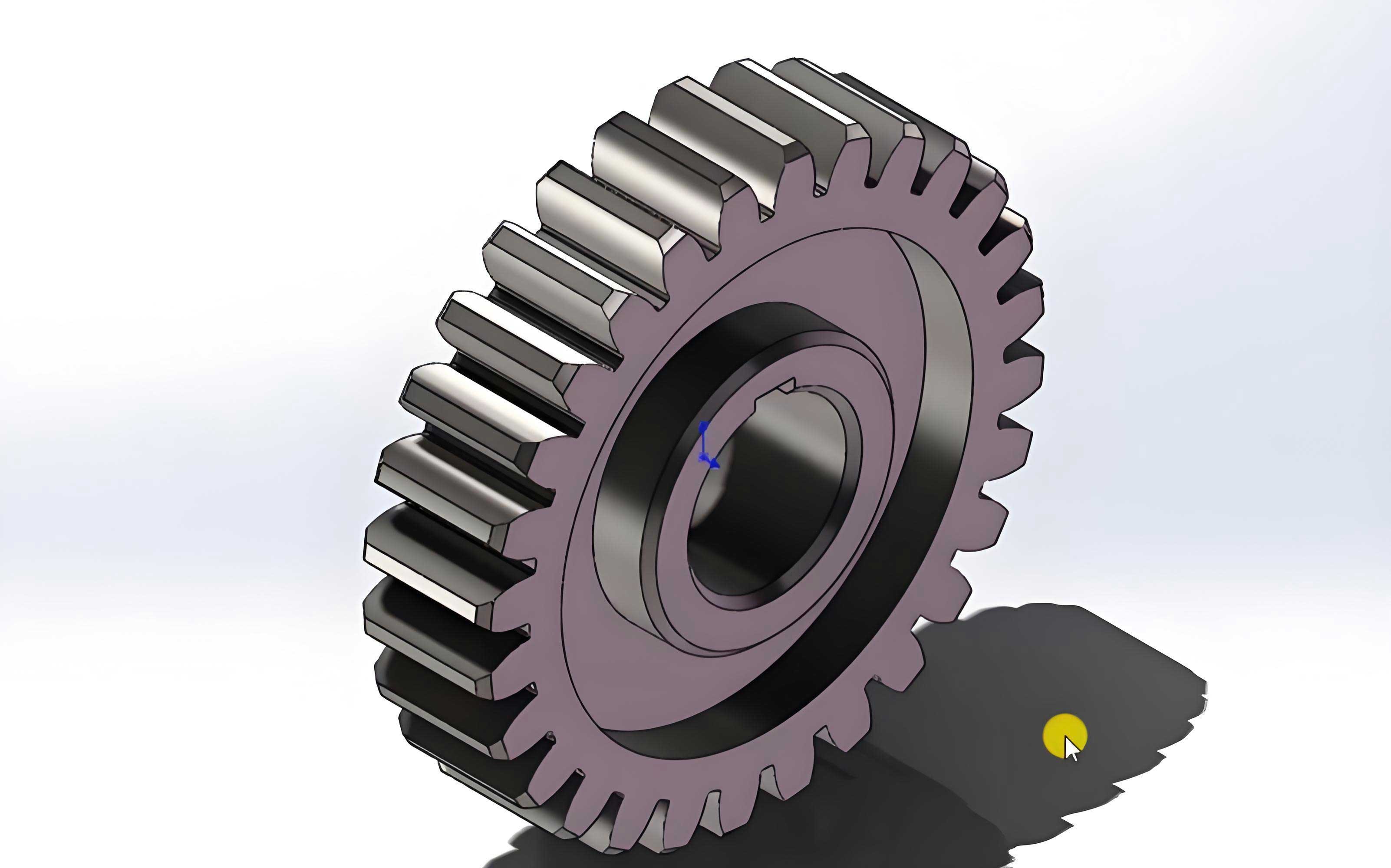
The accuracy of the gear mesh stiffness model is directly linked to the predictive fidelity of the system’s dynamic performance. Traditional energy methods have been extensively refined for higher precision. This study builds upon these foundations, considering the spur gears as cantilever beams starting from the root circle to accommodate different numbers of teeth. The compliance for a single tooth pair in mesh is the sum of the compliances from various deformation sources, including Hertzian contact, fillet-foundation deflection, axial compression, bending, and shear. For a pair of spur gears, the total mesh stiffness $k_{single}$ is given by:
$$k_{single} = \frac{1}{\frac{1}{k_h} + \frac{1}{k_{fp}} + \frac{1}{k_{ap}} + \frac{1}{k_{bp}} + \frac{1}{k_{sp}} + \frac{1}{k_{fg}} + \frac{1}{k_{ag}} + \frac{1}{k_{bg}} + \frac{1}{k_{sg}}}$$
where the subscripts $p$ and $g$ denote the pinion and gear, respectively. $k_h$, $k_f$, $k_a$, $k_b$, and $k_s$ represent the Hertzian contact stiffness, fillet-foundation stiffness, axial compressive stiffness, bending stiffness, and shear stiffness, respectively.
The Hertzian contact stiffness for two cylindrical surfaces is expressed as:
$$k_h = \frac{\pi E B}{4(1 – \nu^2)}$$
where $E$ is the Young’s modulus, $B$ is the face width, and $\nu$ is Poisson’s ratio.
To accurately account for the true tooth profile generated by the rack cutter and the trochoidal fillet, the bending, shear, and axial compression stiffnesses are calculated using integrals with a change of variables. The bending stiffness compliance, for instance, is derived from the strain energy stored in a cantilever beam and is given by:
$$\frac{1}{k_b} = \int_{\alpha}^{\frac{\pi}{2}} \frac{[\cos\beta (y_\beta – y_1) – x_\beta \sin\beta]^2}{E I_{y1}} \cdot \frac{dy_1}{d\gamma} d\gamma + \int_{\beta}^{\tau_c} \frac{[\cos\beta (y_\beta – y_2) – x_\beta \sin\beta]^2}{E I_{y2}} \cdot \frac{dy_2}{d\tau} d\tau$$
Similar integral expressions are used for shear and axial compression stiffness, incorporating the correct geometric boundaries of the spur gear tooth.
A critical refinement involves the fillet-foundation stiffness. The deformation at the fillet region of a loaded tooth is influenced by the adjacent teeth due to structural coupling. An analytical model that captures this coupling effect between two neighboring teeth is employed. The compliance for the fillet-foundation of tooth 2 when tooth 1 is loaded, $k_{f21}$, and vice versa, $k_{f12}$, are calculated as:
$$\frac{1}{k_{f21}} = \frac{\cos \beta_1}{BE \cos \beta_2} \left[ L_1\left(\frac{u_1 u_2}{s^2}\right)^2 + ((\tan\beta_2)M_1 + P_1)\frac{u_1}{s} + ((\tan\beta_1)Q_1 + R_1)\frac{u_2}{s} + ((\tan\beta_1)S_1 + T_1)\tan\beta_2 + U_1\tan\beta_1 + V_1 \right]$$
$$\frac{1}{k_{f12}} = \frac{\cos \beta_2}{BE \cos \beta_1} \left[ L_2\left(\frac{u_1 u_2}{s^2}\right)^2 + ((\tan\beta_1)M_2 + P_2)\frac{u_2}{s} + ((\tan\beta_2)Q_2 + R_2)\frac{u_1}{s} + ((\tan\beta_2)S_2 + T_2)\tan\beta_1 + U_2\tan\beta_2 + V_2 \right]$$
The parameters $L_i$, $M_i$, $P_i$, $Q_i$, $R_i$, $S_i$, $T_i$, $U_i$, $V_i$ are coefficients dependent on the geometry of the spur gear teeth and the relative position of the load application point. The total TVMS for the gear pair is obtained by summing the stiffness contributions of all tooth pairs in simultaneous contact, which alternates between one and two pairs for standard spur gears:
$$k_m = \sum_{i=1}^{n} k_i, \quad n = \text{ceil}(m_p)$$
where $m_p$ is the contact ratio.
| Parameter | Symbol | Value (Pinion/Gear) |
|---|---|---|
| Number of Teeth | $z$ | 100 / 25 |
| Module (mm) | $m$ | 8 |
| Face Width (mm) | $B$ | 120 |
| Pitch Radius (mm) | $r_0$ | 100 / 50 |
| Pressure Angle (degrees) | $\alpha$ | 20 |
| Young’s Modulus (GPa) | $E$ | 206.8 |
| Poisson’s Ratio | $\nu$ | 0.3 |
| Input Torque (N·m) | $T$ | 2000 |
Enhanced Mesh Stiffness Model Incorporating Shaft Misalignment
During the operation of wind turbine gearboxes, shaft deflections due to loads and vibrations can cause deviations from the ideal assembly position. These are manifested as center distance errors and shaft misalignment errors, significantly impacting the meshing of spur gears. In a perfectly aligned system, the gear axes are parallel. Shaft misalignment introduces an angular deviation $\theta$ between the axes.
For spur gears with involute profiles, the line of action is the common tangent to the base circles. The contact force $F$ acts along this line. However, with shaft misalignment, this force vector experiences an angular shift, altering its components. To facilitate stiffness calculation, the force is decomposed into axial ($F_a$), tangential ($F_t$), and radial ($F_r$) components relative to the tooth coordinate system. While $F_r$ remains unchanged, $F_a$ and $F_t$ are modified by the misalignment angle $\theta$.
| Force Component | Aligned Gears | Misaligned Gears ($\theta$ error) |
|---|---|---|
| Axial Force, $F_a$ | $0$ | $F \cos\beta \sin\theta$ |
| Tangential Force, $F_t$ | $F \cos\beta$ | $F \cos\beta \cos\theta$ |
| Radial Force, $F_r$ | $F \sin\beta$ | $F \sin\beta$ |
Furthermore, misalignment causes a variation in the effective contact length along the face width of the spur gears. The “slicing” method is employed, where the gear tooth is divided into $N$ independent, thin slices along its face width. The contact pattern becomes non-uniform, and a gap $e_n$ may exist at the $n$-th slice:
$$e_n = \frac{\sin\theta (\sin\phi – \phi \cos\phi)}{\phi \sin\phi + \cos\phi} \, dz$$
where $dz$ is the slice thickness, and $\phi$ is the generating angle.
Misalignment also introduces an additional stiffness component: torsional stiffness $k_t$. The load distribution across the face width changes from uniform to parabolic, creating a twisting moment on the gear tooth. The strain energy due to torsion $U_t$ is:
$$U_t = \frac{F^2}{2k_t} = \int_{0}^{d} \frac{T_1^2}{2GI_{py}} dx$$
where $T_1 = F_t \cdot t$ is the twisting torque ($t = B/8$ is the distance from the load application point to the center of the contact line), $G$ is the shear modulus, and $I_{py}$ is the polar moment of inertia of the tooth cross-section at distance $x$ from the root. The torsional stiffness compliance is thus:
$$\frac{1}{k_t} = \int_{\alpha}^{\frac{\pi}{2}} \frac{B^2 \cos^2\beta \cos^2\theta}{64G I_{p1}} \cdot \frac{dy_1}{d\gamma} d\gamma + \int_{\beta}^{\tau_c} \frac{B^2 \cos^2\beta \cos^2\theta}{64G I_{p2}} \cdot \frac{dy_2}{d\tau} d\tau$$
The single tooth pair stiffness model for spur gears is then updated to include this term:
$$k_{single} = \frac{1}{\frac{1}{k_h} + \frac{1}{k_{fp}} + \frac{1}{k_{ap}} + \frac{1}{k_{bp}} + \frac{1}{k_{sp}} + \frac{1}{k_{fg}} + \frac{1}{k_{ag}} + \frac{1}{k_{bg}} + \frac{1}{k_{sg}} + \frac{1}{k_{tp}} + \frac{1}{k_{tg}}}$$
Modeling Time-Varying Friction Coefficient and Its Effect on Stiffness
The friction force between the flanks of meshing spur gears is not constant. It varies with the instantaneous contact conditions along the path of contact. The friction coefficient $\mu$ is modeled as a function of sliding-rolling ratio $\xi$, contact pressure $P_{hK}$, lubricant properties, and surface roughness $S$:
$$\mu = e^{f(\xi, P_{hK}, v_0, S)} P_{hK}^{b_2} h_{K}^{b_3} |\xi|^{b_4} V^{b_5} e^{b_6 \xi} v_0^{b_7} R_{K}^{b_8}$$
where $f(\xi, P_{hK}, v_0, S) = b_1 + b_4 |\xi| P_{hK} \lg v_0 + b_5 e^{-|\xi| P_{hK} \lg v_0} + b_9 e^{S}$, and $b_i$ are regression coefficients. The parameters $\xi$, $R_K$, and $P_{hK}$ are calculated at each meshing position $K$:
$$\xi = 2 \left| \frac{(z_1+z_2)(\tan\alpha – \tan\alpha_{1m}(t))}{(z_1+z_2)\tan\alpha + (z_2 – z_1)\tan\alpha_{1m}(t)} \right|$$
$$R_K = r_{b1}\tan\alpha_{1m}(t) – r_{b1} \frac{z_1}{(z_2+z_1)\tan\alpha \tan^2\alpha_{1m}(t)}$$
$$P_{hK} = \frac{F_K}{\pi R_K \left( \frac{1-\nu_1^2}{E_1} + \frac{1-\nu_2^2}{E_2} \right)}$$
The direction of the friction force $F_f = \mu F$ reverses at the pitch point. Considering both time-varying friction and shaft misalignment, the force components on the pinion are modified as follows:
$$F_r = \begin{cases}
F \sin\beta + F_f \cos\beta \cos\theta, & \beta < \tau \\
F \sin\beta, & \beta = \tau \\
F \sin\beta – F_f \cos\beta \cos\theta, & \beta > \tau
\end{cases}$$
$$F_t = \begin{cases}
F \cos\beta \cos\theta – F_f \sin\beta, & \beta < \tau \\
F \cos\beta \cos\theta, & \beta = \tau \\
F \cos\beta \cos\theta + F_f \sin\beta, & \beta > \tau
\end{cases}$$
Consequently, the compliance formulas for axial, shear, bending, fillet-foundation, and torsional stiffness for spur gears must be revised to incorporate these modified force components. For example, the bending stiffness compliance becomes:
$$\frac{1}{k_b} = \int_{\alpha}^{\frac{\pi}{2}} \frac{[(F_t/F)(y_\beta – y_1) – x_\beta (F_r/F)]^2}{E I_{y1}} \cdot \frac{dy_1}{d\gamma} d\gamma + \int_{\beta}^{\tau_c} \frac{[(F_t/F)(y_\beta – y_2) – x_\beta (F_r/F)]^2}{E I_{y2}} \cdot \frac{dy_2}{d\tau} d\tau$$
where $(F_t/F)$ and $(F_r/F)$ are substituted with the piecewise expressions above depending on the meshing phase. Similar substitutions are made in the formulas for $k_a$, $k_s$, $k_f$, and $k_t$.
Dynamic Meshing Angle and Composite Effect of Errors
The TVMS is a function of the pressure angle at the contact point. Errors alter the theoretical operating center distance $d$ to an effective value $d’$, which varies along the face width in the presence of misalignment:
$$d’ = d + \delta + (i B / N) \sin \theta$$
where $\delta$ is the center distance error. This changes the operating pressure angle $\alpha’$:
$$\alpha’ = \cos^{-1}\left( \frac{r_{b1} + r_{b2}}{d’} \right)$$
As a result, the actual pressure angles $\alpha’_{1m}(t)$ and $\alpha’_{2m}(t)$ at the contact point deviate from their nominal values. Their calculation must account for the geometric shift caused by the errors. The transition points between single and double tooth contact for the spur gear pair also become dynamic. For instance, the start of active profile (SAP) angle on the pinion becomes:
$$\alpha_{B2}(t) = \arctan\left( \frac{d’ \sin\alpha’ – \sqrt{r_{a2}^2 – r_{b2}^2}}{r_{b1}} \right)$$
The total mesh stiffness $K_m$ for the spur gear pair, considering sliced teeth with possible partial contact due to gaps $e_n$, is calculated iteratively. The effective mesh deflection $Q_m$ is found, and only slices where $Q_m > e_n$ are considered to be in contact. The total stiffness is then:
$$K_m = \frac{F \cdot \sum_{n=1}^{N} k_{mn}}{F + \sum_{n=1}^{N} k_{mn} e_n}$$
where $k_{mn}$ is the stiffness of the $n$-th slice, calculated using the corrected models for its specific effective center distance $d’_n$ and pressure angles.
Analysis of Influencing Factors on Mesh Stiffness of Spur Gears
The proposed comprehensive model was validated against finite element analysis (FEA) for a spur gear pair from a 2 MW wind turbine gearbox. The results showed excellent agreement, with the RMS value of TVMS from the analytical model differing by only 2.33% from the FEA result for the baseline case, confirming the model’s accuracy.
1. Effect of Time-Varying Friction: The introduction of a time-varying friction coefficient significantly alters the TVMS curve for spur gears. The friction force increases the mesh stiffness during the approach (meshing-in) phase and decreases it during the recess (meshing-out) phase. Unlike models with a constant friction coefficient that show a sharp discontinuity at the pitch point due to force reversal, the model with a time-varying coefficient produces a smoother transition because the friction coefficient itself approaches zero near the pitch point. Increasing input speed reduces the friction coefficient due to higher entrainment velocity, leading to a slight decrease in the overall stiffness modulation amplitude. Increasing input torque raises the contact pressure and friction coefficient, resulting in a more pronounced effect on the stiffness curve.
2. Effect of Center Distance Error: A positive center distance error ($\delta > 0$) increases the operating center distance, which decreases the operating pressure angle $\alpha’$. This reduction in the pressure angle for spur gears leads to a decrease in the TVMS across both single and double tooth contact regions. The single tooth contact period also occupies a larger portion of the meshing cycle. For instance, a positive error of $\delta = 0.10$ mm (0.02% increase) caused a 0.78% reduction in the RMS value of TVMS. The presence of time-varying friction slightly mitigates this reduction because the decreased pressure angle also lowers the friction coefficient.
3. Effect of Shaft Misalignment Error: Shaft misalignment has a more severe impact on the mesh stiffness of spur gears. It introduces a parabolic load distribution, reduces the effective contact length, and adds torsional compliance. As the misalignment angle $\theta$ increases, the TVMS drops dramatically. For $\theta = 0.05^\circ$, the RMS value of TVMS decreased by 21.20% compared to the perfectly aligned case. The single tooth contact period is elongated, and the double tooth contact period is shortened. The transition into and out of the double tooth contact zone becomes less abrupt due to the progressive loss of contact at the slice level.
4. Composite Effect of Both Errors: The combined effect of center distance error and shaft misalignment on spur gears is not a simple superposition. A positive center distance error exacerbates the detrimental effects of shaft misalignment, leading to an even greater reduction in TVMS and a further shortening of the double tooth contact period. Conversely, a negative center distance error ($\delta < 0$) can partially counteract the effects of misalignment by increasing the pressure angle and effectively reducing the operational center distance variation, leading to a higher TVMS and a smoother recess transition compared to the misalignment-only case. This interplay is critical as operational vibrations can induce fluctuating center distance errors that dynamically interact with a steady misalignment.
| Error Condition | Effect on TVMS RMS Value | Effect on Single/Double Tooth Contact Duration | Key Mechanism |
|---|---|---|---|
| Positive Center Distance Error ($\delta > 0$) | Decreases | Increases Single / Decreases Double | Decreased operating pressure angle. |
| Shaft Misalignment ($\theta > 0$) | Sharply Decreases | Increases Single / Decreases Double | Reduced contact length, parabolic load, added torsion. |
| Time-Varying Friction | Slight decrease in RMS, Alters shape | Minimal change | Asymmetric stiffness modulation: increases in approach, decreases in recess. |
| $\delta > 0$ and $\theta > 0$ | Largest Decrease (synergistic) | Greatest increase in Single / decrease in Double | Errors compound to reduce effective pressure angle and contact length. |
| $\delta < 0$ and $\theta > 0$ | Decrease less than misalignment alone (antagonistic) | Moderates the changes from misalignment | Negative $\delta$ counteracts the center distance increase from $\theta$. |
Conclusion
This study establishes a refined analytical model for calculating the time-varying mesh stiffness of spur gears in wind turbine gearboxes. The model uniquely integrates the effects of time-varying tooth flank friction, center distance error, and shaft misalignment error. The slicing method combined with an enhanced energy approach, incorporating revised formulas for bending, shear, axial, fillet-foundation, and newly introduced torsional stiffness, successfully captures the complex interaction of these factors. The model’s results show strong agreement with finite element analysis. The analysis leads to several key conclusions regarding the behavior of spur gears under these conditions.
Firstly, the time-varying friction coefficient causes an asymmetric modulation of the mesh stiffness, increasing it during the approach phase and decreasing it during the recess phase, with a smooth transition at the pitch point. Secondly, positive center distance error reduces mesh stiffness by decreasing the operating pressure angle. Thirdly, shaft misalignment causes a severe reduction in mesh stiffness due to load concentration and torsional deflection, significantly altering the duration of single and double tooth contact periods. Finally, when both errors are present, their effects interact. A positive center distance error synergistically worsens the impact of misalignment, while a negative error can partially compensate for it. These findings underscore the importance of considering the combined influence of installation errors and time-varying friction in the dynamic modeling and vibration analysis of spur gear transmissions in wind turbine gearboxes to ensure accurate prediction and enhanced reliability.