
Spur gears, characterized by their straight, parallel teeth, are one of the most fundamental and widely used components in power transmission systems across industries such as automotive, aerospace, industrial machinery, and precision instruments. The demand for high-performance, high-precision, and cost-effective manufacturing methods for these components is ever-present. Traditional gear machining methods primarily fall into two categories: generating methods (like hobbing and shaping) and form-cutting methods (like form milling). While form milling with a dedicated disc cutter is exceptionally efficient for roughing operations due to its high material removal rate, its application for finishing is severely limited. The root cause is the lack of tool universality; a specific, often expensive, form cutter must be custom-made for each unique gear module, pressure angle, and number of teeth. This makes it economically unviable for low-volume or high-mix production. To bridge this gap, a novel machining strategy known as universal disc cutter enveloping milling has been developed. This method ingeniously combines the high material removal efficiency of form milling with the precision and flexibility typically associated with generating processes. It represents a significant advancement in gear manufacturing technology, offering a highly efficient, precise, and flexible finishing solution, particularly well-suited for flexible manufacturing systems and small-batch production. This article delves into the fundamental principles, mathematical modeling, and tool path calculation methodology for the enveloping milling of spur gears using a universal disc cutter.
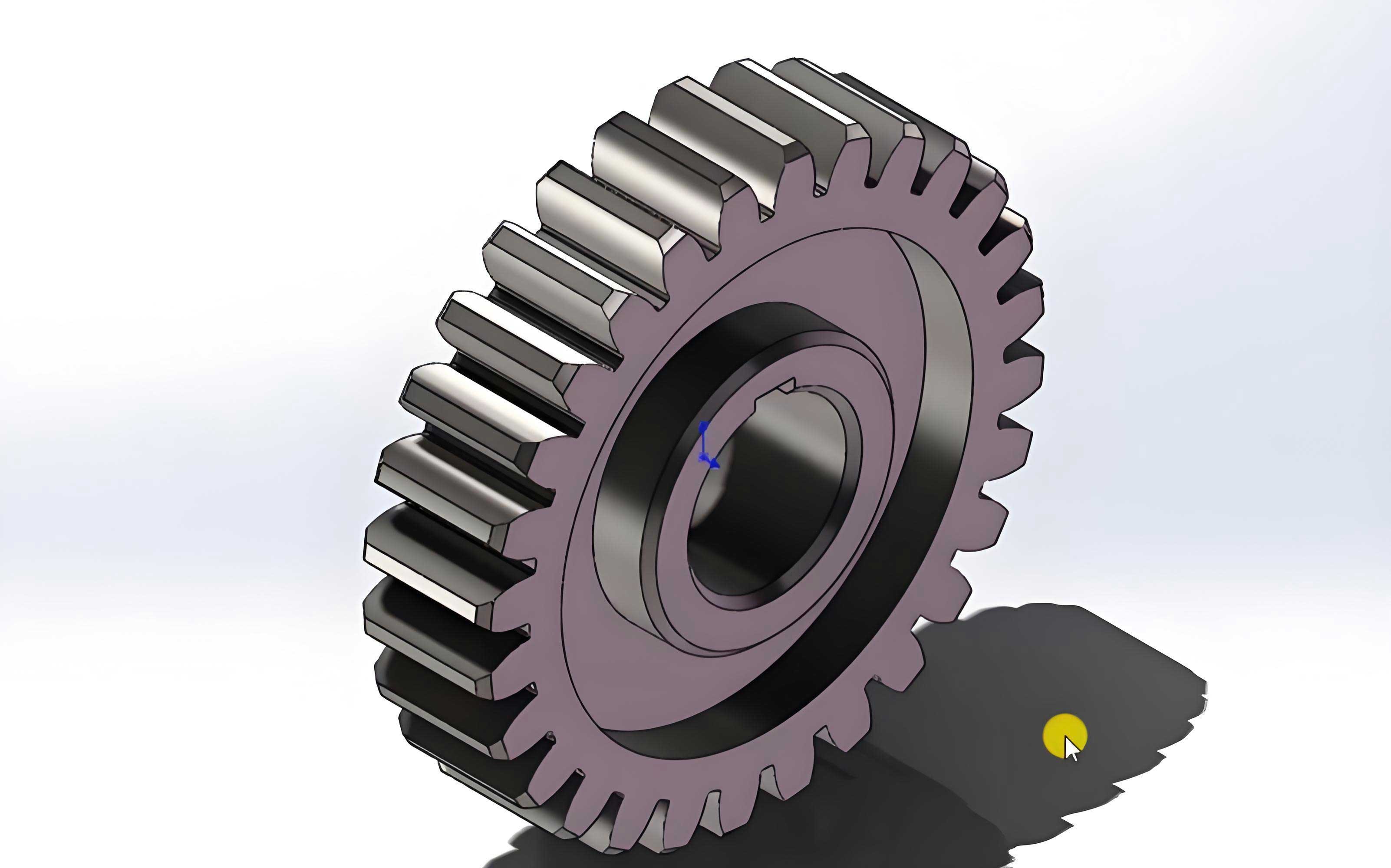
The core innovation of this method lies in conceptualizing a single-tooth of a standard disc cutter as a “moving rack tooth.” The machining process simulates the conjugate meshing action between a rack cutter and the target spur gear. The universal disc cutter, with its simple conical profile, is not a form of the gear tooth space. Instead, the correct involute profile on the workpiece is generated as the envelope of the successive positions of the rotating and traversing cutter relative to the rotating gear blank. This principle merges the theory of conjugate gear-rack generation with the spatial envelope theory for surface generation. The disc cutter performs a primary rotating motion for cutting, while its center follows a precisely calculated path (tool path) relative to the workpiece. Simultaneously, the workpiece (spur gear blank) rotates in a coordinated, timed relationship with the tool movement. The synchronized motion ensures that the cutter’s profile sweeps out a family of surfaces whose envelope precisely matches the desired involute flank of the spur gear.
Mathematical Modeling of the Cutting Tool and Gear Tooth
The foundation for accurate tool path generation is a rigorous mathematical description of both the cutter and the target gear tooth surface.
1. Geometric Model of the Universal Disc Cutter
The active cutting profile of the universal disc cutter is a segment of a right circular cone. A cross-section through the cutter reveals its key dimensions. The mathematical model is established in a coordinate system attached to the cutter, where the Z-axis aligns with the cutter’s axis of rotation. The lateral surface of the conical cutting edge can be parameterized. Let \( R_0 \) be the maximum radius of the cone, and let \( \alpha_t \) be the cone semi-angle (often chosen as the standard pressure angle, e.g., \( 20^\circ \)). The parameter \( R \) is the variable radius at height \( Z \), and \( \phi \) is the angular parameter measured in the plane perpendicular to the cutter axis.
The parametric equations for a point on the cutter’s conical flank are:
$$
\begin{cases}
x = R \cos\phi \\
y = R \sin\phi \\
z = \pm \left( \frac{b}{2} – (R_0 – R) \tan\alpha_t \right)
\end{cases}
$$
where \( b \) is the width of the cutter tip (land). The \( \pm \) sign corresponds to the two flanks: the negative sign typically models the right-hand flank of the cutter (which will generate the left flank of a spur gear tooth), and the positive sign models the left-hand flank. The relationship \( R = R_0 – \frac{z \mp b/2}{\tan\alpha_t} \) holds.
The unit normal vector \( \mathbf{n_c}(R, \phi) \) on the cutter surface is crucial for envelope calculations. It is derived from the partial derivatives of the surface position vector:
$$
\mathbf{n_c} = \frac{\frac{\partial \mathbf{r_c}}{\partial \phi} \times \frac{\partial \mathbf{r_c}}{\partial R}}{\left\| \frac{\partial \mathbf{r_c}}{\partial \phi} \times \frac{\partial \mathbf{r_c}}{\partial R} \right\|}
$$
This yields components proportional to:
$$
\mathbf{n_c} \propto \begin{pmatrix}
\sin\alpha_t \cos\phi \\
\sin\alpha_t \sin\phi \\
\mp \cos\alpha_t
\end{pmatrix}
$$
The correct sign must be chosen based on the flank being considered to ensure the normal points outward from the tool material.
2. Mathematical Description of the Involute Tooth Surface
The flank of a standard spur gear is an involute of a circle. It can be generated by a point on a taut string unwinding from a base circle of radius \( r_b \). The involute surface is a cylindrical surface, extruded along the gear axis. Its mathematical model is parameterized by the involute roll angle \( \sigma \) and the axial coordinate \( u \).
The parametric equations for a point on the involute surface in a coordinate system fixed to the gear are:
$$
\begin{cases}
x_g = r_b (\cos(\sigma_0 + \sigma) + \sigma \sin(\sigma_0 + \sigma)) \\
y_g = r_b (\sin(\sigma_0 + \sigma) – \sigma \cos(\sigma_0 + \sigma)) \\
z_g = u
\end{cases}
$$
Here, \( \sigma_0 \) is the initial angle offset that positions the start of the involute at the base circle. The unit normal vector \( \mathbf{n_g}(\sigma, u) \) on the involute surface is given by:
$$
\mathbf{n_g} = \begin{pmatrix}
-\sin(\sigma_0 + \sigma) \\
\cos(\sigma_0 + \sigma) \\
0
\end{pmatrix}
$$
Notably, the normal is independent of the axial coordinate \( u \) and lies purely in the transverse plane, which is a key characteristic of spur gears.
Tool Path Calculation Methodology for Enveloping Milling
The calculation of the cutter’s motion trajectory is the essence of this method. It involves determining the series of positions and orientations of the universal disc cutter such that its surface envelopes the target involute surface of the spur gear. The process is based on the theory of gearing, specifically the meshing condition between the cutter (modeled as a rack tooth) and the gear.
The fundamental meshing condition states that at the point of contact between two conjugate surfaces, their normal vectors must be collinear, and the relative velocity must have no component along this common normal. This is expressed by the equation:
$$
\mathbf{n} \cdot \mathbf{v}^{(12)} = 0
$$
where \( \mathbf{n} \) is the common normal vector, and \( \mathbf{v}^{(12)} \) is the relative velocity of the cutter (body 1) with respect to the gear (body 2).
To apply this, we define a series of coordinate systems. Let \( S_2(X_2, Y_2, Z_2) \) be fixed to the gear workpiece, with its origin at the gear center. Let \( S_1(X_1, Y_1, Z_1) \) be attached to the disc cutter, typically with its origin at the cutter center and its Z-axis along the cutter spindle. The machine tool provides motions to transform between these systems. The transformation from \( S_1 \) to \( S_2 \) involves a translation representing the cutter center location \( (X, Y, Z) \) and rotations corresponding to the gear rotation angle \( \phi_2 \) and the cutter tilt/helix angle \( \gamma \). For spur gears, the cutter axis is parallel to the gear axis, so \( \gamma = 0 \).
The coordinate transformation matrix \( \mathbf{M}_{21} \) from \( S_1 \) to \( S_2 \) is:
$$
\mathbf{M}_{21} = \begin{bmatrix}
\cos\phi_2 & -\sin\phi_2 & 0 & X \\
\sin\phi_2 & \cos\phi_2 & 0 & Y \\
0 & 0 & 1 & Z \\
0 & 0 & 0 & 1
\end{bmatrix}
$$
The inverse transformation \( \mathbf{M}_{12} = \mathbf{M}_{21}^{-1} \) is also needed.
A point on the cutter surface \( \mathbf{r}^{(1)} = (x_1, y_1, z_1, 1)^T \) is transformed to the gear system as \( \mathbf{r}^{(2)} = \mathbf{M}_{21} \mathbf{r}^{(1)} \). The relative velocity \( \mathbf{v}^{(12)} \) is calculated from the time derivatives of the transformation parameters (e.g., \( \dot{X}, \dot{Y}, \dot{\phi}_2 \)).
By substituting the expressions for \( \mathbf{n}^{(2)} \) (the normal vector transformed to \( S_2 \)) and \( \mathbf{v}^{(12)} \) into the meshing equation, and coupling it with the surface equations, we obtain a system of equations. The solution to this system for a given gear rotation angle \( \phi_2 \) yields the corresponding cutter surface parameters \( (R, \phi) \) of the contact point and the required cutter center coordinates \( (X, Y) \). This process is repeated for discrete values of \( \phi_2 \) to generate the entire tool path.
A more intuitive, simplified calculation approach can be derived by leveraging the rack-and-pinion analogy. The disc cutter’s edge is treated as a single rack tooth. The standard rack has a straight-sided profile with a pressure angle \( \alpha_0 \). The gear rotation is synchronized with a virtual rack translation. The key is to find the initial position and subsequent motion law.
Let us define a reference point \( C(x_0, y_0) \) on the gear’s involute profile, such as its intersection with the pitch circle. Its coordinates are known from gear geometry. For the cutter to be tangent to the involute at this point, the cutter’s cutting edge (a straight line at angle \( \alpha_t \)) must align with the involute’s pressure line. This introduces an initial offset \( \Delta \phi \) for the gear rotation. The initial cutter center position \( O_1 \) is found by offsetting from point \( C \) by the cutter’s geometry (considering its radius at the cutting point and its conical angle).
As the gear rotates through an angle \( \theta \), the virtual rack translates by a distance \( r_p \theta \), where \( r_p \) is the gear’s pitch radius. Therefore, the cutter center must follow this translation, while its orientation remains fixed. The sequence of cutter center locations (the tool path) is given by:
$$
\begin{cases}
X(\theta) = X_0 + r_p \theta \\
Y(\theta) = Y_0 \\
Z(\theta) = \text{constant}
\end{cases}
$$
where \( (X_0, Y_0) \) is the initial cutter center position calculated above. This linear path, combined with the synchronized rotary motion of the workpiece, generates the involute profile for spur gears.
The following table summarizes the key parameters and their role in the tool path calculation:
| Symbol | Description | Role in Calculation |
|---|---|---|
| \( r_b \) | Base circle radius of the spur gear | Defines the fundamental geometry of the target involute tooth surface. |
| \( r_p \) | Pitch circle radius of the spur gear | Determines the translation-to-rotation ratio (\( r_p \theta \)) in the rack-generation analogy. |
| \( \alpha_0 \) | Standard pressure angle of the spur gear | Defines the inclination of the virtual rack tooth (should match cutter cone angle \( \alpha_t \) for standard gears). |
| \( \alpha_t \) | Cone semi-angle of the disc cutter | Defines the geometry of the universal cutting tool. Ideally, \( \alpha_t = \alpha_0 \). |
| \( R_0, b \) | Cutter maximum radius and tip width | Define the specific dimensions of the universal disc cutter. |
| \( (X_0, Y_0, Z_0) \) | Initial cutter center coordinates | Starting point for the tool path, calculated from initial tangency conditions. |
| \( \theta \) | Workpiece (spur gear) rotation angle | The independent variable. The tool path \( X(\theta) \) is a linear function of it. |
Advantages, Applications, and Implementation Considerations
The universal disc cutter enveloping milling method offers a compelling set of advantages for the manufacturing of spur gears:
- Tool Universality and Cost Reduction: A single disc cutter with a standard cone angle (e.g., 20°) can be used to finish spur gears of any module and any number of teeth, as long as they share the same pressure angle. This eliminates the need for a vast inventory of expensive form cutters, dramatically reducing tooling costs, especially in job-shop or prototyping environments.
- High Efficiency: The process retains the high metal removal rate characteristic of milling operations. When used for finishing after a roughing operation (which can be done with the same or a similar cutter using a different path), it provides a very efficient complete machining cycle.
- Flexibility and Agility: Changing from producing one spur gear to another only requires a change in the CNC program (tool path), not a physical tool change (other than potential size constraints). This makes it ideal for high-mix, low-volume production, aligning perfectly with modern flexible manufacturing systems and the trend towards mass customization.
- Good Surface Quality and Accuracy: When properly calibrated, the method can achieve high geometric accuracy and good surface finish on the flanks of spur gears, suitable for many high-performance applications.
The primary application domain for this technology is in the finishing of external spur gears. It is particularly advantageous in industries where gear designs change frequently, such as in aerospace prototyping, specialty vehicle manufacturing, research and development labs, and repair workshops. It bridges the gap between the high setup cost of dedicated gear hobbers/shapers and the limited accuracy/flexibility of manual form milling.
Successful implementation on a CNC machining center or a dedicated gear milling machine requires careful attention to several factors:
- Machine Kinematics and Control: The machine must be capable of precise synchronized motion (C-axis for workpiece rotation and X/Y linear axes for tool movement). The control system must handle the real-time interpolation of this coordinated motion smoothly.
- Tool Path Verification and Simulation: Prior to machining, the calculated tool path should be verified using CAM software with solid model simulation to avoid collisions and ensure the correct envelope is generated.
- Cutter Wear and Compensation: Although universal, the disc cutter is still subject to wear, especially on its tip. Tool wear compensation strategies need to be implemented, potentially by adjusting the radial depth of cut or the programmed tool path offset.
- Rigidity and Dynamics: The process can involve intermittent cuts, depending on the path. Machine tool rigidity and dynamic stability are important to minimize vibrations and achieve good surface finish on the spur gear teeth.
In conclusion, the universal disc cutter enveloping milling method represents a significant step forward in flexible gear manufacturing technology for spur gears. By synthesizing principles from gear theory, spatial kinematics, and CNC machining, it provides a practical and economical solution for producing high-quality spur gears across a wide range of specifications without the burden of specialized tooling. Its relevance continues to grow in manufacturing landscapes that prioritize agility, cost-effectiveness, and the ability to handle diverse, small-batch production runs of precision components like spur gears. Future research may focus on extending this principle to helical gears, optimizing tool paths for even higher efficiency, and integrating in-process measurement for closed-loop quality control.