
In the field of mechanical engineering, the design and manufacturing of spur gears are fundamental to transmission systems. As an engineer, I have explored various CAD platforms to optimize the modeling process, and in this article, I will detail my approach to parametric modeling of spur gears using Pro/E (now Creo) and the simulation of their generation process using Matlab. The goal is to provide a comprehensive methodology that enhances efficiency in spur gear design, analysis, and manufacturing. Parametric modeling allows for quick modifications by altering key variables, making it ideal for custom spur gear applications. This work focuses on cylindrical spur gears, which are widely used due to their simplicity and effectiveness in power transmission. By integrating Pro/E for 3D modeling and Matlab for dynamic simulation, I aim to offer insights that bridge CAD and CAM processes, ultimately supporting advancements in gear technology.
The spur gear is a type of gear with straight teeth cut parallel to the axis of rotation. Its design relies on precise geometric parameters to ensure smooth meshing and efficient power transfer. In this article, I will first outline the design principles of spur gears, including the critical parameters and equations. Then, I will walk through the step-by-step parametric modeling in Pro/E, emphasizing the use of relations and equations to automate the process. Finally, I will describe the generation simulation using Matlab, which visually demonstrates the machining process of spur gears. Throughout, I will incorporate tables and formulas to summarize data and calculations, ensuring clarity and reproducibility. The keyword ‘spur gear’ will be frequently reiterated to maintain focus on this essential component.
Spur gears operate based on involute tooth profiles, which ensure constant velocity ratio and reduce wear. The involute curve is generated by a point on a straight line that rolls without slipping on a base circle. This principle is central to spur gear design, as it defines the tooth shape that minimizes friction and noise. The key parameters for a spur gear include: number of teeth (Z), module (m), face width (B), pressure angle (α), addendum coefficient (ha*), and dedendum coefficient (c*). From these, other dimensions such as pitch diameter, addendum diameter, dedendum diameter, and base diameter can be derived. Below is a table summarizing the primary parameters and their symbols, which I used in my parametric model for spur gears.
| Parameter | Symbol | Description |
|---|---|---|
| Number of Teeth | Z | Total teeth on the spur gear |
| Module | m | Ratio of pitch diameter to number of teeth, defining tooth size |
| Face Width | B | Width of the spur gear along the axis |
| Pressure Angle | α | Angle between the tooth profile and radial line, typically 20° |
| Addendum Coefficient | ha* | Factor for addendum height, usually 1 |
| Dedendum Coefficient | c* | Factor for dedendum height, often 0.25 |
| Addendum | ha | Height from pitch circle to tooth tip |
| Dedendum | hf | Height from pitch circle to tooth root |
| Whole Depth | ht | Total tooth height |
| Pitch Diameter | d | Diameter of the pitch circle |
| Addendum Diameter | da | Diameter of the addendum circle |
| Dedendum Diameter | df | Diameter of the dedendum circle |
| Base Diameter | db | Diameter of the base circle for involute generation |
These parameters are interrelated through mathematical formulas. For instance, the pitch diameter (d) is calculated as: $$d = m \times Z$$. The addendum (ha) and dedendum (hf) are derived from the module and coefficients: $$h_a = (h_a^* + x) \times m$$ and $$h_f = (h_a^* + c^* – x) \times m$$, where x is the profile shift coefficient (often zero for standard spur gears). The addendum diameter (da) and dedendum diameter (df) follow: $$d_a = d + 2 \times h_a$$ and $$d_f = d – 2 \times h_f$$. The base diameter (db) is crucial for involute geometry: $$d_b = d \times \cos(\alpha)$$. In my work, I set α to 20°, a common value for spur gears to balance strength and smooth operation. Using these equations, I established a parametric framework in Pro/E, allowing automatic updates when input variables change. This approach saves time in spur gear design iterations.
Pro/E is a powerful tool for parametric modeling, and I leveraged its features to create a flexible spur gear model. The process began with defining parameters and relations. In Pro/E, I accessed the “Parameters” dialog under the “Tools” menu to input the basic spur gear variables: Z, m, B, α, ha*, and c*. I then used the “Relations” dialog to add equations that compute dependent dimensions. For example, I entered: ha = (hax + x) * m, hf = (hax + cx – x) * m, d = m * z, da = d + 2 * ha, db = d * cos(alpha), and df = d – 2 * hf. Here, I assumed x=0 for a standard spur gear. This step ensured that any modification to primary parameters would automatically adjust the entire spur gear geometry.
Next, I created the basic circles of the spur gear: addendum circle, pitch circle, base circle, and dedendum circle. I sketched these circles on the FRONT plane, using the origin as the center. Initially, I drew arbitrary circles, but then I applied relations to link their diameters to the parameters. For instance, I set the pitch circle diameter to d, the addendum circle to da, the base circle to db, and the dedendum circle to df. This is summarized in the following formulas used in Pro/E relations: $$D1 = d$$, $$D2 = d_a$$, $$D3 = d_b$$, and $$D4 = d_f$$, where D1, D2, D3, and D4 are dimension symbols for the circles. These circles form the foundation for constructing the spur gear teeth.
The involute curve is the heart of spur gear tooth profile. In Pro/E, I generated it using an equation-driven curve. I selected “Insert” > “Model Benchmark” > “Curve” > “From Equation” and chose the coordinate system. The equation for the involute in parametric form is: $$\text{ang} = 90 \times t$$, $$\text{r} = d_b / 2$$, $$\text{s} = \pi \times r \times t / 2$$, $$\text{xc} = r \times \cos(\text{ang})$$, $$\text{yc} = r \times \sin(\text{ang})$$, $$x = xc + s \times \sin(\text{ang})$$, $$y = yc – s \times \cos(\text{ang})$$, and $$z = 0$$, where t varies from 0 to 1. This equation replicates the rolling line mechanism described earlier. To position the involute correctly, I created a datum point at the intersection of the pitch circle and the involute, and a datum axis through the gear center. Then, I established a datum plane through this axis and point, followed by another datum plane rotated by an angle of $$360 / (4 \times Z)$$ from the first. I added a relation to this angle: $$d20 = 360 / (4 \times z)$$, where d20 is the dimension code. This ensured symmetry for the spur gear teeth. Finally, I mirrored the involute across this plane to form one side of the tooth profile.
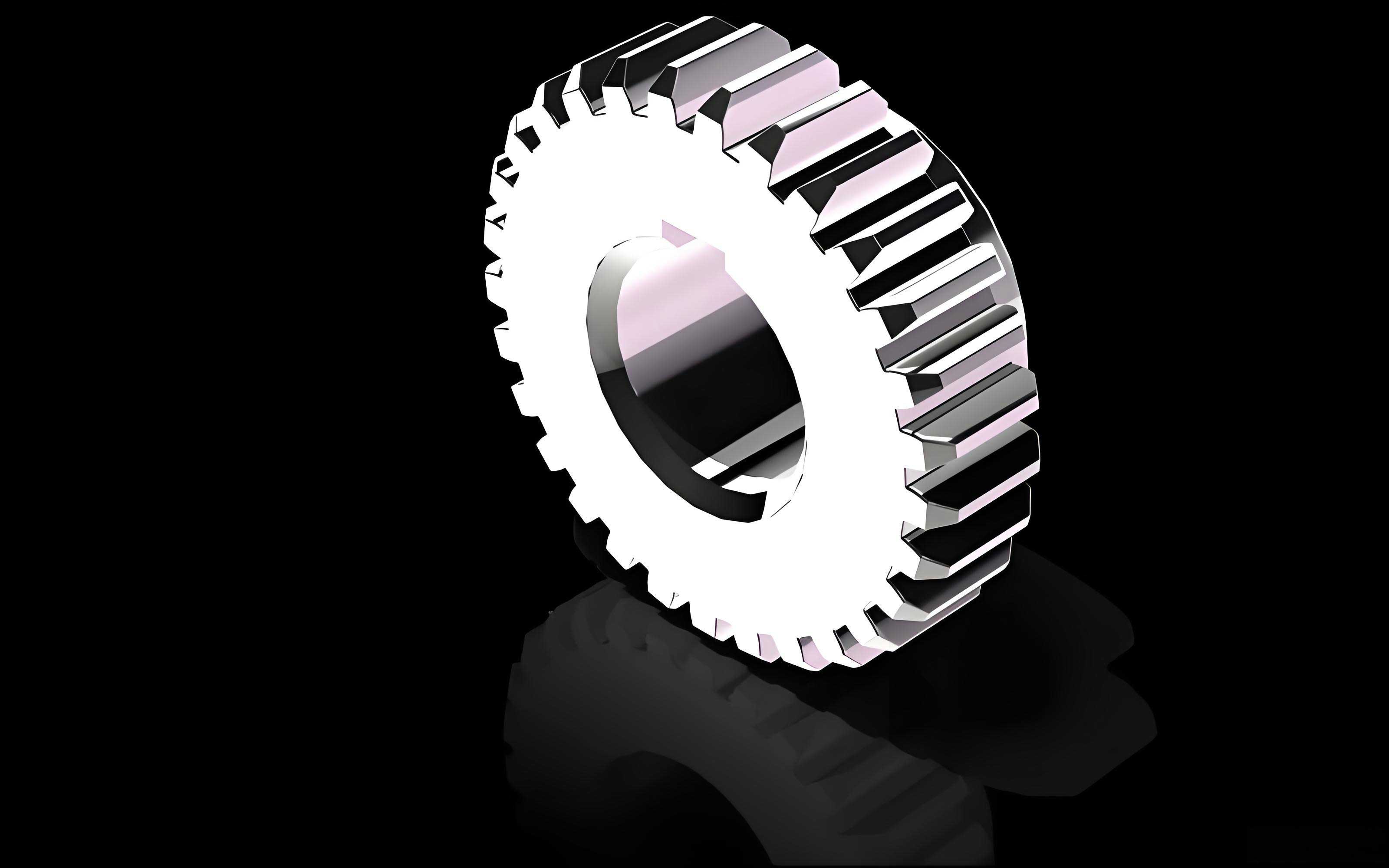
With the involute profile ready, I proceeded to generate a single tooth of the spur gear. I used the “Extrude” feature in Pro/E, sketching the tooth shape by projecting the involute, addendum circle, and dedendum circle onto the FRONT plane. Since the base circle might be larger than the dedendum circle for some spur gears, I extended the involute and added fillets at the root to avoid sharp edges, enhancing the realism of the model. I set the extrusion depth to the face width B, and added a relation so that the depth equals B automatically. This created a solid tooth for the spur gear. To complete the gear, I first extruded a cylinder using the dedendum circle as the sketch, with depth B, forming the gear blank. Then, I copied and pasted the tooth feature using “Selective Paste” with a rotation of $$360 / Z$$ degrees around the central axis. I added a relation to this rotation angle to link it to the number of teeth. Finally, I used the “Pattern” command to array this tooth around the gear, creating all teeth. The resulting spur gear model is fully parametric and adapts to changes in Z, m, or other inputs instantly.
This parametric modeling approach for spur gears offers significant advantages. By defining relations, I eliminated manual recalculations, reducing errors and saving time. For example, if I need a spur gear with different module or tooth count, I simply update the parameters, and the model regenerates accordingly. This flexibility is crucial in engineering applications where spur gears must be customized for specific transmission systems. Moreover, the precise 3D model serves as a foundation for further analyses, such as finite element analysis (FEA) or computational fluid dynamics (CFD), which require accurate geometry. In my experience, using Pro/E for spur gear modeling streamlines the design phase and integrates well with downstream processes like CAM.
Beyond modeling, I explored the generation process of spur gears through simulation. Gear manufacturing often involves generation methods, where a cutting tool (like a rack or hob) engages with a gear blank to form teeth via enveloping motion. This process, known as gear generation or hobbling, produces accurate involute profiles. To visualize it, I used Matlab to create a dynamic simulation of spur gear generation. In this simulation, I modeled a rack cutter (representing the tool) and a gear blank (the workpiece). As the rack translates and the blank rotates, their relative motion generates the tooth shape. The mathematical basis involves the kinematics of gear meshing: the rack’s linear movement corresponds to the rolling of the pitch line on the pitch circle of the spur gear. The simulation updates in real-time, showing how the rack cutter gradually removes material to form the involute teeth. I implemented this in Matlab by solving equations for the rack profile and gear rotation. For instance, the rack tooth profile is defined by straight lines at the pressure angle α, and the gear blank rotates by an angle θ related to the rack displacement s: $$s = r \times \theta$$, where r is the pitch radius of the spur gear. The simulation plots successive positions, creating an animation that illustrates the generation process clearly.
The dynamic simulation reveals the importance of generation in spur gear accuracy. Unlike forming methods, generation ensures that the tooth profile is mathematically correct, leading to better performance in real-world applications. In my Matlab code, I set parameters similar to those in Pro/E: Z=20, m=5 mm, α=20°, and B=10 mm. The simulation runs over multiple steps, and at each step, I calculate the envelope of the rack cutter positions to derive the gear tooth shape. The final output is a visual sequence where the spur gear teeth emerge gradually from the blank. This simulation not only aids in understanding manufacturing but also helps in verifying the design before actual production. For spur gears, such simulations can predict issues like undercutting or interference, allowing designers to adjust parameters early.
To summarize the geometric formulas used in both modeling and simulation, I present a consolidated table below. This table includes key equations for spur gear dimensions, which are essential for parametric design and generation analysis.
| Dimension | Formula | Notes |
|---|---|---|
| Pitch Diameter (d) | $$d = m \times Z$$ | Fundamental diameter for gear sizing |
| Base Diameter (db) | $$d_b = d \times \cos(\alpha)$$ | Critical for involute generation |
| Addendum (ha) | $$h_a = h_a^* \times m$$ | Assuming no profile shift (x=0) |
| Dedendum (hf) | $$h_f = (h_a^* + c^*) \times m$$ | Ensures clearance at tooth root |
| Addendum Diameter (da) | $$d_a = d + 2 \times h_a$$ | Outer diameter of the spur gear |
| Dedendum Diameter (df) | $$d_f = d – 2 \times h_f$$ | Root diameter of the spur gear |
| Circular Pitch (p) | $$p = \pi \times m$$ | Distance between adjacent teeth |
| Tooth Thickness (s) | $$s = \frac{p}{2}$$ | At pitch circle for standard spur gears |
These formulas underscore the systematic nature of spur gear design. In my parametric model, I embedded similar relations to automate calculations. For generation simulation, I also used the involute equation in polar coordinates: $$r(\theta) = \frac{d_b}{2 \times \cos(\phi)}$$, where φ is the pressure angle at any point on the curve. This equation helps in plotting the tooth profile during simulation. By integrating these mathematical principles, I achieved a cohesive workflow from design to visualization for spur gears.
The combination of Pro/E and Matlab provides a robust platform for spur gear development. Pro/E excels in creating detailed 3D models with parametric controls, while Matlab offers powerful scripting for simulations and analyses. In my work, I exported the spur gear dimensions from Pro/E to Matlab to ensure consistency. For instance, after modeling a spur gear with Z=30 and m=4 mm in Pro/E, I used the same parameters in Matlab to simulate its generation. This interoperability enhances the reliability of the process. Furthermore, the parametric approach allows for rapid prototyping of spur gears for various applications, such as automotive transmissions or industrial machinery. Engineers can tweak parameters like module or pressure angle to optimize performance metrics like load capacity or noise reduction.
In conclusion, parametric modeling of spur gears using Pro/E significantly accelerates the design phase by enabling quick modifications through variable adjustments. The use of relations and equations ensures accuracy and consistency, which is vital for high-precision components like spur gears. The dynamic generation simulation in Matlab complements this by providing a visual understanding of the manufacturing process, highlighting the enveloping action that creates involute teeth. Together, these tools facilitate a comprehensive design-to-production pipeline for spur gears. The methodologies described here can be extended to other gear types, such as helical or bevel gears, by adapting the parameters and equations. As technology advances, parametric modeling and simulation will continue to play a key role in optimizing spur gear designs for efficiency and durability. I encourage engineers to embrace these techniques to streamline their workflows and innovate in gear technology.
Reflecting on this project, I found that the parametric modeling of spur gears not only saves time but also reduces errors in complex assemblies. For example, when designing a gearbox with multiple spur gears, changing one gear’s module can automatically update mating gears if relations are properly set. This feature is invaluable in iterative design processes. Additionally, the generation simulation helps in educating newcomers about gear mechanics, making it a useful training tool. As I continue to explore CAD/CAE integration, I plan to incorporate stress analysis on the spur gear models to evaluate their performance under load. This would further enhance the design validation process. Overall, the synergy between Pro/E and Matlab offers a powerful suite for spur gear development, from concept to virtual testing.
To elaborate on the practical applications, consider a case where a spur gear is needed for a high-speed transmission system. Using my parametric model, I can quickly adjust the tooth count and module to achieve the desired speed ratio and torque capacity. The formulas I implemented ensure that the gear meshes correctly with others in the system. Moreover, the generation simulation can predict manufacturing constraints, such as the minimum number of teeth to avoid undercutting. For a spur gear with pressure angle α=20°, the minimum teeth to prevent undercutting is given by: $$Z_{\text{min}} = \frac{2 \times h_a^*}{\sin^2(\alpha)}$$. For ha*=1 and α=20°, Z_min is approximately 17. This insight guides design decisions early on. By embedding such rules in the parametric relations, the model becomes even more intelligent, alerting designers to potential issues.
In summary, this article has detailed my hands-on experience with parametric modeling and generation simulation of spur gears. I have covered the design principles, Pro/E modeling steps with tables and formulas, and Matlab simulation for manufacturing visualization. The key takeaway is that parametric tools like Pro/E empower engineers to create adaptable and precise spur gear models, while simulations like those in Matlab deepen understanding of production processes. As the demand for efficient and reliable spur gears grows in industries like robotics and renewable energy, these methodologies will remain essential. I hope this contribution provides a valuable reference for professionals and students alike, fostering innovation in gear design and analysis.