
The pursuit of high-quality, near-net-shape components directly from sheet metal drives the advancement of precision forming technologies. Among these, closed-extruding fine blanking stands out for its ability to process thicker materials and alloys with lower ductility. Unlike conventional fine blanking, this process confines the workpiece within an almost fully enclosed die cavity throughout the operation. This confinement induces a significantly enhanced triaxial compressive stress state, which is superior for suppressing fracture and producing fully sheared surfaces. However, this very advantage imposes severe demands on the die structure. The extreme pressures generated within the sealed cavity can lead to accelerated wear, elastic deformation, or even catastrophic failure of critical die components like the punch and main die. Therefore, the core challenge in designing a robust closed-extruding fine blanking process lies in managing these internal pressures without compromising the integrity and quality of the formed part, particularly for complex profiles such as spur gears. This article delves into the systematic optimization of die structures, focusing on innovative pressure-relief strategies and enhanced lubrication mechanisms, to enable the efficient and reliable production of spur gear components.
The Imperative for Pressure Management: The Shunting Decompression Chamber
The fundamental issue in closed-extruding fine blanking is the immense forming pressure. In metal forming operations like forging or extrusion, the total pressure (p) on the tooling can be conceptually broken down into the ideal deformation resistance of the material (p_i) and the resistance due to friction (p_f). The ideal deformation resistance is critically dependent on the relative reduction in area, R. This relationship is often expressed as:
$$ p_i = y_m \frac{R}{1 – R} $$
where \( y_m \) is the nominal flow stress of the material. Analysis of this equation reveals a pivotal insight: as the relative area reduction \( R \) approaches 1 (a fully confined, no-escape condition), the ideal deformation resistance \( p_i \) theoretically tends toward infinity. In the context of closed-extruding fine blanking a spur gear, the gear teeth formation involves massive plastic displacement, and without a pressure relief path, the cavity pressure can reach detrimental levels.
To circumvent this, the concept of a Shunting Decompression Chamber (SDC) is introduced. The principle is to intentionally create a controlled “escape route” or overflow volume in a non-critical region of the deforming mass. By providing this volume, the effective relative area reduction \( R \) is decreased from near-unity to a manageable value. This shunting action allows material to flow into the chamber, thereby relieving hydrostatic pressure within the core of the workpiece. Crucially, if the SDC is positioned away from the primary deformation zone (e.g., the gear teeth), the material in the shear zone around the tooth profile can remain under high triaxial compression, preserving the fine-blanking quality, while the overall load on the die set is dramatically reduced. This strategy directly targets the mitigation of radial and tangential stresses on the punch and die, which are primary contributors to tool failure.
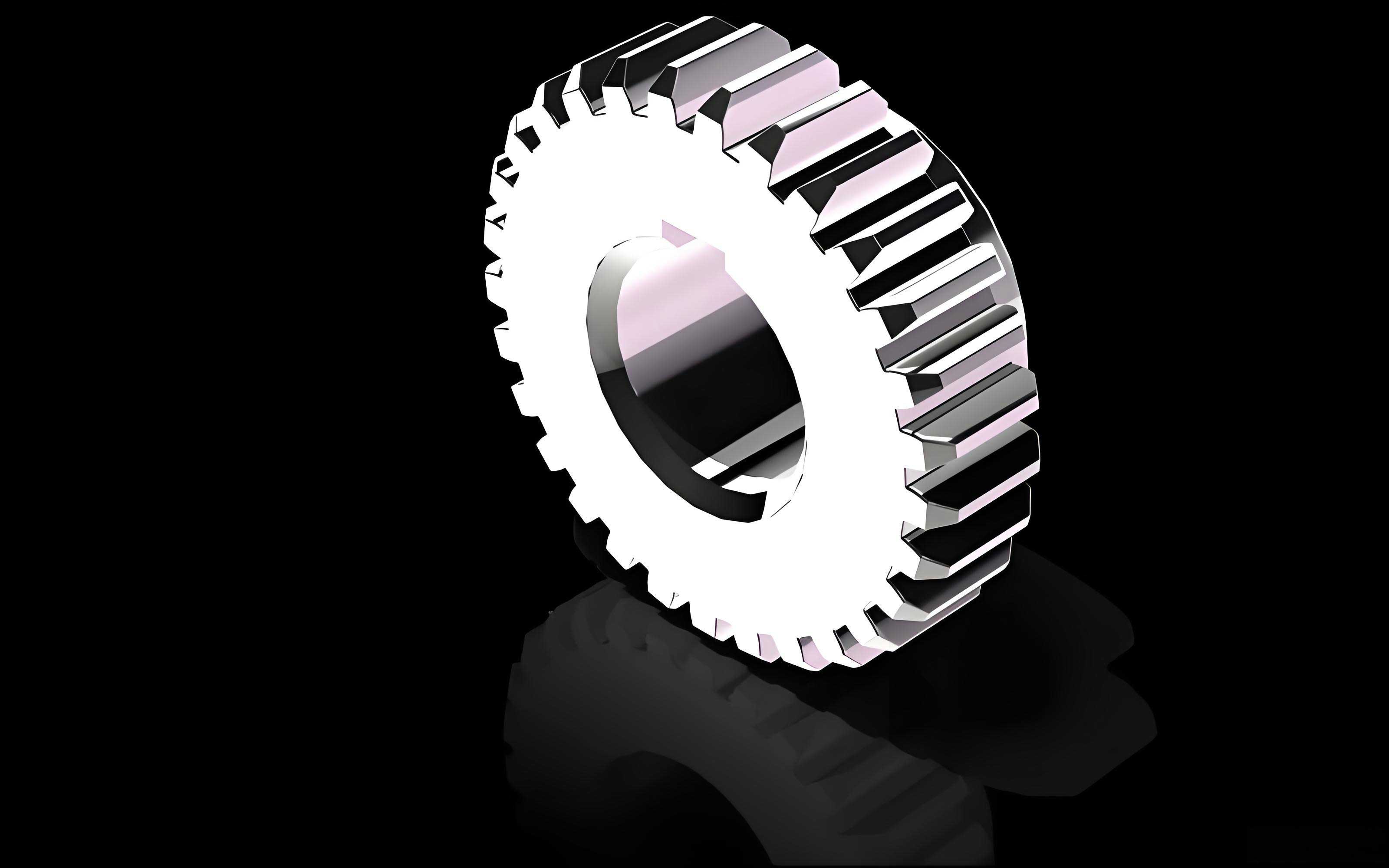
The design of the SDC involves two primary considerations: its location (workpiece vs. punch) and its size (radius/diameter). Each configuration has distinct implications for stress reduction and part quality in the manufacturing of a spur gear.
SDC on the Workpiece Blank
Implementing the SDC directly on the workpiece blank involves pre-drilling a central hole before the fine-blanking operation. Finite Element Analysis (FEA) using Deform-3D software was employed to simulate the closed-extruding fine blanking of a 35 steel spur gear with varying SDC radii (R_sdc) from 1 mm to 8 mm. The primary outputs were the maximum stresses on the punch and main die in the radial, tangential, and axial directions.
The results are summarized in the table below, showing the trend of maximum tooling stress with increasing SDC radius on the blank.
| SDC Radius (mm) | Max Radial Stress (MPa) | Max Tangential Stress (MPa) | Max Axial Stress (MPa) | Trend Description |
|---|---|---|---|---|
| 1 | Very High | Very High | High | Base high-stress condition. |
| 2 | High | High | Moderately High | Noticeable reduction in radial/tangential stress. |
| 4 | Moderate | Moderate | Moderate | Significant reduction; optimal range for pressure relief. |
| 6 | Low | Low | Moderate | Further reduction in radial/tangential stress. |
| 8 | Very Low | Very Low | Moderately Low | Maximum stress relief but potential quality issues. |
The simulation data clearly indicates that increasing the SDC radius on the blank leads to a substantial decrease in radial and tangential stresses on both the punch and die. The axial stress also decreases, but the effect is less pronounced. This is because the SDC primarily relieves the lateral pressure building up as material is forced into the intricate spur gear cavity. However, the influence on part quality must be evaluated. A larger SDC diverts more material, which can affect the stress state in the shear zone. Key quality metrics for the spur gear tooth include the percentage of smooth shear (bright) zone and the height of the rollover (collapse angle). The trend observed shows that while a very small SDC might not sufficiently relieve pressure, an excessively large one (e.g., > 5mm for a given gear size) can increase rollover and potentially reduce the consistency of the bright sheared surface on the spur gear teeth due to altered material flow.
SDC on the Punch
An alternative is to machine the SDC as a blind hole or cavity into the face of the punch. The same FEA methodology was applied to study this configuration. The results showed a similar qualitative trend: tooling stresses decreased with increasing SDC radius. However, the magnitude of stress reduction was generally lower compared to the blank-SDC configuration for the same radius. Furthermore, this approach introduces significant drawbacks for spur gear production. First, a cavity in the punch weakens its structural integrity, especially critical in the high-stress environment of forming spur gear teeth. Second, material flowing into the punch cavity creates a interlocked geometry, making part ejection after blanking difficult and potentially damaging to the delicate spur gear teeth. Third, the presence of the SDC on the punch face can create an uneven pressure distribution during the final stages of blanking.
Experimental Validation and Optimal SDC Design
Practical experiments were conducted to validate the FEA findings. Using a servo-hydraulic press, the total forming force (recorded via the press monitor) was measured during the closed-extruding fine blanking of spur gears from 10 steel blanks with different pre-drilled SDC radii. The results confirmed the force-reduction effect. Furthermore, inspection of the produced spur gears provided critical insight into quality. A small or non-existent SDC led to a higher propensity for micro-cracks at the tooth tips due to extreme tensile stresses. An appropriately sized SDC (e.g., 2-4 mm radius for a medium-sized spur gear) effectively mitigated this cracking while maintaining a small, controlled rollover and a high percentage of cleanly sheared surface on the spur gear profile. An oversized SDC, while further reducing force, led to unacceptable increases in rollover and potential distortion.
Therefore, the conclusive design strategy is to implement the Shunting Decompression Chamber on the workpiece blank. The optimal radius is a compromise, chosen to provide significant pressure relief (drastically lowering radial/tangential die stress) while minimizing negative impacts on the spur gear tooth geometry. This can be expressed as a design objective function to be minimized:
$$ \text{Minimize: } \alpha \cdot S_{tool} + \beta \cdot H_{rollover} + \gamma \cdot (1 – F_{shear}) $$
$$ \text{Subject to: } R_{sdc}^{min} \leq R_{sdc} \leq R_{sdc}^{max} $$
where \( S_{tool} \) is a measure of tooling stress, \( H_{rollover} \) is the rollover height, \( F_{shear} \) is the fraction of smooth shear, and \( \alpha, \beta, \gamma \) are weighting factors. \( R_{sdc}^{min} \) is set to ensure pressure relief, and \( R_{sdc}^{max} \) is set to prevent core weakness in the spur gear blank.
Robust Die Structure Design: The Main Die Assembly
Optimizing pressure is only one facet. The die itself must be constructed to withstand the remaining high stresses. The main die, which forms the external spur gear profile, is subjected to enormous bursting pressures. A monolithic die would require prohibitively large dimensions to prevent fracture. The solution is a prestressed compound (or multi-ring) die assembly.
For a spur gear closed-extruding die, a two-layer compound die is typically sufficient. The inner ring (the die insert containing the precise spur gear cavity) is squeezed by an outer restraining ring. The key to its effectiveness is the use of conical interfaces rather than simple cylindrical fits. The conical fit, achieved through a cold-pressing process, ensures that a significant radial pre-stress is applied to the inner die insert before any operational load. When the internal forming pressure acts during the production of a spur gear, it first has to overcome this compressive pre-stress before placing the insert material into tension. This greatly increases the effective fatigue strength and fracture resistance of the assembly. The design requires a tight tolerance on the cone angle (e.g., 1.5° to 3°) and a high degree of surface contact (>80%) between the rings.
The required prestress \( \sigma_{pre} \) can be estimated based on the expected internal forming pressure \( p_i \) and the safety factor \( n \). For a compound cylinder, the interface pressure \( p_{int} \) needed is:
$$ p_{int} \approx \frac{p_i}{n \cdot K} $$
where \( K \) is a factor related to the diameter ratios of the rings. The necessary interference fit \( \delta \) for a conical assembly is then:
$$ \delta = \frac{p_{int} \cdot d}{E} \left( \frac{K_o^2 + 1}{K_o^2 – 1} + \nu \right) \frac{1}{\tan \alpha} $$
where \( d \) is the nominal interface diameter, \( E \) is Young’s modulus, \( \nu \) is Poisson’s ratio, \( K_o \) is the outer-to-inner diameter ratio of the restraint ring, and \( \alpha \) is the half-cone angle.
Mitigating Friction and Wear: Integrated Lubrication Reservoirs
Even with pressure relief, the sliding interfaces in closed-extruding fine blanking experience severe conditions. Conventional lubrication, applied only to the blank surface beforehand, is often extruded away or breaks down under the extreme pressure and nascent surface generation during spur gear formation. This leads to metal-to-metal contact, galling, and accelerated wear, particularly on the punch flank and the die land.
An innovative solution is to integrate micro-lubrication reservoirs directly into the die components. Specifically, machined grooves or pockets can be added to non-working but adjacent surfaces, such as the face of the counter punch (or pressure pad) and the entry zone of the secondary die. These grooves are filled with a high-performance extreme-pressure (EP) lubricant paste before operation. During the stroke, as the blank material flows and new surfaces are created on the spur gear teeth, it draws lubricant from these reservoirs. This provides a continuous, in-situ supply of lubricant precisely where it is needed most, maintaining a separating film and significantly reducing the coefficient of friction \( \mu \). The reduction in frictional stress \( \tau_f \) is directly beneficial, as it contributes to the total forming pressure:
$$ p_{total} = p_i + p_f = y_m \frac{R}{1 – R} + \mu \cdot p_{contact} \cdot \frac{A_{slide}}{A_{nominal}} $$
By reducing \( \mu \), the integrated reservoir helps lower \( p_{total} \), further protecting the die and improving the surface finish of the spur gear.
Complete Die System Architecture
The optimized features are integrated into a complete die system designed for a two-action hydraulic press. The architecture emphasizes precision and robustness for spur gear production:
- Dual Guidance System: The entire die set is guided by large-diameter leader pins and bushings between the upper and lower plates. Additionally, the punch is precisely laterally located by guide elements (e.g., lock pins) within its固定板, ensuring perfect alignment with the intricate spur gear cavity and preventing offset loads.
- Modular Components: The punch, the compound main die assembly, and the counter punch are designed as separate, hardened inserts mounted in robust holders. This allows for easy replacement and maintenance of critical wear parts after producing thousands of spur gears.
- Force Transmission: The design incorporates strong force pins and pressure plates to evenly distribute the closing and counter forces from the press cylinders to the die components, ensuring uniform loading during the forming of the spur gear.
The synergistic effect of these optimizations—the Shunting Decompression Chamber for pressure management, the prestressed compound die for strength, and the integrated lubrication for wear reduction—creates a die system capable of producing high-precision spur gears with exceptional surface quality and extended tool life.
Conclusion and Future Perspectives
The closed-extruding fine blanking process presents a powerful method for manufacturing complex, load-bearing components like spur gears directly from sheet or plate stock. The principal barrier to its industrial adoption has been the severe service conditions imposed on the tooling. This work has demonstrated a comprehensive strategy for die optimization. The introduction of a Shunting Decompression Chamber, optimally placed on the workpiece blank, is a transformative concept that fundamentally alters the stress state, shifting it from a near-fully constrained to a more manageable pressure-controlled condition. This is quantitatively proven to drastically reduce the radial and tangential stresses responsible for die failure.
Complementing this, the use of a conically-fitted compound die assembly provides the structural integrity to handle the residual stresses, while integrated lubrication reservoirs address the critical issue of friction and galling in the harsh forming environment. The successful experimental validation confirms the practicality of this approach, enabling the production of spur gears with complete, clean sheared surfaces and minimal defects.
Future development can focus on the dynamic optimization of the SDC geometry (e.g., shaped or multi-stage chambers) and the use of advanced surface engineering (e.g., PVD coatings like CrN or AlTiN) on the punch and die to further enhance wear resistance. Additionally, integrating real-time process monitoring to correlate forming force signatures with final spur gear quality could lead to adaptive control systems, pushing the limits of this precision forming technology for even more demanding applications.