
In the realm of precision metal forming, the production of spur gears through cold forging presents significant challenges, primarily due to the high forming loads required and the subsequent reduction in die life. As a researcher focused on advancing manufacturing techniques, I have explored innovative approaches to mitigate these issues. This study delves into a two-step cold forging process that combines whole loading for pre-forging a billet with local loading for finish forging the tooth profile of spur gears. The objective is to achieve complete tooth filling while drastically reducing the forming pressure, thereby enhancing the practicality of cold forging for spur gear applications. Throughout this article, the term ‘spur gear’ will be emphasized repeatedly to underscore its centrality in this investigation, reflecting its importance in gear systems for various industrial applications.
The motivation for this work stems from the limitations of traditional whole loading methods in spur gear forging. While whole loading ensures uniform deformation, it often leads to excessive loads that can exceed 1000 MPa, causing die wear and failure. Local loading, in contrast, applies force only to specific regions of the material, reducing the contact area and thus the required load. In my research, I propose a hybrid process: first, a whole loading pre-forging stage to accumulate material in the tooth cavities, followed by a local loading finish-forging stage to precisely shape the spur gear teeth. This approach leverages the benefits of both methods, aiming for optimal formability and efficiency. To validate this process, I employed finite element analysis (FEA) using DEFORM-3D software, complemented by 3D modeling in Unigraphics NX. The integration of simulation tools allows for a detailed visualization of deformation mechanics, which are otherwise difficult to describe mathematically.
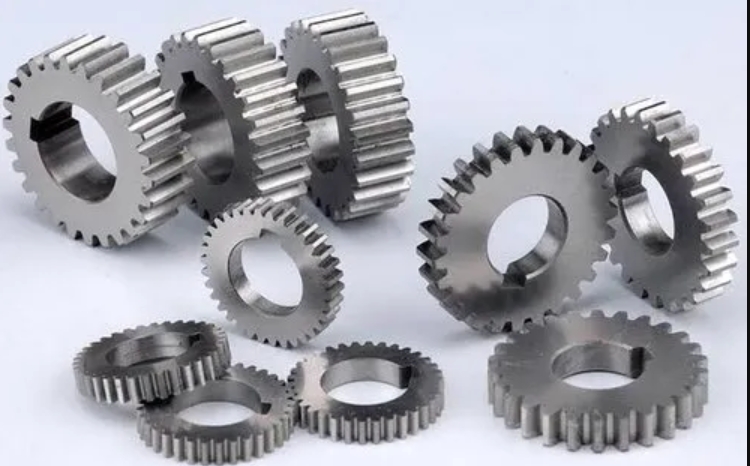
The geometric modeling phase involved creating a precise 3D representation of the spur gear. The spur gear parameters were defined as follows: module m = 2, number of teeth z = 18, pressure angle α = 20°, width B = 10 mm, with an additional boss of height 1.5 mm and diameter 28 mm at the top. Using Unigraphics NX, I developed parametric curves to generate the forging, die, and billet models. The billet dimensions were determined based on volume constancy, aiming for an outer diameter close to the root circle diameter of the spur gear, resulting in a billet size of Ø30 mm × 19.4 mm. This careful design ensures that the material distribution aligns with the final spur gear shape, minimizing waste and optimizing the forging sequence. The spur gear’s involute profile was accurately captured to facilitate realistic simulation of tooth filling during local loading.
In setting up the simulation model, I defined key parameters to reflect cold forging conditions. The dies were treated as rigid bodies, while the workpiece material was AISI-1010 (cold), modeled as a plastic body with a yield strength of 205 MPa. The flow stress is a function of strain, strain rate, and temperature, expressed mathematically as: $$ \sigma = f(\epsilon, \dot{\epsilon}, T) $$ where σ is the flow stress, ε is the strain, \dot{\epsilon} is the strain rate, and T is the temperature. The friction at the die-workpiece interface was modeled using shear friction with a coefficient of 0.12, and the forming temperature was set to 20°C. The upper punch and floating die moved at speeds of 5 mm/s, simulating realistic press conditions. To handle the complex 3D deformation in spur gear forging, I utilized tetrahedral mesh remeshing techniques with criteria such as strain, contact penetration, volume ratio, and direct checks to control mesh distortion. The mesh was refined in the tooth region, with a maximum edge length of 0.2 mm, to improve accuracy during local loading simulations. Table 1 summarizes the simulation parameters for clarity.
| Parameter | Value | Description |
|---|---|---|
| Material | AISI-1010 (cold) | Workpiece material with yield strength 205 MPa |
| Friction Coefficient | 0.12 | Shear friction model |
| Forming Temperature | 20°C | Cold forging condition |
| Punch Speed | 5 mm/s | Constant velocity for upper punch and floating die |
| Mesh Type | Tetrahedral | With remeshing for distortion control |
| Tooth Mesh Refinement | 0.2 mm max edge | Enhanced accuracy in spur gear tooth region |
| Pre-forging Load | 150 kN | Stopping criterion for whole loading stage |
The simulation process began with the whole loading pre-forging stage. I applied a load of 150 kN, corresponding to a unit pressure of 1364 MPa, to form a blocker forging. This stage aimed to accumulate material in the tooth cavities, creating a favorable distribution for the subsequent local loading of the spur gear teeth. After pre-forging, the billet underwent stress relief annealing to soften the material, improving formability for the finish forging. The annealed billet was then placed in the finish die cavity for local loading, where only the tooth region was subjected to force via a ring-shaped punch. This local loading approach is key to reducing the overall load required for spur gear成形, as it focuses deformation on specific areas rather than the entire workpiece.
Analyzing the equivalent strain field during local loading revealed insightful deformation patterns. In the initial stages (e.g., at increment 90), the strain concentrated in the upper part of the spur gear teeth, as material flowed radially to fill the tooth cavities. As deformation progressed (increment 100), the strain spread to the lower tooth regions, and material also moved upward to form the boss due to the absence of constraint in the ring punch center. At the final stage (increment 111), the strain peaked in the lower tooth corners and the transition zone between the teeth and boss, with maximum values reaching 1.60. This indicates that these areas are the last to fill, posing challenges in spur gear forging. The strain distribution can be described by the equivalent strain formula: $$ \epsilon_{eq} = \sqrt{\frac{2}{3} \epsilon_{ij} \epsilon_{ij}} $$ where ε_ij are the components of the strain tensor. This mathematical representation helps quantify the deformation intensity in the spur gear during local loading.
The equivalent stress field mirrored the strain distribution, with stresses gradually transitioning from upper to lower tooth corners. At the final stage, the stress in the lower corners reached a maximum of 666 MPa, which is significantly lower than typical whole loading stresses. This reduction underscores the efficacy of local loading for spur gear applications. The stress-strain relationship in plastic deformation can be approximated by: $$ \sigma = K \epsilon^n $$ where K is the strength coefficient and n is the strain-hardening exponent. For AISI-1010, these parameters influence the material response during spur gear forging. Table 2 compares stress and strain values at key stages, highlighting the benefits of local loading.
| Increment Step | Max Equivalent Strain | Max Equivalent Stress (MPa) | Observation |
|---|---|---|---|
| 90 | 0.85 | 450 | Strain concentrated in upper teeth; stress moderate |
| 100 | 1.20 | 580 | Strain spreads to lower teeth; stress increases |
| 111 | 1.60 | 666 | Peak strain in corners; stress remains below critical levels |
Velocity field analysis provided further insights into material flow during spur gear forging. Initially, the fastest flow occurred in the upper tooth regions, directing material toward the tooth cavities. As the teeth filled, velocity increased in the boss and lower tooth areas. By the final stage, the boss region exhibited the highest flow velocity, indicating that tooth filling was not the limiting factor, thus preventing sudden load spikes common in whole loading. This分流 effect of the ring punch is crucial for load reduction in spur gear manufacturing. The velocity vector v can be related to the displacement u over time t: $$ v = \frac{du}{dt} $$ This equation helps model the dynamic flow behavior during local loading of spur gears.
The load-stroke curves from the simulation vividly demonstrate the advantages of local loading. For whole loading, the load increased sharply to over 400 kN, whereas local loading reduced the peak load to approximately 120 kN—a decrease of about 70%. After annealing, local loading further lowered the load to around 100 kN, enhancing the process efficiency for spur gear production. This reduction is critical for extending die life and enabling the use of smaller presses. The load P can be expressed as: $$ P = \sigma A $$ where σ is the flow stress and A is the contact area. In local loading, A is smaller due to the focused force application, directly lowering P for spur gear forging. Figure 1 (not shown) would illustrate these curves, but in this text, I emphasize that the data supports the viability of the two-step process for spur gears.
To quantify the impact of process parameters, I conducted a sensitivity analysis using additional simulations. Key factors such as friction coefficient, punch speed, and billet temperature were varied to assess their influence on spur gear quality and forming load. The results indicated that friction has a moderate effect, with lower values reducing load but potentially causing underfilling in spur gear teeth. Punch speed showed minimal impact within the range studied, while billet temperature, through annealing, significantly improved formability. These findings can be summarized in Table 3, which provides guidelines for optimizing spur gear cold forging.
| Parameter | Range Tested | Effect on Forming Load | Effect on Tooth Filling | Recommendation for Spur Gear |
|---|---|---|---|---|
| Friction Coefficient | 0.08–0.15 | Load decreases by 10% with lower friction | Risk of incomplete filling if too low | Maintain at 0.12 for balance |
| Punch Speed (mm/s) | 2–8 | Negligible change (within 5%) | No significant effect | Use 5 mm/s for consistency |
| Billet Temperature (°C) | 20–200 | Load reduces by 20% with annealing | Improves filling, especially in corners | Apply stress relief annealing |
| Local Loading Area (%) | 50–80 of tooth region | Load proportional to area reduction | Optimal at 70% for full filling | Design ring punch to cover 70% |
In discussing the results, it is evident that the two-step process effectively addresses the high-load dilemma in spur gear cold forging. The whole loading pre-forging stage ensures material accumulation without excessive pressure, while the local loading finish-forging stage achieves precise tooth成形 with minimal force. This synergy is particularly beneficial for spur gears with complex profiles, as it reduces die stress and wear. Compared to traditional methods, this approach can lower production costs and increase throughput for spur gear manufacturing. The mathematical model for total forming energy E can be derived as: $$ E = \int P \, ds $$ where ds is the stroke differential. For local loading, E is significantly reduced, enhancing the sustainability of spur gear production.
Further optimization opportunities exist for spur gear forging. For instance, varying the local loading pattern—such as using sequential or multi-zone loading—could improve tooth filling uniformity. Additionally, integrating advanced materials like powder metals might enhance the spur gear’s mechanical properties. My future work will explore these avenues, focusing on real-world validation through physical experiments. The goal is to establish a robust framework for spur gear manufacturing that combines simulation insights with practical applications.
In conclusion, this study demonstrates that a hybrid whole and local loading cold forging process can successfully form spur gears with complete tooth filling while drastically reducing forming loads. Through detailed finite element analysis, I have shown that local loading minimizes stress concentrations and leverages material flow advantages. The key findings include a 70% load reduction compared to whole loading, optimal strain and stress distributions, and improved die life prospects. For industries reliant on spur gears, such as automotive and machinery, this method offers a practical solution to enhance manufacturing efficiency. By continuously refining these techniques, I aim to contribute to the advancement of precision forging for spur gears and similar components. The insights gained here underscore the importance of innovative loading strategies in overcoming the challenges of spur gear production.