
In the field of equipment maintenance, especially for mining machinery and pneumatic tools, the task of replacing or replicating damaged spur gears is a common yet challenging endeavor. Often, the original gear specifications are unavailable, and we are left with a physical gear that must be accurately measured to determine its critical parameters. The challenges are multifaceted: Is the spur gear based on a module system or a diametral pitch system? What is its pressure angle? Is it a standard or a stub tooth profile? Has it been modified with profile shift (x-factor)? Relying solely on simple measurements like the number of teeth, bore diameter, or outside diameter is insufficient for accurate reconstruction. I have encountered situations, such as with a spur gear from a Japanese excavator, where the tooth addendum coefficient clearly deviated from standard values. This experience underscores the necessity of employing a systematic and precise measurement methodology. The core principle guiding this process is that the base pitch of a spur gear is invariant—it depends only on the module and pressure angle, unaffected by addendum modifications or profile shift. This article details the formulas, procedures, and practical insights I have gathered for successfully determining the parameters of a spur gear.
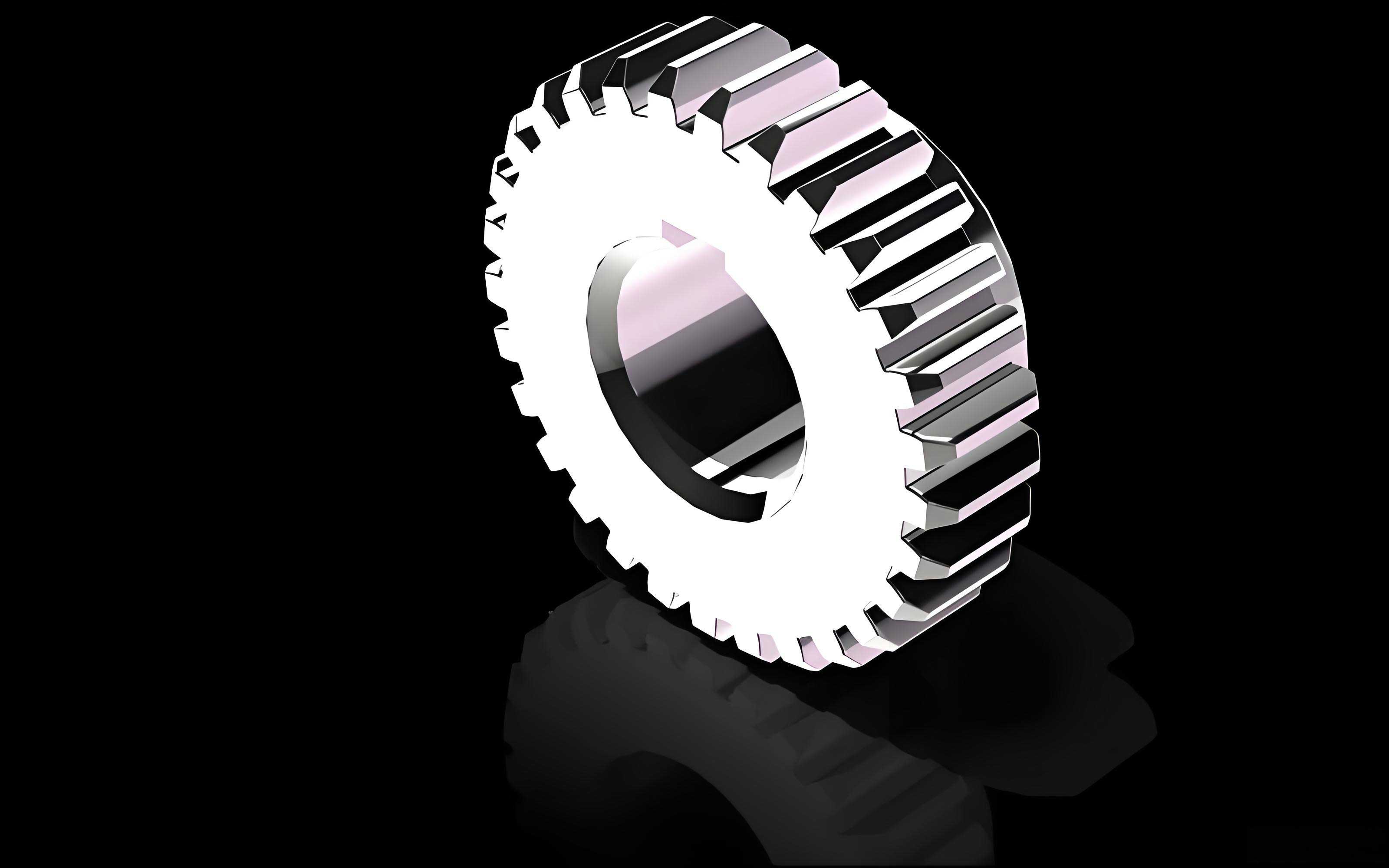
Understanding the fundamental tooth shape systems is the first critical step. The two primary systems are the module system and the diametral pitch system. The module (m) is defined as the ratio of the reference pitch diameter (d) to the number of teeth (Z). Its formula is:
$$ m = \frac{d}{Z} $$
The module value series is standardized. Common values include: 0.1, 0.15, 0.2, 0.3, 0.4, 0.5, 0.6, 0.7, 0.8, 1, 1.25, 1.5, 1.75, 2, 2.25, 2.5, 2.75, 3, (3.25), 3.5, (3.75), 4, 4.5, 5, 5.5, 6, (6.5), 7, 8, 9, 10, and so on. For a spur gear, the module directly dictates the size of the tooth.
The diametral pitch (DP), prevalent in countries like the United States and the United Kingdom, is defined as the number of teeth per inch of pitch diameter. Its relationship with module is:
$$ DP = \frac{25.4}{m} $$
A higher DP value corresponds to a smaller module. A spur gear with a DP of 1 is equivalent to a module of 25.4 mm. The standard DP series includes: 2.5, 3, 4, 4.5, 5, 6, 7, 8, 9, 10, 11, 12, 14, 16, 18, 20, 21, 22, 24, 26, 28, 30, 32, 34, 36, 37, 38, 40, 42, 45, 48, 50, 54, etc. All formulas for a module-system spur gear can be adapted for a diametral-pitch spur gear by substituting ‘m’ with ‘25.4/DP’.
Different countries have established their own standard parameters for spur gears. The key parameters are the pressure angle (α), the addendum coefficient (ha*), and the dedendum clearance coefficient (c*). The following table summarizes these basic parameters for various national standards, which serves as a vital reference during the spur gear identification process.
| Country | System | Standard Pressure Angle α | Addendum Coefficient ha* | Dedendum Clearance Coefficient c* |
|---|---|---|---|---|
| China | Module (m) | 20° | 1 | 0.25 (0.35 for shaping/shaving) |
| China | Module (m) | 20° | 0.8 | 0.30 |
| Russia | Module (m) | 20° | 1 | 0.25 |
| Russia | Module (m) | 20° | 0.8 | 0.30 |
| Russia | Module (m) | 20° | 1 | 0.20 |
| Germany | Module (m) | 20° | 1 | 0.10–0.30 |
| Germany | Module (m) | 15° | 1 | 0.167 |
| Japan | Module (m) | 20° | 1 | 0.25 |
| France | Module (m) | 20° | 1 | 0.25 |
| Switzerland | Module (m) | 20° | 1 | 0.25 |
| Switzerland | Module (m) | 15° | 1 | 0.25 |
| USA | Diametral Pitch (DP) | 14.5° | 1 | 0.167 |
| USA | Diametral Pitch (DP) | 20° | 1 | 0.167 |
| USA | Diametral Pitch (DP) | 20° | 0.8 | 0.167 |
| UK | Diametral Pitch (DP) | 20° | 1 | 0.44 |
| UK | Diametral Pitch (DP) | 20° | 1 | 0.25 |
Another important variation is the double module or double diametral pitch system, which is a form of stub tooth spur gear. Here, a larger module (or smaller DP) is used to calculate the pitch diameter, while a different module (or DP) is used to calculate the tooth height dimensions. The formulas are:
$$ d = m_1 \cdot Z, \quad t = \pi m_1, \quad h_a = h_a^* \cdot m_2, \quad h_f = (h_a^* + c^*) \cdot m_2 $$
Where m1 is used for diameter-related calculations and m2 for tooth depth. Standard series for these double systems are listed below.
| Double Module Series | Double Diametral Pitch Series | ||
|---|---|---|---|
| m1 | m2 | DP1 | DP2 |
| 1.5 | 1.25 | 3 | 4 |
| 1.75 | 1.5 | 4 | 5 |
| 2.25 | 1.75 | 5 | 7 |
| 2.5 | 2 | 6 | 8 |
| 2.75 | 2 | 7 | 9 |
| 3 | 2.25 | 8 | 10 |
| 3.25 | 2.5 | 9 | 11 |
| 3.5 | 2.5 | 10 | 12 |
| 3.75 | 2.75 | 11 | 14 |
| 4 | 3 | 12 | 14 |
| 4.25 | 3.25 | 14 | 18 |
| 4.5 | 3.25 | 16 | 21 |
| 4.75 | 3.5 | 18 | 24 |
| 5 | 3.75 | 20 | 26 |
| 5.25 | 4 | 22 | 29 |
| 5.5 | 4 | 24 | 32 |
| 5.75 | 4.5 | 26 | 35 |
| 6 | 4.5 | 28 | 37 |
| 6.25 | 4.75 | 30 | 40 |
| 6.5 | 5 | 32 | 42 |
| 7.5 | 5.5 | 34 | 45 |
| 8 | 6.5 | 36 | 48 |
| 38 | 50 | ||
| 40 | 54 | ||
The cornerstone of spur gear parameter determination is precise measurement. The most reliable starting point is the measurement of base pitch via the span measurement method, also known as the measurement of chordal tooth thickness over a number of teeth. The base pitch (Pb) is calculated from two span measurements:
$$ P_b = W_n – W_{n-1} $$
Where Wn is the span measurement over ‘n’ teeth, and Wn-1 is the span measurement over ‘n-1’ teeth. It is crucial to ensure that the caliper contacts the tooth flanks near the reference pitch circle for both measurements. Multiple sets of measurements should be taken and averaged. Furthermore, a wear compensation of 0.10 mm to 0.20 mm (0.004″ to 0.008″) must be added to this average value, especially for small pneumatic tool spur gears where 0.10 mm is typical. The theoretical relationship between base pitch, module, and pressure angle is:
$$ P_b = \pi m \cos \alpha $$
Therefore, the module can be expressed as:
$$ m = \frac{W_n – W_{n-1}}{\pi \cos \alpha} $$
At this stage, the pressure angle (α) is unknown. However, since standard pressure angles are limited (primarily 14.5°, 15°, and 20°), we can substitute these values into the formula. The calculated ‘m’ (or its corresponding DP value) that is closest to a standard integer or half-integer from the series indicates the most likely pressure angle. To facilitate this trial process, the following conversion factors are extremely useful.
| Pressure Angle α | 1/(π cos α) | 25.4/(π cos α) |
|---|---|---|
| 14.5° | 0.3288 | 77.2547 |
| 15° | 0.3295 | 77.0775 |
| 20° | 0.3387 | 74.9841 |
Using this table, for a measured Pb (in mm), calculate m = Pb × (1/(π cos α)) for each α. The α that yields an m value matching the standard series confirms the system. For a diametral pitch spur gear, DP = 25.4/m. Once a candidate module and pressure angle are identified, they must be verified by calculating other gear dimensions (like pitch diameter, tip diameter) and comparing them with physical measurements of the spur gear.
Determining if a spur gear has profile shift (is “x-modified”) is the next critical step. This can be done using two methods: center distance measurement or span measurement comparison. If the mating spur gear pair is available, measure the center distance (a) between their shafts. The operating pressure angle (αw) can be calculated from:
$$ \alpha_w = \cos^{-1} \left( \frac{m (Z_1 + Z_2)}{2a} \cos \alpha \right) $$
If αw equals the standard pressure angle α, then the gear pair is either unmodified or has equal and opposite profile shifts (high correction). If αw ≠ α, the pair has unequal profile shifts (angular correction). If center distance cannot be measured, calculate the theoretical span measurement for an unmodified spur gear (Wn_calc) using the formula:
$$ W_{n\_calc} = m \cos \alpha \left[ (n – 0.5) \pi + Z \cdot \text{inv}(\alpha) \right] $$
Where the involute function is defined as $$ \text{inv}(\alpha) = \tan \alpha – \alpha $$ (with α in radians). Compare Wn_calc with the measured, wear-compensated span value (Wn_meas). If they are equal, the spur gear is unmodified. If not, the profile shift coefficient (x) can be calculated from the span measurement deviation:
$$ x = \frac{W_{n\_meas} – W_{n\_calc}}{2m \sin \alpha} $$
For a high-correction gear pair (x1 = -x2), the individual coefficients can also be estimated from tip diameters (da):
$$ x_1 = \frac{1}{4} \left( \frac{d_{a1} – d_{a2}}{m} – (Z_1 + Z_2) \right), \quad x_2 = -x_1 $$
For an angular-correction pair, the sum of profile shift coefficients (Σx) is first found from the operating pressure angle:
$$ \Sigma x = \frac{Z_1 + Z_2}{2 \tan \alpha} (\text{inv}(\alpha_w) – \text{inv}(\alpha)) $$
Then, individual coefficients can be derived using tip diameter measurements:
$$ x_1 = \frac{1}{4} \left( \frac{d_{a1} – d_{a2}}{m} – (Z_1 + Z_2) + 2\Sigma x \right), \quad x_2 = \Sigma x – x_1 $$
Cross-verifying the profile shift coefficient obtained from the span method with the one from the tip diameter method significantly enhances the accuracy of the spur gear parameter determination.
Several practical considerations are paramount during the spur gear measurement process. First, for a spur gear with an odd number of teeth, the measured tip diameter and root diameter must be corrected. The measured value across the teeth should be multiplied by a correction factor k to obtain the true diameter:
$$ k = \frac{1}{\cos(90^\circ / Z)} $$
Second, recognizing physical clues can speed up the initial assessment. A module-system spur gear with a 20° pressure angle typically has a more curved tooth profile and a root fillet that is relatively narrow with a larger radius. In contrast, a diametral-pitch spur gear with a 14.5° pressure angle often exhibits a straighter tooth profile and a root that is wider with a smaller fillet radius. Third, a useful rule of thumb is that nearly all spur gears used in planetary reducers of pneumatic tools worldwide are angular-corrected, module-system gears with a 20° pressure angle and an addendum coefficient of 1. This knowledge provides a strong starting hypothesis when dealing with such components.
Finally, while this guide focuses on spur gears, maintenance often involves helical gears and spiral bevel gears. For helical spur gears (helical gears), the primary challenge is determining the helix angle accurately. The simple roller or ink imprint method can have significant errors. In maintenance, which often involves single-piece or low-volume production, replacing helical or spiral bevel gear pairs as a set is frequently the most cost-effective and reliable strategy. As long as the original transmission ratio and center distance are maintained, the exact helix angle of the individual spur gear component may not need to be replicated precisely for the new pair. However, if a single helical spur gear must be manufactured (e.g., a gear integral to a pump shaft), more precise methods, such as using a milling machine with change gears to physically trace and match the lead of the helix, become necessary.
In conclusion, the successful determination of parameters for a replacement spur gear hinges on a methodical approach that leverages the invariant nature of the base pitch. By accurately measuring span lengths, strategically applying known standard values for pressure angles and module series, and cross-checking calculated dimensions against physical measurements for tip diameter and center distance, one can reliably deduce the module or diametral pitch, pressure angle, profile shift status, and tooth height coefficients of any spur gear. This process, while detail-oriented, is fundamental to effective equipment maintenance and ensures the longevity and proper function of the machinery reliant on these critical spur gear components.