
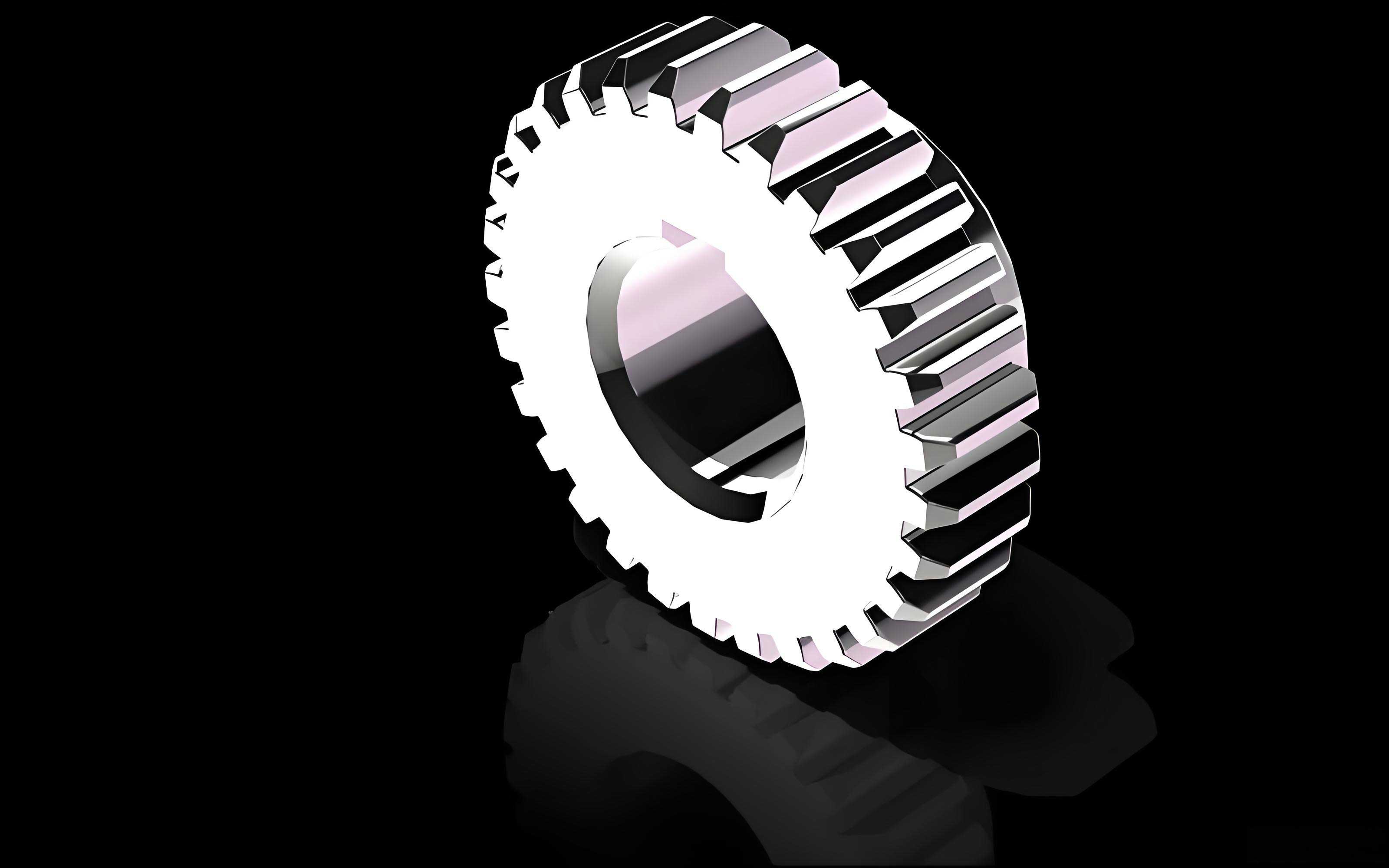
In the realm of advanced manufacturing, precision forging stands out as a transformative technology that minimizes material waste, reduces machining steps, and enhances product quality. Among various applications, the precision forging of spur gears represents a particularly promising frontier. The spur gear, a fundamental component in mechanical transmission systems, traditionally requires extensive machining to achieve the desired tooth profile. However, through precision forging, it is possible to form the complete tooth shape via plastic deformation, eliminating or significantly reducing subsequent processing. This approach aligns with the principles of green manufacturing, offering efficiencies in energy, materials, and cost. In this study, I delve into the intricacies of spur gear precision forging, focusing on a small spur gear with a hole—specifically, one with 18 teeth and a modulus of 2.5. By employing the principle of a movable container (floating die) and integrating finite element simulation with physical experiments, I aim to unravel the metal flow patterns, optimize process parameters, and assess the influence of factors such as web position, friction, extrusion speed, and punch fillet radius on the forging outcome. The goal is to provide actionable insights that can enhance the feasibility and efficiency of spur gear precision forging in industrial settings.
The core innovation in this research lies in the adoption of a movable container system. Unlike conventional fixed-die setups, the movable container introduces a dynamic friction effect that facilitates metal flow into the intricate tooth cavities, especially at the corners, which are typically challenging to fill. The mechanism involves a shoulder punch that, after completing the extrusion phase, drives the floating die insert downward. This motion aligns the frictional forces on the container surface with the direction of metal flow, leveraging inertial effects in the upper cavity and positive friction in the lower cavity to promote filling at both ends of the gear. For the specific spur gear under consideration, which includes a central hole, a flat web design is utilized with a consistent thickness of 5 mm. Since the tooth surface requires no further machining post-forging, the tooth parameters mirror those of the final part drawing. To account for minimal finishing allowances on the upper and lower tooth faces, the forged gear height is set to 18 mm, while the splined hole is not formed during forging; instead, a pilot hole of Ø18 mm is created with a draft angle of 1°30′. The punch is designed with a fillet radius of 2 mm to mitigate stress concentrations. The critical aspect explored here is the positioning of the web—the residual material after piercing—which can significantly impact metal distribution and filling completeness. Four distinct web position schemes are defined, as summarized in Table 1, where ‘a’ denotes the distance from the web to the upper surface and ‘b’ the distance to the lower surface of the forged gear, with all dimensions in millimeters.
| Scheme | Distance to Upper Surface (a, mm) | Distance to Lower Surface (b, mm) | Description |
|---|---|---|---|
| 1 | 13 | 0 | Web at the bottom |
| 2 | 9 | 4 | Web in lower-middle |
| 3 | 5 | 8 | Web in upper-middle |
| 4 | 0 | 13 | Web at the top |
To simulate the forging process, I employed DEFORM-3D, a powerful finite element analysis software tailored for metal forming applications. The geometric model was constructed using UG NX4.0, leveraging the rotational symmetry of the spur gear to reduce computational effort. Specifically, a 1/18 sector of the full gear was modeled, incorporating the punch, movable container, and workpiece. The workpiece, initially a solid cylinder, is sized based on the volume constancy principle and the gear’s root circle diameter, resulting in dimensions of Ø38 mm × 21 mm. The material selected for simulation is commercially pure lead, chosen for its low yield strength and suitability for room-temperature experiments. The constitutive relationship for lead, which governs its stress-strain behavior, is expressed as:
$$\sigma = 11.3 + 3.35(\epsilon)^{0.5} \, \text{MPa}$$
where $\sigma$ is the flow stress and $\epsilon$ is the strain. This equation, along with other material properties like elastic modulus, Poisson’s ratio, and specific heat capacity, was input into a custom DEFORM-3D material library. The die components are treated as rigid bodies, and symmetry constraints are applied to the sector faces to replicate the full gear behavior. The simulation accounts for thermal effects, with an initial temperature of 20°C and heat transfer between the workpiece, dies, and environment. The friction condition is modeled using a shear friction law, with a friction factor set to 0.4 for baseline cases. The process mimics a hydraulic press operation, with a tool speed of 0.2 mm/s; upon completion of the punch extrusion, the movable container descends at the same speed, embodying the floating die principle.
Parallel to the simulation, physical experiments were conducted to validate the numerical findings. Specimens were prepared by melting and casting lead ingots into cylindrical billets, which were then machined to precise dimensions of Ø38 mm × 21 mm. The experimental die assembly, as illustrated in the setup, allows for adjustable web positions by interchanging punches and spacer blocks on the ejector gear. Tests were performed on a WAW-1000C microcomputer-controlled electro-hydraulic servo testing machine, enabling precise control over loading and displacement. During forging, the metal flow and filling behavior were observed, and forming forces were recorded to compare with simulation predictions. This combined approach ensures a robust analysis of the spur gear precision forging process.
The results from both simulation and experiment reveal intricate details about metal flow and filling completeness across the four web position schemes. As depicted in the comparative analysis, when the web is positioned at the bottom (Scheme 1), metal tends to flow more readily downward due to gravitational and frictional effects, leading to insufficient filling at the upper tooth cavities and causing a collapse or “sag” at the top. In Scheme 2, with the web in the lower-middle region, the positive friction from the movable container enhances filling in the lower cavities, but the punch’s loading point remains in the lower part of the spur gear, resulting in severe underfilling at the upper tooth corners. Scheme 3, with the web in the upper-middle position, strikes a balance: the positive friction aids lower cavity filling, while the punch force applied to the upper section promotes upward metal flow, yielding the best overall filling performance with both upper and lower tooth cavities adequately formed. Scheme 4, with the web at the top, leads to excessive upward flow in experiments, often forming flash due to minor gaps in the die assembly, whereas simulations show faster filling at upper corners but relatively slower at lower corners. Thus, Scheme 3 emerges as the optimal web position for this spur gear configuration, ensuring complete tooth profile formation with minimal defects.
The forming force analysis further corroborates these observations. Figure 1 presents a comparative graph of forming forces from simulation and experiment across the web positions. The force trends show that as the web moves upward from the bottom (b increasing from 0 to 4 mm), the forming force decreases, reaching a minimum at b = 4 mm (Scheme 2) with a value of approximately 91.2 kN. However, this minimum force coincides with poor filling quality. Beyond this point, as b increases to 8 mm (Scheme 3), the forming force rises, but the filling improves significantly. For b > 8 mm, experimental forces spike due to flash formation, while simulated forces decline gradually. This highlights a trade-off between forming force and filling completeness, emphasizing that optimization must consider both aspects. The force-stroke curve for Scheme 3, as shown in Figure 2, delineates three distinct stages: Stage I (extrusion phase), where the punch initially contacts the billet, causing localized deformation with a slow force increase; Stage II (combined extrusion-upsetting phase), where metal flows into tooth cavities, increasing resistance and force; and Stage III (forging closure phase), where final corner filling occurs under high pressure, leading to a steep force rise. This triphasic pattern is consistent across simulations and experiments, validating the model’s accuracy.
| Parameter | Range Studied | Effect on Forming Force | Quantitative Change |
|---|---|---|---|
| Friction Factor (m) | 0.2 to 1.0 | Force increases with friction | ~37% increase (165.24 kN to 226.8 kN) |
| Extrusion Speed (v) | 5 mm/s to 35 mm/s | Force increases with speed | ~18.3% increase |
| Punch Fillet Radius (r) | 1 mm to 6 mm | Force decreases with radius | >20% decrease for r = 3–6 mm |
To deepen the understanding, I conducted parametric studies via simulation, varying key factors such as friction, extrusion speed, and punch fillet radius. The results, summarized in Table 2, demonstrate their substantial impact on forming force—a critical metric for die life and process efficiency. Friction, modeled through the shear factor m, shows a direct proportionality: increasing m from 0.2 to 1.0 raises the force by about 37%, from 165.24 kN to 226.8 kN. This underscores the importance of lubrication in actual spur gear forging to reduce friction and lower forces. Extrusion speed, often elevated in production for throughput, also elevates force; a rise from 5 mm/s to 35 mm/s results in an 18.3% force increment, attributable to increased strain rates and uneven metal flow. The punch fillet radius plays a mitigating role: larger radii (e.g., 3–6 mm) reduce stress concentrations and facilitate metal flow, decreasing force by over 20%, whereas smaller radii (1–3 mm) have a negligible effect (<5% change). Thus, optimizing these parameters can enhance the viability of spur gear precision forging, balancing force reduction with filling quality.
Beyond force considerations, the metal flow dynamics in spur gear forging are governed by principles like the minimum resistance theorem, which states that metal tends to flow toward paths of least resistance. In the context of the movable container, this is harnessed to direct material into tooth cavities. The velocity field during deformation can be described by a continuity equation for incompressible plastic flow:
$$\nabla \cdot \mathbf{v} = 0$$
where $\mathbf{v}$ is the velocity vector. Combined with the yield criterion and flow rule, this helps predict filling patterns. For instance, the effective strain distribution in the workpiece reveals that regions near the tooth roots experience higher deformation, ensuring dense microstructure. The simulation outputs, such as strain contours and velocity vectors, provide visual insights into how the spur gear geometry is progressively filled, affirming the efficacy of the floating die design.
In terms of practical implications, this research offers guidelines for die design and process planning in spur gear manufacturing. The optimal web position (Scheme 3) suggests that placing the web in the upper-middle section of the gear facilitates balanced metal flow, reducing defects like underfilling or flash. Additionally, the parametric insights advocate for using moderate extrusion speeds (e.g., 10–20 mm/s), effective lubricants (to achieve friction factors around 0.2–0.4), and generous punch fillet radii (≥3 mm) to curb forming forces and extend die longevity. These adjustments are crucial for scaling up spur gear precision forging to industrial levels, where cost-effectiveness and durability are paramount.
Looking forward, there are avenues for further exploration. For example, integrating multi-stage forging sequences or investigating alternative materials like steel alloys could expand the applicability of this process. Advanced simulation techniques, such as coupled thermomechanical analysis with damage prediction, might refine accuracy. Moreover, real-time monitoring during forging could enable adaptive control, optimizing parameters on the fly. The spur gear, as a ubiquitous component, stands to benefit immensely from such advancements, paving the way for more sustainable and efficient manufacturing paradigms.
In conclusion, through a blend of finite element simulation and experimental validation, this study elucidates the complexities of spur gear precision forging using a movable container. The findings highlight that web position significantly influences metal flow and filling, with an upper-middle location yielding the best results for the spur gear examined. Process parameters like friction, extrusion speed, and punch geometry markedly affect forming forces, offering levers for optimization. By embracing these insights, manufacturers can enhance the precision and economy of spur gear production, contributing to the broader goals of advanced manufacturing. The journey toward perfecting spur gear forging continues, but with each simulation and experiment, we move closer to realizing its full potential.