
In power transmission systems, the spur gear stands as one of the most fundamental and widely used components. The reliable and efficient operation of a spur gear pair is intrinsically linked to the performance of the lubricating film separating the contacting teeth. Under steady-state rolling and sliding conditions, the elastohydrodynamic lubrication (EHL) regime typically maintains a protective film. However, many mechanical systems involve oscillatory motion, such as in swing arms, actuators, and reversals in machinery. This oscillatory motion presents a unique challenge for the spur gear, as the surface velocities and load directions change periodically, including passages through zero velocity. This significantly complicates the lubrication dynamics, often leading to a transition from a hydrodynamic to a mixed or even boundary lubrication regime at the motion reversal points. Furthermore, the lubricant in practical systems is seldom perfectly clean; it is often contaminated by solid particles generated from wear, ingested from the environment, or introduced during assembly. The presence of these solid particles within the highly stressed EHL contact of a spur gear pair can drastically alter the pressure distribution and film thickness, potentially leading to increased wear, surface distress, and premature failure.
This article presents a comprehensive numerical investigation into the influence of solid particles on the transient EHL performance of a spur gear operating under a sinusoidal oscillatory motion. A modified transient EHL model is established, incorporating the effects of solid particles within the contact zone. The time-varying effects of load, curvature, and entrainment velocity specific to the spur gear meshing cycle during oscillation are fully considered. The impact of a single particle, particle distribution density, and particle velocity on the crucial lubrication parameters—pressure and film thickness—is analyzed in detail. The objective is to deepen the understanding of the complex tribological interactions in contaminated lubricants under non-steady conditions, providing insights that are critical for the design and maintenance of reliable oscillating spur gear drives.
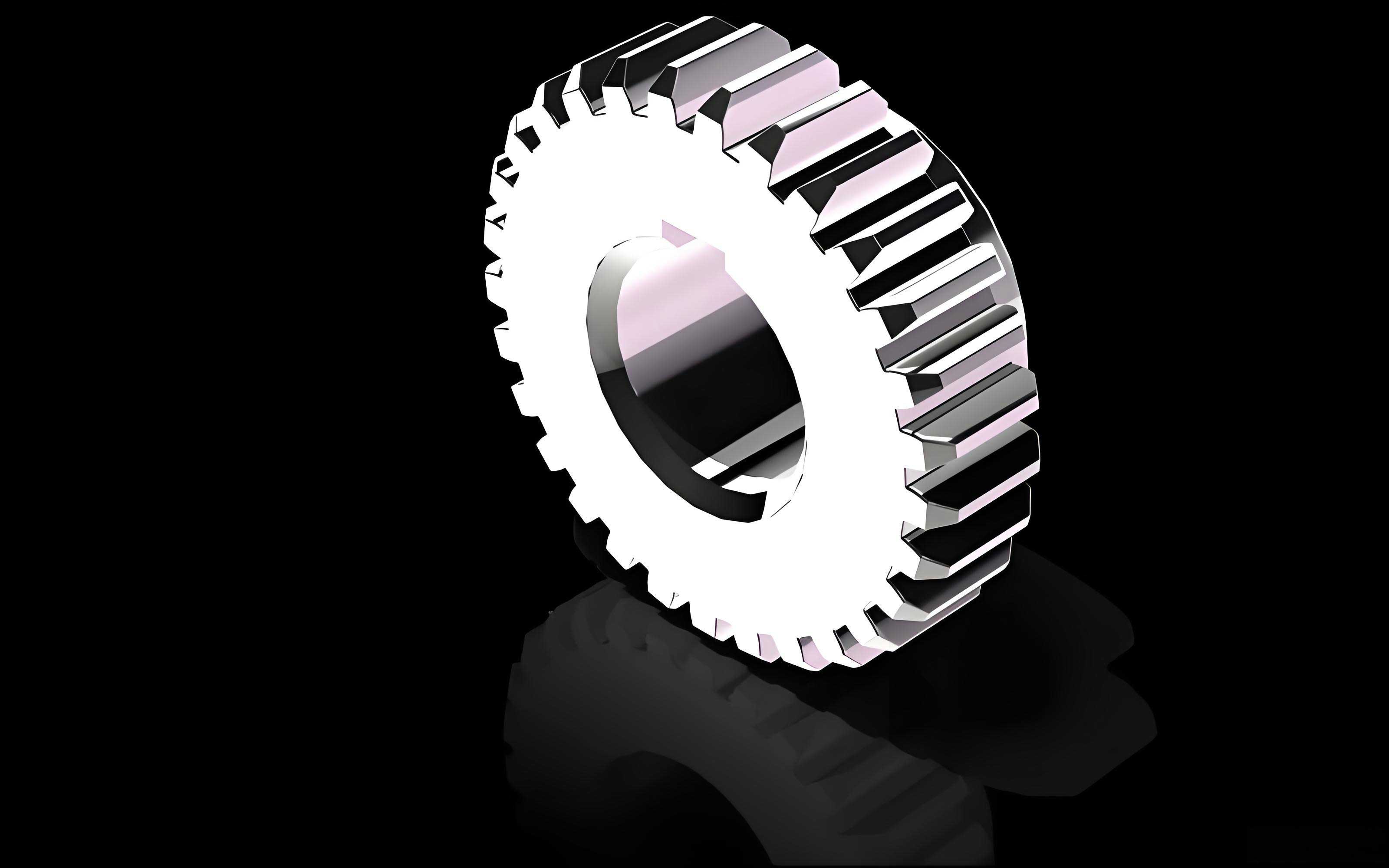
Mathematical Model for Spur Gear EHL with Solid Particles
1.1 Governing Equations for the Contaminated Contact
The contact between two spur gear teeth is modeled as a transient line contact problem. The lubricant is assumed to be an isothermal Newtonian fluid with piezo-viscous and compressible properties. The classic Reynolds equation governs the pressure generation in the full-film regions. However, the presence of solid particles necessitates a modification to this equation within the region occupied by a particle.
Consider a solid particle, assumed to be spherical for simplicity, located within the contact zone of the spur gear. The film domain is divided into three regions along the direction of motion (x-direction): Region 1 (upstream of the particle), Region 2 (the particle-influenced zone), and Region 3 (downstream of the particle). The modified Reynolds equation for Region 2 is derived from the fundamental equations of fluid motion.
Starting with the simplified momentum equation for a thin film:
$$ \frac{\partial p}{\partial x} = \frac{\partial \tau_{xz}}{\partial z} $$
where $p$ is pressure, $x$ is the coordinate along the rolling direction, $z$ is the coordinate across the film thickness, and $\tau_{xz}$ is the shear stress. For a Newtonian fluid, $\tau_{xz} = \eta \partial u / \partial z$, where $\eta$ is the dynamic viscosity and $u$ is the fluid velocity in the x-direction. Integrating twice with respect to $z$ yields the general velocity profile:
$$ u(x,z) = \frac{1}{2\eta} \frac{\partial p}{\partial x} z^2 + \frac{C_1}{\eta} z + \frac{C_2}{\eta} $$
In Region 2, which contains the particle of half-length $z_0$ in the z-direction, the boundary conditions differ from the standard no-slip conditions. The domain is split into two sub-layers, A and B, above and below the particle’s vertical centerline, respectively. The particle itself moves with a velocity $u_p$.
For sub-layer A ($z_0 \le z \le h/2$), the boundary conditions are:
$u = u_1$ at $z = h/2$ (velocity of surface 1), and
$u = u_p$ at $z = z_0$ (velocity of the particle surface).
Applying these to solve for constants $C_1$ and $C_2$ and then integrating the velocity profile across sub-layer A gives the flow rate per unit length $q_{xA}$:
$$ q_{xA} = -\frac{1}{12\eta}\frac{\partial p}{\partial x} \left( \frac{h^3}{8} – z_0^3 \right) + \frac{h z_0}{8\eta} \frac{\partial p}{\partial x} \left( \frac{h}{2} – z_0 \right) + \frac{u_1 + u_p}{2} \left( \frac{h}{2} – z_0 \right) $$
Similarly, for sub-layer B ($-h/2 \le z \le -z_0$), with $u = u_2$ at $z = -h/2$ and $u = u_p$ at $z = -z_0$, the flow rate $q_{xB}$ is:
$$ q_{xB} = -\frac{1}{12\eta}\frac{\partial p}{\partial x} \left( \frac{h^3}{8} – z_0^3 \right) + \frac{h z_0}{8\eta} \frac{\partial p}{\partial x} \left( \frac{h}{2} – z_0 \right) + \frac{u_2 + u_p}{2} \left( \frac{h}{2} – z_0 \right) $$
The total flow rate in Region 2, $q_x = q_{xA} + q_{xB}$, is therefore:
$$ q_x = -\frac{1}{48\eta} \frac{\partial p}{\partial x} (h – 2z_0)^3 + (h – 2z_0)\frac{u_1 + u_2 + 2u_p}{4} $$
Substituting the mass flow rate $m_x = \rho q_x$ into the integrated form of the continuity equation,
$$ \frac{\partial m_x}{\partial x} + \frac{\partial (\rho h)}{\partial t} = 0 $$
yields the modified Reynolds equation for the particle-occupied region (Region 2) in a spur gear contact:
$$ -\frac{\partial}{\partial x}\left[ \frac{\rho (h – 2z_0)^3}{48\eta} \frac{\partial p}{\partial x} \right] + \frac{\partial}{\partial x}\left[ \rho (h – 2z_0) \frac{u_1 + u_2 + 2u_p}{4} \right] + \frac{\partial [\rho (h – 2z_0)]}{\partial t} = 0 $$
In Regions 1 and 3, the standard transient Reynolds equation for the spur gear contact applies:
$$ \frac{\partial}{\partial x}\left( \frac{\rho h^3}{\eta} \frac{\partial p}{\partial x} \right) = 12 \frac{\partial (\rho u h)}{\partial x} + 12 \frac{\partial (\rho h)}{\partial t} $$
where $u = (u_1 + u_2)/2$ is the entrainment velocity.
1.2 Oscillatory Motion Model for the Spur Gear
The motion of the spur gear is defined by a sinusoidal oscillation. The pinion angular velocity $\omega_1(t)$ and the applied load $w(t)$ vary synchronously with time $t$ over a period $T$:
$$ \omega_1(t) = \Omega_m \sin(2\pi f t), \quad w(t) = W_m \sin(2\pi f t) $$
where $\Omega_m$ and $W_m$ are the amplitude of angular velocity and load, respectively, and $f$ is the oscillation frequency. At times $t=0, T/2, T$, the entrainment velocity $u$ becomes zero, corresponding to the reversal points of the spur gear’s oscillatory cycle. The meshing kinematics (changing radii of curvature $R_1$, $R_2$ and entrainment velocity $u$) are calculated at each timestep based on the instantaneous angular velocity and the gear geometry.
Complete Set of Governing Equations
The full system of equations for modeling the spur gear EHL problem with solid particles includes the following:
Film Thickness Equation:
The film thickness $h$ at any point $x$ and time $t$ for the spur gear contact is given by:
$$ h(x,t) = h_0(t) + \frac{x^2}{2R(t)} + v(x,t) $$
where $h_0(t)$ is the rigid central film thickness, $R(t)$ is the time-varying effective radius of curvature of the spur gear teeth at the contact point, and $v(x,t)$ is the elastic deformation calculated by the Boussinesq integral:
$$ v(x,t) = -\frac{2}{\pi E’} \int_{x_{in}}^{x_{out}} p(s,t) \ln|x-s| \, ds $$
Here, $E’$ is the equivalent elastic modulus.
Force Balance Equation:
The pressure profile must support the applied instantaneous load $w(t)$ on the spur gear tooth:
$$ \int_{x_{in}}^{x_{out}} p(x,t) \, dx = w(t) $$
Viscosity-Pressure Relationship (Roelands):
$$ \eta(p) = \eta_0 \exp\left\{ (\ln \eta_0 + 9.67) \left[ -1 + (1 + \frac{p}{p_0})^{Z} \right] \right\} $$
where $\eta_0$ is the atmospheric viscosity, $p_0$ is a reference pressure, and $Z$ is the viscosity-pressure index.
Density-Pressure Relationship (Dowson-Higginson):
$$ \rho(p) = \rho_0 \left( 1 + \frac{0.6 \times 10^{-9} p}{1 + 1.7 \times 10^{-9} p} \right) $$
where $\rho_0$ is the atmospheric density.
To facilitate numerical solution, the equations are non-dimensionalized using the following scheme, where parameters with subscript ‘0’ refer to reference conditions (typically at the pitch point under steady state):
| Parameter | Symbol | Non-dimensional Form |
|---|---|---|
| Coordinate | $x$ | $X = x / b$ |
| Pressure | $p$ | $P = p / p_H$ |
| Film Thickness | $h$ | $\bar{h} = h R_0 / b^2$ |
| Time | $t$ | $\bar{t} = t u_0 / b$ |
| Viscosity | $\eta$ | $\bar{\eta} = \eta / \eta_0$ |
| Density | $\rho$ | $\bar{\rho} = \rho / \rho_0$ |
| Load | $w$ | $W = w / (E’ R_0)$, $C_{wt}=w/w_0$ |
| Entrainment Velocity | $u$ | $U = \eta_0 u / (E’ R_0)$, $C_{ut}=u/u_0$ |
| Effective Radius | $R$ | $C_{Rt}=R/R_0$ |
Here, $b$ and $p_H$ are the semi-width and maximum pressure of the Hertzian contact at the reference load $w_0$, and $R_0$ is the reference effective radius for the spur gear pair.
Numerical Method
The system of non-dimensionalized equations is solved using a fully coupled approach. The modified and standard Reynolds equations are discretized using the finite difference method. The elastic deformation integral is evaluated efficiently using the multi-grid multi-level integration technique. The non-linear system is solved iteratively on the finest grid, with corrections propagated through a W-cycle multi-grid solver utilizing 6 grid levels. A total of 961 uniformly spaced nodes are used on the finest grid. The computational domain is set to $X_{in} = -4.5$ to $X_{out} = 1.5$. One complete oscillation period of the spur gear is divided into 120 time steps. The solution at each time step is considered converged when the relative errors for both pressure and load are less than $10^{-3}$.
Results and Discussion for the Spur Gear System
The analysis is performed for a standard involute spur gear pair. The base parameters for the gear and lubricant are listed in the table below.
| Parameter | Symbol | Value |
|---|---|---|
| Pinion Teeth | $z_1$ | 35 |
| Gear Ratio | $i$ | 4 |
| Module | $m$ | 2 mm |
| Pressure Angle | $\phi$ | 20° |
| Face Width | $L$ | 20 mm |
| Contact Ratio | $\epsilon_{\alpha}$ | 1.768 |
| Velocity Amplitude | $N_m$ | 800 rpm ($\Omega_m$) |
| Oscillation Frequency | $f$ | 10 Hz |
| Base Lubricant Viscosity | $\eta_0$ | 0.075 Pa·s |
| Pressure-Viscosity Coefficient | $\alpha$ | 2.2 × 10⁻⁸ Pa⁻¹ |
| Equivalent Elastic Modulus | $E’$ | 2.26 × 10¹¹ Pa |
4.1 Influence of a Single Solid Particle
The presence of a single solid particle in the spur gear contact significantly perturbs the otherwise smooth pressure and film profile. The figure below compares the central and minimum film thickness, as well as the central and maximum pressure, over one oscillation cycle for a clean case and a case with one spherical particle (non-dimensional radius $S_R = 0.1$, centered at $X_c = -1.2$, velocity $u_p = 0.9$ m/s).
Under oscillatory motion, both pressure and film thickness for the spur gear exhibit a “double-hump” shape over time. The minimum values occur at the motion reversal instants ($t/T = 0, 0.5, 1$), where the entrainment velocity is zero and the load is near its minimum, relying primarily on the squeeze-film effect. The introduction of the solid particle causes a local perturbation. While the central pressure ($P_c$) and maximum pressure ($P_{max}$) show relatively minor changes, the film thickness is more sensitive. Both the central film thickness ($H_c$) and, more critically, the minimum film thickness ($H_{min}$) are notably reduced when the particle is present. This reduction in $H_{min}$ directly increases the risk of asperity contact and wear in the oscillating spur gear.
| Condition | $P_c$ (GPa) at t=T/4 | $P_{max}$ (GPa) at t=T/4 | $H_c$ (µm) at t=T/4 | $H_{min}$ (µm) at t=T/2 |
|---|---|---|---|---|
| Clean Spur Gear | 0.42 | 0.68 | 0.185 | 0.052 |
| With One Particle | 0.44 | 0.66 | 0.168 | 0.041 |
4.2 Effect of Solid Particle Distribution Density
The severity of contamination is often characterized by particle concentration or distribution density. To model this, cases with one ($N=1$) and two ($N=2$) particles are compared. The two-particle case represents a higher local density, with particles of different sizes ($S_R = 0.1$ and $0.03$) located at $X_c = -0.7$ and $0.0$, respectively.
The results, summarized in the table below, show a pronounced effect. With a higher particle density ($N=2$), both $P_c$ and $P_{max}$ are significantly elevated compared to the single-particle case. The pressure profile develops sharp, localized spikes near each particle. More alarmingly, the film thickness is further compromised. Both $H_c$ and $H_{min}$ see dramatic reductions. At the motion reversal ($t=T/2$), $H_{min}$ plunges to a dangerously low value, well below 0.05 µm, indicating a severe breakdown of the protective lubricant film in the spur gear contact. This highlights how increased contaminant density exponentially worsens the lubrication conditions under oscillation.
| Particle Density (N) | $P_c$ (GPa) at t=T/4 | $P_{max}$ (GPa) at t=T/4 | $H_c$ (µm) at t=T/4 | $H_{min}$ (µm) at t=T/2 |
|---|---|---|---|---|
| 1 | 0.44 | 0.66 | 0.168 | 0.041 |
| 2 | 0.51 | 0.85 | 0.142 | 0.028 |
4.3 Time-Varying Effects and Profile Evolution
The transient nature of the spur gear oscillation leads to complex, time-evolving pressure and film profiles. The snapshots below illustrate the spatial distribution at key instants (t/T = 0, 0.25, 0.5, 0.75, 1) for the two-particle case. At the start/end of the cycle (t=0, T), pressure and film thickness are at their global minima. At the mid-cycle (t=T/2), although entrainment velocity is zero, a non-zero acceleration creates a dominant squeeze-film effect with a minor wedge contribution, resulting in slightly higher pressure and film than at the endpoints. The pressure “valley” between the two particles is clearly visible, caused by the disruption of lubricant flow. Notably, the profiles at t=T/4 and t=3T/4 are not symmetric, underscoring the inherent asymmetry of the spur gear’s oscillatory cycle due to the continuously changing meshing kinematics and load phase.
4.4 Influence of Solid Particle Velocity
The velocity of a contaminant particle relative to the surfaces is another critical factor. The analysis considers a single particle with varying speeds ($u_p = 0.3, 0.9, 1.5$ m/s). The key finding is that particle velocity has a negligible impact on the overall pressure magnitude ($P_c$, $P_{max}$) and a small effect on the central film thickness ($H_c$). However, its effect on the minimum film thickness ($H_{min}$) is profound and highly detrimental to the spur gear’s surface protection.
As shown in the table, a five-fold increase in particle velocity (from 0.3 to 1.5 m/s) causes the minimum film thickness to decrease by approximately 40%. Higher particle velocity increases the shear rate in the fluid around the particle and enhances its ploughing effect through the contact, both of which act to locally drain the lubricant film more efficiently. This makes high-speed particles particularly dangerous for oscillating spur gears operating near the thin-film boundary.
| Particle Speed $u_p$ (m/s) | $P_c$ (GPa) at t=T/4 | $P_{max}$ (GPa) at t=T/4 | $H_c$ (µm) at t=T/4 | $H_{min}$ (µm) at t=T/2 |
|---|---|---|---|---|
| 0.3 | 0.43 | 0.67 | 0.172 | 0.048 |
| 0.9 | 0.44 | 0.66 | 0.168 | 0.041 |
| 1.5 | 0.45 | 0.65 | 0.165 | 0.029 |
Conclusion
This investigation into the elastohydrodynamic lubrication of a spur gear under oscillatory motion with solid particle contamination leads to the following key conclusions:
- The oscillatory motion inherently creates challenging conditions for the spur gear, characterized by a double-hump variation in pressure and film thickness over a cycle, with minima occurring at the velocity reversal points where the protective film is most vulnerable.
- The introduction of solid particles into the contact zone of the spur gear primarily degrades the film thickness. While pressure peaks may shift locally, the most critical effect is the significant reduction in both central and, especially, minimum film thickness.
- The density of particle contamination is a major aggravating factor. A higher concentration of particles leads to substantially increased contact pressures and dramatically thinner lubricant films, pushing the spur gear contact towards failure.
- The velocity of contaminant particles has a disproportionately large effect on the minimum film thickness. Higher particle speeds can cause severe local film thinning, posing a significant threat to the surface integrity of oscillating spur gears.
These findings underscore the critical importance of effective filtration and contamination control in lubrication systems for spur gears subjected to oscillatory or reversing motions. Maintaining clean oil is not merely a general recommendation but a specific necessity to preserve the elastohydrodynamic film under these demanding transient conditions and ensure the long-term reliability of the spur gear transmission.