
In my extensive experience within the powder metallurgy (PM) industry, the development of high-performance components for automotive systems presents both a significant challenge and a remarkable opportunity. Among these components, the spur gear stands out due to its critical role in power transmission, particularly in automotive engine and transmission systems. The transition from traditional forging to powder metallurgy for manufacturing these spur gears offers substantial benefits, including weight reduction, noise damping, efficiency improvements, and material savings. This article details my first-hand perspective on the comprehensive research and development process for creating a high-strength iron-based powder metallurgy spur gear, specifically designed to meet the rigorous demands of modern automotive engines. Throughout this discussion, the term ‘spur gear’ will be frequently emphasized to underscore its central importance in this technological advancement.
The primary objective was to design and produce a spur gear that could reliably replace a forged counterpart in a passenger car engine transmission. The specific spur gear in question, used in models such as the Haima, Southeast Lingyue, and Junjie, required exceptional mechanical properties. The working environment for such a spur gear is severe, with the gear teeth subjected to high impact loads and cyclic stresses. The core challenges in powder metallurgy for this spur gear involved controlling dimensional accuracy—particularly in the tooth profile during pressing, sintering, and heat treatment—and achieving a microstructure that provides high surface hardness for wear resistance coupled with a tough core for impact absorption. This combination of ‘hard exterior and tough interior’ is essential for the longevity and reliability of the automotive spur gear.
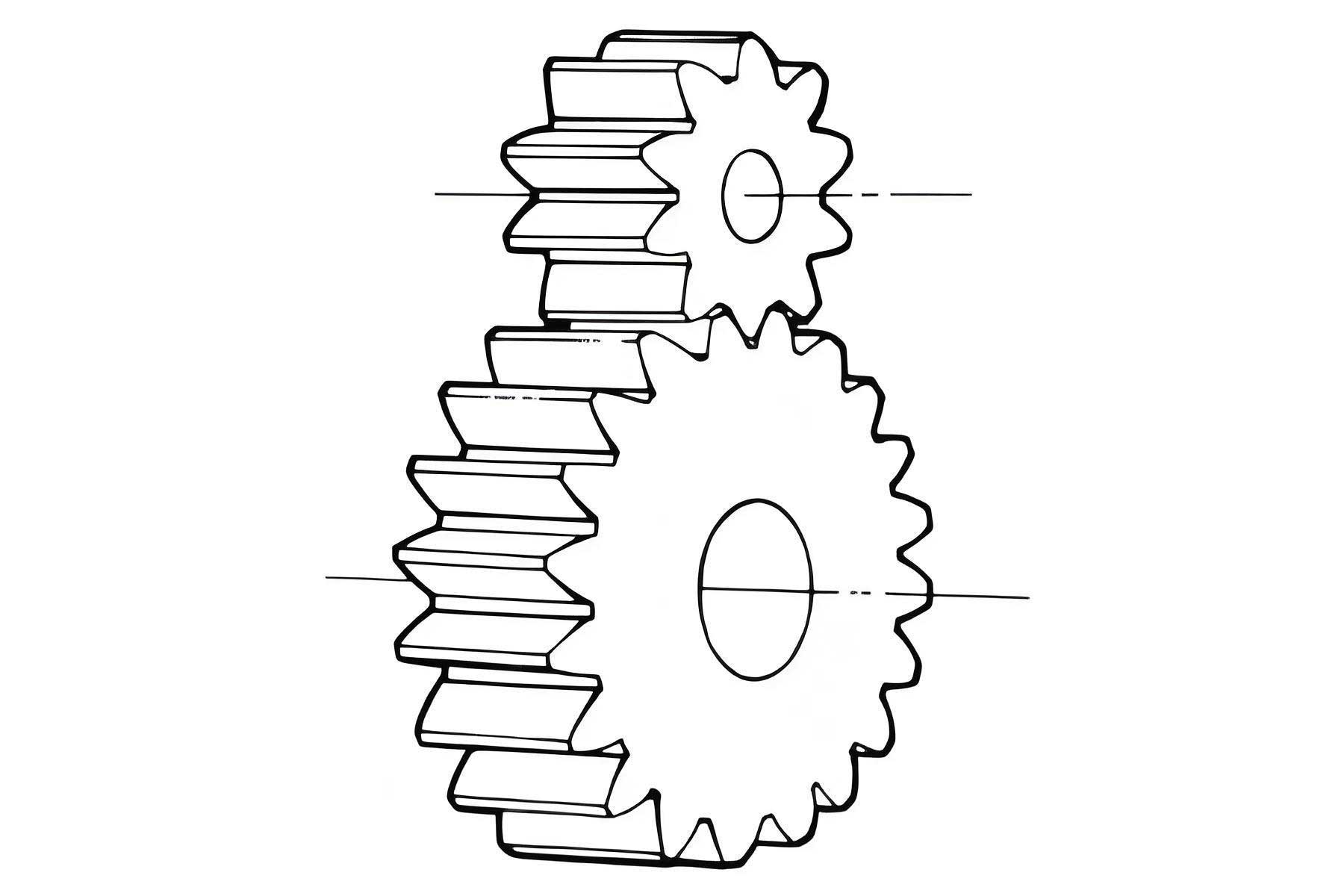
A thorough product analysis is the foundation of any successful powder metallurgy project. The spur gear had a complex geometry featuring an involute spline and a thin web section. Key technical requirements for this spur gear were: a core hardness between 150–350 HV1, a surface hardness of ≥550 HV1 (according to ISO 6508) after carbonitriding, an effective case depth of 0.3–0.6 mm (at 500 HV0.1 per ISO 4507), and a maximum torque capacity of 160 N·m. The dimensional precision of the tooth form and the spline was paramount. The basic gear and spline parameters served as the starting point for all subsequent design and tooling work. Controlling the dimensional change from the green compact to the finished sintered and heat-treated spur gear required a deep understanding of the material system’s behavior.
Material selection is a critical step in powder metallurgy. For this high-strength spur gear, I selected a pre-alloyed water-atomized powder: Ancorsteel FD-4600A, supplemented with 0.3 wt% graphite. The base powder composition is Fe-1.75Ni-0.5Mo-1.5Cu. The alloying strategy is deliberate. Carbon, added as graphite, is fundamental for forming carbide phases and enabling subsequent heat treatment to achieve high hardness. Copper enhances strength and density through solid solution strengthening and liquid phase sintering. Nickel significantly improves tensile strength and, crucially, impact toughness; its presence helps stabilize sintering dimensions when combined with copper. Molybdenum increases hardenability and strength, and reduces temper embrittlement. The choice of this material system was predicated on its excellent sintered strength and its favorable response to heat treatment, which is essential for the final performance of the spur gear. The relationship between alloy content and final properties can be summarized by empirical strength models. For instance, the approximate yield strength of a sintered and heat-treated Fe-based alloy can be related to its density and composition. A simplified form is:
$$ \sigma_y \approx \sigma_0 + K_\rho \cdot \rho + \sum (K_i \cdot C_i) $$
where $\sigma_y$ is the yield strength, $\sigma_0$ is the base strength of pure iron, $\rho$ is the relative density, $K_\rho$ is a density coefficient, $C_i$ is the concentration of alloying element i (Ni, Cu, Mo), and $K_i$ are their respective strengthening coefficients. For a spur gear, achieving a high and uniform $\rho$ is as important as the alloy composition.
| Element | Weight Percentage | Primary Role in Spur Gear Performance |
|---|---|---|
| Fe | Balance | Base matrix, provides ductility and magnetic properties |
| Ni | 1.75% | Solid solution strengthening, improves toughness and fatigue resistance |
| Mo | 0.50% | Increases hardenability, refines microstructure, enhances strength |
| Cu | 1.50% | Promotes liquid phase sintering, increases density and strength |
| C (as Graphite) | 0.30% | Forms carbides, enables hardening via heat treatment |
The heart of powder metallurgy part fabrication lies in tooling design. For this complex spur gear, the design of the pressing tool set was paramount. The gear’s geometry necessitated a multi-level tool system. I employed a “one upper, two lower” punch configuration with a actively floating die. This design facilitates dual-action pressing, ensuring better density distribution, especially in the critical tooth regions of the spur gear. The lower punches were split into an outer and an inner punch to form the gear’s step and the bore. The die itself was a prestressed assembly (die insert and shrink ring) to withstand the high pressing pressures. The most intricate aspect was machining the die cavity for the involute teeth and spline of the spur gear. To compensate for sintering shrinkage and elastic expansion after ejection (springback), the die cavity must be manufactured oversized. The required cavity dimensions are calculated based on the material’s compressibility and sintering shrinkage factor. The basic relationship for the die cavity dimension $D_{die}$ is:
$$ D_{die} = \frac{D_{final}}{(1 – S_s)(1 + S_e)} $$
where $D_{final}$ is the desired final dimension on the spur gear, $S_s$ is the linear sintering shrinkage factor (a negative value indicates growth), and $S_e$ is the elastic strain recovery factor (springback) upon ejection. For the tooth profile, this calculation is applied to the reference diameter and module. The specific parameters for the spline die cavity were meticulously determined through iterative trials.
| Parameter | Symbol | Target on Spur Gear (mm) | Calculated Die Cavity (mm) | Notes |
|---|---|---|---|---|
| Number of Teeth | z | 23 | N/A | Direct copy |
| Module | m | 1.5 | ~1.53 | Adjusted for shrinkage |
| Pressure Angle | α | 30° | 30° | Unchanged |
| Reference Diameter | d | 34.500 | ~35.1 | Major factor for tooling |
| Major Diameter | d_a | 36.800 | ~37.4 | Critical for tooth tip density |
The preparation process for the spur gear is a sequence of interdependent steps: powder mixing, compaction, sintering, heat treatment, and secondary operations. Each step must be meticulously controlled to achieve the target properties in the final spur gear.
Compaction: The blended powder (Ancorsteel FD-4600A + 0.3% graphite) was compacted on a 630-ton mechanical press. The tooling setup described earlier was used. The press cycle involved fill, compression, and ejection stages. To ensure uniform density in the spur gear—a key factor for isotropic mechanical properties and dimensional stability—the floating die and lower punches were precisely controlled. The compaction pressure $P_c$ is related to the green density $\rho_g$ by a non-linear equation, often approximated for iron-based powders by:
$$ \rho_g = A + B \cdot \ln(P_c) $$
where A and B are material constants. For this spur gear, a compaction pressure of approximately 600 MPa was used to achieve a green density in the range of 6.8-7.0 g/cm³. The ejection phase was carefully designed with a two-stage motion to prevent damage to the delicate teeth of the green spur gear compact.
Sintering: The green spur gear compacts were placed on flat graphite plates to prevent distortion during thermal processing. Sintering was conducted in a mesh belt furnace at 1120°C for 90 minutes under a protective atmosphere of dissociated ammonia (75% H₂, 25% N₂). Sintering is a diffusion-driven process where metallurgical bonds form between powder particles, significantly increasing strength. The densification during sintering can be modeled by constitutive equations. For solid-state sintering, a simplified form is:
$$ \frac{\Delta L}{L_0} = k \cdot t^{1/n} \cdot \exp\left(-\frac{Q}{RT}\right) $$
where $\Delta L/L_0$ is the linear shrinkage, $k$ is a constant, $t$ is time, $n$ is an exponent related to the dominant diffusion mechanism, $Q$ is the activation energy, $R$ is the gas constant, and $T$ is the absolute temperature. The presence of copper, which forms a transient liquid phase, enhances densification. The sintered microstructure, primarily a pearlitic/ferritic matrix with alloy-rich regions, provides a good foundation for the subsequent hardening of the spur gear.
Heat Treatment: To achieve the required surface hardness and core toughness, the sintered spur gears underwent a carbonitriding process. This is a thermochemical treatment where carbon and nitrogen are diffused into the surface. The gears were first dewaxed at 200°C, then heated to 820°C in an endothermic atmosphere with a controlled carbon potential of 0.45% and ammonia addition for nitrogen. They were held for 30 minutes to achieve the desired case depth, followed by oil quenching and tempering at 120°C. The case depth, a critical parameter for the spur gear’s durability, is governed by the diffusion equation (Fick’s second law). For a constant surface concentration, the case depth $d_{case}$ is approximately proportional to the square root of time:
$$ d_{case} \approx \sqrt{D \cdot t} $$
where $D$ is the effective diffusivity of carbon and nitrogen in austenite at the process temperature. The resulting microstructure consisted of a hard martensitic case with retained austenite and carbonitrides, transitioning to a tougher, lower-carbon martensite and bainite structure in the core of the spur gear.
| Process Step | Key Parameters | Target Value / Condition | Purpose for Spur Gear |
|---|---|---|---|
| Powder Mixing | Base powder, Graphite, Lubricant | Ancorsteel FD-4600A + 0.3% C + 0.75% Lubricant | Homogeneous alloy distribution, compaction aid |
| Compaction | Pressure, Tool Motion | ~600 MPa, Active die float | Achieve high, uniform green density |
| Sintering | Temperature, Time, Atmosphere | 1120°C, 90 min, Dissociated NH₃ | Create metallurgical bonds, achieve final sintered dimensions |
| Heat Treatment | Process, Temperature, Carbon Potential, Quench medium | Carbonitriding, 820°C, Cp=0.45, Oil quench + 120°C temper | Produce hard wear-resistant surface and tough core |
| Secondary Operations | Vibratory Finishing, Vacuum Impregnation | 40 min with abrasive media, 120°C oil under vacuum | Deburr, improve surface finish, seal porosity |
The performance of the developed powder metallurgy spur gear was rigorously evaluated. Dimensional inspection confirmed that all critical tolerances for the gear teeth and splines were met. Metallographic examination revealed a well-defined case-core structure. Mechanical testing showed a surface hardness of 580–630 HV1 and a core hardness of 250–330 HV1, comfortably within the specification. The effective case depth was measured at 0.4 mm. The most critical test was the engine bench test, where the spur gear was subjected to durability and fatigue cycles under a torque of 160 N·m. The spur gear performed flawlessly, with no significant wear observed on the tooth flanks after the test duration. This confirmed that the powder metallurgy spur gear could reliably replace the forged component, offering the additional benefits of lower weight, reduced noise, and higher manufacturing efficiency due to near-net-shape production.
The success of this project hinged on a systems approach, integrating material science, tooling engineering, and process control. The choice of the pre-alloyed powder system was crucial for achieving consistent and high performance in the spur gear. The tooling design, particularly the compensation for dimensional changes, was iterative and based on empirical data specific to our plant and material. The sintering and heat treatment cycles were optimized not just for properties but also for minimizing distortion of the thin sections of the spur gear. Factors such as the stacking of parts during sintering and the fixturing during heat treatment were found to be non-trivial for maintaining the precision of the spur gear.
From a broader perspective, the potential for powder metallurgy in gear applications is vast. The geometric freedom of PM allows for the design of complex shapes, like internal splines and hubs, integral to the spur gear, which would be costly or impossible with machining. The material efficiency of PM, often above 95%, aligns with sustainable manufacturing goals. Future developments for PM spur gears could involve higher-density processes like double press/double sinter or metal injection molding to further boost dynamic load capacity. The integration of simulation software for predicting compaction density gradients, sintering distortion, and heat treatment response will further shorten development cycles for new spur gear designs.
In conclusion, the development of this high-strength iron-based powder metallurgy spur gear demonstrates the maturity and capability of PM technology for demanding structural applications. By carefully selecting the alloy system, designing precision tooling with compensation for process-induced dimensional changes, and controlling the thermal processes, we successfully manufactured a spur gear that meets all the mechanical and dimensional requirements for automotive engine transmission. The spur gear exhibited excellent surface hardness, adequate core toughness, and superb wear resistance in testing. This project validates that powder metallurgy is not just a cost-effective alternative but a performance-driven manufacturing solution for critical components like the spur gear, enabling lighter, quieter, and more efficient automotive drivetrains. The lessons learned and methodologies established are directly applicable to the development of other high-performance powder metallurgy components, further solidifying the role of PM in advanced manufacturing.
Further analytical consideration can be given to the stress state in a spur gear tooth. The bending stress at the root of a spur gear tooth, which is a primary mode of failure, can be estimated using the Lewis formula, modified for modern standards:
$$ \sigma_b = \frac{F_t}{b \cdot m \cdot Y} \cdot K_A \cdot K_V \cdot K_{H\beta} \cdot K_{H\alpha} $$
where $F_t$ is the tangential tooth load, $b$ is the face width, $m$ is the module, $Y$ is the Lewis form factor, and the $K$ factors account for application, dynamic load, load distribution across the face, and transverse load sharing, respectively. For a powder metallurgy spur gear, the material’s endurance limit and its sensitivity to porosity are critical inputs into such calculations. The successful performance of our PM spur gear under high torque indicates that the achieved density and microstructure resulted in a bending fatigue strength sufficient for the application.
The economic and environmental advantages of producing this spur gear via powder metallurgy are substantial. Compared to forging, the near-net-shape capability drastically reduces machining scrap. A simple comparison of material utilization can be made:
$$ \eta_{PM} = \frac{m_{gear}}{m_{compact}} \approx 0.98, \quad \eta_{Forging/Machining} = \frac{m_{gear}}{m_{billet}} \approx 0.5-0.7 $$
where $\eta$ is the material utilization efficiency, $m_{gear}$ is the mass of the finished spur gear, $m_{compact}$ is the mass of the powder compact, and $m_{billet}$ is the mass of the forged blank or bar stock before machining. The higher $\eta_{PM}$ translates directly to lower raw material costs and less waste for each spur gear produced. Furthermore, the energy consumption per part is often lower in PM processes due to the elimination of extensive machining operations.
In summary, every aspect of this project—from the initial analysis of the spur gear’s function to the final validation testing—was guided by a deep understanding of powder metallurgy principles and a commitment to precision engineering. The result is a robust, reliable, and high-performance powder metallurgy spur gear that fully meets the challenges of modern automotive design. The continued innovation in powder grades, process monitoring, and design for manufacturability promises to expand the boundaries of what is possible with powder metallurgy spur gears in the future.