
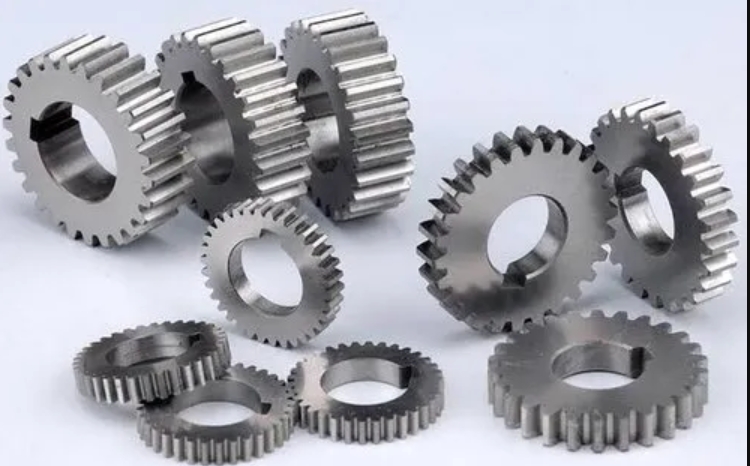
The spur gear is one of the most fundamental and widely used components in mechanical power transmission systems. Its popularity stems from a compelling set of advantages: high reliability, long service life, constant instantaneous velocity ratio, excellent transmission efficiency, compact design, and suitability for a broad range of power and speed applications. The involute tooth profile is the standard for modern spur gear design due to its favorable meshing properties.
In theory, a pair of ideal involute spur gears will mesh perfectly if their base pitches are equal. However, in real-world applications, perfect conditions are unattainable. Manufacturing inaccuracies, elastic deformations under load, thermal distortions, and torsional wind-up in shafts and gear bodies all contribute to deviations from the ideal base pitch equality. These deviations manifest as meshing impacts when a new tooth pair enters the mesh, leading to increased vibration and noise. This phenomenon is particularly pronounced under high-speed and high-torque conditions, where deformations are magnified. The resulting dynamic loads not only elevate noise levels but also significantly accelerate fatigue, pitting, and tooth breakage, drastically reducing the operational life of the spur gear set.
Since the mid-20th century, the engineering industry has adopted gear microgeometry optimization, commonly known as gear modification or “gearing,” as a critical solution to these challenges. Leading global manufacturers in automotive, aerospace, and heavy machinery universally apply modification techniques to gears in engines, transmissions, and axles. Empirical testing and theoretical analyses consistently demonstrate that under demanding operating conditions, a theoretically perfect, unmodified spur gear tooth often underperforms. In contrast, a properly modified spur gear exhibits substantially increased load-carrying capacity, reduced noise, and enhanced durability. Therefore, applying tooth profile modification is not merely an enhancement but a necessity for modern, high-performance spur gear drives.
Gear microgeometry optimization encompasses two primary aspects: profile modification (alterations along the tooth flank) and lead modification (alterations along the tooth width). The influencing factors and effects for profile and lead modifications differ significantly. Furthermore, the force distribution and meshing behavior between spur gears and helical gears are distinct. This analysis focuses specifically on profile modification for spur gears with low contact ratio (typically, transverse contact ratio, $\epsilon_{\alpha} < 2$), where the transition from single-tooth to double-tooth contact is a primary source of excitation.
Classification and Evaluation of Profile Modification
Profile Modification Methods
Profile modification for a spur gear can be classified along three dimensions:
1. By Modified Region:
- Tip Relief: Material is removed from the tip region of the tooth. This is the most common and generally preferred method as it mitigates entry impact without weakening the critical root section.
- Root Relief: Material is removed from the root region. This approach is less common because it reduces the tooth bending strength at its most vulnerable point. It is typically considered only when tip relief alone is insufficient to control meshing dynamics.
2. By Modification Curve Shape:
- Linear Relief: A straight-line removal of material from the start of the modification to the tooth edge.
- Parabolic Relief: Material removal follows a parabolic curve, offering a smoother transition into the modified zone.
- Circular (Barreling) Relief: A symmetric, circular arc removal centered near the pitch point, creating a “barrel-shaped” profile.
- Combined Relief: A linear or parabolic relief combined with a small amount of circular barreling.
3. By Modification Length: The length is defined by the roll angle or linear distance from the start of relief (SR) to the tooth edge.
- Short Relief (SR at $\epsilon_{\alpha} = 1$): Relief begins at the point where the theoretical contact ratio drops to 1. This aggressively shortens the active profile.
- Standard Relief (SR at Single/Double Pair Contact Boundary): Relief begins precisely at the theoretical transition point from double-tooth to single-tooth contact. This is often considered the optimal starting point.
- Long Relief (SR at Pitch Point): Relief begins at the pitch point, affecting a larger portion of the active profile.
In practice, avoiding root relief is standard unless absolutely necessary. Therefore, the primary profile modification types for a spur gear are based on combinations of shape and length, resulting in 13 common types for analysis.
The modification amount, $C_{\alpha}$, is a critical design parameter. A common empirical formula, such as the MAAG guideline, provides an initial estimate based on the transmitted torque and gear geometry to compensate for static deflection:
$$ C_{\alpha} = f_{m} \cdot \frac{F_t}{b} $$
where $F_t$ is the tangential force, $b$ is the face width, and $f_m$ is a factor accounting for material, support conditions, and accuracy grade. For a balanced design, this total amount is often equally split between the mating pinion and gear as tip relief.
Evaluation Metrics
Several metrics can be used to evaluate the effectiveness of a profile modification on a spur gear pair. The two most critical for dynamic performance are:
1. Transmission Error (TE) Variation: Transmission Error is defined as the difference between the actual angular position of the output gear and the position it would occupy if the gear pair were perfectly conjugate. It is the primary excitation source for gear noise and vibration.
$$ TE(\theta) = \theta_{output, actual} – \frac{N_{input}}{N_{output}} \cdot \theta_{input} $$
The dynamic excitation is proportional to the variation (peak-to-peak value) of TE over a mesh cycle, $\Delta TE$. A key goal of profile modification is to minimize $\Delta TE$, which directly reduces dynamic loads ($K_v$ factor) and noise. Reducing the dynamic load factor $K_v$ subsequently increases the calculated safety factors for bending and contact stress.
2. Dynamic Amplitude (Vibration): The oscillatory response of the gear-shaft-bearing system, often measured as acceleration or velocity at a housing point, is a secondary but important indicator of NVH (Noise, Vibration, and Harshness) performance.
Analytical Case Study for a Low Contact Ratio Spur Gear Pair
Gear Data and Operating Conditions
The following analysis is based on a specific spur gear pair designed for a vehicular transmission. The parameters and operating conditions are summarized below.
| Condition | Torque (Nm) | % of Rated Torque | Speed (RPM) |
|---|---|---|---|
| Condition 1 (High Load, Low Speed) | 1600 | 100% | 1100 |
| Condition 2 (Medium Load, Medium Speed) | 1280 | 80% | 1375 |
| Condition 3 (Low Load, High Speed) | 960 | 60% | 1833 |
| Parameter | Pinion (Driver) | Gear (Driven) |
|---|---|---|
| Number of Teeth, $z$ | 34 | 26 |
| Module, $m_n$ (mm) | 4.4 | |
| Center Distance, $a$ (mm) | 135 | |
| Pressure Angle, $\alpha$ (°) | 20 | |
| Face Width, $b$ (mm) | 30 | |
| Transverse Contact Ratio, $\epsilon_{\alpha}$ | 1.5287 | |
| Accuracy Grade | ISO 7 | |
| Material | 20CrMnTi (Case-Hardened Steel) | |
Modification Definition and Modeling
Using the empirical formula, the total required profile modification was estimated to be approximately 20 µm. This amount was applied solely as tip relief, equally distributed as 10 µm on both the pinion and gear of the spur gear pair. Thirteen different modification strategies were modeled, encompassing the shapes and lengths described earlier. A commercial gear analysis software (MASTA) was used to build a detailed system model including the spur gears, shafts, and bearings, and to perform loaded tooth contact analysis (LTCA) for the three operating conditions.
Results: Transmission Error Variation and Amplitude
The primary output from the analysis was the Transmission Error function for each modification case and load condition. The critical metric, the peak-to-peak variation $\Delta TE$, was extracted. The dynamic response amplitude was also recorded. The results for $\Delta TE$ and amplitude are consolidated in the following tables, normalized against the unmodified spur gear baseline (set to 100%).
| Profile Modification Type | Condition 1: 1600Nm / 1100 RPM | Condition 2: 1280Nm / 1375 RPM | Condition 3: 960Nm / 1833 RPM |
|---|---|---|---|
| Unmodified (Baseline) | 100.0% | 100.0% | 100.0% |
| Circular (Barrel) Relief | 86.2% | 80.5% | 77.3% |
| Parabolic Short Relief | 95.1% | 92.8% | 91.4% |
| Parabolic Standard Relief | 91.3% | 88.1% | 85.7% |
| Parabolic Long Relief | 94.0% | 90.9% | 89.1% |
| Linear Short Relief | 97.5% | 96.0% | 95.2% |
| Linear Standard Relief | 92.8% | 89.4% | 86.9% |
| Linear Long Relief | 96.7% | 94.5% | 93.3% |
| Linear + Barrel Short Relief | 93.0% | 90.1% | 88.4% |
| Linear + Barrel Standard Relief | 88.5% | 84.3% | 81.6% |
| Linear + Barrel Long Relief | 91.9% | 88.7% | 86.4% |
| Parabolic + Barrel Short Relief | 90.7% | 87.2% | 84.8% |
| Parabolic + Barrel Standard Relief | 87.1% | 82.6% | 79.7% |
| Parabolic + Barrel Long Relief | 89.8% | 86.0% | 83.5% |
| Profile Modification Type | Condition 1: 1600Nm / 1100 RPM | Condition 2: 1280Nm / 1375 RPM | Condition 3: 960Nm / 1833 RPM |
|---|---|---|---|
| Unmodified (Baseline) | 100.0% | 100.0% | 100.0% |
| Circular (Barrel) Relief | 84.1% | 78.0% | 71.2% |
| Parabolic Standard Relief | 90.5% | 85.9% | 81.7% |
| Linear Standard Relief | 91.9% | 87.4% | 83.5% |
| Linear + Barrel Standard Relief | 86.3% | 80.2% | 75.1% |
| Parabolic + Barrel Standard Relief | 85.0% | 78.9% | 73.8% |
Conclusions and Practical Guidelines
Based on the comprehensive analysis of the low contact ratio spur gear pair under varying loads and speeds, the following conclusions and design recommendations can be drawn:
1. Necessity of Modification: Profile modification has a profound and beneficial impact on the meshing performance of a low contact ratio spur gear. For instance, under Condition 3, applying simple circular relief reduced TE variation by 23% and vibration amplitude by 29% compared to the unmodified spur gear. This confirms that modification is essential for improving dynamic behavior and longevity.
2. Load Sensitivity: The effectiveness of profile modification is more pronounced at lower load conditions for this spur gear set. At the high-speed, low-torque Condition 3, circular relief reduced $\Delta TE$ by 23%. In contrast, at the high-torque, low-speed Condition 1, the reduction was only 14%. This suggests that modifications designed to mitigate impact are relatively more beneficial when elastic deflections are smaller relative to the modification amount.
3. Superiority of Circular (Barrel) Relief: Across all three operating conditions, circular relief consistently provided the largest reduction in Transmission Error variation. This indicates that a symmetric barreling profile centered near the pitch point offers the best overall adaptability to varying loads and speeds for a general-purpose spur gear application. It effectively smoothens the load transition throughout the mesh cycle.
4. Optimal Combined Modification for Variable Loads: While pure circular relief shows excellent overall performance, a combined modification (linear or parabolic with an added barrel component) of standard length often represents the most robust practical choice. The linear/parabolic component accurately compensates for the deflection-induced error, while the small barrel component provides tolerance to misalignments and slight load variations. Pure circular relief with a large amount can excessively reduce the effective contact ratio at light loads, potentially increasing noise. The combined approach mitigates this risk.
5. Optimal Modification Length: For low contact ratio spur gears, the analysis strongly supports the use of standard length relief, where modification begins at the theoretical single-tooth/double-tooth contact boundary. In nearly all modification shapes, the “Standard Relief” length yielded better results (lower $\Delta TE$) than both “Short” and “Long” relief lengths. Starting relief at this point optimally trims the part of the profile that causes the most significant meshing impact without unnecessarily shortening the load-carrying path.
In summary, for a low contact ratio spur gear operating under variable conditions, the recommended practice is to apply a tip relief with a combined linear-parabolic and slight circular barrel shape, starting at the single/double tooth contact transition point. The total relief amount should be calculated based on the maximum expected deflection, and the effectiveness should be verified through loaded tooth contact analysis targeting the minimization of Transmission Error variation. This systematic approach ensures the spur gear achieves low noise, high durability, and reliable performance.