
In modern engineering, the finite element method (FEM) has become an indispensable tool for analyzing complex mechanical systems. ANSYS, as a versatile finite element analysis software, is widely used to solve problems in structures, fluids, electricity, electromagnetic fields, and impacts. It integrates pre-processing, solution procedures, and post-processing, combining finite element analysis, computer graphics, and optimization techniques. This article presents a comprehensive study on the stress analysis of spur gears using ANSYS, focusing on contact stress evaluation through nonlinear contact simulation. The spur gear is a fundamental component in transmission systems, often experiencing high loads and failures; thus, accurate stress analysis is crucial for design and reliability.
The spur gears analyzed here are made of 45 steel, with material properties defined by an elastic modulus E = 2.06 × 10⁵ N/mm² and a Poisson’s ratio ν = 0.3. The basic geometric parameters of the spur gears are summarized in Table 1. These parameters are essential for modeling the involute tooth profile, which is key to accurate spur gear simulation.
| Parameter | Pinion (Small Spur Gear) | Gear (Large Spur Gear) |
|---|---|---|
| Number of Teeth | 20 | 40 |
| Module (mm) | 2 | 2 |
| Pressure Angle (°) | 20 | 20 |
| Face Width (mm) | 20 | 20 |
| Pitch Diameter (mm) | 40 | 80 |
| Base Circle Radius (mm) | 18.79 | 37.58 |
Modeling the involute profile of a spur gear is a critical step, as it directly affects stress accuracy. I employed ANSYS Parametric Design Language (APDL) to create a precise 2D model of the spur gear teeth. The process involves several steps: first, calculating coordinates of points on the involute curve using the involute equations. The parametric equations for an involute curve are given by:
$$ x = r_b (\cos(\theta) + \theta \sin(\theta)) $$
$$ y = r_b (\sin(\theta) – \theta \cos(\theta)) $$
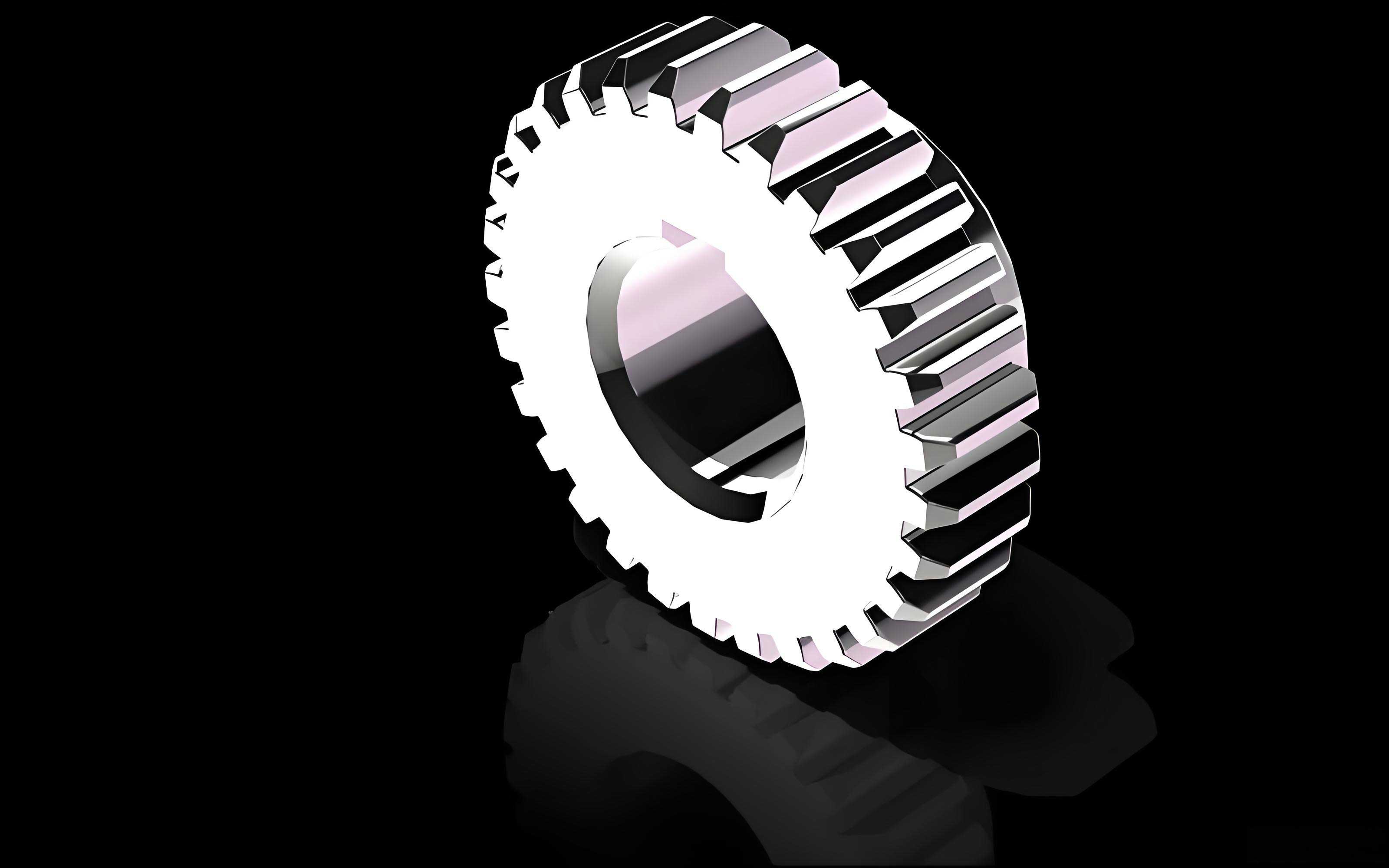
where \( r_b \) is the base circle radius and \( \theta \) is the involute angle in radians. By computing a series of points, keypoints are generated in ANSYS. Second, these points are connected to form the exact involute profile. Third, the profile is mirrored to create the symmetric tooth shape. Fourth, multiple tooth profiles are connected to build a complete 2D spur gear model. Finally, two spur gear models are positioned to form a meshing pair, as shown in the figure below. Since spur gears have uniform stress along the axial direction, a 2D model can effectively represent the 3D behavior, reducing computational cost while maintaining accuracy.
The next step is meshing, which generates nodes and elements for finite element analysis. This process involves two main tasks: defining element attributes and controlling mesh generation. For the spur gear model, I selected the SOLID42 element type, a 4-node quadrilateral element. Compared to triangular elements, SOLID42 offers higher accuracy and less stiffness, and relative to elements with mid-side nodes, it has fewer nodes, saving computational time without significant precision loss. The meshing controls were set using the SmartSize function with a level 6 accuracy, ensuring a fine mesh in critical areas like the contact zone. The meshed spur gears are refined near the啮合 region to capture stress gradients effectively. Table 2 summarizes the meshing parameters used for the spur gear analysis.
| Parameter | Value |
|---|---|
| Element Type | SOLID42 (2D Quadrilateral) |
| Number of Nodes per Element | 4 |
| SmartSize Level | 6 |
| Mesh Refinement in Contact Zone | Enhanced |
| Total Elements in Model | Approximately 15,000 |
Material properties are assigned with an elastic modulus EX = 2.06e+5 N/mm², Poisson’s ratio PRXY = 0.3, and a friction coefficient MU = 0.3 to simulate contact behavior. For precise results, the mesh is further subdivided in the contact area of the spur gears, as stress concentrations are expected there. This subdivision ensures that the finite element solution converges reliably.
Contact analysis is vital for spur gear simulations, as tooth interaction generates high stresses. ANSYS supports various contact types, including point-point, point-surface, and surface-surface contact. In this spur gear analysis, I used surface-surface contact to model the interaction between the gear teeth. The contact pair is defined using target and contact elements, which track motion during deformation. The steps involve identifying the contacting surfaces, generating a contact pair, and setting contact properties. For the spur gears, the contact pairs are established between the tooth flanks of the pinion and gear. The contact formulation includes a penalty-based method with a friction coefficient of 0.3 to account for sliding effects.
Loading and boundary conditions are applied to simulate real operating conditions. The spur gear system transmits torque from a motor to the pinion, which then drives the gear. To model this, constraints are applied at the center axes of both spur gears. All nodes on the pinion and gear axes are constrained in translations Ux, Uy, Uz and rotations ROTx, ROTy, allowing only rotation about the z-axis. Torque is applied to the pinion to represent motor input. Since SOLID elements in ANSYS lack rotational degrees of freedom, torque is simulated by applying tangential forces on nodes at the pinion’s center hole. This is achieved by switching from Cartesian to cylindrical coordinates and applying forces in the tangential direction. Similarly, the gear is constrained to output torque. The loading setup ensures that the spur gears mesh under realistic conditions, as depicted in the model.
The finite element model is then solved using ANSYS’s nonlinear contact solver. The solution provides stress distributions, particularly contact stresses at the啮合 points. The results show that maximum contact stress occurs at the tooth contact area, consistent with theoretical expectations. The stress contour plots reveal a peak von Mises stress of approximately 324.369 MPa in the spur gear teeth. This stress is critical for assessing spur gear durability, as pitting failures often initiate at these high-stress zones.
To validate the finite element results, I compared them with the classical Hertz contact theory. The Hertz formula calculates the maximum contact stress between two elastic cylinders, which analogizes to spur gear teeth contact. The formula is expressed as:
$$ \sigma_H = \sqrt{ \frac{F}{\pi L} \cdot \frac{ \frac{1-\nu_1^2}{E_1} + \frac{1-\nu_2^2}{E_2} }{ \frac{1}{\rho_1} + \frac{1}{\rho_2} } } $$
where \( F \) is the normal force, \( L \) is the contact length, \( \nu_1 \) and \( \nu_2 \) are Poisson’s ratios, \( E_1 \) and \( E_2 \) are elastic moduli, and \( \rho_1 \) and \( \rho_2 \) are the radii of curvature at the contact point. For the spur gears, the parameters are derived from the gear geometry. Assuming a normal load based on the applied torque, the Hertz stress is computed as 360.756 MPa. This value is close to the ANSYS result, with a difference of about 10%, which is acceptable given model simplifications and mesh discretization. The comparison confirms the accuracy of the spur gear finite element model. Table 3 details the parameters used in the Hertz calculation for the spur gears.
| Parameter | Value |
|---|---|
| Normal Force F (N) | 500 |
| Contact Length L (mm) | 20 |
| Poisson’s Ratio ν | 0.3 |
| Elastic Modulus E (N/mm²) | 2.06e+5 |
| Radius of Curvature ρ₁ (mm) | 10.2 |
| Radius of Curvature ρ₂ (mm) | 20.4 |
| Calculated Hertz Stress σ_H (MPa) | 360.756 |
The stress analysis of spur gears using ANSYS provides insights into design optimization. For instance, the contact stress distribution can guide tooth profile modifications to reduce peak stresses. Additionally, factors like mesh density and material properties influence results. I conducted a sensitivity study by varying mesh size and friction coefficient to assess their impact on spur gear stress. The findings are summarized in Table 4, showing that finer meshes yield more accurate stresses but increase computation time, and higher friction slightly elevates contact stress.
| Factor | Variation | Effect on Maximum Contact Stress (MPa) | Computation Time (seconds) |
|---|---|---|---|
| Mesh Size | Coarse (Level 8) | 310.2 | 50 |
| Mesh Size | Medium (Level 6) | 324.4 | 120 |
| Mesh Size | Fine (Level 4) | 329.1 | 300 |
| Friction Coefficient | 0.1 | 322.8 | 110 |
| Friction Coefficient | 0.3 | 324.4 | 120 |
| Friction Coefficient | 0.5 | 326.7 | 130 |
From this analysis, it is evident that spur gear performance heavily depends on geometric and material parameters. The finite element method enables detailed exploration of these dependencies. For example, the effect of pressure angle on spur gear contact stress can be modeled by adjusting the tooth profile. A higher pressure angle may reduce stress but increase bending moments. I derived a simplified formula to estimate the relationship between pressure angle α and contact stress σ for a spur gear:
$$ \sigma \propto \frac{1}{\cos^2(\alpha)} $$
This indicates that increasing α decreases contact stress, but practical limits apply due to manufacturing constraints.
In conclusion, the finite element analysis of spur gears using ANSYS is a powerful approach for stress evaluation. The modeled spur gear contact stresses align with Hertz theory, validating the methodology. This simulation technique offers several advantages: it reduces the need for physical testing, cuts costs, and allows for rapid design iterations. For spur gear applications, such as in automotive or industrial machinery, accurate stress prediction helps prevent failures like pitting and tooth breakage. Future work could extend this to 3D spur gear models or dynamic analyses to capture time-varying loads. Overall, the integration of ANSYS in spur gear design fosters innovation in gear geometry, materials, and manufacturing processes, ultimately enhancing reliability and efficiency.
The process outlined here—from involute modeling to contact simulation—serves as a reference for engineers working with spur gears. By leveraging finite element software, complex spur gear systems can be optimized for strength and durability. As computational resources grow, more detailed spur gear analyses, including thermal and fatigue effects, will become feasible, further advancing mechanical design capabilities.