
As a researcher in materials science and engineering, my focus has consistently been on advancing manufacturing techniques for critical mechanical components. Among these, the spur gear stands as a fundamental element in countless mechanical systems, from automotive transmissions to industrial machinery. The relentless pursuit of higher performance—encompassing greater precision, reduced noise, enhanced load capacity, increased operational speeds, lighter weight, and extended service life—has driven the industry toward hardened gear teeth. While traditional methods like “machining, followed by carburizing and heat treatment” have been the mainstay, they present inherent limitations: suboptimal material utilization, severed metal flow lines, and often, a non-ideal carburized case depth profile that can compromise strength and fatigue resistance. My investigation centers on an innovative integrated process: “Carburizing-Warm Extrusion” for spur gears. This approach involves carburizing a simple cylindrical preform first, followed by warm precision plastic forming into the final gear shape. This paper, from my first-hand experimental perspective, comprehensively explores the resultant case depth distribution and its profound relationship with the mechanical performance of the spur gear.
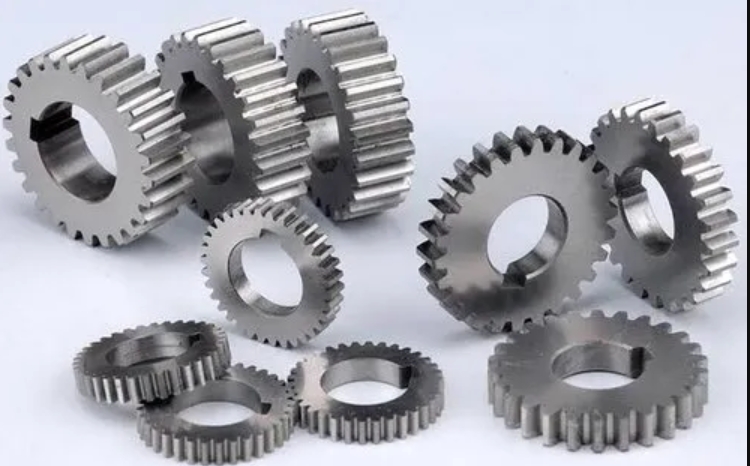
The spur gear, with its straight teeth parallel to the axis of rotation, remains a cornerstone of power transmission design due to its simplicity and efficiency. The quest for a high-performance spur gear often leads to surface hardening techniques, with carburizing being predominant for case-hardened steels. The conventional sequence, however, creates a metallurgical disconnect. Machining the tooth profile severs the natural grain flow, creating stress concentration points. Subsequent carburizing, applied to the finished geometry, typically yields a uniform case depth along the tooth contour. This uniformity is not optimal from a mechanical loading standpoint. The root of the spur gear tooth, subjected to the highest bending stresses, ideally requires a tougher, more ductile core, while the flank and tip, facing wear and contact stresses, benefit from a thick, hard case. The integrated “Carburizing-Warm Extrusion” process is designed to address these very challenges simultaneously.
Experimental Methodology and Materials
The core of my study was a direct comparative analysis between spur gears produced via the novel integrated process and those made by the conventional route.
1. Material Selection
The material chosen for this investigation was 20CrMnTi, a chromium-manganese-titanium steel widely adopted in the automotive industry for high-stress components like vehicle transmission spur gears. Its excellent hardenability and core toughness after carburizing make it ideal. The chemical composition is detailed in Table 1.
| Element | C | Cr | Mn | Ti | Si | P | S |
|---|---|---|---|---|---|---|---|
| wt.% | 0.20 | 1.10 | 0.95 | 0.06 | 0.25 | 0.025 | 0.025 |
The spur gear specifications were: Normal Module (m_n) = 4 mm, Number of Teeth (z) = 25, Radial displacement coefficient = +0.3.
2. Process Routes
Route A (Integrated “Carburizing-Warm Extrusion”): Cylindrical blanks were first gas-carburized to achieve a nominal total case depth of approximately 1.0 mm, with a surface carbon content targeting about 0.8 wt.%. These carburized blanks were then heated to a warm-forming temperature range (investigated between 650°C and 850°C) and subsequently precision extruded into the final spur gear shape using a closed-die forging setup on a 1000-ton hydraulic press.
Route B (Conventional “Machine-Carburize”): Blanks were first machined (hobbed) to the final spur gear tooth profile. These machined gears then underwent the same carburizing treatment as the Route A blanks to achieve a comparable nominal case depth.
Both sets of gears underwent identical post-forming/carburizing heat treatment sequences: direct quenching and low-temperature tempering to achieve a surface hardness >58 HRC.
3. Characterization Techniques
Metallographic samples containing 2-3 full teeth were sectioned, mounted, polished, and etched (using nital). Microstructural analysis and case depth measurement were performed using optical microscopy (Zeiss Axio Imager). Micro-hardness traverses from surface to core were conducted. The flow lines (fiber structure) were revealed via deep etching techniques. Analytical modeling of deformation during extrusion was also employed to correlate with observed case depth distribution.
Results and Analysis: A Tale of Two Structures
The differences between the spur gears produced by the two routes were striking and fundamental, affecting both macro-distribution (case depth) and micro-texture (flow lines).
1. Carburized Case Depth Distribution
Conventional Spur Gear (Route B): As expected, the carburized layer was essentially uniform along the tooth profile contour—flank, root, and tip exhibited nearly identical effective case depth (measured to 550 HV). This is a direct consequence of diffusing carbon into an already-finished geometry.
“Carburizing-Warm Extrusion” Spur Gear (Route A): The profile was radically different and aligned with theoretical predictions for ideal performance. The case depth was not uniform. The thickest layer was found at the tooth tip (approximately 1.2 mm). It gradually tapered along the tooth flanks, reaching its minimum thickness at the tooth root fillet (approximately 0.7 mm). This gradient is a direct result of plastic flow during warm extrusion. The pre-existing carburized layer on the cylindrical blank acts as a “shell” that gets redistributed with the metal. During die filling, material from the region destined to become the root undergoes severe compressive and shear strains, causing substantial thinning of the initial carburized case. Conversely, material flowing to form the tip experiences less severe thinning or even localized thickening due to metal folding and accumulation. This can be conceptually modeled by considering the effective strain ($\varepsilon$) at different points. The final effective case depth ($\delta_{eff}$) relates to the initial depth ($\delta_0$) and the strain by a simplifying relationship of the form:
$$
\delta_{eff} \approx \delta_0 \cdot e^{-\varepsilon}
$$
where a higher local strain ($\varepsilon$) at the root leads to greater thinning of the initial carburized layer ($\delta_0$). Table 2 summarizes the measured case depths.
| Spur Gear Production Route | Tooth Tip Case Depth (mm) | Tooth Flank Case Depth (mm) | Tooth Root Case Depth (mm) |
|---|---|---|---|
| Conventional (Machine then Carburize) | 1.05 ± 0.05 | 1.00 ± 0.05 | 0.98 ± 0.05 |
| Integrated (Carburize then Warm Extrude) | 1.20 ± 0.08 | 0.95 ± 0.07 | 0.70 ± 0.06 |
2. Metal Flow Lines (Fiber Structure)
This aspect revealed perhaps the most visually compelling advantage of the integrated process for spur gear manufacturing.
Conventional Spur Gear: The machining process completely severs the inherent grain flow of the bar stock. No continuous flow lines following the tooth profile are visible. The microstructure is essentially isotropic with respect to macro-texture, which can be detrimental under cyclic loading.
“Carburizing-Warm Extrusion” Spur Gear: The warm forging process imparted a pronounced and continuous fiber structure. The flow lines meticulously followed the complex contour of the spur gear tooth—sweeping from the root fillet, up along the active flank, and around the tip. This unbroken grain flow is analogous to the grain structure in wood, providing inherent directional strength. In a spur gear under load, the maximum tensile bending stress occurs at the root on the loaded flank. Having metal fibers aligned parallel to this stress direction (i.e., flowing along the root contour) significantly enhances resistance to crack initiation and propagation. The flow lines act as natural barriers against crack advancement perpendicular to them.
Mechanistic Discussion: Linking Process, Structure, and Performance
The observed structural differences are not merely academic; they translate directly into the functional performance metrics of the spur gear, particularly bending fatigue strength and impact toughness.
1. The Relationship Between Case Depth Distribution and Forming Mechanics
The formation of the ideal gradient in the “Carburizing-Warm Extrusion” spur gear is governed by the kinematics of metal flow in closed-die forging. The process parameters—especially the forming temperature and die design (corner radii, draft angles)—are critical control variables. At lower warm-forming temperatures (e.g., 650°C), material flow is more restricted, and deformation is highly concentrated in the root region, causing extreme thinning of the carburized shell there. At higher temperatures (e.g., 850°C), improved material plasticity allows for more uniform flow, moderating the gradient. By strategically controlling these parameters, one can “dial in” a specific case depth profile optimized for a given spur gear application. The goal is to achieve a root case depth that provides sufficient wear and fatigue resistance without embrittlement, while a thicker tip case combats wear and pitting. The surface hardness ($H_s$) and residual stress ($\sigma_{RS}$) profiles are also affected by this gradient and the subsequent quenching of a pre-carburized, work-hardened surface layer, often leading to more compressive stresses at the critical root region, further enhancing fatigue performance.
2. The Synergy of Flow Lines and Carburized Case
The performance of the integrated spur gear is not merely the sum of its improved case profile and fiber structure; it’s their synergy. The warm extrusion process after carburizing results in significant grain refinement within the carburized case itself, especially in areas of high strain like the root. This is due to dynamic recrystallization and/or recovery during warm working. Therefore, the root of the “Carburizing-Warm Extrusion” spur gear possesses a thinner but much finer-grained carburized layer compared to the conventionally processed gear. Fine-grained microstructures exhibit superior toughness and fatigue crack initiation resistance. Combined with the continuous, favorably oriented fiber structure underneath, this creates a root region that is exceptionally resistant to bending fatigue failure.
3. Quantitative Analysis: Case Depth vs. Bending Fatigue and Impact Strength
Extensive testing and literature confirm a non-monotonic relationship between effective case depth and key mechanical properties for a carburized spur gear. My findings align with this established wisdom, which can be generalized as follows:
Impact Toughness: The energy required to cause fracture under a single impact load (Impact Fracture Limit Energy, $E_{IFL}$) decreases approximately linearly with increasing effective case depth ($\delta_{eff}$). A thicker, high-carbon martensitic case is inherently more brittle. This relationship can be expressed as:
$$
E_{IFL} \approx A – B \cdot \delta_{eff}
$$
where $A$ and $B$ are material and process-dependent constants. Therefore, the thinner case at the root of the integrated spur gear inherently promotes better impact toughness compared to a conventionally processed gear with a uniformly thick root case.
Bending Fatigue Strength: The relationship here exhibits an optimum. Bending fatigue strength (or the limiting load, $S_{FL}$) increases with case depth initially, as it suppresses subsurface crack initiation. However, beyond a critical thickness, the increasing brittleness and the potential for higher residual tensile stresses at the case-core interface become detrimental, causing a drop in performance. Empirical data often shows a maximum in bending fatigue limit load occurring at an effective case depth ($\delta_{eff, opt}$) that is a fraction of the tooth module. For a module 4 mm spur gear, this optimum is often found near 0.8 mm. This can be modeled phenomenologically as:
$$
S_{FL} \approx C \cdot \delta_{eff} \cdot e^{-D \cdot \delta_{eff}^2} \quad \text{for a given root geometry}
$$
where $C$ and $D$ are constants. The “Carburizing-Warm Extrusion” process naturally engineers the spur gear to have a root case depth close to this optimum (0.7 mm in our study), while providing a thicker, more wear-resistant case elsewhere. Table 3 contrasts the ideal vs. conventional scenarios.
| Spur Gear Region | Primary Failure Mode | Ideal Case Depth Profile | Conventional Process Result | Integrated Process Result |
|---|---|---|---|---|
| Tooth Root | Bending Fatigue Fracture | Thinner, tough, fine-grained case (~0.7-0.9*m_n) | Thick, potentially brittle case | Optimally thin, fine-grained case |
| Tooth Flank | Contact Fatigue (Pitting), Wear | Moderately thick, hard case | Uniformly thick case | Gradually thinning, hard case |
| Tooth Tip | Wear, Deformation | Thickest, very hard case | Uniformly thick case | Thickest, hard case |
Conclusion and Engineering Implications
My systematic investigation into the “Carburizing-Warm Extrusion” process for manufacturing spur gears leads to several robust conclusions with significant practical implications:
First, the integrated process is a powerful tool for microstructure engineering. It enables the creation of a spur gear with a non-uniform, functionally graded carburized case depth that aligns with the stress state of the loaded tooth. The thick case at the tip and the optimally thin, fine-grained case at the root represent a material distribution that is superior to the uniform case from conventional processing.
Second, the process inherently generates a continuous, favorable metal flow line pattern that follows the spur gear tooth contour. This unbroken fiber structure significantly enhances the directional mechanical properties, particularly the bending fatigue strength at the critical root region, by aligning the “grain” of the material with the primary tensile stress direction.
Third, the synergy between the optimized case depth and the refined, flow-oriented microstructure results in a spur gear component that promises enhanced performance metrics. The specific improvements include higher resistance to bending fatigue failure, better impact toughness at the root, and potentially improved wear resistance on the flanks and tip—all while achieving higher material yield and production efficiency compared to traditional subtractive methods.
In essence, the “Carburizing-Warm Extrusion” technique moves beyond simple shaping and hardening. It represents a holistic approach to manufacturing a high-performance spur gear, where the process itself is designed to dictate an optimal final microstructure. This paves the way for next-generation gear design, where performance limits are pushed not just by alloy chemistry, but by intelligent, integrated processing routes that tailor the material’s architecture at a fundamental level.