
In modern mechanical transmission systems, spur gears play a pivotal role due to their simplicity, efficiency, and reliability. Particularly in demanding applications such as offshore platform drives, where compact design and high strength are paramount, accurate assessment of spur gear strength is crucial. Traditional methods like the AGMA standards provide conservative estimates, but with advancements in computational tools, finite element analysis (FEA) offers a more detailed and realistic insight into stress distributions. This article presents a comprehensive study on the strength analysis of spur gears, integrating theoretical calculations per AGMA standards with finite element simulations using Pro/E for parametric modeling and ABAQUS for FEA. The focus is on a pair of external involute spur gears, examining both contact and bending stresses to validate the feasibility of FEA for spur gear design optimization.
The analysis begins with a detailed theoretical evaluation based on AGMA guidelines, followed by the creation of a precise three-dimensional model of the spur gear pair in Pro/E. This model is then imported into ABAQUS for finite element analysis under dynamic meshing conditions. The results from FEA are compared with traditional AGMA calculations, highlighting correlations and discrepancies. Throughout this work, the term ‘spur gear’ is emphasized to underscore its significance in power transmission systems. Multiple tables and equations are used to summarize parameters and formulations, ensuring clarity and depth. The goal is to demonstrate that finite element methods can effectively capture complex stress patterns in spur gears, providing a foundation for enhanced design practices.
Introduction to Spur Gear Strength Analysis
Spur gears are fundamental components in gear trains, characterized by teeth that are parallel to the axis of rotation. Their design involves intricate geometry, primarily based on the involute curve, which ensures smooth and efficient power transmission. In high-load environments like marine drives, spur gears must withstand significant contact and bending stresses without failure. Traditional strength calculations, such as those outlined by the American Gear Manufacturers Association (AGMA), rely on empirical formulas derived from Hertzian contact theory and beam theory. While these methods are widely accepted and provide a safe design margin, they often simplify real-world conditions, such as dynamic load sharing and localized stress concentrations.
Finite element analysis, on the other hand, allows for a more nuanced investigation by simulating the actual meshing behavior of spur gears. By modeling the gears as three-dimensional solids and applying realistic boundary conditions, FEA can reveal stress distributions across the tooth surface and root fillet regions during operation. This approach not only validates theoretical predictions but also identifies potential failure zones that might be overlooked in conventional calculations. In this study, we leverage Pro/E for accurate parametric modeling of spur gears, ensuring geometric precision, and ABAQUS for advanced finite element simulations. The integration of these tools facilitates a robust analysis workflow, from design to validation.
The importance of this work lies in its application to real-world engineering scenarios. For instance, in offshore platforms, gear systems must operate reliably under harsh conditions, and any failure can lead to costly downtime. By employing FEA, engineers can optimize spur gear designs for weight reduction and increased load capacity, contributing to more efficient and durable transmission systems. This article delves into the specifics of the analysis process, covering theoretical foundations, modeling techniques, finite element setup, and result interpretation, all while emphasizing the role of spur gears in mechanical power transmission.
Theoretical Analysis of Spur Gear Strength Using AGMA Standards
The theoretical assessment of spur gear strength follows the AGMA standards, which provide formulas for calculating contact stress and bending stress. These formulas incorporate various factors to account for load distribution, dynamic effects, and material properties. For this analysis, we consider a pair of spur gears with specified operational parameters. The key geometric and operational data are summarized in the table below.
| Parameter | Symbol | Value | Units |
|---|---|---|---|
| Number of teeth (pinion) | \(Z_1\) | 25 | – |
| Number of teeth (gear) | \(Z_2\) | 80 | – |
| Module | \(m\) | 5 | mm |
| Pressure angle | \(\alpha\) | 20 | ° |
| Face width | \(b\) | 50 | mm |
| Addendum coefficient | \(h_a^*\) | 1 | – |
| Dedendum coefficient | \(c^*\) | 0.25 | – |
| Profile shift coefficient | \(X\) | 0 | – |
| Input power | \(P\) | 26.7 | kW |
| Input torque | \(T\) | 818 | N·m |
| Pinion speed | \(n_1\) | 311 | r/min |
| Service life | \(t\) | 1000 | h |
| Transmission ratio | \(u\) | 3.2 | – |
These parameters define the basic geometry of the spur gear pair, which is essential for both theoretical calculations and finite element modeling. The center distance \(a\) is calculated as:
$$ a = \frac{(Z_1 + Z_2) \cdot m}{2} = \frac{(25 + 80) \times 5}{2} = 262.5 \text{ mm} $$
This center distance ensures proper meshing of the spur gears and is used in the assembly process.
AGMA Contact Strength Calculation for Spur Gears
The contact stress in spur gears arises from the Hertzian pressure between mating teeth. The AGMA formula for contact stress \(\sigma_H\) is derived from the fundamental Hertz equation, modified to include factors for gear-specific conditions. The equation is:
$$ \sigma_H = Z_E \sqrt{\frac{F_t K_o K_v K_s K_H Z_R}{b d Z_I}} $$
Where:
- \(Z_E\) is the elastic coefficient, which accounts for the material properties of the gear pair. For steel gears, \(Z_E = 189.812 \sqrt{\text{N/mm}^2}\).
- \(F_t\) is the tangential load on the spur gear teeth, calculated from the input torque: \(F_t = \frac{2T}{d} = \frac{2 \times 818 \times 1000}{125} = 13088 \text{ N}\), where \(d = m Z_1 = 5 \times 25 = 125 \text{ mm}\) is the pitch diameter of the pinion.
- \(K_o\) is the overload factor, assumed as 1.25 for moderate shock conditions.
- \(K_v\) is the dynamic factor, accounting for internal dynamic loads. Based on the gear quality and speed, \(K_v = 1.05\).
- \(K_s\) is the size factor, taken as 1 for standard spur gear sizes.
- \(K_H\) is the load distribution factor, which considers non-uniform load across the face width. For this setup, \(K_H = 1.163\).
- \(Z_R\) is the surface condition factor, assumed as 1 for properly finished spur gear teeth.
- \(Z_I\) is the geometry factor for contact stress, which depends on the tooth profile and mesh geometry. For this spur gear pair, \(Z_I = 0.11\).
Substituting these values into the equation yields the theoretical contact stress:
$$ \sigma_H = 189.812 \sqrt{\frac{13088 \times 1.25 \times 1.05 \times 1 \times 1.163 \times 1}{50 \times 125 \times 0.11}} = 1021.24 \text{ MPa} $$
This value represents the maximum expected contact stress on the spur gear teeth according to AGMA standards, serving as a benchmark for the finite element analysis.
AGMA Bending Strength Calculation for Spur Gears
Bending stress in spur gears is critical at the tooth root, where stress concentration can lead to fatigue failure. The AGMA bending stress formula is based on the Lewis equation, enhanced with additional factors. The expression is:
$$ \sigma_F = \frac{F_t K_o K_v K_s}{b m_t} \frac{K_H K_B}{Y_J} $$
Where:
- \(m_t\) is the transverse module, equal to the normal module \(m = 5 \text{ mm}\) for spur gears.
- \(K_B\) is the rim thickness factor, taken as 1 for solid spur gear blanks.
- \(Y_J\) is the geometry factor for bending stress, which depends on the tooth form and load application point. For this spur gear, \(Y_J = 0.404\).
- Other factors are as defined previously for contact stress.
Plugging in the numerical values gives the theoretical bending stress:
$$ \sigma_F = \frac{13088 \times 1.25 \times 1.05 \times 1}{50 \times 5} \times \frac{1.163 \times 1}{0.404} = 197.67 \text{ MPa} $$
This bending stress is anticipated at the root of the spur gear teeth under the given loading conditions. The AGMA calculations provide a conservative estimate, which will be compared with FEA results to assess accuracy.
Parametric Modeling of Spur Gears in Pro/E
Accurate three-dimensional modeling is essential for reliable finite element analysis. Pro/Engineer (Pro/E) is employed for parametric modeling of the spur gear pair, allowing for precise control over geometric features. The modeling process involves generating the involute tooth profile, creating the gear body, and assembling the gear pair with proper meshing alignment.
Generation of Involute Curve for Spur Gears
The tooth profile of a spur gear is based on the involute curve, which ensures conjugate action and constant velocity ratio. In Pro/E, the involute is created using parametric equations in a Cartesian coordinate system. The base circle diameter \(d_b\) is calculated as \(d_b = d \cos \alpha = 125 \cos 20^\circ = 117.46 \text{ mm}\). The parametric equations for the involute are defined as follows:
ang = 90 * t
r = d_b / 2
s = pi * r * t / 2
xc = r * cos(ang)
yc = r * sin(ang)
x = xc + s * sin(ang)
y = yc - s * cos(ang)
z = 0
Here, \(t\) is a parameter ranging from 0 to 1. These equations produce a precise involute curve, which is then mirrored to form a symmetric tooth profile. The generated curve is trimmed between the base circle and addendum circle to define the active flank of the spur gear tooth.
Creation of Spur Gear Model
Once the involute profile is established, the complete tooth contour is formed by adding the root fillet and dedendum curve. The fillet radius is determined based on the gear geometry to reduce stress concentration. The tooth profile is then extruded along the axial direction to create a single tooth feature. Using pattern commands in Pro/E, this tooth is circularly arrayed around the gear axis to generate the full set of teeth. The resulting spur gear model includes all geometric details, such as the hub and keyway, but for analysis simplicity, the focus is on the teeth and rim. The figure below illustrates a typical spur gear model created through this parametric approach.
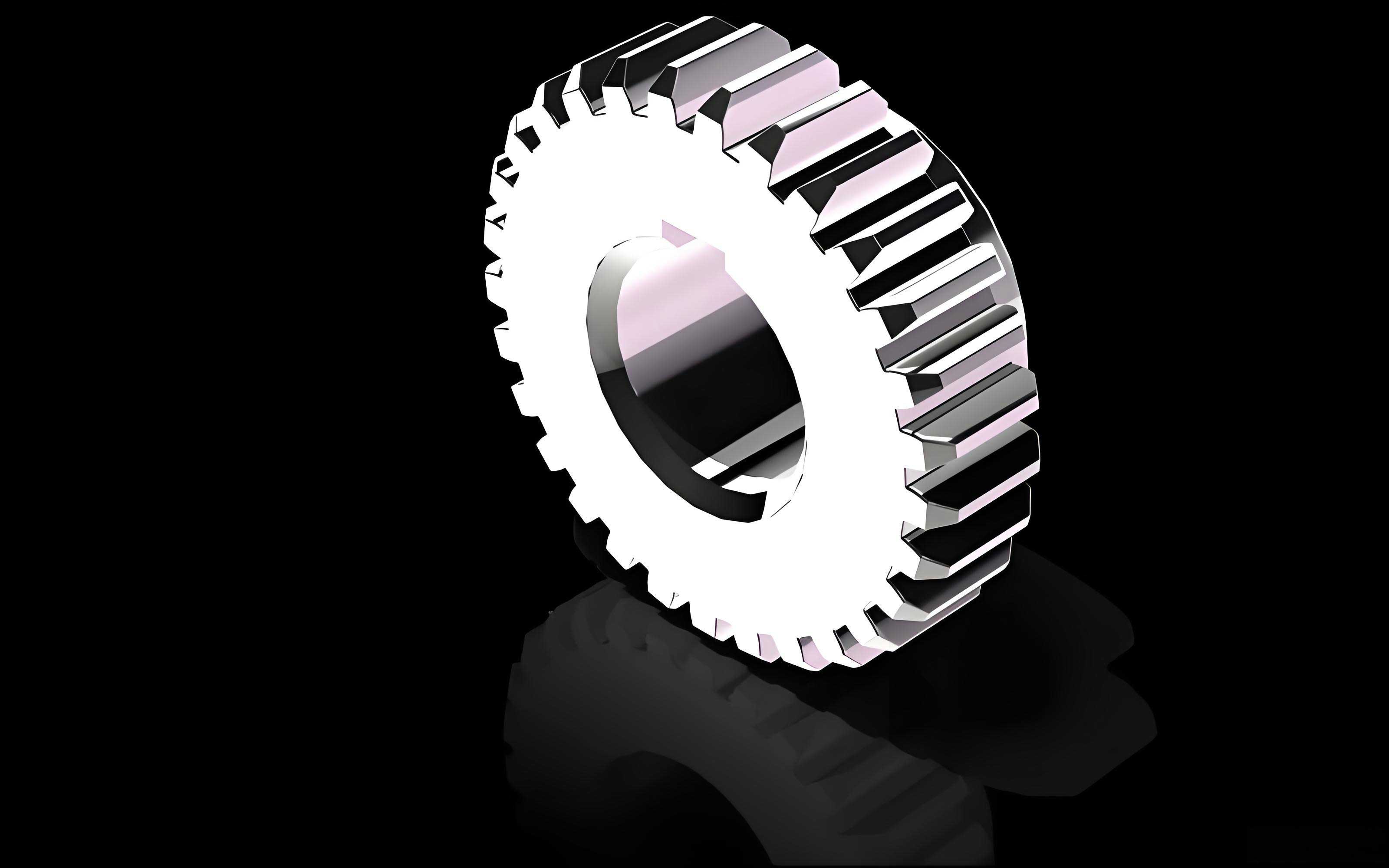
This image represents a generic spur gear, similar to the ones modeled in this study. The parametric method ensures that any changes in gear parameters, such as module or number of teeth, automatically update the model, facilitating design iterations.
Assembly of Spur Gear Pair
For finite element analysis, the meshing interaction between two spur gears must be accurately represented. In Pro/E, an assembly is created by first defining two axes separated by the center distance \(a = 262.5 \text{ mm}\). The pinion and gear are inserted and constrained using pin connections, aligning their axes with the predefined axes and matching their end faces. To achieve proper meshing without backlash, the cam mechanism tool in Pro/E is utilized. Specifically, the contacting tooth flanks of both spur gears are selected as cam surfaces, enforcing a zero-clearance condition. This results in a globally interference-free assembly, as verified by volume interference checks. The assembled spur gear pair is then ready for export to ABAQUS in a neutral format like STEP (.stp).
Finite Element Analysis of Spur Gears in ABAQUS
Finite element analysis in ABAQUS involves importing the gear model, defining material properties, meshing, setting up contact interactions, applying boundary conditions, and solving for stresses. This process enables a dynamic simulation of the spur gear meshing, capturing transient stress states.
Importing Model and Defining Material Properties
The STEP file from Pro/E is imported into ABAQUS, preserving the geometry of the spur gear pair. Both gears are assigned material properties corresponding to 40Cr steel, commonly used in high-strength gear applications. The material is modeled as linear elastic with the following properties:
| Property | Value | Units |
|---|---|---|
| Young’s modulus, \(E\) | \(2.06 \times 10^5\) | MPa |
| Poisson’s ratio, \(\nu\) | 0.3 | – |
| Density, \(\rho\) | \(7.85 \times 10^{-9}\) | tonne/mm³ |
These properties are essential for calculating deformations and stresses in the spur gears under load.
Meshing Strategy for Spur Gears
Meshing is a critical step in FEA, balancing accuracy and computational efficiency. For the spur gear analysis, a hexahedral-dominated mesh is generated using the swept technique, resulting in C3D8R elements (8-node linear brick elements with reduced integration). To focus computational resources on areas of interest, the teeth that are likely to engage during meshing are refined with smaller elements, while non-engaged regions are coarsely meshed. This adaptive meshing approach ensures accurate stress resolution in contact zones without excessive model size. A typical mesh for the spur gear pair consists of approximately 200,000 elements, with convergence studies confirming that further refinement yields minimal changes in stress values (less than 2%).
Contact Definition Between Spur Gears
The interaction between mating spur gear teeth is modeled using surface-to-surface contact in ABAQUS. The gear tooth flanks are defined as contact pairs, with the larger gear designated as the contact surface and the smaller pinion as the target surface. A penalty friction formulation is applied with a coefficient of friction of 0.1, representing typical lubricated conditions. The contact behavior is set to “hard” contact in the normal direction, allowing separation under tension. Multiple contact pairs are established for teeth that may engage during rotation, ensuring comprehensive capture of meshing dynamics. This setup accurately simulates the load transfer and stress generation in the spur gear pair.
Boundary Conditions and Loading
To simulate the operating conditions of the spur gears, appropriate boundary conditions and loads are applied. The analysis uses a dynamic implicit step to account for inertial effects. Reference points (RPs) are created at the centers of both spur gears and coupled with their inner bore surfaces using kinematic coupling constraints. This allows loads and displacements to be applied at the RPs while distributing them across the gear bodies. The boundary conditions are as follows:
- For the pinion (small spur gear): The reference point RP-small is constrained in all translational directions (U1=U2=U3=0) and rotational directions except about the axis of rotation (UR1=UR2=0). A rotational displacement UR3 = 0.754 rad is applied, corresponding to the rotation needed for five teeth to mesh, based on the pinion speed and simulation time.
- For the gear (large spur gear): The reference point RP-big is similarly constrained (U1=U2=U3=UR1=UR2=0). A torque of 2617.6 N·m is applied about its axis (UR3 direction), derived from the input power and transmission ratio.
These conditions replicate the driving and driven roles of the spur gears in the transmission system.
Solution and Post-Processing
The finite element model is solved using ABAQUS/Standard. The analysis outputs stress contours for both contact and bending stresses over the meshing cycle. Post-processing involves extracting maximum stress values and their locations, particularly at the pitch line for contact stress and at the tooth root for bending stress. The results are visualized using contour plots, enabling detailed examination of stress distributions across the spur gear teeth.
Results and Comparison Between FEA and AGMA Standards
The finite element analysis provides detailed stress data for the spur gear pair during meshing. The key results are summarized and compared with the theoretical AGMA calculations to validate the FEA approach.
Contact Stress Results from FEA
The FEA reveals that the maximum contact stress on the spur gear teeth occurs in the single-tooth contact region near the pitch line. The contour plot shows a localized high-stress area, with a peak value of 833 MPa. This stress is lower than the AGMA prediction of 1021.24 MPa, indicating that the theoretical method is more conservative. The table below compares the contact stress values.
| Method | Maximum Contact Stress (MPa) | Location |
|---|---|---|
| AGMA Standard | 1021.24 | Pitch line (theoretical) |
| Finite Element Analysis | 833 | Pitch line (single-tooth contact) |
The difference of approximately 18% can be attributed to factors such as load sharing between multiple teeth and stress redistribution in the finite element model, which are not fully captured by the AGMA formula. This demonstrates that FEA offers a more realistic assessment of contact stresses in spur gears.
Bending Stress Results from FEA
For bending stress, the FEA identifies the maximum value at the tooth root of the pinion during single-tooth engagement. The peak bending stress is 172.8 MPa, compared to the AGMA value of 197.67 MPa. The comparison is shown in the table.
| Method | Maximum Bending Stress (MPa) | Location |
|---|---|---|
| AGMA Standard | 197.67 | Tooth root (theoretical) |
| Finite Element Analysis | 172.8 | Tooth root (single-tooth contact) |
The FEA result is about 13% lower than the AGMA prediction, again highlighting the conservative nature of traditional calculations. The stress concentration at the root fillet is well-captured by the fine mesh, confirming the accuracy of the finite element model for spur gear bending analysis.
Dynamic Meshing Behavior of Spur Gears
An advantage of FEA is its ability to simulate the dynamic meshing process of spur gears. The analysis shows stress variations as teeth engage and disengage, with transitions between single and double-tooth contact zones. For instance, during double-tooth contact, the load is shared, reducing individual tooth stresses. This dynamic insight is valuable for understanding fatigue life and optimizing tooth profiles. The FEA results also indicate that stress distributions are sensitive to alignment and manufacturing tolerances, underscoring the importance of precise modeling.
Discussion on Spur Gear Strength Analysis
The comparison between AGMA standards and finite element analysis reveals several insights. First, the AGMA formulas provide a safe and straightforward method for spur gear design, but they tend to overestimate stresses due to simplifying assumptions. In contrast, FEA accounts for complex geometries, load distributions, and boundary conditions, yielding more accurate stress predictions. This is particularly beneficial for high-performance spur gears used in critical applications, where weight reduction and reliability are essential.
Second, the parametric modeling approach in Pro/E ensures that spur gear designs can be easily modified and re-analyzed, facilitating iterative optimization. For example, changes in module, pressure angle, or profile shift can be quickly incorporated, and their effects on stress can be evaluated through FEA. This flexibility is crucial for custom spur gear designs tailored to specific operational requirements.
Third, the finite element method enables detailed investigation of failure mechanisms. By examining stress contours, engineers can identify potential crack initiation sites, such as at the tooth root or contact surface, and implement design improvements like optimized fillet radii or surface treatments. Additionally, FEA can be extended to include nonlinear material behavior, thermal effects, and wear, providing a comprehensive strength assessment for spur gears.
It is important to note that the accuracy of FEA depends on proper modeling assumptions. In this study, factors like mesh density, contact definition, and material linearity were carefully considered. Future work could explore advanced topics such as dynamic loading spectra, multi-body interactions in gear trains, and probabilistic design for spur gears under uncertainty.
Conclusion
This study demonstrates the feasibility of using finite element analysis for strength evaluation of spur gears. By combining Pro/E for precise parametric modeling and ABAQUS for advanced simulations, we have analyzed both contact and bending stresses in a pair of external involute spur gears. The FEA results show good agreement with traditional AGMA calculations, albeit with lower stress values, indicating that AGMA standards are conservative. The finite element approach captures dynamic meshing behavior and localized stress concentrations, offering a more realistic perspective for spur gear design.
The methodology presented here can be applied to various spur gear configurations, aiding in the development of stronger, lighter, and more efficient gear systems. As computational power increases, FEA will become an indispensable tool for gear engineers, enabling innovations in spur gear technology for demanding applications like offshore platforms, automotive transmissions, and industrial machinery. Ultimately, the integration of theoretical standards and finite element analysis provides a robust framework for ensuring the reliability and performance of spur gears in mechanical power transmission.