
As a researcher in the field of metal forming, I have focused on advancing precision forging technologies for mechanical components, particularly spur gears. Spur gears are among the most widely used mechanical transmission elements due to their simplicity and efficiency in power transfer. However, during operation, they are subjected to continuous impact loads, which demand high-quality tooth profiles to ensure durability and performance. Traditional manufacturing methods often involve extensive machining, leading to material waste and reduced mechanical properties. In contrast, precision forging, or near-net shape forming, offers a promising alternative by directly producing complete tooth shapes with minimal post-processing. This approach not only conserves material but also enhances mechanical performance by preserving continuous metal flow lines along the tooth contours. Despite its advantages, the forging range for spur gears—defined by parameters such as gear thickness, hole diameter, and forming pressure—remains underexplored. This gap motivates my study to investigate the cold precision forging range of spur gears using DEFORM-3D numerical simulation, aiming to provide a theoretical foundation for optimizing production processes.
In this work, I examine a series of spur gears with a constant module of m=2, varying tooth numbers, and different set pressures. For instance, I consider a standard spur gear with a tooth count of z=32, pressure angle α=20°, and zero modification coefficient (x=0). The primary objective is to determine the forging range under a set pressure of 2300 MPa, which is within the safe load limit of a three-layer prestressed combined die capable of handling up to 2500 MPa. By analyzing the filling behavior and forming loads, I aim to derive a theoretical forging range curve that can guide practical applications. The methodology involves a closed heading-hollow distributary die structure with a two-stroke process, simulated via DEFORM-3D to model the complex metal flow and stress distribution during forming.
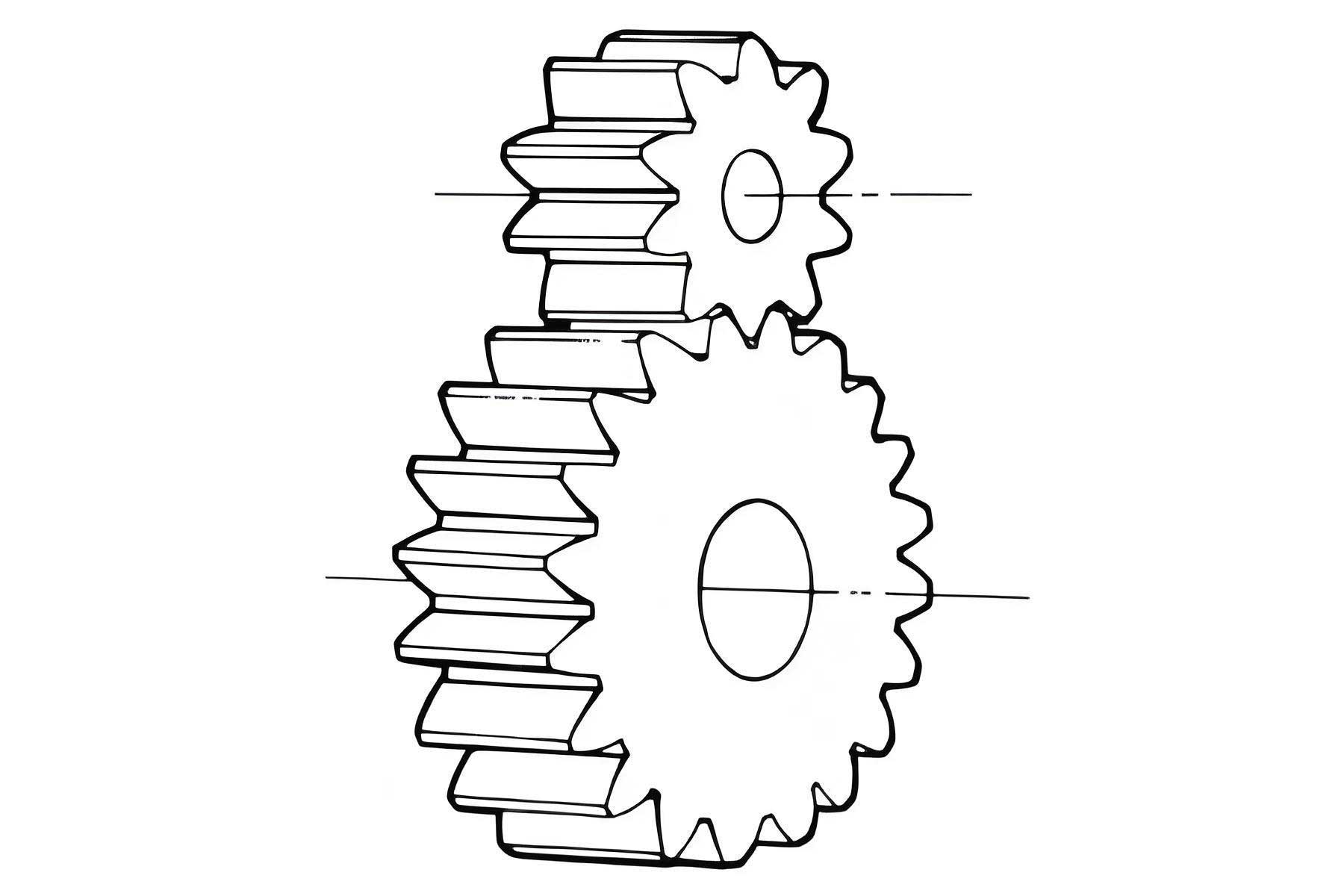
The forging process for spur gears employs a innovative die design known as closed heading-hollow distributary with a two-stroke action. This setup consists of an upper punch, a lower punch, a floating die, and a core rod controlled by a small hydraulic cylinder. The process unfolds in three sequential steps. First, the core rod descends with the upper punch at the same speed until it contacts the lower punch, where it halts. The upper punch continues downward, applying pressure to the billet until it reaches a preset unit pressure of 2300 MPa. At this point, the core rod retracts, creating a hollow space for metal redistribution—this is the hollow distributary phase. Second, the upper punch resumes its downward motion until the pressure again hits 2300 MPa, completing the tooth formation. Finally, the upper punch retracts, the floating die returns via spring force, and the forged spur gear is ejected using an air cushion. This two-stroke approach streamlines production by consolidating multiple stages into a single die, reducing tooling costs and shortening process cycles compared to conventional methods that require separate dies for preliminary and final forging.
To simulate this process, I utilized DEFORM-3D, a finite element analysis software tailored for metal forming applications. The model incorporates key components: a stationary die, moving upper and lower punches, and a plastic billet. The billet material is selected as AISI-4120 steel, commonly used in gear applications due to its good hardenability and strength. Given the symmetry of the spur gear with 32 teeth, I analyzed a 1/32 sector to reduce computational time while maintaining accuracy. The punches move at a constant velocity of 10 mm/s, and the simulation is conducted at room temperature (20°C), neglecting heat transfer effects to focus on mechanical behavior. Friction conditions are set with a coefficient of 0.08 to account for lubricated cold forging. For mesh refinement, automatic remeshing is enabled with a step size of 0.12 mm, ensuring precision in capturing deformation details. The table below summarizes the simulation parameters:
| Parameter | Value |
|---|---|
| Billet Material | AISI-4120 Steel |
| Module (m) | 2 mm |
| Tooth Count (z) | 32 |
| Pressure Angle (α) | 20° |
| Forming Temperature | 20°C |
| Punch Velocity | 10 mm/s |
| Friction Coefficient | 0.08 |
| Mesh Step Size | 0.12 mm |
| Set Unit Pressure | 2300 MPa |
The simulation results reveal intricate metal flow patterns during the forging of spur gears. I observed several distinct phases in tooth filling. Initially, as the upper punch compresses the billet, metal begins to flow into the tooth cavities, starting from the tips. This stage corresponds to a gradual increase in punch pressure, peaking near the set limit. For example, with a hollow hole diameter D=20.65 mm, the metal initially moves from both top and bottom surfaces toward the center, with the分流点 (flow division point) located at the mid-wall of the inner hole. When the tooth tips are nearly filled, the pressure approaches 2300 MPa, prompting the core rod retraction to prevent die damage. Upon retraction, metal redistributes, flowing both into the tooth roots and the hollow hole, shifting the分流点 to the root region. This causes a temporary pressure drop, followed by a resurgence as the tooth corners fully fill. Excess metal escapes into the hollow hole, ensuring complete filling without overpressure. The final forged spur gear exhibits well-defined teeth with minimal flash, requiring only minor machining to remove burrs and adjust the hole size.
To quantify the forging range, I conducted multiple simulations with varying billet dimensions, specifically different hollow hole diameters (D) and gear heights (H). The gear height is normalized by the module as H/m, and the hole diameter is normalized by the root circle diameter Df as D/Df. The root circle diameter for a standard spur gear can be calculated using the formula: $$D_f = m \times z – 2.5 \times m$$ For m=2 and z=32, this gives $$D_f = 2 \times 32 – 2.5 \times 2 = 64 – 5 = 59 \, \text{mm}$$ The set pressure remains constant at 2300 MPa. The table below presents a subset of simulation data, indicating whether the spur gear formed successfully and the resulting forged height:
| Case | Billet Dimensions (mm) | Load (kN) | Forged Height H (mm) | Formation Status |
|---|---|---|---|---|
| 1 | Ø59 × Ø17.70 × 25 | 210 | N/A | Failed |
| 2 | Ø59 × Ø18.24 × 25 | 207 | 19.75 | Successful |
| 3 | Ø59 × Ø20.65 × 25 | 191 | 19.00 | Successful |
| 4 | Ø59 × Ø23.60 × 25 | 185 | 18.30 | Successful |
| 5 | Ø59 × Ø26.55 × 25 | 175 | 17.00 | Successful |
| 6 | Ø59 × Ø28.91 × 25 | 182 | 15.42 | Successful |
| 7 | Ø59 × Ø29.50 × 25 | 178 | N/A | Failed |
| 8 | Ø59 × Ø19.47 × 10 | 206 | N/A | Failed |
| 9 | Ø59 × Ø20.06 × 10 | 200 | 7.75 | Successful |
| 10 | Ø59 × Ø23.60 × 10 | 199 | 7.37 | Successful |
| 11 | Ø59 × Ø26.55 × 10 | 188 | 6.80 | Successful |
| 12 | Ø59 × Ø29.50 × 10 | 176 | 6.32 | Successful |
| 13 | Ø59 × Ø32.45 × 10 | 168 | 5.74 | Successful |
| 14 | Ø59 × Ø34.81 × 10 | 160 | 5.30 | Successful |
| 15 | Ø59 × Ø35.40 × 10 | 161 | N/A | Failed |
Based on this data, I derived the theoretical forging range curve by plotting H/m against D/Df. Using Quadratic B-Spline curve fitting in Origin 8.0, I obtained a relationship that defines the feasible region for spur gear formation under 2300 MPa. The curve indicates that for a spur gear with m=2 and z=32, the gear thickness ratio H/m should ideally lie between 5 and 7 for optimal filling. Ratios below 4.0 or above 8.5 often lead to incomplete tooth formation, making forging impractical. Similarly, the hollow hole diameter ratio D/Df must be controlled; values exceeding 0.52 result in excessive metal flow into the hole, causing incomplete root filling and material waste. Conversely, overly small holes hinder tip filling. This can be expressed mathematically as a constraint: $$4.0 < \frac{H}{m} < 8.5 \quad \text{and} \quad \frac{D}{D_f} \leq 0.52$$ for successful forging. The curve highlights the trade-offs between geometry and formability, providing a visual guide for designers.
The forging range curve is pivotal for practical applications. For instance, in producing spur gears via cold precision forging, engineers can refer to this curve to select appropriate billet dimensions and hole sizes, minimizing trial-and-error. The curve also underscores the importance of the hollow distributary mechanism in managing pressure and metal flow. By allowing controlled escape of excess material, the process prevents die overloading and ensures complete tooth filling. This is particularly relevant for high-precision spur gears used in automotive transmissions or industrial machinery, where tooth integrity directly impacts performance and lifespan. Moreover, the study validates the efficiency of the two-stroke die design, which reduces production steps and costs compared to multi-die setups.
In conclusion, my investigation into the cold precision forging range of spur gears using DEFORM-3D simulation has yielded valuable insights. The closed heading-hollow distributary two-stroke process proves effective for forming spur gears with minimal post-processing. The theoretical forging range curve, derived from extensive numerical data, delineates the feasible combinations of gear thickness and hole diameter under a set pressure of 2300 MPa. This curve serves as a practical tool for optimizing spur gear production, ensuring full tooth filling while conserving material. Future work could explore variations in module, tooth count, or material properties to expand the forging range database. Additionally, experimental validation of the simulated results could further refine the model. Overall, this research contributes to advancing near-net shape manufacturing for spur gears, enhancing their mechanical properties and production efficiency.
The implications of this study extend beyond spur gears to other precision-forged components. By leveraging finite element simulation, manufacturers can predict forming behavior and avoid defects, reducing waste and improving quality. As industries increasingly adopt sustainable practices, such precision forging techniques align with goals of resource efficiency and performance enhancement. For spur gears, in particular, the ability to forge near-net shapes with continuous grain flow promises longer service life and better resistance to impact loads, meeting the demands of modern mechanical systems.