
The cold precision forging of spur gears represents a highly desirable manufacturing route, offering the potential to produce net-shape or near-net-shape components with superior mechanical properties and surface finish, eliminating or significantly reducing subsequent machining. However, the practical application of this technology for solid or complex-geometry spur gears, such as those with a central hexagonal bore, faces significant technical hurdles. The primary challenges stem from the inherently high deformation resistance of materials at room temperature, the difficulty in completely filling intricate tooth profiles—especially at the corner radii—and the consequently enormous forming loads required. These high loads not only demand large-capacity presses but also pose a severe threat to die life. My research focuses on investigating advanced die design strategies to mitigate these issues. Specifically, this article presents a comprehensive numerical analysis of the influence of floating die concepts on the forging process of a spur gear featuring a central hexagonal through-hole.
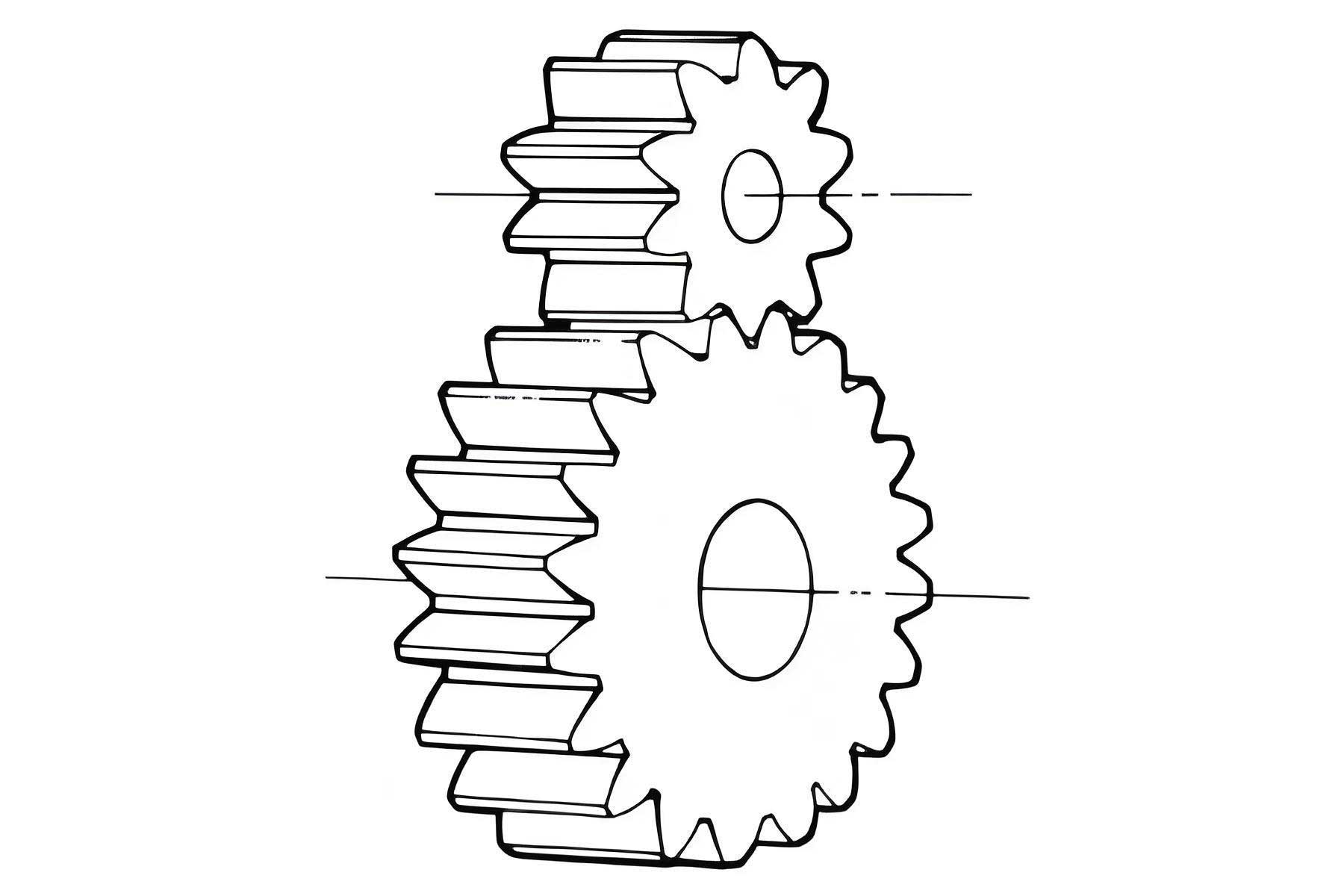
The fundamental obstacle in cold forging a spur gear is ensuring complete die filling. The process is analogous to radial extrusion. During the initial stage, axial friction influences material flow, while in the final stage, radial friction becomes the dominant factor. Crucially, the resistance to filling is not uniform across the tooth width. Material at the mid-width section primarily encounters resistance from the tooth cavity walls. In contrast, material in contact with the upper and lower punch surfaces experiences additional frictional forces from these interfaces. This results in a greater flow resistance for material at the top and bottom regions compared to the center, leading to insufficient filling at the gear’s corner radii, as illustrated by the pressure distribution. This non-uniform pressure, exacerbated by friction, is a root cause of incomplete spur gear formation.
The introduction of a floating die mechanism fundamentally alters the frictional conditions and stress state within the workpiece. In a conventional setup with a stationary die, the upper punch moves downward. Friction between the stationary die and the billet acts upwards, opposing the punch motion. This causes a loss of axial pressure transmitted through the billet, resulting in higher effective stress and better filling capability in the upper regions near the moving punch. Conversely, when a floating die is employed, it moves synchronously with the upper punch at the same velocity. In this configuration, the frictional force exerted by the die on the billet is directed downwards, additive to the punch force. This creates a pressure gradient where the axial pressure increases towards the lower, stationary punch. Consequently, the material near the bottom yields and deforms more readily, enhancing the filling of the lower tooth regions of the spur gear. This manipulation of friction via die movement is the core principle behind the floating die technique for improving spur gear formability.
To systematically evaluate the effectiveness of this approach, I conducted a series of three-dimensional finite element simulations using DEFORM-3D software. The study part was a spur gear with 18 teeth, a module of 2.5 mm, and a central hexagonal through-hole. A billet with an outer diameter of 38 mm, inner diameter of 24 mm, and height of 19.5 mm was designed based on volume constancy. Exploiting symmetry, only half of the model was simulated to enhance computational efficiency. The billet material was defined as AISI-1045, modeled as a rigid-plastic body, while all dies were treated as rigid bodies. The initial temperature was set to 20°C (room temperature), and a shear friction model with a coefficient of 0.12 was applied. The speed for both the upper punch and the floating die was set at 5 mm/s. Three distinct process schemes were devised and analyzed:
Scheme 1: Basic Floating Die Process. The floating die and upper punch move downward together at identical speeds. This is the simplest implementation of the concept aimed at improving overall filling.
Scheme 2: Floating Die with Axial Relief Hole. This scheme incorporates an axial relief hole (25 mm diameter) in the center of the upper punch. The floating die mechanism is still active. The purpose of the hole is to provide an alternative flow path for excess material, thereby reducing the overall forming pressure while maintaining the filling benefits of the floating die for the spur gear teeth.
Scheme 3: Two-Step Floating Die with Axial Relief. This is a two-stage process. First, a pre-forging operation is performed using the basic floating die setup (Scheme 1). The process is stopped when the load reaches a pre-defined threshold (2,940 kN for the full billet). The preform, which has accumulated material in the tooth regions, is then inverted. The second stage employs a floating die with an axial relief hole (28 mm diameter) in the upper punch to finish the forging. This approach aims to optimize material distribution and further reduce final forging loads for the spur gear.
The simulation results were evaluated based on three key metrics: the distribution of effective strain, the completeness of tooth profile filling, and the magnitude of the forming load. The effective strain fields revealed distinct patterns. In Scheme 1, the maximum strain was concentrated uniformly at the tooth roots, where material undergoes severe deformation as it flows around the sharp corners to fill the cavity. For Scheme 2, the peak strain localized in the transition zone between the relief hole and the tooth form, indicating intense deformation as material splits to fill both the gear teeth and the hole. Scheme 3 showed a more uniform strain distribution, with the maximum remaining at the tooth roots from the preform stage, and the final stage adding less severe strain.
The assessment of tooth filling provided clear visual and quantitative differences. Scheme 1 showed improved filling compared to a fixed-die process, but minor underfilling was still evident at the upper tooth corners due to the residual pressure gradient. Scheme 2 achieved excellent and complete filling of the spur gear tooth profile; however, a significant amount of material was extruded into the axial relief hole. Scheme 3 yielded the most favorable outcome: the spur gear teeth were completely and uniformly filled across the entire width, and the extent of material flowing into the larger relief hole during the final stage was minimal. This demonstrates the superior control over material flow in the two-step process.
The most significant impact was observed in the forming loads. The load-stroke curves for the three schemes exhibited characteristic shapes, typically divided into three stages: initial rapid elastic-plastic loading, a steady rising phase as the tooth form develops, and a final sharp rise as flash forms or material confinement increases. The peak loads, however, differed dramatically. The basic floating die process (Scheme 1) required the highest load, with a peak of approximately 5,280 kN. The incorporation of the axial relief hole in Scheme 2 effectively reduced this peak load to about 3,680 kN, a reduction of roughly 30.3%. The most effective load reduction was achieved by Scheme 3. The final forging step in this two-stage process peaked at only about 3,000 kN, representing a substantial reduction of 43.2% compared to the basic floating die approach. This drastic decrease is attributed to the optimal preform geometry from the first stage, which reduces the severity of deformation in the final stage, combined with the pressure-relieving effect of the axial hole.
The relationship between the process mechanics and the final outcome can be partly summarized by the ideal deformation resistance formula for upsetting or extrusion-type operations:
$$P = Y \ln\left(\frac{1}{1-R}\right)$$
where $P$ is the deformation pressure, $Y$ is the nominal flow stress of the material, and $R$ is the relative area reduction. In spur gear forging, as the die cavities fill, the free surface area of the billet decreases rapidly, causing $R$ to increase and consequently driving the pressure $P$ upwards sharply in the final moments. The relief hole in Schemes 2 and 3 provides an alternative “free surface,” effectively moderating the increase in $R$ and thus controlling the peak pressure $P$.
| Process Scheme | Key Feature | Peak Load (kN) | Load Reduction vs. Scheme 1 | Tooth Filling Quality |
|---|---|---|---|---|
| Scheme 1 | Basic Floating Die | 5,280 | — | Good, minor upper corner underfill |
| Scheme 2 | Floating Die + Axial Relief | 3,680 | 30.3% | Excellent, but high relief hole fill |
| Scheme 3 | Two-Step (Preform + Finish with Relief) | 3,000 | 43.2% | Optimal, complete fill with minimal waste |
In conclusion, the numerical investigation into the cold precision forging of a hexagonal-bored spur gear clearly demonstrates the profound impact of floating die technology. While the basic floating die process significantly enhances the filling capability of the spur gear teeth compared to conventional methods, it does so at the cost of very high forming loads. The strategic integration of an axial material relief path with the floating die action presents a superior solution. It not only maintains excellent spur gear tooth fill but also drastically reduces the required forming force, alleviating equipment demands and improving die life. The most advanced approach, the two-step process involving floating die pre-forging followed by a floating-die finish forging with an axial relief, delivers the best overall performance. It achieves perfect spur gear profile filling while minimizing the extrusion of waste material into the relief hole and effecting the largest reduction in peak forming load. These findings provide a strong foundation for designing efficient and robust cold forging processes for complex spur gears, making the technology more viable for industrial application.