
In mechanical power transmission systems, spur gears are among the most widely used components due to their simplicity, reliability, and ability to transmit motion and power efficiently. The meshing efficiency of a spur gear pair is a critical performance metric, directly influencing the overall energy consumption, thermal management, and operational lifespan of gearboxes. In this paper, I explore how key structural parameters of involute spur gears affect their instantaneous and average meshing efficiency. The analysis is grounded in the fundamental concept of contact forces between gear teeth and incorporates a detailed examination of the friction conditions at the tooth interface. By developing mathematical models for efficiency, I aim to provide designers with insights that can guide the selection of optimal gear parameters for high-efficiency applications.
The efficiency of a spur gear drive is not constant during the mesh cycle; it varies as the contact point moves along the path of action. This variation stems from changes in the relative sliding velocity, the load distribution, and the friction conditions at each instant of tooth engagement. To accurately capture this behavior, I first establish a model for the instantaneous meshing efficiency based on the forces acting between a pair of spur gear teeth. The central element in this model is the friction coefficient between the contacting tooth surfaces, which is itself a complex function of operating conditions, lubrication regime, and surface properties.
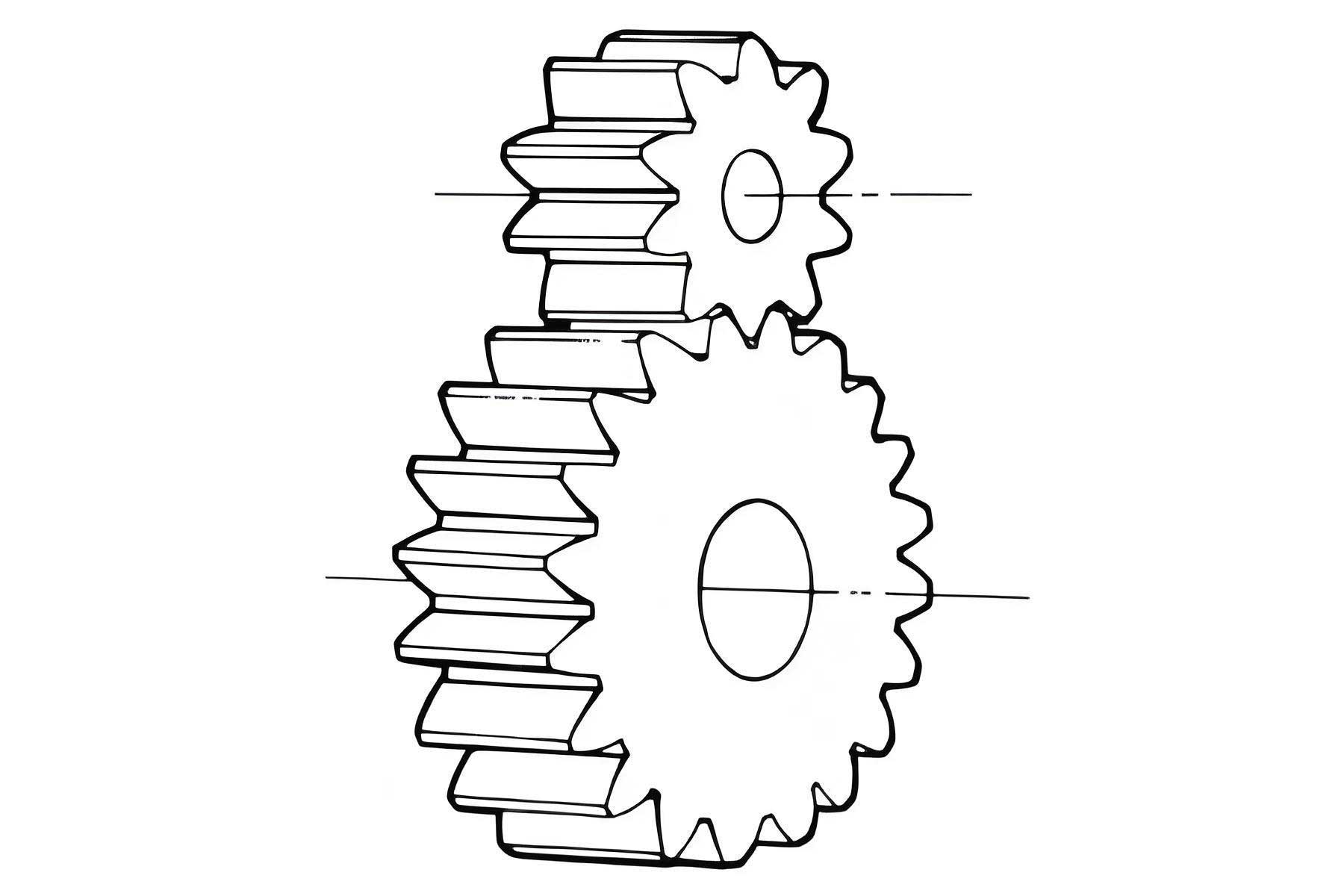
Modeling the friction coefficient for spur gear contacts is challenging due to the transient nature of elastohydrodynamic lubrication (EHL) in the gear mesh. In practice, a constant average friction coefficient is often employed for preliminary efficiency calculations. However, more refined models exist. For instance, under boundary or mixed lubrication conditions (film thickness ratio Λ < 3), the Benedict-Kelley model can be used, while for full-film EHL (Λ > 4), the Xu-Kahraman model may be more appropriate. A comprehensive friction model switches between these based on the instantaneous Λ value. For the purpose of deriving a general efficiency expression applicable to a wide range of spur gear designs, I adopt a constant, spatially-averaged friction coefficient f. This simplification allows for the derivation of closed-form equations while still capturing the essential influence of friction on spur gear efficiency. The common range for this average friction coefficient in well-lubricated spur gears is between 0.03 and 0.09.
Consider an involute spur gear pair in mesh, as illustrated in the force diagram. The driver gear (Gear 1) rotates with angular velocity ω1, and the driven gear (Gear 2) with ω2. The line of action is N1N2, and the pitch point is P. At any generic contact point D on the line of action, the total contact force R between the teeth acts along a line that is inclined by the friction angle φ relative to the common normal (line of action). The friction angle is related to the friction coefficient by \( \tan \phi = f \). The pressure angles at the contact point for Gear 1 and Gear 2 are α1 and α2, respectively. The input and output power at this instant can be expressed in terms of the force, velocities, and angles. From the fundamental law of gearing, the velocity components along the common normal are equal: \( v_1 \cos \alpha_1 = v_2 \cos \alpha_2 \). The instantaneous efficiency η is the ratio of output power to input power. For a contact point located between the pitch point P and the start of active profile (S1), the force direction is such that the instantaneous efficiency η1 is derived as:
$$ \eta_1 = \frac{1 + \tan \phi \tan \alpha_2}{1 + \tan \phi \tan \alpha_1} $$
Conversely, for a contact point between P and the end of active profile (S2), the direction of friction reverses, leading to a different expression for the instantaneous efficiency η2:
$$ \eta_2 = \frac{1 – \tan \phi \tan \alpha_2}{1 – \tan \phi \tan \alpha_1} $$
These two equations form the cornerstone for analyzing the spur gear meshing efficiency at any point during engagement. They clearly show that the efficiency is a function of the friction coefficient and the pressure angles at the specific contact point. Since α1 and α2 are geometric parameters that change continuously as the contact moves, the efficiency varies throughout the mesh cycle.
To utilize these equations for a specific spur gear pair, the pressure angles α1 and α2 must be expressed in terms of standard gear parameters and the position along the line of action. For a standard involute spur gear with module m, pressure angle α, and numbers of teeth z1 and z2, the base circle radii are \( r_{b1} = 0.5 m z_1 \cos \alpha \) and \( r_{b2} = 0.5 m z_2 \cos \alpha \). The distance from the pitch point P to the current contact point is denoted by x. Using the geometry of involute curves, the pressure angles can be related to x:
$$ \tan \alpha_1 = \tan \alpha + \frac{x}{r_{b1}} $$
$$ \tan \alpha_2 = \tan \alpha – \frac{x}{r_{b2}} \quad \text{(for points between P and S1)} $$
$$ \tan \alpha_2 = \tan \alpha + \frac{x}{r_{b2}} \quad \text{(for points between P and S2)} $$
Substituting these relationships into the instantaneous efficiency formulas allows us to express efficiency solely as a function of x, the gear parameters, and the friction coefficient. For the approach path (P to S1), the efficiency becomes:
$$ \eta_1(x) = \frac{1 + \tan \phi \left( \tan \alpha – \frac{x}{r_{b2}} \right)}{1 + \tan \phi \left( \tan \alpha + \frac{x}{r_{b1}} \right)} $$
For the recess path (P to S2), the efficiency is:
$$ \eta_2(x) = \frac{1 – \tan \phi \left( \tan \alpha + \frac{x}{r_{b2}} \right)}{1 – \tan \phi \left( \tan \alpha – \frac{x}{r_{b1}} \right)} $$
These equations explicitly show how the instantaneous spur gear efficiency depends on the distance from the pitch point. At the pitch point (x = 0), both formulas yield an efficiency of 1 (or 100%), assuming no friction. However, with friction, the efficiency at x=0 is slightly less than 1. The efficiency decreases as the contact point moves away from the pitch point because the sliding velocity and the mechanical advantage change.
While instantaneous efficiency is insightful, the average meshing efficiency over the entire path of contact is more practical for design evaluation and system-level power loss calculations. The average efficiency \( \bar{\eta} \) is obtained by integrating the instantaneous efficiency along the effective length of the line of action (from S1 to S2) and dividing by that length. The total contact length S1S2 is determined by the addendum circles of the two spur gears and can be calculated from the gear geometry. Let the distances PS1 = L1 and PS2 = L2. The average efficiency is then:
$$ \bar{\eta} = \frac{1}{L_1 + L_2} \left( \int_{0}^{L_1} \eta_1(x) \, dx + \int_{0}^{L_2} \eta_2(x) \, dx \right) $$
Performing these integrations using the expressions for η1(x) and η2(x) yields closed-form, albeit complex, analytical formulas for the average spur gear meshing efficiency. The results of the integration are:
$$ \bar{\eta} = \frac{1}{L_1 + L_2} \left[ \frac{r_{b1}}{r_{b2}} L_1 – \frac{r_{b1}+r_{b2}}{\tan \phi} \ln \left( \frac{1 + \tan \phi \tan \alpha}{1 + \tan \phi \tan \alpha_{a1}} \right) + L_2 – \frac{r_{b2}(1 – \tan \phi \tan \alpha)}{\tan \phi} \ln \left( 1 + \frac{\tan \phi ( \tan \alpha_{a2} – \tan \alpha)}{1 – \tan \phi \tan \alpha} \right) \right] $$
where αa1 and αa2 are the pressure angles at the addendum circles of the driver and driven spur gears, respectively. These angles are calculated from the gear geometry: \( \alpha_{a1} = \arccos( r_{b1} / r_{a1} ) \) and \( \alpha_{a2} = \arccos( r_{b2} / r_{a2} ) \), with ra being the addendum radius. The contact lengths L1 and L2 are \( L_1 = r_{b1} (\tan \alpha_{a1} – \tan \alpha) \) and \( L_2 = r_{b2} (\tan \alpha_{a2} – \tan \alpha) \).
This model provides a direct way to compute the average meshing efficiency for any standard involute spur gear pair given its basic parameters: number of teeth z1 and z2, module m, pressure angle α, addendum coefficient, and an average friction coefficient f. To illustrate the application of this model and to investigate the influence of key spur gear parameters, I conduct a series of parametric studies. The base case parameters are: z1 = 19, z2 = 52, m = 5 mm, α = 20°, ha* = 1.0, c* = 0.25, and f = 0.05.
The first analysis examines the difference in efficiency between a speed-reducing spur gear set and a speed-increasing spur gear set. It is crucial to note that the roles of driver and driven gears are reversed in these two cases. For the reducing case (z1 < z2), Gear 1 is the driver. For the increasing case (z1 > z2), Gear 2 becomes the driver, and the formulas for α1 and α2 must be adjusted accordingly because the “driver” is now the gear with more teeth. The instantaneous efficiency profiles along the path of action for both configurations, using the same physical gear pair but swapping the driving role, are plotted conceptually. The calculations show that the instantaneous efficiency is generally higher for the speed-increasing spur gear arrangement than for the speed-reducing one at corresponding points along the mesh path. This is due to the more favorable pressure angle relationships that reduce the loss component.
To quantify the average efficiency trend, I calculate \( \bar{\eta} \) for a driver spur gear with z1 = 19 and a range of driven spur gear teeth counts from 19 to 99 (reducing) and then for the inverse configuration (increasing). The results are summarized in Table 1.
| Transmission Type | Driver Teeth (z_drive) | Driven Teeth (z_driven) | Ratio (i) | Average Efficiency \( \bar{\eta} \) (%) |
|---|---|---|---|---|
| Speed Reduction | 19 | 19 | 1.00 | 98.71 |
| 19 | 30 | 0.63 | 98.88 | |
| 19 | 52 | 0.37 | 99.02 | |
| 19 | 75 | 0.25 | 99.11 | |
| 19 | 99 | 0.19 | 99.16 | |
| Speed Increase | 99 | 19 | 5.21 | 99.41 |
| 75 | 19 | 3.95 | 99.38 | |
| 52 | 19 | 2.74 | 99.33 | |
| 30 | 19 | 1.58 | 99.22 | |
| 19 | 19 | 1.00 | 98.71 |
The data clearly indicates that for speed-reducing spur gear pairs, the average meshing efficiency improves as the reduction ratio increases (i.e., as z2 becomes larger relative to z1). Conversely, for speed-increasing spur gear pairs, the efficiency is higher than for equivalent reduction ratios, and it decreases as the increase ratio becomes larger. In all cases, the spur gear configuration for speed increase yields a higher average efficiency than its speed-reduction counterpart with the same absolute gear sizes. This finding has significant implications for the design of gearboxes in applications like wind turbines, where a speed-increasing gearbox is used.
The influence of the friction coefficient on spur gear efficiency is straightforward but critical. Using the base case spur gear pair (z1=19, z2=52, α=20°), I compute the average meshing efficiency for a range of friction coefficients from 0.03 to 0.09. The results are presented in Table 2.
| Friction Coefficient (f) | Friction Angle φ (degrees) | Average Efficiency \( \bar{\eta} \) (%) | Efficiency Drop from f=0.03 (%) |
|---|---|---|---|
| 0.03 | 1.72 | 99.41 | 0.00 |
| 0.04 | 2.29 | 99.21 | -0.20 |
| 0.05 | 2.86 | 99.02 | -0.39 |
| 0.06 | 3.43 | 98.82 | -0.59 |
| 0.07 | 4.00 | 98.63 | -0.78 |
| 0.08 | 4.57 | 98.44 | -0.97 |
| 0.09 | 5.14 | 98.25 | -1.16 |
The table demonstrates an inverse proportional relationship between the friction coefficient and the spur gear meshing efficiency. Every 0.01 increase in the friction coefficient causes an average efficiency drop of approximately 0.2 percentage points for this specific spur gear set. This underscores the importance of effective lubrication, high-quality surface finish, and proper material selection to minimize friction in spur gear applications.
Another fundamental design parameter for spur gears is the pressure angle α. While 20° is the most common standard, other values like 14.5°, 15°, 22.5°, and 25° are also used in specialized applications. To analyze its effect, I calculate the average efficiency for the base spur gear pair (z1=19, z2=52, f=0.05) across these different pressure angles. The results are compiled in Table 3.
| Pressure Angle α (degrees) | Base Circle Radius Ratio (r_b2/r_b1) | Contact Length (S1S2) [mm] | Average Efficiency \( \bar{\eta} \) (%) |
|---|---|---|---|
| 14.5 | 2.7368 | 22.15 | 98.76 |
| 15.0 | 2.7368 | 21.28 | 98.81 |
| 20.0 | 2.7368 | 15.31 | 99.02 |
| 22.5 | 2.7368 | 13.49 | 99.11 |
| 25.0 | 2.7368 | 11.98 | 99.20 |
The data reveals a clear trend: increasing the pressure angle leads to higher average meshing efficiency for the spur gear pair. This improvement occurs despite a reduction in the total length of the line of action. A larger pressure angle reduces the radial component of the tooth force and alters the relationship between α1 and α2 along the path of contact in a way that diminishes the power loss contribution from friction. However, it is important to balance this benefit against other design considerations for spur gears, such as root bending strength (which benefits from a larger pressure angle) and contact ratio (which decreases with a larger pressure angle, potentially affecting smoothness of operation).
The module of a spur gear, which scales the physical size of the teeth, does not appear explicitly in the final average efficiency formula when expressed in terms of pressure angles and tooth counts. This indicates that, for geometrically similar spur gear pairs (i.e., same z1, z2, α, and profile), the module has a negligible direct effect on the theoretical meshing efficiency derived from tooth friction alone. However, the module indirectly influences efficiency through its effect on load-dependent losses (e.g., bending and contact deformation), lubricant churning losses, and the operating conditions that affect the friction coefficient. These secondary effects are not captured by the pure kinematic model presented here but are critical in a complete spur gear system efficiency analysis.
The models and analyses presented provide a framework for understanding the parametric sensitivity of spur gear efficiency. For designers, several guidelines emerge. First, when high efficiency is paramount, opting for a larger pressure angle within the feasible design space can be beneficial. Second, understanding that a speed-increasing spur gear stage will inherently have slightly lower frictional losses than a speed-reducing stage with the same gears can inform transmission architecture decisions. Third, minimizing the friction coefficient through lubrication design and surface engineering is always a direct path to higher spur gear efficiency. Finally, while the module doesn’t affect the basic tooth-friction efficiency, it should be chosen to manage other losses and meet strength requirements.
In conclusion, the meshing efficiency of involute spur gears is a dynamic characteristic profoundly influenced by basic design parameters. The instantaneous efficiency is highest at the pitch point and decreases towards the ends of the contact path. The average meshing efficiency, which is of practical interest, can be calculated analytically using the integrated model. Key findings are that larger pressure angles and larger reduction ratios (for reducer spur gears) contribute to improved average efficiency. Conversely, the friction coefficient is inversely proportional to efficiency. Furthermore, a spur gear pair configured for speed increase operates at a higher average meshing efficiency than the same pair configured for speed reduction. These insights, derived from force-based mechanical models, offer valuable guidance for the optimization of spur gear designs in power transmission systems where energy efficiency is a critical performance metric.