
In my extensive work with mechanical systems, I have often encountered the challenge of spur gear measurement and calculation, particularly when dealing with foreign equipment where original design parameters are unavailable. Spur gears, as fundamental components in power transmission, require precise dimensional accuracy to ensure optimal performance. This article details my approach to spur gear plotting, focusing on involute cylindrical spur gears, and provides practical methods for determining key parameters such as module, diametral pitch, pressure angle, and modification coefficients. I will emphasize the importance of using formulas and tables for summarization, and through first-person perspective, share insights from real-world applications.
The process of spur gear measurement involves deducing the original design specifications from physical samples. For spur gears, the critical parameters include the number of teeth \(z\), module \(m\) or diametral pitch \(DP\), pressure angle \(\alpha\), center distance \(a\), and modification coefficient \(x\). Among these, the number of teeth is easily obtained by counting, but the others require systematic measurement and calculation. I have found that understanding the base tooth profile standards of different countries is essential, as spur gears from various regions may follow distinct systems. For instance, many countries use the module system with a pressure angle of \(20^\circ\), while others, like the United States and the United Kingdom, use the diametral pitch system with pressure angles ranging from \(14.5^\circ\) to \(25^\circ\).
To determine the base tooth profile of a spur gear, I typically rely on measuring the common normal line length, as it offers high accuracy and convenience. The common normal line length, denoted as \(W_k\), is measured using a caliper or micrometer that ensures tangency with the opposite involute tooth flanks. The number of teeth spanned, \(k\), must be chosen appropriately to avoid measurement errors near the tooth tip or root. For spur gears, I calculate the span number using the formula:
$$ k = \frac{z}{9} + 0.5 $$
This formula is derived from empirical practices for standard spur gears, but adjustments may be needed for modified gears. Once \(k\) is determined, I measure at least two sets of common normal line lengths, such as \(W_{k-1}^*\), \(W_k^*\), and \(W_{k+1}^*\), to compute the base pitch \(P_b\). The base pitch is crucial because it remains constant for a given gear pair and directly relates to the module and pressure angle. I calculate it as:
$$ P_b = W_k^* – W_{k-1}^* $$
By referring to base pitch tables, I can identify the corresponding module \(m\) or diametral pitch \(DP\) and pressure angle \(\alpha\). This method is particularly reliable for spur gears with minimal wear, as it minimizes errors from tooth surface damage.
After establishing the base tooth profile, I proceed to determine the modification coefficient \(x\) for the spur gear. The modification coefficient, often called the addendum modification coefficient, indicates whether the gear is standard or modified. I prefer using the common normal line method for this calculation, as it is less affected by tooth tip dimensions. The formula I use is:
$$ x = \frac{W’ – W^*}{2m \sin \alpha} $$
Here, \(W’\) is the measured common normal line length, and \(W^*\) is the theoretical common normal line length for a standard spur gear without modification. For spur gears, I compute \(W^*\) using:
$$ W^* = m \cos \alpha [\pi (k – 0.5) + z \cdot \text{inv} \alpha] $$
where \(\text{inv} \alpha\) is the involute function of the pressure angle. In practice, I measure multiple common normal line lengths and average the results to improve accuracy. However, this method can be influenced by tooth wear, so I always cross-verify with other dimensional measurements.
To validate my calculations, I utilize radial dimension data such as the tip diameter \(d_a\) and root diameter \(d_f\). For spur gears, these diameters are related to the module and modification coefficient by:
$$ d_a = m(z + 2 + 2x) $$
$$ d_f = m(z – 2.5 + 2x) $$
These equations assume standard tooth height coefficients, but variations exist based on national standards. I compare the calculated diameters with measured values to check for consistency. If discrepancies arise, I consider factors like tooth wear or non-standard tooth profiles. Additionally, for gear pairs, I measure the center distance \(a’\) and use it to refine the modification coefficients. The theoretical center distance for a spur gear pair is:
$$ a = \frac{m(z_1 + z_2)}{2} $$
For modified spur gears, the center distance may differ, and I calculate the total modification coefficient \(\sum x\) from the measured center distance to adjust individual coefficients.
In my experience, spur gear measurement often involves dealing with gears from different countries, each with unique base tooth profiles. Below is a table summarizing common involute base tooth profiles for spur gears from major developed countries, which I frequently reference during my work:
| Country | Tooth Profile Type | Module \(m\) or Diametral Pitch \(DP\) | Pressure Angle \(\alpha\) (degrees) | Addendum Coefficient \(h_a^*\) | Dedendum Coefficient \(c^*\) | ||||||
|---|---|---|---|---|---|---|---|---|---|---|---|
| International Standard | Standard | \(m\) | 20 | 1 | 0.25 | ||||||
| China | Standard | \(m\) | 20 | 1 | 0.25 | Germany | Standard | \(m\) | 20 | 1 | 0.1–0.3 |
| Japan | Standard | \(m\) | 20 | 1 | 0.25 | ||||||
| United States | Standard | \(DP\) | 20 or 25 | 1 | 0.157–0.4 | ||||||
| United Kingdom | Standard | \(DP\) | 20 | 1 | 0.25 |
This table helps me quickly identify the likely standards for a spur gear based on its origin. For example, if I encounter a spur gear from the U.S., I anticipate a diametral pitch system with a pressure angle of \(20^\circ\) or \(25^\circ\), while German spur gears typically follow the module system with \(\alpha = 20^\circ\).
To illustrate the spur gear measurement process, I will describe two cases from my practice. The first involves a spur gear pair from an American-made reducer. The measured data were: for the driving spur gear, \(z_1 = 26\), \(W_4 = 90.76\, \text{mm}\), \(W_5 = 114.86\, \text{mm}\), tip diameter \(d_{a1} = 238.4\, \text{mm}\), root diameter \(d_{f1} = 197\, \text{mm}\); for the driven spur gear, \(z_2 = 37\), \(W_5 = 116.41\, \text{mm}\), \(W_6 = 140.52\, \text{mm}\), \(d_{a2} = 329.8\, \text{mm}\), \(d_{f2} = 288.5\, \text{mm}\); and center distance \(a’ = 267\, \text{mm}\). I began by computing the base pitch for both spur gears. For the driving spur gear:
$$ P_{b1} = W_5 – W_4 = 114.86 – 90.76 = 24.1\, \text{mm} $$
For the driven spur gear:
$$ P_{b2} = W_6 – W_5 = 140.52 – 116.41 = 24.11\, \text{mm} $$
The close match confirmed accurate measurement. Consulting base pitch tables, I identified this as a diametral pitch spur gear with \(DP = 3\) and \(\alpha = 25^\circ\), consistent with American standards. Next, I calculated the modification coefficients. For the driving spur gear, using the common normal line method, I obtained \(x_1 = 0.0583\) on average. For the driven spur gear, \(x_2 = -0.0780\). Using the measured center distance, I refined these coefficients to \(x_1 = 0.0859\) and \(x_2 = -0.0505\). Finally, I verified the results by computing the tip and root diameters. For American spur gears with \(\alpha = 25^\circ\), \(h_a^* = 1\) and \(c^* = 0.4\). The calculated diameters aligned well with measurements, validating the spur gear parameters.
The second case involved a German spur gear with data: \(z = 21\), \(W_3 = 160.6\, \text{mm}\), \(W_4 = 219.56\, \text{mm}\), \(d_a = 481.5\, \text{mm}\), \(d_f = 383.2\, \text{mm}\). The base pitch was:
$$ P_b = W_4 – W_3 = 219.56 – 160.6 = 58.96\, \text{mm} $$
This indicated a module spur gear with \(m = 20\) and \(\alpha = 20^\circ\), per German standards. The modification coefficient calculated from common normal line lengths was \(x = 0.5168\), but after considering wear and pairing with a gear of \(z = 13\) and center distance \(a’ = 359.6\, \text{mm}\), I adjusted it to \(x = 0.5268\). However, initial diameter calculations using standard coefficients showed discrepancies. I realized that for this spur gear, a non-standard tooth height might be used to improve meshing performance. Assuming \(h_a^* = 1.2\) and \(c^* = 0.267\), based on German practices for ground spur gears, the recalculated diameters matched the measurements closely, confirming the parameters.
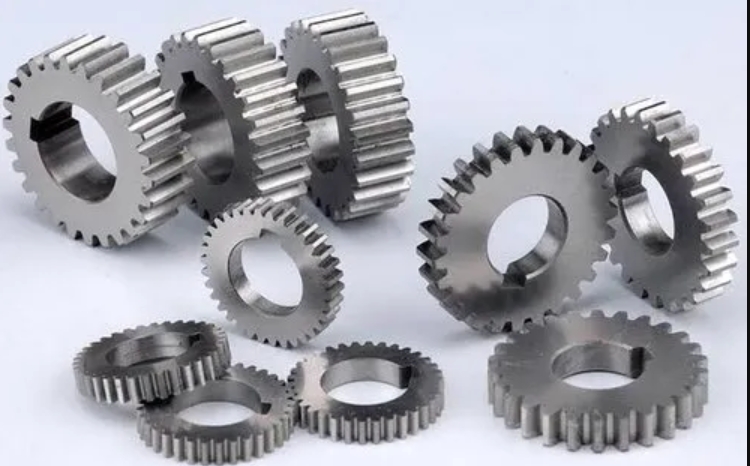
In both cases, the spur gear measurement process relied heavily on common normal line measurements and iterative validation. I have found that for spur gears, this approach is efficient and minimizes errors, especially when dealing with worn or modified gears. The key is to combine multiple measurement techniques and cross-check with theoretical formulas. For instance, the common normal line method for spur gears is complemented by tip diameter measurements, which provide additional constraints. Moreover, understanding the context of the spur gear’s application—such as whether it is part of a high-precision transmission or a heavy-duty machinery—can guide assumptions about tooth profiles.
Beyond basic measurement, I often employ computational tools to automate calculations for spur gears. Using spreadsheets or custom software, I input measured data and quickly obtain parameter estimates. For example, the base pitch calculation for spur gears can be programmed as:
$$ P_b = \frac{\sum_{i=1}^{n} (W_{k+i} – W_{k+i-1})}{n} $$
where \(n\) is the number of measured intervals. This averaging reduces random errors. Similarly, the modification coefficient for spur gears can be derived from a system of equations involving tip diameter, root diameter, and center distance. I frequently use the following relationship for spur gear pairs:
$$ a’ = \frac{m(z_1 + z_2)}{2} + m(x_1 + x_2) $$
This allows me to solve for \(x_1\) and \(x_2\) when the center distance is known. For single spur gears, I rely more on tip and root diameters, expressed as:
$$ d_a = m(z + 2h_a^* + 2x) $$
$$ d_f = m(z – 2h_a^* – 2c^* + 2x) $$
By solving these equations simultaneously, I can deduce \(h_a^*\) and \(x\) if the standard coefficients are uncertain. This is particularly useful for spur gears from older equipment where documentation is lacking.
Another aspect I consider in spur gear measurement is the effect of manufacturing tolerances and wear. Spur gears in service often exhibit tooth flank wear, which can affect common normal line measurements. To account for this, I measure multiple positions along the gear circumference and use statistical methods to estimate the original dimensions. For spur gears with significant wear, I may resort to alternative methods, such as using a standard gear hob to determine the module and pressure angle indirectly. However, this requires access to a variety of hobs and is less convenient for field measurements. Therefore, I always prioritize non-destructive methods like common normal line measurement for spur gears.
In terms of applications, spur gear measurement is critical in industries like automotive, aerospace, and mining, where gear replacement or reverse engineering is common. For example, in mining machinery, spur gears are used in reducers and drives, and their failure can lead to costly downtime. By accurately measuring spur gear parameters, I can facilitate the fabrication of replacement parts without original drawings. This not only saves time but also ensures compatibility and performance. My experience has shown that a systematic approach—starting with tooth count, then base profile determination, followed by modification coefficient calculation, and finally validation—yields reliable results for spur gears.
To further elaborate on spur gear measurement, I will discuss the mathematical foundations of involute geometry. The involute curve of a spur gear is defined by the path of a point on a taut string unwinding from a base circle. The parametric equations for an involute are:
$$ x = r_b (\cos \theta + \theta \sin \theta) $$
$$ y = r_b (\sin \theta – \theta \cos \theta) $$
where \(r_b\) is the base radius of the spur gear, given by \(r_b = \frac{m z \cos \alpha}{2}\), and \(\theta\) is the roll angle. This geometry underpins the common normal line measurement, as the line tangent to two opposite involutes corresponds to the base pitch. For spur gears, the base pitch is constant and related to the circular pitch \(p\) by:
$$ P_b = p \cos \alpha = \pi m \cos \alpha $$
This relationship is why measuring \(P_b\) allows me to deduce \(m\) and \(\alpha\) for spur gears. In practice, I use lookup tables based on this equation to match measured base pitches to standard values.
Additionally, I often deal with spur gears that have undergone profile modifications to reduce noise or improve strength. These modifications, such as tip relief or root fillet changes, can complicate measurement. For such spur gears, I focus on the active tooth flank regions where the involute profile is intact. The common normal line method still applies, but I may need to adjust the span number \(k\) to avoid modified zones. I use the formula for \(k\) with a correction factor:
$$ k = \frac{z}{9} + 0.5 + \frac{2x}{\pi} $$
This accounts for modification in spur gears and ensures tangency near the pitch circle. Empirical testing has shown this to be effective for most industrial spur gears.
In conclusion, spur gear measurement and calculation is a meticulous but manageable task when approached systematically. From my first-person perspective, I emphasize the importance of common normal line measurements, cross-validation with radial dimensions, and awareness of international standards. The use of formulas and tables, as demonstrated, streamlines the process and enhances accuracy. Whether dealing with American diametral pitch spur gears or German module spur gears, the principles remain consistent: determine the base tooth profile, compute modification coefficients, and verify with empirical data. This methodology not only aids in reverse engineering but also contributes to the maintenance and optimization of mechanical systems involving spur gears. By sharing these insights, I hope to provide a practical resource for engineers and technicians working with spur gears in diverse applications.