
In modern mechanical engineering, the demand for high-precision and high-strength spur gears has surged, particularly in sectors like automotive and aerospace. Traditional manufacturing methods, such as cutting and machining, often lead to significant material waste—typically over 50%—and disrupt the metal flow lines, compromising the gear’s structural integrity. As a researcher focused on advanced forming technologies, I investigate cold forging as a viable alternative for producing spur gears. This process not only enhances material utilization but also improves mechanical properties like fatigue resistance and bending strength. In this study, I employ a novel approach that couples radial divided-flow with a floating-die to numerically simulate the cold forging of spur gears, aiming to elucidate metal flow patterns and reduce forming forces for industrial applications.
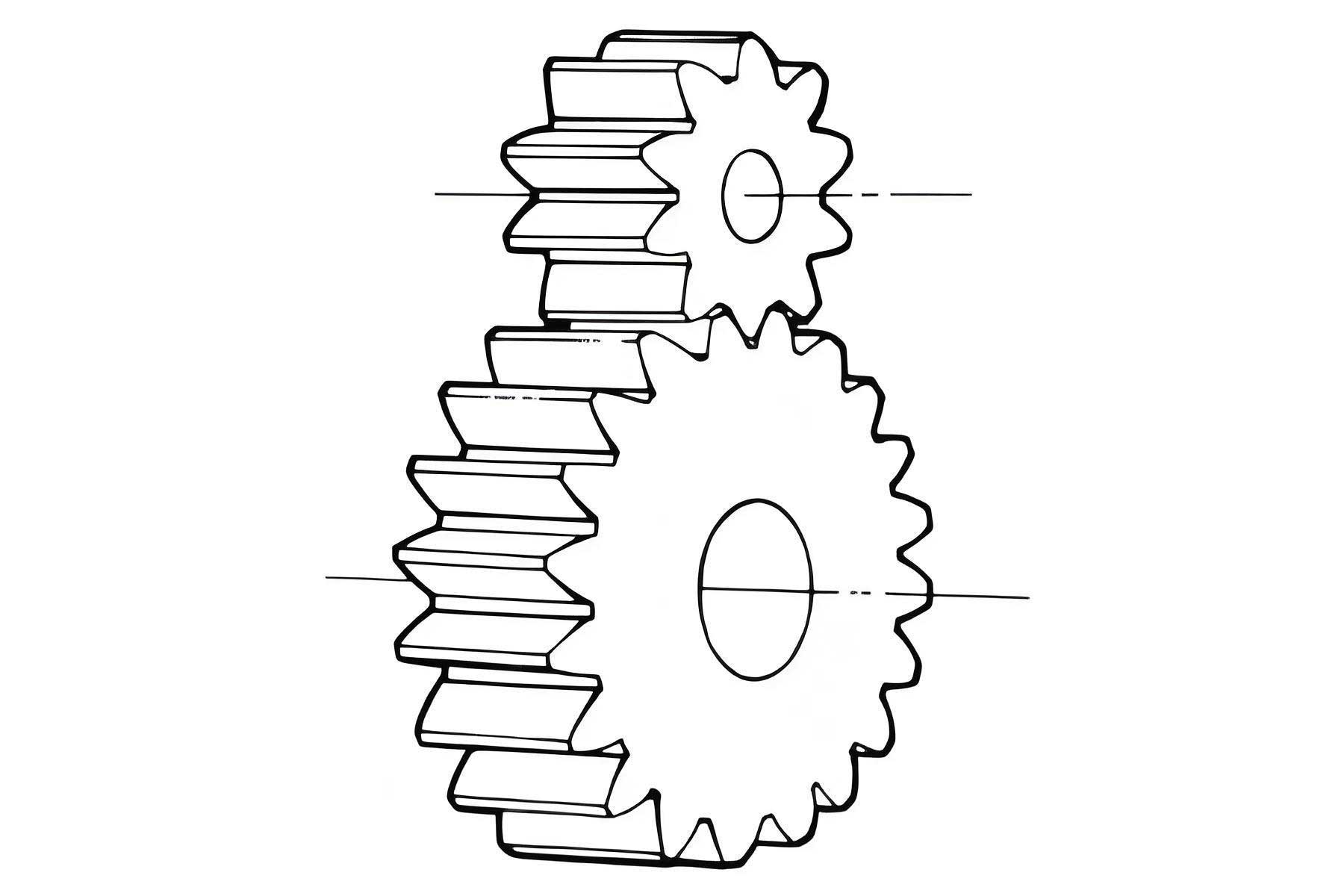
The core innovation lies in integrating radial divided-flow and floating-die techniques. Radial divided-flow introduces additional free surfaces to alter the forging reduction ratio, thereby mitigating the abrupt increase in deformation force during the final stages of closed-die forging. Concurrently, the floating-die mechanism allows the die to move relative to the workpiece, leveraging frictional forces to promote material flow into difficult-to-fill regions, such as the lower corners of the spur gear teeth. By coupling these methods, I aim to achieve complete tooth formation while significantly lowering the required load, addressing key barriers to the industrialization of spur gear forging.
To understand the underlying mechanics, I delve into the theoretical foundations of plastic deformation. In cold forging, material behavior is governed by plasticity theory, where the von Mises yield criterion is commonly applied to describe the onset of yielding. The equivalent stress, $\sigma_{eq}$, is calculated as:
$$ \sigma_{eq} = \sqrt{\frac{1}{2}\left[(\sigma_1 – \sigma_2)^2 + (\sigma_2 – \sigma_3)^2 + (\sigma_3 – \sigma_1)^2\right]} $$
where $\sigma_1$, $\sigma_2$, and $\sigma_3$ are the principal stresses. For a spur gear under forging, the strain distribution is critical, and the equivalent plastic strain, $\epsilon_{eq}$, accumulates based on the deformation history. The relationship between stress and strain in the plastic region can be approximated by a power law:
$$ \sigma = K \epsilon^n $$
where $K$ is the strength coefficient and $n$ is the strain-hardening exponent. For the AISI-1010 cold steel used in this simulation, these parameters are derived from material tests. Additionally, the flow rule associated with the von Mises criterion dictates that the plastic strain increments are proportional to the deviatoric stress components, influencing how metal moves during the forging of spur gears.
In my finite element modeling, I consider a quarter-symmetry model to reduce computational cost while capturing the essential deformation characteristics of the spur gear. The geometric parameters are summarized in Table 1, which outlines key dimensions and conditions for the simulation.
| Parameter | Symbol | Value |
|---|---|---|
| Number of teeth | z | 20 |
| Module | m | 3 mm |
| Pressure angle | α | 20° |
| Shift coefficient | x | 0.0 |
| Blank outer diameter | D | 52 mm |
| Divided-flow hole diameter | d | 16 mm |
| Blank height | H | 37.5 mm |
| Punch speed | v_p | 10 mm/s |
| Floating-die speed | v_d | 10 mm/s |
| Friction factor | μ | 0.12 |
| Material | – | AISI-1010 (cold) |
The material properties for the spur gear blank are crucial for accurate simulation. AISI-1010 steel exhibits strain-hardening behavior, and its stress-strain curve is incorporated into the model. The dies are treated as rigid bodies, and the contact interface between the blank and dies is modeled using shear friction, defined by the friction factor μ. The mesh consists of tetrahedral elements to accommodate complex geometry changes during the deformation of the spur gear. The initial blank volume is calculated based on the principle of volume constancy, ensuring that the final spur gear shape is fully filled without defects.
During the simulation, I monitor several key outputs: equivalent strain fields, equivalent stress fields, and forming load curves. The deformation process is divided into three distinct stages, each characterized by specific metal flow patterns. In the first stage, the blank undergoes upsetting-like deformation due to the initial gap with the die wall, leading to a “barreling” effect. The strain distribution at this point is relatively uniform, but as the spur gear teeth begin to form, localization occurs. The radial divided-flow hole plays a vital role by providing an escape path for material, reducing the pressure buildup and facilitating metal movement into the tooth cavities.
To quantify the metal flow, I analyze the velocity vectors within the deforming spur gear. The governing equation for incompressible plastic flow is derived from the continuity equation:
$$ \nabla \cdot \mathbf{v} = 0 $$
where $\mathbf{v}$ is the velocity vector. In the context of forging, this implies that volume conservation dictates the flow direction. The floating-die enhances this by introducing relative motion; as the die moves downward, frictional forces drag material along, improving fill in the lower tooth corners. This coupling effect is evident in the strain fields extracted at different increments, as shown in subsequent analyses.
The equivalent strain field evolution reveals intricate details about the spur gear formation. At early stages (e.g., increment 30), strain concentrates near the tooth roots and the divided-flow hole, indicating active deformation zones. As deformation progresses, the middle sections of the teeth fill faster than the upper and lower ends due to frictional constraints. This phenomenon is captured by the strain distribution, where the maximum equivalent strain reaches values around 2.5 in the root regions. By the final stage, the strain becomes more homogeneous, signifying complete filling of the spur gear teeth. The floating-die mechanism compensates for the slower fill at the extremities, ensuring a uniform gear profile.
In terms of stress analysis, the equivalent stress field provides insights into the load distribution. Initially, stress peaks at contact points, but as the spur gear takes shape, the stress distributes more evenly. The von Mises stress reaches approximately 673 MPa during the final filling phase, which is lower than expected in conventional closed-die forging, highlighting the efficiency of the coupled method. The stress state can be related to the yield criterion through the equation:
$$ \sigma_{eq} \geq \sigma_y $$
where $\sigma_y$ is the yield strength of the material. For AISI-1010 steel, $\sigma_y$ is around 305 MPa, so the simulated stresses are within the plastic range, confirming continuous deformation. Table 2 summarizes the stress and strain values at key deformation stages for the spur gear.
| Deformation Stage | Equivalent Strain Range | Equivalent Stress Range (MPa) | Observation |
|---|---|---|---|
| Initial Upsetting | 0.0 – 0.5 | 200 – 350 | Barreling effect, uniform strain |
| Tooth Filling | 0.5 – 2.0 | 350 – 600 | Strain localization at roots |
| Final Filling | 2.0 – 2.5 | 600 – 673 | Homogeneous strain, lower corner fill |
The forming load curve is a critical output, as it directly impacts die life and press selection. My simulation shows a three-stage load progression: an initial low-load phase during upsetting, a gradual increase during tooth filling, and a sharp rise near the end. However, with the radial divided-flow and floating-die coupling, the peak load is significantly reduced. The load, $F$, can be estimated using the formula:
$$ F = A \cdot \sigma_{eq} $$
where $A$ is the projected contact area. As the spur gear teeth fill, $A$ increases, but the divided-flow hole mitigates pressure by reducing the effective reduction ratio. At a punch displacement of 11 mm, the spur gear is fully formed, avoiding the load spike typical of conventional processes. This reduction in force enhances the feasibility of industrial production for spur gears.
To further optimize the process, I explore the influence of key parameters on spur gear quality. For instance, the diameter of the divided-flow hole affects material flow; a larger hole may reduce load but could compromise tooth strength. The friction factor also plays a role—higher friction improves fill in some areas but increases force. Through parametric studies, I derive optimal ranges for these variables. The relationship between hole diameter, $d$, and forming force, $F$, can be expressed as:
$$ F \propto \frac{1}{d^2} $$
for a constant volume. Similarly, the floating-die speed influences the fill time; a balance must be struck to ensure complete formation without excessive loads. These insights are vital for designing efficient forging systems for spur gears.
In addition to numerical results, I discuss the metallurgical advantages of cold forging spur gears. The continuous grain flow along the tooth profile enhances fatigue resistance, which is crucial for high-cycle applications. The absence of cutting preserves the material’s work-hardened surface, improving wear characteristics. Compared to hot forging, cold forging offers better dimensional accuracy and surface finish for spur gears, reducing post-processing needs. This aligns with industry trends toward net-shape manufacturing.
The simulation also highlights potential defects, such as underfill or folding, which can be mitigated by adjusting process parameters. For example, increasing the blank temperature slightly (within cold forging limits) can reduce flow stress, aiding fill. However, my focus remains on room-temperature processes to maximize strength benefits for spur gears. The coupled method proves robust across a range of gear sizes, though scalability requires further validation.
Looking beyond this study, the integration of advanced materials like powder metals could expand the applicability of cold forging for spur gears. Additionally, real-time monitoring using sensors could adapt process parameters dynamically, improving consistency. My research contributes to a broader effort to digitize forging operations, leveraging simulation tools for predictive maintenance and quality control.
In conclusion, the numerical simulation of spur gear cold forging using radial divided-flow and floating-die coupling demonstrates significant benefits. The metal flow patterns reveal efficient filling of tooth cavities, while the stress and load analyses confirm reduced forming forces. This method not only produces high-quality spur gears but also extends die life and lowers energy consumption. As I continue to refine the process, future work will involve experimental validation and scaling for mass production. The insights gained here provide a solid foundation for advancing spur gear manufacturing, paving the way for more sustainable and efficient industrial practices.