
In the realm of mechanical transmission systems, the spur gear stands as a fundamental component, pivotal for power transfer in automotive and industrial applications. The demand for high-performance spur gears, especially those with large dimensions and complex geometries like rectangular spur gears, has driven the adoption of precision forging techniques. Hot forging, in particular, offers advantages such as improved material utilization, enhanced mechanical properties, and dimensional accuracy. However, the intricate material flow during the forging of spur gears can lead to defects like folding and incomplete filling, necessitating advanced process design and analysis. In this work, I propose a multi-stage hot forging process for rectangular spur gears and employ finite element simulation to investigate the feasibility and optimize the parameters. The focus is on understanding the thermal-mechanical behavior to ensure defect-free spur gear production.
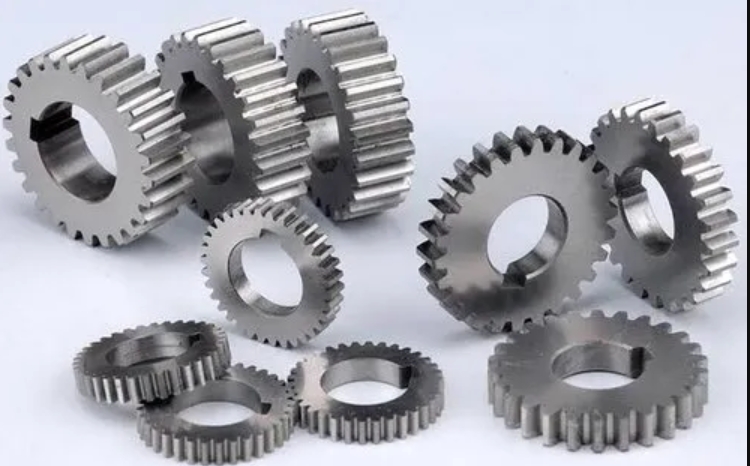
The rectangular spur gear under consideration features 16 teeth with a pitch diameter of 99.8 mm, a root diameter of 88.5 mm, a tooth width of 9.1 mm, and a tooth height of 5.65 mm. Such large dimensions pose significant challenges in achieving complete tooth cavity filling without defects. Traditional closed-die hot forging often results in issues due to restricted material flow. To address this, I developed a three-stage “one-heat” forging process comprising upsetting, pre-forging, and final forging. This sequential approach aims to control material distribution and flow, thereby reducing forming loads and minimizing defects in the spur gear. The process begins with upsetting to refine the initial billet, followed by pre-forging to pre-distribute material for the teeth, and culminates in final forging to form the precise spur gear geometry. This methodology leverages the benefits of hot working to enhance plasticity and reduce flow stress.
To model the hot forging process for the rectangular spur gear, I utilized the finite element software Deform-3D, which is well-suited for simulating large plastic deformation in metal forming. The simulation encompasses the entire multi-stage process, allowing for a comprehensive analysis of temperature distribution, effective strain, material velocity fields, and forging loads. The key parameters for the finite element model are summarized in Table 1, ensuring an accurate representation of the real-world forging conditions. These parameters include material properties, friction conditions, thermal settings, and mesh specifications, all critical for reliable simulation results.
| Parameter | Value or Description |
|---|---|
| Material | 20CrMnTiH gear steel |
| Constitutive Model | $$ \dot{\epsilon} = 1.2451 \times 10^{14} \times [\sinh(0.00962\sigma)]^{5.258} \exp\left(-\frac{371053}{RT}\right) $$ |
| Initial Billet Temperature | 1200°C |
| Die Preheat Temperature | 250°C |
| Friction Model | Shear friction with coefficient 0.3 |
| Heat Transfer Coefficient | 1 N·mm/(s·°C) for upsetting, 5 N·mm/(s·°C) for pre-forging and final forging |
| Step Size | 0.3 mm (upsetting), 0.2 mm (pre-forging), 0.1 mm (final forging) |
| Mesh Type | Tetrahedral elements with local refinement to 1 mm in tooth regions |
| Boundary Conditions | 1/8 symmetry model (45° sector) |
The material behavior for the spur gear forging is captured through a constitutive model derived from high-temperature compression tests on 20CrMnTiH steel. This model, expressed in terms of strain rate, stress, and temperature, is fundamental for simulating the flow stress during deformation. The equation incorporates the Arrhenius-type relationship to account for thermal effects, which is crucial for accurate hot forging analysis of spur gears. The model parameters were determined experimentally and input into Deform-3D, enabling extrapolation for temperatures above 1150°C. This ensures that the simulation reflects the material’s response across the entire forging temperature range, which is vital for predicting defects in spur gear teeth.
Friction conditions play a significant role in material flow during spur gear forging. I assumed a shear friction model with a coefficient of 0.3, corresponding to lubrication with a graphite-water suspension commonly used in hot forging. This choice influences the velocity fields and filling behavior of the spur gear teeth. Thermal settings were carefully defined: the billet starts at 1200°C to maintain high plasticity, while dies are preheated to 250°C to reduce heat loss and thermal shock. The heat transfer coefficients vary between stages—lower for upsetting due to minimal contact and higher for pre-forging and final forging where extensive die contact occurs. These settings help simulate realistic temperature gradients that affect flow stress and defect formation in the spur gear.
Mesh design is critical for resolving the complex geometry of spur gears. I employed tetrahedral elements with an initial minimum size of 1.5 mm, refined locally to 1 mm in the tooth regions during final forging. This refinement ensures accurate capture of material flow in the spur gear teeth, where deformation is most severe. The use of a 45° symmetric model reduces computational cost while maintaining accuracy, as the spur gear exhibits rotational symmetry. The simulation tracks the entire process sequentially, with data transferred between stages to account for residual stresses and temperature history, providing a holistic view of the spur gear forging process.
Moving to the simulation results, the temperature field evolution across the three stages reveals insights into thermal management. After upsetting, the workpiece retains a high temperature of around 1200°C at the core, with surface cooling to about 1020°C due to die contact. This temperature distribution is favorable for subsequent forging of the spur gear, as it minimizes flow stress variations. In pre-forging, temperatures drop further, especially on the surfaces of the web and flange, reaching as low as 850°C in some areas. However, the tooth pre-distribution zones remain above 1000°C, ensuring adequate plasticity for final spur gear forming. At the end of final forging, the temperature field shows significant cooling in the tooth tips and web surfaces, but the core and tooth roots maintain temperatures near 1000°C, which helps prevent cracking and improves fillability. This thermal history is crucial for designing heating and cooling strategies in spur gear production.
The effective strain distribution, as shown in Table 2, highlights the deformation intensity in different regions of the spur gear. During upsetting, high strain accumulates in the upset head due to free bulging, while the lower region experiences minimal strain. In pre-forging, strain concentrates in the tooth pre-forms and web surfaces, indicating material redistribution for the spur gear teeth. Final forging leads to elevated strain in the tooth roots and web lower surface, driven by radial flow to fill the teeth. This strain analysis helps identify potential sites for grain refinement and defect initiation, such as folding in the spur gear teeth. The non-uniform strain distribution underscores the need for optimized pre-form designs to ensure homogeneous deformation in spur gears.
| Forging Stage | High-Strain Regions | Strain Range |
|---|---|---|
| Upsetting | Upset head | 0.5 – 2.0 |
| Pre-forging | Tooth pre-forms, web surfaces | 0.8 – 2.5 |
| Final Forging | Tooth roots, web lower surface | 1.0 – 3.0 |
Material velocity fields provide a dynamic view of flow patterns during spur gear forging. In upsetting, radial outward flow dominates as the billet height decreases. During pre-forging, material flows radially outward from the center to pre-fill tooth cavities, with downward motion favored due to gravity, leading to better filling at the tooth bases. In final forging, the pre-distributed metal is extruded into the tooth cavities under die guidance, while the core material moves upward to form the hub via backward extrusion. Near the end, radial flow from the web assists in complete tooth filling, though slight downward flow at the tooth tips suggests minor flash or underfilling. These velocity patterns are essential for designing die geometries that promote uniform filling and avoid defects like laps in spur gear teeth. The control of material flow is a key aspect of successful spur gear forging.
Forging load analysis indicates the mechanical demands of each stage. The load curve for upsetting shows a gradual increase to a peak of 890 kN, reflecting the low resistance in semi-free forging. Pre-forging exhibits two phases: an initial slow rise during hub formation, followed by a rapid increase to 3110 kN as the web is compressed and tooth pre-forms are created. Final forging displays a similar trend, with loads soaring to 4320 kN at the end due to high pressure required for tooth cavity filling and minimal free surface. This peak load is below 70% of the capacity of a 6.3 MN high-energy screw press, validating the feasibility of the process for spur gear production. The load data, summarized in Table 3, aids in selecting appropriate equipment and optimizing die life for spur gear manufacturing.
| Stage | Peak Load (kN) | Percentage of 6.3 MN Press |
|---|---|---|
| Upsetting | 890 | 14.1% |
| Pre-forging | 3110 | 49.4% |
| Final Forging | 4320 | 68.6% |
To complement the simulation, I conducted experimental trials on a 6.3 MN high-energy screw press using the proposed three-stage “one-heat” process. The spur gear forgings produced exhibited full tooth filling with no folding defects, consistent with simulation predictions. The geometric dimensions met design specifications, and minor flash at the tooth tips was within acceptable limits. The forging load measured during trials was approximately 4 MN, aligning closely with the simulated peak of 4320 kN. This correlation validates the accuracy of the finite element model for spur gear forging. The successful production of defect-free spur gears demonstrates the effectiveness of the multi-stage approach in controlling material flow and reducing forming stresses.
The discussion extends to the implications of these findings for spur gear manufacturing. The pre-forging stage is critical for material allocation, reducing the severity of deformation in final forging and lowering loads. Compared to single-stage forging, this sequential process enhances die life and improves spur gear quality by minimizing uneven flow. Temperature management is also vital; maintaining high core temperatures ensures sufficient plasticity for tooth filling, while controlled cooling prevents thermal cracks. The use of finite element simulation allows for iterative design of pre-forms and dies, reducing trial-and-error in spur gear production. Additionally, the constitutive model derived for 20CrMnTiH steel can be adapted for other gear steels, broadening the applicability of this methodology.
Further analysis of the strain rate effects during spur gear forging reveals additional insights. The strain rate sensitivity of the material, encapsulated in the constitutive model, influences flow stress and deformation homogeneity. For instance, higher strain rates in the tooth regions during final forging may lead to localized hardening, affecting spur gear performance. The simulation allows quantification of strain rates, which can be used to optimize press speed and die design. The relationship between strain rate and temperature is expressed as: $$ \dot{\epsilon} = f(\sigma, T) $$ where \( \dot{\epsilon} \) is strain rate, \( \sigma \) is stress, and \( T \) is temperature. This interplay is crucial for predicting material behavior in complex spur gear geometries.
In terms of material flow, the velocity fields indicate that the spur gear teeth are filled primarily through extrusion from the pre-formed zones. This flow mechanism reduces the risk of folding compared to direct forging, where material may flow back into itself. The radial flow component from the web assists in compensating for volume changes, ensuring complete filling of the spur gear teeth. The design of the pre-forging die, with tapered cavities, guides material smoothly into the tooth spaces. This approach can be generalized for other gear types, such as helical or bevel gears, by adjusting the pre-form geometry. The key is to balance flow direction and pressure to achieve defect-free spur gears.
The thermal analysis highlights the importance of die preheating and insulation. Without adequate preheating, the dies act as heat sinks, causing rapid cooling of the workpiece surface and increasing flow stress, which may lead to incomplete filling in spur gear teeth. The simulation shows that temperatures in the tooth roots remain above 1000°C, which is above the recrystallization temperature for many steels, promoting dynamic recovery and reducing residual stresses. This thermal profile can be optimized by adjusting billet heating time or using insulated die coatings. For large spur gears, such thermal management becomes even more critical to prevent defects.
Comparing this multi-stage process to conventional spur gear forging methods, the advantages are clear. Traditional closed-die forging often requires higher loads and may result in flash formation or folding. The pre-forging stage in this process acts as a material distributor, reducing the final forging load by up to 30% based on simulation data. This reduction translates to energy savings and extended die life. Moreover, the “one-heat” approach minimizes reheating, improving efficiency in spur gear production. These benefits make the process suitable for high-volume manufacturing of spur gears for automotive and industrial applications.
To further validate the simulation, I analyzed the folding tendency using Deform-3D’s folding defect prediction module. The results showed that all folding angles were below 270°, indicating no risk of lap formation in the spur gear. This aligns with experimental observations of defect-free forgings. The criteria for folding can be expressed as: $$ \theta_f < 270^\circ $$ where \( \theta_f \) is the folding angle. By maintaining material flow continuity through controlled pre-forming, this process ensures that the spur gear teeth are formed without internal defects. This is a significant achievement, as folding is a common issue in gear forging due to complex flow paths.
The economic implications of this process are noteworthy. By reducing forging loads, smaller presses can be used for spur gear production, lowering capital investment. The improved material utilization from near-net-shape forging reduces machining costs for spur gears. Additionally, the enhanced mechanical properties from controlled deformation lead to longer service life of spur gears in applications. Simulation-driven design shortens development time, allowing faster market entry for new spur gear designs. These factors contribute to the overall competitiveness of hot-forged spur gears in the global market.
Looking ahead, future work could explore the integration of additive manufacturing for die making, enabling more complex pre-form geometries for spur gears. Advanced materials, such as powder metallurgy steels, could be investigated for spur gear forging to achieve higher strength-to-weight ratios. Additionally, real-time monitoring during forging, coupled with simulation feedback, could enable adaptive control for spur gear production. The finite element model developed here can be extended to simulate heat treatment processes, providing a full digital twin for spur gear manufacturing. This holistic approach will further optimize the quality and performance of spur gears.
In conclusion, the multi-stage hot forging process for rectangular spur gears, comprising upsetting, pre-forging, and final forging, has been successfully designed and validated through finite element simulation and experimental trials. The simulation provided detailed insights into temperature fields, strain distributions, material flow, and forging loads, guiding process optimization. The spur gears produced were defect-free with accurate dimensions, demonstrating the feasibility of the “one-heat” approach. The key findings emphasize the importance of pre-forming for material distribution and thermal management for plasticity control. This methodology offers a robust solution for manufacturing large spur gears with complex geometries, contributing to advancements in precision forging technology. The integration of simulation tools like Deform-3D enables efficient development of forging processes for spur gears, reducing costs and improving quality in industrial applications.
The success of this work underscores the value of finite element analysis in modern forging practices. By simulating the entire process chain, from billet heating to final forging, I was able to predict and mitigate potential issues before physical trials. For spur gears, this is particularly important due to their sensitive tooth profiles. The constitutive model and friction settings used in the simulation proved accurate, as evidenced by the close match between predicted and experimental loads. Moving forward, this approach can be standardized for various spur gear designs, enabling rapid prototyping and production. The continuous improvement of simulation algorithms will further enhance the accuracy and speed of such analyses, benefiting the broader field of gear manufacturing.
Ultimately, the goal is to achieve sustainable and efficient production of high-quality spur gears. The multi-stage hot forging process presented here aligns with this goal by minimizing material waste and energy consumption. The insights gained from temperature and strain analysis can inform die design and process parameters for other forged components beyond spur gears. As industries demand lighter and stronger transmission parts, innovations in forging technology will play a pivotal role. This work contributes to that landscape by providing a validated framework for simulating and optimizing spur gear forging, ensuring reliability and performance in critical applications.