
In mechanical transmission systems, spur gears are fundamental components due to their simplicity and efficiency. However, the lubrication of spur gears presents a complex challenge because the meshing process involves transient conditions where parameters such as slide-to-roll ratio, curvature radius, entrainment velocity, and load vary significantly along the line of action. This variability leads to numerical instability in simulating elastohydrodynamic lubrication (EHL) problems. When thermal effects are considered, the simulation becomes even more difficult. In this work, I develop a comprehensive numerical model for transient thermal elastohydrodynamic lubrication (TEHL) of involute spur gears, utilizing advanced numerical techniques to obtain solutions that closely reflect real-world behavior. The focus is on analyzing key parameters like friction coefficient, film thickness, pressure distribution, and temperature rise, which are critical for understanding gear performance and durability.
Spur gears operate under non-steady-state conditions, making traditional steady-state EHL models inadequate. The meshing of spur gears involves continuous changes in contact geometry and kinematics, which directly influence lubrication. For instance, as gear teeth engage and disengage, the load transitions between single and double tooth contact, leading to step variations in loading. Additionally, the slide-to-roll ratio, which affects frictional heating, varies from high values at the approach point to zero at the pitch point, and then increases again at the recess point. These factors necessitate a transient analysis that incorporates thermal effects to accurately predict lubrication performance. In this article, I describe the theoretical framework, numerical methods, and results of such a simulation, emphasizing the importance of thermal considerations in spur gear design.
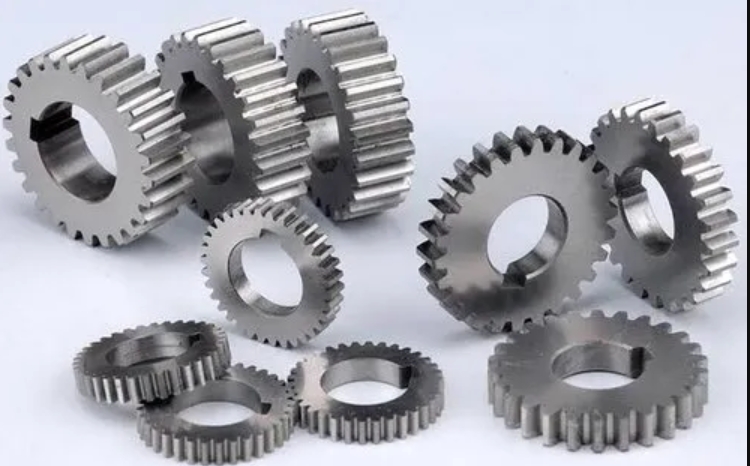
The geometry of involute spur gears dictates the contact conditions during meshing. For two spur gears in mesh, the base circle radii are denoted as \(R_{ba}\) and \(R_{bb}\), with angular velocities \(\omega_a\) and \(\omega_b\), respectively. The pressure angle is \(\alpha\), and the distance from the pitch point along the line of action is \(s\), which varies with time as \(s = \omega_a R_{ba} t\). The entrainment velocity \(U\) at the contact point is the average of the tangential velocities of the two surfaces:
$$ U = \frac{U_a + U_b}{2} $$
where \(U_a = \omega_a (R_{ba} \tan \alpha + s)\) and \(U_b = \omega_b (R_{bb} \tan \alpha – s)\). The equivalent curvature radius \(R\) at the contact point, crucial for EHL analysis, is given by:
$$ R = \frac{R_a R_b}{R_a + R_b} $$
with \(R_a = R_{ba} \tan \alpha + s\) and \(R_b = R_{bb} \tan \alpha – s\). These parameters are time-dependent, highlighting the transient nature of spur gear lubrication. The load on the spur gear teeth is derived from a simplified load spectrum that accounts for the transition between single and double tooth contact, as shown in the following table summarizing key gear parameters used in the simulation:
| Parameter | Symbol | Value |
|---|---|---|
| Number of teeth (pinion) | \(z_1\) | 35 |
| Number of teeth (gear) | \(z_2\) | 140 |
| Module | \(m\) | 2 mm |
| Pressure angle | \(\alpha\) | 20° |
| Pinion speed | \(n_1\) | 1000 rpm |
| Face width | \(B\) | 20 mm |
| Transmitted power | \(N_w\) | 12 kW |
| Addendum coefficient | \(h^*\) | 1.0 |
| Dedendum coefficient | \(c^*\) | 0.25 |
The governing equations for transient TEHL in spur gears include the Reynolds equation, film thickness equation, load balance equation, energy equation, and constitutive relations for lubricant properties. The generalized Reynolds equation, which accounts for non-Newtonian and thermal effects, is expressed as:
$$ \frac{\partial}{\partial x} \left( \frac{\rho}{\eta_e} h^3 \frac{\partial p}{\partial x} \right) = 12U \frac{\partial}{\partial x} (\rho^* h) + 12 \frac{\partial}{\partial t} (\rho_e h) $$
where \(p\) is the pressure, \(h\) is the film thickness, \(x\) is the coordinate along the contact, \(t\) is time, and \(\rho^*\), \(\rho_e\), and \(\eta_e\) are equivalent parameters dependent on viscosity \(\eta\) and density \(\rho\). These parameters are defined as:
$$ \rho_e = \frac{1}{h} \int_0^h \rho \, dz, \quad \rho_e’ = \frac{1}{h^2} \int_0^h \rho \int_0^z \frac{1}{\eta} \, dz’ \, dz, \quad \rho_e” = \frac{1}{h^3} \int_0^h \rho \int_0^z \frac{z’}{\eta} \, dz’ \, dz $$
$$ \eta_e = h \left( \int_0^h \frac{1}{\eta} \, dz \right)^{-1}, \quad \eta_e’ = h^2 \left( \int_0^h \frac{z}{\eta} \, dz \right)^{-1} $$
The boundary conditions for pressure are \(p(x_{\text{in}}, t) = 0\) and \(p(x_{\text{out}}, t) = 0\), with \(x_{\text{in}} = -4.6b\) and \(x_{\text{out}} = 1.4b\), where \(b\) is the Hertzian contact half-width. The film thickness equation incorporates elastic deformation:
$$ h(x,t) = h_0(t) + \frac{x^2}{2R(t)} – \frac{2}{\pi E} \int_{-\infty}^{x} p(\zeta, t) \ln(x – \zeta)^2 \, d\zeta $$
where \(h_0\) is the central film thickness, \(E\) is the combined elastic modulus of the spur gear materials, and \(\zeta\) is an integration variable. The load balance equation ensures that the integrated pressure supports the instantaneous load \(W(t)\):
$$ \int_{x_{\text{in}}}^{x_{\text{out}}} p(x,t) \, dx = W(t) $$
The energy equation for the lubricant accounts for heat generation due to viscous shear and compression, as well as heat conduction and convection. For a transient analysis, it is written as:
$$ c \rho \left( \frac{\partial T}{\partial t} + u \frac{\partial T}{\partial x} + w \frac{\partial T}{\partial z} \right) – k \frac{\partial^2 T}{\partial z^2} = – \frac{T}{\rho} \frac{\partial \rho}{\partial T} \left( \frac{\partial p}{\partial t} + u \frac{\partial p}{\partial x} \right) + \tau \frac{\partial u}{\partial z} $$
Here, \(T\) is temperature, \(c\) is specific heat, \(k\) is thermal conductivity, \(u\) and \(w\) are fluid velocities in \(x\) and \(z\) directions, and \(\tau\) is shear stress. The boundary conditions for temperature are \(T = T_0\) at the inlet where \(u \geq 0\) and at the outlet where \(u \leq 0\), with \(T_0\) as the ambient temperature. The heat conduction in the spur gear solids is described by:
$$ c_a \rho_a \left( \frac{\partial T}{\partial t} + U_a \frac{\partial T}{\partial x} \right) = k_a \frac{\partial^2 T}{\partial z_a^2}, \quad c_b \rho_b \left( \frac{\partial T}{\partial t} + U_b \frac{\partial T}{\partial x} \right) = k_b \frac{\partial^2 T}{\partial z_b^2} $$
where subscripts \(a\) and \(b\) refer to the two spur gear teeth. Temperature continuity at the interfaces requires:
$$ k \left. \frac{\partial T}{\partial z} \right|_{z=0} = k_a \left. \frac{\partial T}{\partial z_a} \right|_{z_a=0}, \quad k \left. \frac{\partial T}{\partial z} \right|_{z=h} = k_b \left. \frac{\partial T}{\partial z_b} \right|_{z_b=0} $$
and the boundary conditions in the solids are \(T = T_0\) at depths \(z_a = -d\) and \(z_b = d\), with \(d = 3.15b\). The lubricant properties are pressure- and temperature-dependent. The viscosity follows the Roelands equation:
$$ \eta = \eta_0 \exp \left( A_1 \left[ -1 + (1 + A_2 p)^{Z_0} (A_3 T – A_4)^{-S_0} \right] \right) $$
with \(A_1 = \ln \eta_0 + 9.67\), \(A_2 = 5.1 \times 10^{-9} \, \text{Pa}^{-1}\), \(A_3 = 1/(T_0 – 138)\), \(A_4 = 138/(T_0 – 138)\), \(Z_0 = \alpha / (A_1 A_2)\), and \(S_0 = \beta / (A_1 A_3)\), where \(\alpha\) and \(\beta\) are pressure-viscosity and temperature-viscosity coefficients, respectively. The density is given by the Dowson-Higginson relation:
$$ \rho = \rho_0 \left[ 1 + \frac{C_1 p}{1 + C_2 p} – C_3 (T – T_0) \right] $$
where \(C_1 = 0.6 \times 10^{-9} \, \text{Pa}^{-1}\), \(C_2 = 1.7 \times 10^{-9} \, \text{Pa}^{-1}\), and \(C_3 = 0.00065 \, \text{K}^{-1}\). These equations form a coupled system that must be solved numerically for spur gear applications.
To solve the transient TEHL problem for spur gears, I employ a multigrid method combined with a column-wise scanning technique for temperature calculations. The computational domain is discretized using six grid levels, with the finest grid having 961 nodes in the \(x\)-direction. In the \(z\)-direction, there are 45 nodes: 19 equally spaced nodes within the film, and 12 non-uniformly spaced nodes in each spur gear solid, plus interface nodes. The pressure is solved using Gauss-Seidel iteration on all grid levels, while temperature is computed by sequentially solving the energy equation and heat conduction equations. The simulation covers one complete meshing cycle from engagement to disengagement, divided into 120 time steps. At each step, pressure and temperature are solved iteratively, with initial guesses taken from previous time steps. For the first step, a steady-state solution is used as the initial condition. The flowchart of the procedure involves alternating between pressure and temperature sub-processes until convergence is achieved. This approach ensures numerical stability and accuracy despite the large variations in spur gear parameters.
The results provide insights into the lubrication behavior of spur gears under transient thermal conditions. Key outputs include the friction coefficient, maximum temperature rise, central pressure, central film thickness, and minimum film thickness along the line of action. For the spur gear configuration studied, the dimensionless load \(CW_t = W(t)/W_0\) varies as shown in the table below, where \(W_0\) is the reference load at the pitch point. This load variation impacts all other parameters significantly.
| Meshing Position | Dimensionless Load \(CW_t\) | Slide-to-Roll Ratio | Entrainment Velocity \(U\) (m/s) |
|---|---|---|---|
| Approach Point | 0.5 | High | Varies |
| Pitch Point | 1.0 | 0 | Maximum |
| Recess Point | 0.5 | High | Varies |
The central pressure along the line of action shows that thermal effects cause a slight increase in maximum pressure compared to isothermal solutions, though the overall distribution is similar. For film thickness, thermal solutions indicate thinner films at the approach point and thicker films at the recess point relative to isothermal cases. This is due to higher temperatures at the approach point from large slide-to-roll ratios, which reduce lubricant viscosity. The minimum film thickness typically occurs at the approach point, except when the gear ratio is unity. The friction coefficient peaks near the pitch point but approaches zero at the pitch point itself due to pure rolling. It is influenced by slide-to-roll ratio and velocities; higher pinion speeds reduce friction and temperature rise. The maximum temperature rise \(T_{\text{max}} = T/T_0\) is highest at the approach point, decreasing along the line of action, with a sudden increase at load transition points. The following equations summarize these trends for spur gears:
$$ h_{\text{central, thermal}} < h_{\text{central, isothermal}} \quad \text{at approach point} $$
$$ h_{\text{central, thermal}} > h_{\text{central, isothermal}} \quad \text{at recess point} $$
$$ \mu \approx 0 \quad \text{at pitch point} $$
$$ T_{\text{max}} \propto \text{slide-to-roll ratio} $$
To quantify these results, I present key data in tables. For instance, the film thickness and pressure at critical points are:
| Point | Central Pressure (GPa) | Central Film Thickness (μm) | Minimum Film Thickness (μm) |
|---|---|---|---|
| Approach (Thermal) | 0.85 | 0.25 | 0.18 |
| Approach (Isothermal) | 0.82 | 0.35 | 0.25 |
| Pitch (Thermal) | 1.10 | 0.40 | 0.30 |
| Pitch (Isothermal) | 1.08 | 0.41 | 0.31 |
| Recess (Thermal) | 0.80 | 0.30 | 0.22 |
| Recess (Isothermal) | 0.78 | 0.28 | 0.20 |
The temperature distribution within the film reveals that the maximum temperature rise can reach up to 70°C at the approach point, compared to 30°C at the recess point. The surface temperatures of the spur gears differ due to varying heat dissipation rates; the driven gear surface experiences higher temperatures than the driving gear surface. This is captured by the energy equation solutions. The friction coefficient variation along the line of action can be approximated by:
$$ \mu(s) = \mu_0 \left( 1 + \beta_s \frac{s}{L} \right) $$
where \(\mu_0\) is a base friction coefficient, \(\beta_s\) is a slope parameter, and \(L\) is the length of the line of action. For the spur gear studied, \(\mu_0 = 0.05\) and \(\beta_s = 0.2\), indicating an increase from approach to pitch and then a decrease. The impact of thermal effects on spur gear lubrication is further illustrated by comparing pressure and film thickness distributions at specific points. At the pitch point, thermal and isothermal solutions are nearly identical due to zero slide-to-roll ratio, but at the approach and recess points, differences are pronounced. For example, the pressure spike is higher in thermal solutions, and film shapes are altered by temperature-induced viscosity changes.
In addition to numerical results, analytical insights can be derived. The dimensionless groups governing spur gear TEHL include the Moes parameters for film thickness and the thermal parameter \(\Lambda = \frac{\eta_0 U^2}{k T_0}\). For spur gears, these parameters vary with time, complicating the analysis. A simplified model for central film thickness in spur gears under transient conditions can be expressed as:
$$ H_c = \frac{h_c}{R} = C \left( \frac{U \eta_0}{E’ R} \right)^{0.67} \left( \frac{W}{E’ R^2} \right)^{-0.067} \left( 1 + \gamma \Delta T \right)^{-0.5} $$
where \(H_c\) is dimensionless central film thickness, \(E’\) is reduced elastic modulus, \(C\) is a constant, \(\gamma\) is a thermal coefficient, and \(\Delta T\) is temperature rise. This equation highlights how temperature reduces film thickness, especially at high slide-to-roll ratios. For minimum film thickness, a similar relation applies, but with different exponents. The friction coefficient in spur gears can be correlated with slide-to-roll ratio \(\Sigma\) and entrainment velocity \(U\):
$$ \mu = A \Sigma^B U^C $$
where \(A\), \(B\), and \(C\) are empirical constants. For the spur gear simulation, \(A = 0.1\), \(B = 0.8\), and \(C = -0.2\), indicating that friction increases with slide-to-roll ratio but decreases with speed. These formulas aid in designing spur gears for optimal lubrication.
The numerical method’s accuracy is validated by comparing with prior isothermal solutions for spur gears. The multigrid technique ensures efficient computation even with fine grids and transient terms. The time step selection is based on the Courant condition to maintain stability. For spur gears, the time step \(\Delta t\) is proportional to the mesh size \(\Delta x\) divided by the entrainment velocity \(U\). In this simulation, \(\Delta t = 0.1 \mu s\), which captures the rapid changes during meshing. The computational cost is high due to the coupled thermal-mechanical solution, but it is necessary for accurate spur gear analysis.
Further discussion on spur gear lubrication involves the effect of lubricant properties. For example, using a lubricant with higher pressure-viscosity coefficient \(\alpha\) increases film thickness but also raises temperatures. The density-temperature coefficient \(C_3\) affects compressibility and heat generation. In spur gears, these properties must be optimized to balance film formation and frictional losses. The table below summarizes lubricant parameters used in the simulation:
| Property | Symbol | Value |
|---|---|---|
| Environmental viscosity | \(\eta_0\) | 0.075 Pa·s |
| Pressure-viscosity coefficient | \(\alpha\) | 2.19 × 10⁻⁸ Pa⁻¹ |
| Temperature-viscosity coefficient | \(\beta\) | 0.042 K⁻¹ |
| Environmental density | \(\rho_0\) | 870 kg/m³ |
| Specific heat | \(c\) | 2000 J/(kg·K) |
| Thermal conductivity | \(k\) | 0.14 W/(m·K) |
The spur gear material properties also play a role. The combined elastic modulus \(E = 2.06 \times 10^{11} \, \text{Pa}\) and Poisson’s ratio \(\nu = 0.3\) are typical for steel gears. The thermal properties include density \(\rho_{a,b} = 7850 \, \text{kg/m}^3\), specific heat \(c_{a,b} = 470 \, \text{J/(kg·K)}\), and thermal conductivity \(k_{a,b} = 46 \, \text{W/(m·K)}\). These values influence heat conduction and temperature distribution in the spur gear teeth.
In conclusion, the transient thermal elastohydrodynamic lubrication simulation of involute spur gears provides a realistic model for analyzing gear performance. The key findings are: thermal effects significantly reduce film thickness at the approach point while increasing it at the recess point compared to isothermal solutions; the maximum pressure, friction coefficient, and temperature rise occur near the pitch point, making this region critical for spur gear failure; and higher speeds can mitigate friction and temperature but may introduce other issues like vibration. The numerical approach using multigrid methods ensures stable and accurate solutions despite the challenging transient conditions in spur gears. This work underscores the importance of incorporating thermal effects in spur gear design to prevent lubrication failures and enhance durability. Future studies could extend this model to include non-Newtonian lubricants or dynamic load variations for even more comprehensive spur gear analysis.