
In the realm of modern manufacturing, the pursuit of efficiency, precision, and material savings drives continuous innovation. As a researcher deeply engaged in advanced metal forming technologies, I have long been fascinated by the challenges and opportunities presented by cold precision forging, particularly for complex components like spur gears. The traditional machining of spur gears, while reliable, often involves significant material waste, multiple processing steps, and high energy consumption. Cold precision forging emerges as a promising alternative, offering near-net-shape production with superior mechanical properties and reduced environmental impact. However, when it comes to spur gears with big modulus—those with larger tooth sizes—the process encounters formidable obstacles: excessive forming forces, difficulty in filling intricate die cavities (especially at corners and edges), and accelerated模具 wear leading to shortened tool life. These issues have historically limited the widespread industrial adoption of cold forging for such components. In this extensive exploration, I will detail a novel approach I have developed and studied: the dentiform cavity flow dividing method. This technique, combined with floating die systems, aims to overcome these barriers, making the cold precision forging of big modulus spur gears not just feasible but highly practical. Throughout this discussion, I will emphasize the spur gear as the central component, delving into the methodology, numerical validation, and experimental proof that underscore the viability of this innovative process.
The core idea behind the dentiform cavity flow dividing method is elegantly simple yet profoundly effective. Instead of attempting to force material into every corner of a fully closed die cavity under immense pressure—a process that invariably leads to skyrocketing loads and potential failure—this method introduces strategically placed “escape routes” or分流 cavities within the die itself. Specifically, these cavities are located at the deepest points of the gear tooth profile in the die, essentially extending the standard tooth cavity upwards. The primary goal is to avoid the final, high-pressure stage where the material is forced into sharp corners and edges. By allowing a controlled amount of material to flow into these分流 cavities once the main tooth form is essentially complete, we can terminate the forging operation earlier. The resulting forged spur gear possesses slight excess material (flash) in these designated areas, which can be easily removed via subsequent minor machining operations like turning or grinding on the outer diameter—crucially, without ever touching the tooth flanks. This preserves the continuous fiber flow lines on the tooth surfaces, a key advantage of forged gears that contributes to their enhanced fatigue strength and durability.
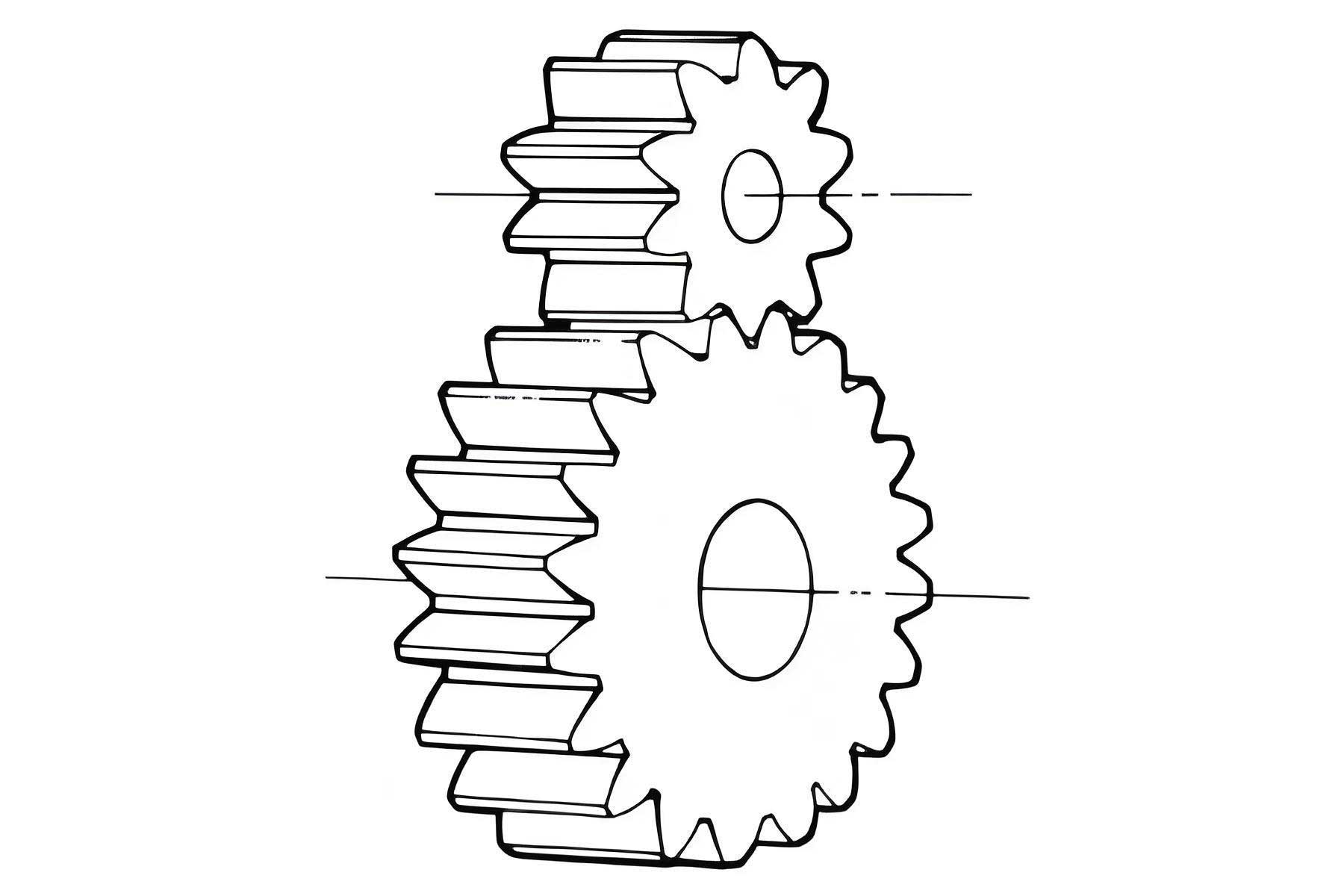
The design of these分流 cavities is not arbitrary; it follows a set of rigorous principles I established. First, the cavity must be positioned at the most challenging area to fill, typically the tip corners and edges of the spur gear tooth. This ensures that the material does not preferentially flow into the分流 cavity too early, which would compromise the filling of the main tooth profile. Second, the geometry of the分流 cavity itself is critical. Initial designs employed an arc-shaped cavity, but further analysis revealed that a rectangular-shaped cavity offers superior performance. The rectangular shape provides a larger free surface area for the material at the end of the forging stroke, further reducing the resistance to flow and, consequently, the final forming load. The fundamental equations governing material flow in such processes can be described using plasticity theory. The effective strain rate $\dot{\bar{\epsilon}}$ and stress $\bar{\sigma}$ are key parameters, often related by a constitutive model like:
$$ \bar{\sigma} = K \dot{\bar{\epsilon}}^m $$
where $K$ is the strength coefficient and $m$ is the strain rate sensitivity exponent. For cold forging conditions, $m$ is typically low. The goal of the flow dividing method is to reduce the local strain rates and stresses in the corner regions, preventing the exponential rise in forming force described by the relationship between pressure $P$, flow stress $\sigma_f$, and geometry factor $Q$:
$$ P = Q \cdot \sigma_f $$
where $Q$ becomes very large for fully constrained corner filling. The分流 cavity effectively reduces the geometric constraint, lowering $Q$. To quantify the spur gear geometry, standard parameters are essential. For the spur gear studied in this work, the key dimensions are summarized in the table below:
| Parameter | Value | Description |
|---|---|---|
| Module (m) | 3 mm | Size of the spur gear teeth |
| Number of Teeth (z) | 25 | Total teeth on the spur gear |
| Pressure Angle (α) | 20° | Angle defining tooth shape |
| Addendum Coefficient | 1.0 | Ratio for tooth height above pitch circle |
| Dedendum Coefficient | 1.25 | Ratio for tooth height below pitch circle |
| Face Width | 15 mm | Thickness of the spur gear |
To thoroughly analyze the proposed spur gear forging process, I turned to advanced numerical simulation techniques. Employing the finite element method (FEM) within a commercial software environment (such as DEFORM-3D), I constructed a three-dimensional model. Due to the cyclic symmetry of the spur gear, the analysis was efficiently performed on a sector containing two teeth, significantly reducing computational cost while maintaining accuracy. The workpiece material was modeled as a rigid-plastic, isotropic material, obeying the von Mises yield criterion. For this study, a steel analogous to AISI-4120 was selected, common in gear applications. The flow stress data for cold forging conditions was incorporated into the model. The dies—the upper punch and the lower floating die containing the tooth profile and分流 cavity—were treated as rigid bodies. The process conditions were set to room temperature (20°C), neglecting thermal effects as the deformation is rapid and adiabatic heating is limited in cold forging. The friction at the die-workpiece interface was modeled using the shear friction model, with a friction factor $m_f$ set to 0.08, representing good lubrication conditions typical for cold precision forging.
The simulation setup involved the upper punch moving downward at a constant velocity (e.g., 10 mm/s), compressing the cylindrical billet against the floating die. The floating die system is another crucial element; it moves axially with the punch initially, which helps in filling the lower portions of the spur gear teeth by utilizing frictional forces favorably. The key outcomes from the numerical simulations were revealing. For the traditional closed-die forging of the spur gear (without any flow dividing), the load-stroke curve exhibited a characteristic sharp exponential increase in the final stage as the material tried to fill the tooth corners. The maximum load recorded was substantial. In contrast, for the spur gear forged using the arc-shaped分流 cavity, this sharp increase was mitigated but not entirely eliminated. The load peaked at a lower value but still showed a noticeable final rise. However, with the improved rectangular分流 cavity, the load-stroke curve became much more favorable. The forming load increased steadily and then plateaued or even decreased slightly as material began to flow into the分流 cavity, completely avoiding the destructive final pressure spike. The comparison is starkly evident in the following table summarizing the simulated maximum loads:
| Forging Process for Spur Gear | Simulated Peak Load (Metric Tons) | Percentage Reduction vs. Closed-Die |
|---|---|---|
| Traditional Closed-Die Forging | 168 t | 0% (Baseline) |
| Arc-Shaped Flow Dividing Cavity | 108 t | Approximately 36% |
| Rectangular Flow Dividing Cavity | 91 t | Approximately 46% |
The effective strain distribution within the forged spur gear provided further insights. In all cases, the peripheral regions of the gear teeth, especially near the dedendum (root) area, underwent the most severe deformation. This is because material in these zones flows along curved paths with large strain increments to form the tooth flank contours. The effective strain $\bar{\epsilon}$ in these areas can be several times higher than in the central rib or tooth tip regions. The material flow pattern showed three distinct streams: one forming the central web via simple upsetting, and two forming the left and right flanks via complex, constrained flow. The mathematical representation of effective strain for a given deformation path is:
$$ \bar{\epsilon} = \int d\bar{\epsilon} = \int \sqrt{\frac{2}{3} d\epsilon_{ij} d\epsilon_{ij}} $$
where $d\epsilon_{ij}$ are the components of the strain increment tensor. The high strain in the tooth root periphery is beneficial as it leads to strain hardening and refined microstructure, enhancing the mechanical properties of that critical region in the final spur gear. The分流 cavity method did not adversely affect this beneficial strain distribution; it merely prevented the excessive loads associated with corner filling.
To validate the numerical predictions, I conducted physical experiments. Using a 200-ton hydraulic press, I forged spur gear samples from industrial pure lead. Lead is an excellent model material for cold forging studies due to its low yield stress at room temperature and similar plastic behavior to steel under cold working conditions, allowing the use of lower-capacity presses to simulate industrial processes. Two process variants were tested: the traditional closed-die method and the proposed method with the rectangular分流 cavity. The experimental spur gear had the same geometry as the simulated one. The die set was manufactured with precision, incorporating the rectangular分流 cavity in the lower die. The billet was cylindrical, with a diameter slightly smaller than the root diameter of the spur gear. The process was conducted under controlled lubrication.
The experimental results corroborated the simulation findings conclusively. For the spur gear forged using the rectangular flow dividing method, a complete tooth form was achieved at a press load setting of approximately 400 kN. At this load, the分流 cavity was not completely filled, showing significant free surface, indicating that the process was terminated in the optimal range. The forged spur gear exhibited excellent filling of the main tooth profile beyond the standard tooth line, with the excess material confined to the extended分流 cavity area. A simple turning operation on the outer diameter would yield a final, precise spur gear component. In stark contrast, achieving a fully filled spur gear using the traditional closed-die method required nearly double the force—around 800 kN. This 50% reduction in required forming force in the experiment aligns remarkably well with the 46% reduction predicted by the simulation for the rectangular cavity, confirming the accuracy and reliability of the finite element model. This agreement between numerical and physical results provides strong confidence in the proposed methodology for forging spur gears.
The implications of successfully implementing this dentiform cavity flow dividing method for spur gears are substantial. Firstly, it directly addresses the primary technical bottleneck—high forming pressure—enabling the use of smaller, less expensive forging presses or extending the life of existing equipment. Secondly, by ensuring complete filling without extreme pressures, the method significantly reduces die stresses, which is a major factor in improving模具寿命. The die life $N$ can be empirically related to the maximum die stress $\sigma_{die}^{max}$ by relationships like:
$$ N \propto \left( \frac{\sigma_{die}^{max}}{\sigma_{f,die}} \right)^{-b} $$
where $\sigma_{f,die}$ is the fatigue strength of the die material and $b$ is an exponent. Reducing $\sigma_{die}^{max}$ through flow dividing thus exponentially increases potential die life. Thirdly, the process maintains the integrity of the spur gear’s metallurgical properties. The continuous grain flow around the tooth profile, unbroken by machining, results in superior fatigue resistance, impact strength, and load-bearing capacity compared to a machined spur gear. The economic benefits are also clear: material savings from near-net-shape forming, reduction in machining steps (only a quick outer diameter turning is needed), and lower energy consumption per part.
Looking forward, the potential applications and refinements of this technique are exciting. While this study focused on a spur gear with a module of 3 mm, the principle is scalable. For spur gears with even larger moduli, the benefits in load reduction could be even more pronounced. Furthermore, the concept of strategic flow dividing could be adapted to other complex forged components with challenging filling requirements, such as helical gears, splines, or non-circular gears. Future work could involve optimizing the exact dimensions and taper of the rectangular分流 cavity using advanced optimization algorithms coupled with FEM to minimize both the required load and the amount of subsequent machining scrap. Another avenue is exploring the combination of this method with other advanced forging techniques, like warm forging or isothermal forging, for materials that are difficult to form at room temperature. The integration of real-time process monitoring and control to precisely terminate the forging stroke when the tooth form is complete could further enhance consistency and quality in mass production of spur gears.
In conclusion, the dentiform cavity flow dividing method represents a significant breakthrough in the cold precision forging of spur gears, particularly those with big modulus. Through a combination of innovative die design, sophisticated numerical simulation, and careful experimental validation, I have demonstrated that this approach effectively solves the twin problems of high forming loads and incomplete die filling. The rectangular分流 cavity design proves superior to the initial arc-shaped design, offering the greatest reduction in required force—approximately 46-50% compared to traditional closed-die forging. This process ensures the production of high-quality spur gears with excellent mechanical properties due to preserved fiber flow, all while offering substantial economic advantages through material and energy savings. As manufacturing industries worldwide strive for greater sustainability and efficiency, such advanced forming technologies for critical components like spur gears will undoubtedly play a pivotal role in shaping the future of precision engineering.