
In the process of precision forging for straight bevel gear components, the single most critical factor determining the final part quality is the accuracy of the tooth profile within the forging die cavity. The manufacturing of this cavity is predominantly achieved through Electrical Discharge Machining (EDM), a process where a shaped electrode erodes the desired form into the hardened die steel. Consequently, the geometric fidelity of this electrode—typically made from high-purity copper for its excellent EDM performance—directly dictates the accuracy of the die and, ultimately, the forged straight bevel gear. An imprecise electrode will invariably lead to a defective die, producing out-of-specification forgings, wasting significant resources, time, and capital.
Traditionally, the inspection of such master electrode gears posed a significant challenge. Conventional methods, like using a composite error checking instrument with a master gear, can assess parameters such as mounting distance, axial runout, and axis angle variation. However, these methods fall short in providing a comprehensive, point-by-point evaluation of the actual tooth flank form. Furthermore, they rely on a master gear whose manufacturing precision must exceed that of the electrode by at least one grade, a requirement often prohibitively difficult and expensive for most workshops to meet for high-precision applications. Neglecting a thorough form inspection, however, risks producing faulty forging dies. This paper details a robust and accessible methodology developed to overcome this limitation: a computer-aided calculation and magnified drawing technique for the precise inspection of straight bevel gear electrodes.
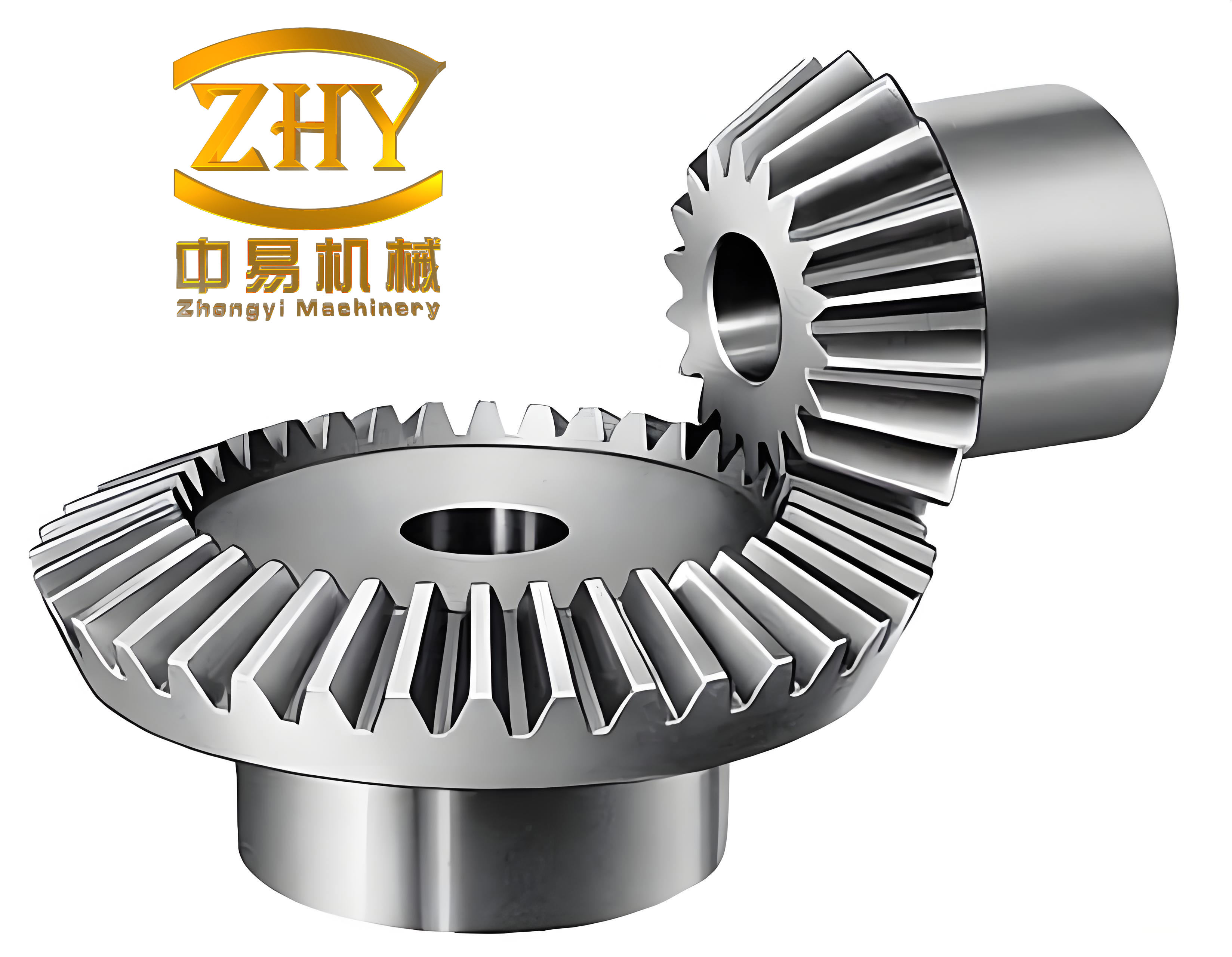
The core principle of our inspection method involves generating a highly magnified, precise theoretical tooth profile—including its tolerance zone—on a stable transparent medium. This drawing serves as a master template. The physical electrode gear is then mounted on a universal optical projector, and its magnified shadow is superimposed onto the master drawing for direct visual comparison and quantitative assessment. The creation of this master drawing is where computational power becomes indispensable, as manual graphical methods for the complex, magnified profile of a straight bevel gear are prone to significant cumulative errors.
Electrode Gear Design and the Need for Profile Modification
It is crucial to understand that the electrode gear is not an exact geometric replica of the final desired forged gear. To compensate for systematic errors introduced during downstream manufacturing, intentional modifications are designed into the electrode’s tooth form. The primary factors necessitating these corrections include:
- Non-uniform Electrode Wear during EDM: The erosion rate of the copper electrode is not constant across the entire tooth profile, leading to a deviation between the electrode’s initial form and the cavity it produces.
- Forging and Thermal Deformation: The metal flow during the precision forging process and subsequent cooling shrinkage cause predictable distortions in the forged gear’s geometry.
- Die Elastic Deformation and Wear: Under the immense pressures of forging, the die cavity elastically deforms, and over time, it experiences wear, both affecting the final part dimensions.
To counteract these effects, the electrode is designed with a modified pressure angle (and sometimes a modified module). Therefore, the standard against which we inspect the manufactured electrode is *this modified theoretical profile*, not the basic gear data of the final product.
The fundamental modification is applied to the pressure angle. If the nominal pressure angle of the final gear is $\alpha$, the electrode’s pressure angle $\alpha_e$ is designed as:
$$\alpha_e = \alpha + \Delta \alpha$$
where $\Delta \alpha$ is the empirically determined correction angle, which can be positive or negative depending on the specific process stack-up. This correction alters the entire involute curve of the tooth flank.
| Compensation Factor | Effect on Forged Gear | Typical Electrode Design Adjustment |
|---|---|---|
| EDM Wear | Reduces effective pressure angle in cavity | Increase pressure angle ($+\Delta \alpha$) |
| Forging Expansion | Increases tooth thickness | Reduce electrode tooth thickness |
| Die Elastic Opening | Increases tooth thickness and space width | Complex correction often addressed via pressure angle |
| Shrinkage | Uniformly reduces all linear dimensions | Increase electrode module or scaling factor |
Computational Framework for the Magnified Master Profile
The inspection is performed on the back-cone developed view of the straight bevel gear tooth. The back cone is an imaginary cone whose elements are perpendicular to the pitch cone elements at the pitch circle. “Developing” this cone means unwrapping it onto a plane, which transforms the spherical tooth profile of the bevel gear into an equivalent spur gear profile in that plane. This equivalent spur gear is called the “formative” or “virtual” gear, and its parameters govern the tooth form in the developed view.
For a straight bevel gear with the following key parameters:
- Number of teeth: $z$
- Module at large end: $m$
- Shaft angle: $\Sigma$ (typically 90°)
- Pressure angle: $\alpha$ (the modified $\alpha_e$ for the electrode)
- Pitch diameter at large end: $d = m \cdot z$
- Pitch cone angle: $\delta = \arctan(z_1 / z_2)$ for a pair, or a given value for a single gear.
The parameters of the equivalent spur gear at the large end are calculated as follows:
$$ \text{Equivalent Number of Teeth, } z_v = \frac{z}{\cos \delta} $$
$$ \text{Equivalent Pitch Radius, } r_v = \frac{m \cdot z_v}{2} = \frac{d}{2 \cos \delta} $$
$$ \text{Equivalent Base Radius, } r_{bv} = r_v \cdot \cos \alpha_e $$
$$ \text{Equivalent Addendum Radius, } r_{av} = r_v + h_a $$
where $h_a$ is the addendum of the straight bevel gear at the large end. All subsequent coordinate calculations for the magnified drawing are based on this equivalent spur gear system.
The core of the computer program is to calculate Cartesian coordinates for points along the tooth profile in the developed plane, magnified by a factor $K$ (e.g., $K=50$). The profile consists of three segments: the involute flank above the base circle, the trochoidal fillet near the root, and the tip land. For high-precision inspection, we focus on accurately generating the involute and defining the root boundary.
For any point $i$ on the involute flank at a radius $r_i$ (where $r_{bv} \le r_i \le r_{av}$), its pressure angle $\alpha_i$ is:
$$ \alpha_i = \arccos\left(\frac{r_{bv}}{r_i}\right) $$
The involute function (involute of pressure angle) is $ \text{inv}(\alpha_i) = \tan(\alpha_i) – \alpha_i $ (with $\alpha_i$ in radians).
The key measurement is the chordal tooth thickness $ \bar{s}_i $ at radius $r_i$. Its calculation involves finding the tooth thickness on the arc at that radius and then converting it to its chordal value. The arc tooth thickness $s_i$ at radius $r_i$ is derived from the arc tooth thickness $s_v$ at the equivalent pitch radius $r_v$:
$$ s_i = r_i \left( \frac{s_v}{r_v} + 2(\text{inv}(\alpha_e) – \text{inv}(\alpha_i)) \right) $$
where $s_v$ is the designed arc tooth thickness of the equivalent gear at the large end.
The corresponding half-angle $\theta_i$ subtended by this arc thickness at the gear center is:
$$ \theta_i = \frac{s_i}{2 r_i} $$
Finally, the Cartesian coordinates $(x_i, y_i)$ of the point on the involute profile (relative to the tooth centerline) for the magnified drawing are:
$$ x_i = K \cdot r_i \cdot \sin(\theta_i) $$
$$ y_i = K \cdot r_i \cdot \cos(\theta_i) $$
The program iterates this calculation for multiple radii $r_i$ to generate a dense point cloud defining one side of the involute flank. The other side is a mirror image.
| Parameter | Symbol | Value (Example) | Notes |
|---|---|---|---|
| Number of Teeth | $z$ | 16 | From gear design |
| Large End Module | $m$ | 5 mm | From gear design |
| Pressure Angle (Modified) | $\alpha_e$ | 22.5° | Electrode design value |
| Pitch Cone Angle | $\delta$ | 26.565° | $\delta = \arctan(z/z_{mate})$ |
| Equivalent Teeth | $z_v$ | 17.888 | $z_v = z / \cos(\delta)$ |
| Equiv. Pitch Radius | $r_v$ | 44.721 mm | $r_v = m \cdot z_v / 2$ |
| Equiv. Base Radius | $r_{bv}$ | 41.352 mm | $r_{bv} = r_v \cdot \cos(\alpha_e)$ |
| Magnification Factor | $K$ | 50 | For drawing and projection |
| Calc. Point Radius | $r_i$ | 47.0 mm | Sample point near tip |
| Point Pressure Angle | $\alpha_i$ | 28.43° | $\alpha_i = \arccos(r_{bv}/r_i)$ |
| Magnified X-Coordinate | $x_i$ | ~834.2 units | $x_i = K \cdot r_i \cdot \sin(\theta_i)$ |
| Magnified Y-Coordinate | $y_i$ | ~2340.5 units | $y_i = K \cdot r_i \cdot \cos(\theta_i)$ |
Generating the Master Drawing and Tolerance Zone
With the computed coordinate data, the standard tooth profile is plotted on a dimensionally stable transparent film. The Y-axis represents the gear’s central axis, and the X-axis represents the chordal direction. A smooth curve is drawn through the calculated $(x_i, y_i)$ points to form the involute flank. Below the base circle radius $r_{bv}$, the profile is approximated by a radial line (straight line from the root fillet tangent point to the base circle), which is acceptable for inspection purposes as the exact trochoid is highly sensitive to cutter geometry. The tooth root fillet radius is drawn based on the tool specification, typically a standard value like $0.3m$.
The critical step for quantitative inspection is creating the tolerance zone. The gear drawing specifies a tolerance on chordal tooth thickness, $\Delta \bar{s}$. This single tolerance on a chordal measurement must be translated into a parallel boundary zone for the entire flank profile. For a given point on the theoretical involute at coordinates $(x, y)$, the direction normal to the curve must be found. The tooth thickness tolerance $\Delta \bar{s}$ is then applied in this normal direction to establish the two boundaries of the acceptable zone.
An accurate approach uses the computed data. The half-angle $\theta_i$ is directly related to the arc tooth thickness. A change in tooth thickness $\Delta s$ at the pitch circle results in a change in half-angle $\Delta \theta$ at any radius $r_i$, approximated for small changes by:
$$ \Delta \theta_i \approx \frac{\Delta s}{2 r_v} $$
The resulting lateral shift $\Delta x_i$ of the profile point at $(x_i, y_i)$ is approximately:
$$ \Delta x_i \approx K \cdot r_i \cdot \cos(\theta_i) \cdot \Delta \theta_i = K \cdot r_i \cdot \cos(\theta_i) \cdot \frac{\Delta s}{2 r_v} $$
Using the upper and lower limits of the chordal thickness tolerance to derive $\Delta s$, the upper and lower boundary lines for the profile can be plotted parallel to the theoretical curve. This creates a clear, magnified “corridor” within which the projected image of the actual electrode tooth must lie to be considered acceptable.
The formula for the approximate normal offset $d_{norm}$ for a tolerance $\Delta s$ on arc thickness at pitch line is:
$$ d_{norm} \approx K \cdot \frac{\Delta s}{2} \cdot \frac{\cos(\alpha_i)}{\cos(\alpha_e)} $$
This shows the offset is not constant but varies with the local pressure angle $\alpha_i$.
Projection Inspection Procedure and Evaluation
The manufactured copper electrode gear, after roughing and finishing (but before any final edge-breaking or polishing that might obscure its true machined form), is meticulously cleaned. It is then mounted on the stage of a universal optical projector (e.g., a model with 500x magnification capability). The mounting fixture ensures the gear’s back face is used as the primary datum, aligning it perpendicular to the projector’s optical axis. Precise alignment is critical: the gear is rotated and translated until the projected shadow of its back-cone developed view aligns such that the theoretical apex of the pitch cone coincides with the projector’s optical center. This ensures the projected image corresponds directly to the developed view used for the master drawing.
The master drawing on the transparent film is placed on the projector’s viewing screen. It is aligned so that its vertical (Y) axis—representing the gear centerline—and its horizontal (X) baseline are perfectly superimposed with the projector’s crosshair axes. The magnified shadow of the actual electrode tooth is then projected onto this master drawing.
A systematic inspection is performed by evaluating the following aspects through visual comparison and using the projector’s precision micrometer stage for measurements:
- Involute Profile Conformance: The entire active flank of the projected tooth shadow is observed. It must lie smoothly within the tolerance zone corridor drawn on the master template. Any visible bulges, flats, or deviations outside the zone indicate a profile error. The smoothness of the curve is also assessed.
- Pressure Angle Accuracy: The general inclination of the active flank is checked. If the involute curve is systematically offset towards one side of the tolerance zone along its entire length, it indicates a deviation in the actual pressure angle from the designed $\alpha_e$. This is a critical check for the electrode modification.
- Chordal Thickness at Various Heights: Using the projector’s crosshairs, the chordal thickness can be measured at specified radial distances (e.g., at the pitch line). This measured value (divided by the magnification factor $K$) is compared to the designed value and its tolerance limits.
- Total Tooth Depth (Whole Depth): The distance from the tip line to the root line in the projected image is measured and compared against the designed full depth $h$, ensuring proper engagement depth and root clearance in the final forged straight bevel gear.
- Root Fillet Form and Undercut: The general shape and smoothness of the transition from the flank to the root are inspected. Excessive undercut or an incorrect fillet radius, which could act as a stress concentrator in the forging die, can be detected.
If any of these checks reveal deviations beyond the acceptable tolerance zone, the electrode is rejected. This immediate feedback allows for corrective action—adjusting the CNC program for gear cutting, correcting the cutter geometry or setup, or modifying the EDM preparation process—before producing a batch of defective electrodes that would lead to costly scrap forging dies.
| Inspection Item | Method on Projector | Acceptance Criterion | Primary Concern if Failed |
|---|---|---|---|
| Full Involute Profile | Visual overlay with master template | Entire flank within tolerance zone | Incorrect tool profile, machine error |
| Pressure Angle | Check parallelism of flank to template zone center | No systematic angular shift | Wrong electrode design modification or cutter angle |
| Chordal Thickness @ Pitch | Micrometer measurement of shadow | Within $\bar{s} \pm \Delta \bar{s}$ | Incorrect feed or cutter positioning |
| Total Tooth Depth | Vertical measurement from tip to root line | Within $h \pm \Delta h$ | Incorrect cutter depth setting |
| Root Fillet Contour | Visual comparison to template radius | Smooth blend, no sharp notch | Cutter tip wear or damage, incorrect tool |
| Symmetry (Adjacent Teeth) | Compare left/right flanks of same tooth & adjacent teeth | Consistent form and thickness | Workpiece or cutter runout, indexing error |
Conclusion and Broader Applicability
The computer-aided magnified drawing technique for inspecting straight bevel gear electrodes provides a highly effective and practical solution to a critical quality control challenge in precision forging die manufacturing. By leveraging straightforward computational geometry to generate an exact magnified reference, it bypasses the need for ultra-precision master gears and enables a direct, comprehensive visual and quantitative assessment of the electrode’s tooth form. This method directly targets the most sensitive aspect—the profile geometry—which traditional composite checking methods cannot adequately evaluate.
The effectiveness of this approach has been validated through extensive production application. By implementing this inspection protocol, manufacturers gain precise control over the EDM electrode quality. This control directly translates into consistent accuracy of the forged gear tooth cavities, dramatically reducing the risk of producing batches of non-conforming forged straight bevel gear components. The subsequent savings in avoided scrap, rework, and downtime are substantial. Furthermore, the principles of this method—generating a magnified theoretical profile from modified design data and using optical comparison—are not limited to straight bevel gear electrodes. They can be readily adapted to the inspection of electrodes for spiral bevel gears, hypoid gears, and other complex, sculptured form tools where traditional inspection methods are inadequate, providing a versatile tool for ensuring quality in advanced manufacturing processes.
In summary, the integration of computational design data with basic optical metrology creates a powerful synergy for precision manufacturing. For anyone involved in the demanding field of gear forging, mastering such a technique for the critical inspection of straight bevel gear electrodes is not just an option but a fundamental requirement for achieving and maintaining world-class quality and efficiency.