
In this article, I explore the development and implementation of a comprehensive computer-aided design (CAD) system for straight bevel gear differentials, which are widely used in wheeled vehicles due to their simple structure, ease of manufacturing, and maintenance convenience. The traditional design process for these differentials involves extensive parameter calculations and drafting, which is time-consuming and labor-intensive. By integrating modern design methodologies, optimization techniques, and automated drafting, the CAD system aims to significantly reduce design cycles, improve accuracy and reliability, and achieve optimal and automated design processes. This work builds upon prior research on single-pair straight bevel gear optimization, extending it to a full differential system as part of a broader initiative. The system is developed in Fortran, implemented on an IBM-PC, and utilizes support software such as optimization libraries, graphic packages, and Chinese character libraries, with batch processing to manage memory constraints.
The CAD system for straight bevel gear differentials offers multiple functionalities to cater to diverse user needs. These include geometric calculations, strength verification, optimization design, and automatic drafting of key component drawings. The system employs natural language for human-computer interaction, supports both Chinese and English input/output, and is structured modularly for flexibility. Below is a summary of the core functionalities in table format.
| Function | Description |
|---|---|
| Geometric Calculation | Computes dimensions for straight bevel gear differentials, including cone distance, gear tooth profiles, and assembly parameters. |
| Strength Verification | Performs bending strength checks for straight bevel gears,挤压 stress analysis for planetary shafts, and torsional strength for half-shafts. |
| Optimization Design | Applies mathematical models to minimize volume or maximize torque, subject to constraints like gear strength and size limits. |
| Automatic Drafting | Generates working drawings for major components (e.g., planetary gears, half-shaft gears) using parameterized techniques. |
The program structure is modular, consisting of a main program that calls various subroutines based on user inputs. Key modules include input subroutines, optimization method routines, geometric calculation subroutines, strength analysis subroutines, and drafting modules. A flowchart illustrates the decision-making process: the main program determines the type of parameter calculation (e.g., geometric or strength-based) and the optimization objective function (e.g., volume minimization or torque maximization). For instance, if optimizing for volume, the system iterates through planetary gear tooth counts as input loops to reduce design variable dimensionality. The modular design allows for easy expansion, such as adding new objective functions for differential locking effects or other performance metrics.
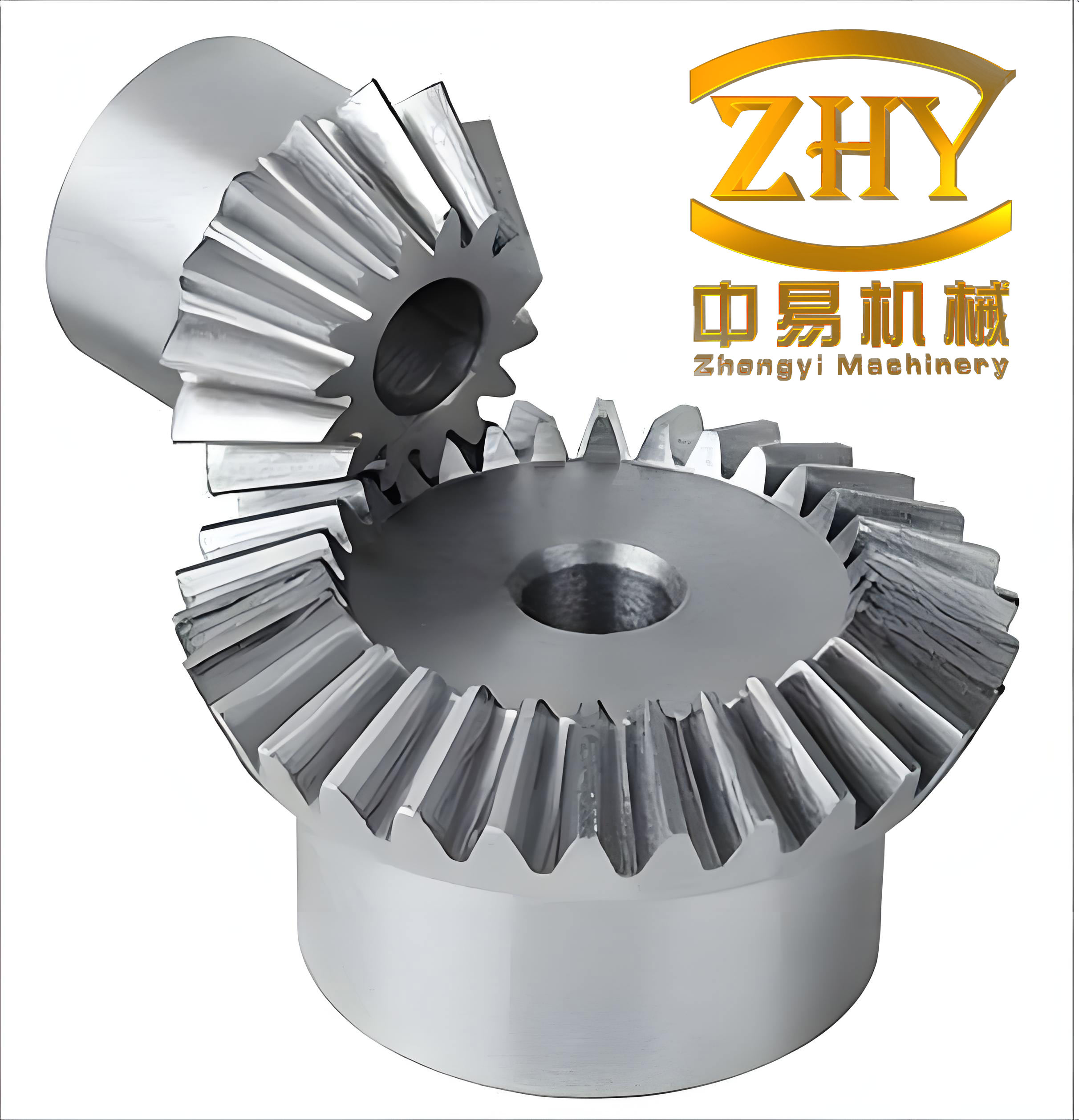
The optimization design mathematical model is central to the CAD system. For straight bevel gear differentials, the objective function can be tailored based on design priorities. Two primary objectives are considered: minimizing differential volume or maximizing transmitted torque. In volume minimization, the goal is to reduce the overall size while ensuring strength, which is crucial for vehicle layout and mobility. The objective function for volume minimization is expressed as:
$$ f_1(X) = \frac{\pi}{4} \left[ B \left( d_{p1}^2 + d_{p2}^2 \right) + n \left( L d_{ps}^2 + d_{hs}^2 \right) \right] $$
where \( m \) is the module of the straight bevel gear, \( z_1 \) and \( z_2 \) are the tooth numbers of the planetary and half-shaft gears, \( \delta_1 \) and \( \delta_2 \) are their pitch cone angles, \( B \) is the face width, \( R \) is the cone distance, \( d_{p1} \) and \( d_{p2} \) are the large-end pitch diameters, \( d_{ps} \) and \( d_{hs} \) are the diameters of the planetary shaft and half-shaft, and \( n \) is the number of planetary gears. If angle modification is applied to the straight bevel gears, maximizing the sum of modification coefficients is also desirable. This can be combined with volume minimization using a weighted approach:
$$ f_2(X) = w_1 f_1(X) + w_2 (x_{1t} + x_{2t}) $$
where \( x_{1t} \) and \( x_{2t} \) are the angle modification coefficients for the planetary and half-shaft straight bevel gears, and \( w_1, w_2 \) are weighting factors.
For torque maximization, when structural space is limited, the objective is to maximize the torque capacity based on gear bending strength, planetary shaft挤压 strength, and half-shaft torsional strength. The function is:
$$ f_3(X) = \min(T_{gear}, T_{shaft}, T_{half}) $$
where \( T_{gear} \), \( T_{shaft} \), and \( T_{half} \) are the maximum torques derived from gear bending, planetary shaft挤压, and half-shaft torsion, respectively. Since straight bevel gears in differentials experience fewer meshing cycles, pitting failure is less critical, so contact strength is often neglected in torque calculations.
Design variables are selected based on the objective function and differential type. Key variables include the module \( m \), face width coefficient \( \phi_R \), planetary shaft diameter \( d_{ps} \), half-shaft diameter \( d_{hs} \), and for pressure angles of 20°, angle modification coefficients. The tooth numbers \( z_1 \) and \( z_2 \) are often treated as input parameters in loops to reduce dimensionality. Below is a table summarizing design variable sets for different scenarios.
| Pressure Angle | Objective | Design Variables |
|---|---|---|
| 22.5° | Volume Minimization (Torque Fixed) | \( [\phi_R, m, d_{ps}, d_{hs}] \) |
| 22.5° | Torque Maximization (Size Fixed) | \( [x_{1t}, x_{2t}, m, d_{ps}, d_{hs}] \) |
| 20° | Volume Minimization (Torque Fixed) | \( [\phi_R, m, d_{ps}, d_{hs}, x_{1t}, x_{2t}] \) |
| 20° | Torque Maximization (Size Fixed) | \( [x_{1t}, x_{2t}, m, d_{ps}, d_{hs}] \) |
Constraint functions ensure the straight bevel gear differential meets practical requirements. These include limits on gear tooth numbers, face width coefficient, module size, gear bending strength, planetary shaft挤压 stress, half-shaft torsional strength, and for angle modification, restrictions on undercut, overlap ratio, tooth tip thickness, and transition curve interference. For straight bevel gears, constraints are evaluated using equivalent spur gear methods. Key constraints are formulated as inequalities. For example, gear bending strength requires:
$$ S_{F1} \geq [S_F], \quad S_{F2} \geq [S_F] $$
where \( S_{F1} \) and \( S_{F2} \) are bending safety factors for planetary and half-shaft straight bevel gears, and \( [S_F] \) is the allowable safety factor. Similarly,挤压 stress on the planetary shaft must satisfy:
$$ \sigma_{cr} \leq [\sigma_{cr}] $$
and torsional stress on the half-shaft:
$$ \tau \leq [\tau] $$
For angle modification, constraints like undercut prevention are expressed using equivalent gear parameters. For instance, the condition to avoid undercut in straight bevel gears is approximated as:
$$ x_t \geq h_{a0}^* – \frac{z_v \sin^2 \alpha}{2} $$
where \( x_t \) is the modification coefficient, \( h_{a0}^* \) is the addendum coefficient, \( z_v \) is the virtual tooth number, and \( \alpha \) is the pressure angle.
Several issues are addressed in the optimization process. The constrained quasi-Newton method (CVM) is employed due to its efficiency in handling numerous parameters and computationally expensive function evaluations typical for straight bevel gear differentials. Curve fitting is used extensively to approximate data tables, such as tangential modification coefficients for pressure angles of 22.5° and tooth counts. Using least squares fitting, errors are kept below 1%. For example, the fitted curve for tangential modification coefficient \( x_t \) at 22.5° pressure angle is:
$$ x_t = 0.45 – 0.01z + 0.0001z^2 $$
Variable scaling is applied to normalize design variables with different magnitudes, improving optimization sensitivity. For instance, \( \phi_R \) (range 0.2-0.35) and \( d_{ps} \) (range 20-50 mm) are scaled as:
$$ \phi_R’ = 10 \phi_R, \quad d_{ps}’ = 0.1 d_{ps} $$
Constraint functions are also normalized to values between 0 and 1, ensuring balanced handling during optimization. Parameter rounding and standardization are critical for manufacturability. Variables like tooth numbers, module, and shaft diameters are rounded to integers or standard values. Rounding considers additional constraints, such as the assembly condition for straight bevel gear differentials, which requires:
$$ \frac{z_{left} + z_{right}}{n} = \text{integer} $$
where \( z_{left} \) and \( z_{right} \) are tooth counts of left and right half-shaft straight bevel gears, and \( n \) is the number of planetary gears. Also, changes in cone distance due to rounding must be limited:
$$ \left| \frac{R – R_0}{R_0} \right| \leq \epsilon $$
where \( R_0 \) is the target cone distance and \( \epsilon \) is a tolerance.
Parameterized automatic drafting technology enables the generation of working drawings for straight bevel gear differential components. The system uses a graphic package (e.g., GKS) as base software, with interface routines to link it to Fortran. This allows for dynamic drawing based on design parameters. The drafting process involves: opening data files from parameter design; calculating coordinate points for graphic features; repeatedly calling subroutines for lines, circles, and arcs; dimensioning with tolerances; and annotating technical conditions and feature tables. Coordinates are treated as variables, facilitating adjustments for different design sizes. The drafting sequence is flexible, permitting easy modifications. For instance, the drawing for a planetary straight bevel gear can be generated in about 90 seconds on an IBM-PC.
Data flow and management in the system combine file-based and program-based approaches. Input parameters, such as differential type and material properties, can be provided via data files or interactive dialogue. The parameter calculation program selects optimization models, stores results in data files, and drafting programs retrieve these for drawing. Standard data (e.g., tolerance tables) are managed through files for independence, while frequently accessed data use program-based retrieval with DATA statements. This hybrid approach enhances efficiency and maintainability for straight bevel gear differential design.
A design example illustrates the system’s effectiveness. For a vehicle differential with high reliability requirements, initial parameters include: input torque 1200 Nm, input speed 3000 rpm, gear ratio 6, gear life 10^7 cycles, material 20CrMnTi with carburizing, hardness 58-62 HRC, gear accuracy level 7, planetary gear count 4, and symmetric open structure. The CAD system was run on an IBM-PC, with results compared for volume minimization and torque maximization objectives. Key outcomes are summarized in the table below, demonstrating improvements over traditional design.
| Design Parameter | Volume Minimization Result | Torque Maximization Result | Traditional Design |
|---|---|---|---|
| Planetary Gear Teeth (\( z_1 \)) | 10 | 11 | 10 |
| Half-Shaft Gear Teeth (\( z_2 \)) | 16 | 18 | 16 |
| Module (\( m \), mm) | 5.5 | 6.0 | 5.0 |
| Face Width Coefficient (\( \phi_R \)) | 0.28 | 0.30 | 0.25 |
| Cone Distance (\( R \), mm) | 98.5 | 110.2 | 95.0 |
| Volume (\( \text{cm}^3 \)) | 1250 | 1400 | 1350 |
| Max Torque (Nm) | 1300 | 1500 | 1200 |
| Bending Safety Factor | 2.5 | 2.8 | 2.0 |
The optimization for straight bevel gear differentials achieved a volume reduction of 7.4% and torque increase of 25% compared to traditional methods, with computation times around 2 minutes. The automatic drafting produced accurate working drawings, such as for planetary straight bevel gears, meeting all design specifications. These results highlight the system’s adaptability, precision, and time-saving benefits. However, further refinement and testing are needed to commercialize it as a robust CAD product for straight bevel gear differentials.
In conclusion, the CAD system for straight bevel gear differentials represents a significant advancement in vehicle transmission design. By integrating optimization, automated drafting, and modular programming, it addresses the complexities of straight bevel gear differential design efficiently. The use of mathematical models, constraint handling, and parameterization ensures optimal performance and manufacturability. Future work could expand the system to include dynamic analysis, noise reduction, or integration with broader vehicle CAD platforms, further enhancing the design of straight bevel gear differentials for automotive applications.