
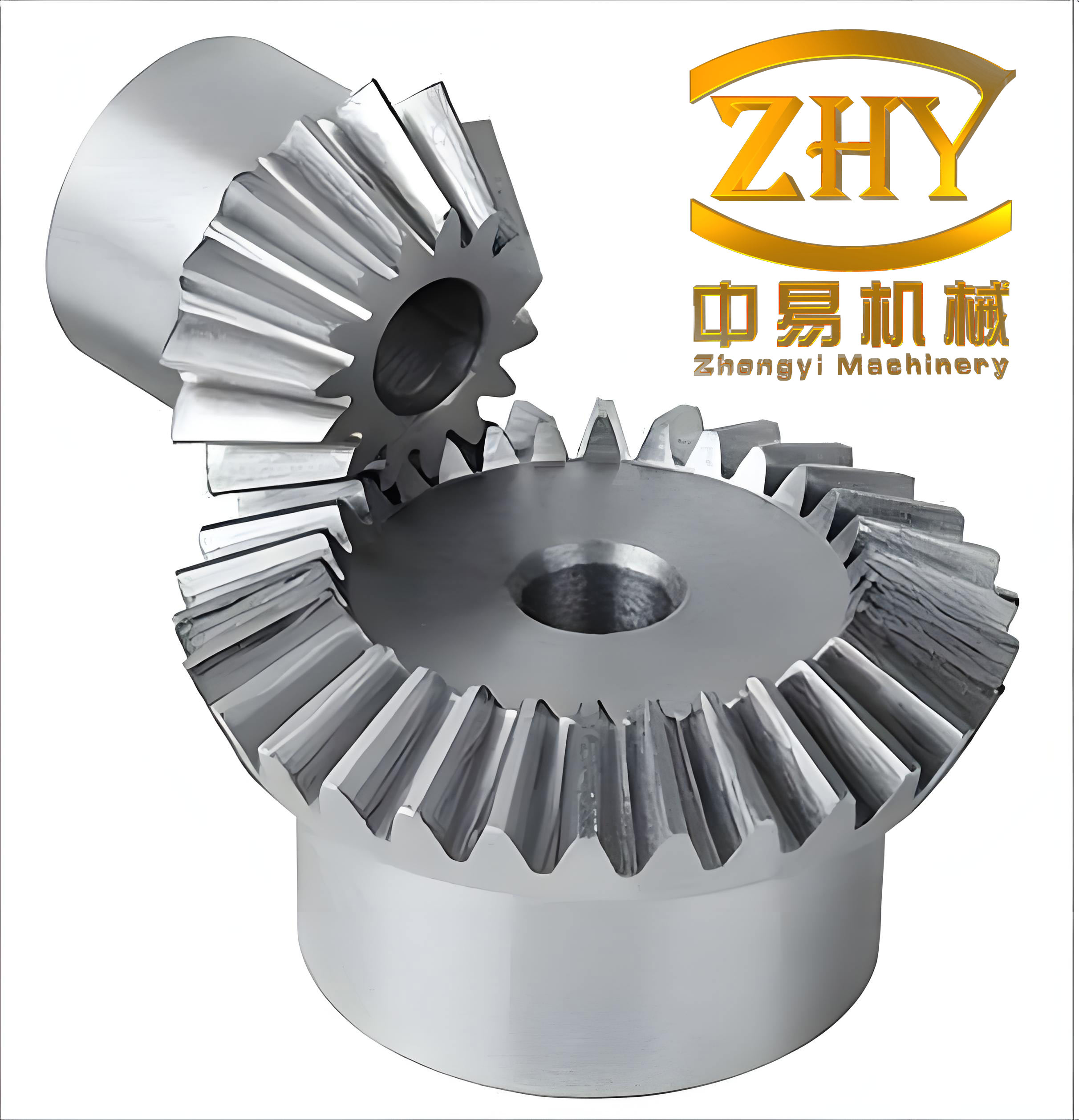
In the precision-driven world of gear manufacturing, the quality of the final straight bevel gear is profoundly influenced by the accuracy of its blank—the forged or machined workpiece before the teeth are cut. Through years of experience and analysis, I have observed that even minor deviations in blank dimensions and geometry can cascade into significant errors during tooth generation, inspection, and final assembly. This article delves into the multifaceted relationship between straight bevel gear blank accuracy and cutting precision. I will systematically examine how errors in bore diameter, face runout, outer diameter, tip cone element runout, mounting distance, crown-to-back distance, tip angle, and tooth thickness affect the final gear’s performance. For each parameter, I will propose practical inspection methodologies and derive the essential mathematical relationships, often using formulas and summary tables, to quantify these effects. The ubiquitous presence of straight bevel gears in automotive differentials, industrial machinery, and aerospace applications makes this analysis crucial for engineers and manufacturers aiming for silent, efficient, and durable power transmission.
The manufacturing process for a straight bevel gear begins with a meticulously prepared blank. According to national standards, several tolerance items are specified for the blank, such as bore diameter, outer diameter, tip cone element runout, and crown-to-back distance. These are not merely drawing annotations; they are vital process control points. Neglecting blank accuracy can lead to periodic errors, accumulated pitch errors, tooth trace deviations, and incorrect backlash, ultimately resulting in premature failure, noise, and vibration. Therefore, controlling the straight bevel gear blank’s form and dimensions is the first and perhaps most critical step in ensuring a high-quality final product. I will now explore each critical parameter in detail.
Bore Diameter Error and Face Runout: The Genesis of Eccentricity
For straight bevel gears with a central bore, the accuracy of this bore and the perpendicularity of the mounting face are paramount. When the blank is mounted on the cutting machine’s arbor or mandrel, any error in bore size or face runout introduces a geometric eccentricity. This eccentricity means the axis of rotation during cutting does not perfectly coincide with the gear’s theoretical axis. This misalignment is a primary source of periodic error, accumulated pitch error, and radial runout of the tooth ring after cutting. The total installation eccentricity \( e \) can be considered a composite of several factors:
- Radial runout of the machine tool spindle’s bore (\( e_1 \)).
- Radial runout of the mandrel or arbor itself (\( e_2 \)).
- Fit clearance between the gear blank bore and the mandrel (\( e_3 \)).
- Runout of the fixture’s supporting face (\( e_4 \)).
- Face runout of the gear blank’s reference face (\( e_5 \)).
- Tilting of the machine tool spindle (\( e_6 \)).
- Runout of the machine tool spindle’s end face (\( e_7 \)).
The resultant eccentricity \( e \) is approximately the vector sum: \( e \approx \sqrt{e_1^2 + e_2^2 + e_3^2 + e_4^2 + e_5^2 + e_6^2 + e_7^2} \). This eccentricity \( e \) directly translates into tooth-to-tooth composite error \( F_i” \) and total cumulative pitch error \( F_p \). A simplified relationship for the induced radial runout \( F_r \) is: $$ F_r \approx 2e $$. Bore diameter should be checked using limit gauges (GO and NO-GO gauges), while face runout is measured using a dial indicator on a bench center or a runout checking instrument.
| Error Source | Primary Effect on Cut Gear | Typical Inspection Method | Control Tolerance Guideline |
|---|---|---|---|
| Bore Diameter Oversize | Increased mandrel clearance, causing clamping eccentricity and tooth runout. | Limit plug gauges. | IT6-IT7 grade, often with zero negative deviation for shrink fits. |
| Bore Diameter Undersize | Difficulty in mounting, potential distortion during forcing. | Limit plug gauges. | IT6-IT7 grade. |
| Reference Face Runout | Geometric eccentricity, leading to periodic error and uneven tooth load. | Dial indicator on centers, referencing the bore axis. | Typically 5-10 μm for precision straight bevel gears. |
Outer Diameter Error: Governing the Tip Clearance
The outer diameter \( D_a \) of a straight bevel gear blank directly determines the position of the tooth tips after cutting. An error \( \Delta D_a \) in this dimension alters the actual tooth addendum. Since the tooth depth is fixed by the cutting tool, a change in addendum modifies the theoretical tip clearance when the gear meshes with its mate. For a given mounting distance, if the outer diameter is larger than nominal, the tip clearance is reduced, risking interference and increased noise. Conversely, a smaller outer diameter increases tip clearance, which may reduce the effective contact ratio and load-carrying capacity. Therefore, the upper limit deviation for the outer diameter of a straight bevel gear blank is often set to zero to prevent insufficient tip clearance. The outer diameter can be measured using micrometers, vernier calipers, or specialized snap gauges for high-volume production. The relationship between outer diameter error \( \Delta D_a \) and the change in theoretical tip clearance \( \Delta c \) is approximately: $$ \Delta c \approx -\frac{\Delta D_a}{2 \sin \delta_a} $$, where \( \delta_a \) is the tip angle.
Tip Cone Element Runout: Ensuring Concentricity
Runout of the tip cone element is measured perpendicular to the cone surface. This error indicates that the tip cone is not concentric with the bore axis. During cutting, this runout will cause variation in the tooth root line position and affect the uniformity of the tooth depth around the circumference. For straight bevel gears that use the tip cone as a subsequent grinding or heat-treating datum, this runout must be tightly controlled. It is typically checked on a runout checking instrument using centers or a mandrel, with a dial indicator positioned perpendicular to the cone surface. The tolerance is usually within 8-15 μm for precision gears. The effect of tip cone runout \( F_{tc} \) on tooth thickness variation \( \Delta S \) can be estimated if the runout is treated as an eccentricity \( e_{tc} \): $$ \Delta S \approx 2 e_{tc} \tan \alpha \cos \delta_a $$, where \( \alpha \) is the pressure angle.
Theoretical Mounting Distance and Crown-to-Back Distance: Defining the Mesh
The theoretical mounting distance \( X \) is the axial distance from the mounting face to the apex of the pitch cone. This is a fundamental design and assembly dimension. The crown-to-back distance \( A \) (also called back-cone to back distance) is the axial distance from the mounting face to the crown point (the intersection of the tip cone and the back cone). These two dimensions are intrinsically linked and critical for positioning the straight bevel gear correctly in the mesh. The crown-to-back distance is often used as a practical manufacturing and inspection substitute for the theoretical mounting distance, as the pitch cone apex is a virtual point outside the material. The formula relating crown-to-back distance \( A \), outer diameter \( D_a \), and tip angle \( \delta_a \) is: $$ A = \frac{D_a}{2} \cos \delta_a $$. For a straight bevel gear with module \( m \), number of teeth \( z \), and addendum coefficient \( h_a^* \), the outer diameter at the heel is \( D_a = mz + 2 h_a^* m \cos \delta \), where \( \delta \) is the pitch cone angle. The upper limit deviation for \( A \) is frequently set to zero to safeguard the minimum tip clearance.
Measuring \( A \) accurately is vital. In batch production, dedicated limit gauges (GO/NO-GO) or comparators with dial indicators are used. When using a dial comparator, the reading \( \Delta L \) relates to the crown-to-back error \( \Delta A \) and the tip angle error \( \Delta \delta_a \) as follows, where \( l \) is the distance from the dial contact point to the heel of the blank: $$ \Delta L = \Delta A \sec \delta_a + l \Delta \delta_a \tan \delta_a $$. To minimize the influence of tip angle error, the contact point \( l \) should be as close to the heel as possible. An error \( \Delta A \) in the crown-to-back distance directly shifts the tooth flank position. If the mounting distance in assembly remains fixed, an error \( \Delta A \) causes a change in addendum \( \Delta h_a \): $$ \Delta h_a = \Delta A \tan \delta_a $$. This, in turn, affects the measured chordal tooth thickness \( \bar{s} \) at the reference circle. The change in chordal thickness \( \Delta \bar{s} \) due to \( \Delta A \) is approximately: $$ \Delta \bar{s} \approx -2 \Delta A \tan \alpha \tan \delta_a $$.
| Parameter | Symbol | Formula / Relationship | Notes |
|---|---|---|---|
| Crown-to-Back Distance | \( A \) | $$ A = \frac{D_a}{2} \cos \delta_a $$ | Primary inspection dimension for the blank. |
| Change in Addendum | \( \Delta h_a \) | $$ \Delta h_a = \Delta A \tan \delta_a $$ | Due to crown-to-back error \( \Delta A \). |
| Change in Chordal Thickness | \( \Delta \bar{s} \) | $$ \Delta \bar{s} \approx -2 \Delta A \tan \alpha \tan \delta_a $$ | Approximation for small errors. |
| Dial Indicator Reading | \( \Delta L \) | $$ \Delta L \approx \Delta A \sec \delta_a + l \Delta \delta_a \tan \delta_a $$ | l is contact point distance from heel. |
Tip Angle Error: Influencing Measurement and Assembly
The tip angle \( \delta_a \) defines the cone on which the tooth tips lie. An error \( \Delta \delta_a \) in this angle affects multiple aspects of straight bevel gear manufacturing and inspection. Firstly, it can lead to an incorrect crown-to-back distance measurement, as shown in the previous formula. Secondly, if the tip cone is used as a datum for measuring tooth trace error (lead deviation), the tip angle error will directly bias the measurement result. When measuring tooth trace along the tip cone, a tip angle error \( \Delta \delta_a \) induces a measured error \( \Delta F_\beta \) that is not a true tooth flank deviation. The relationship is: $$ \Delta F_\beta \approx b \Delta \delta_a \tan \alpha_a $$, where \( b \) is the face width and \( \alpha_a \) is the pressure angle at the tip circle. This can be significant; for example, a \( 10′ \) tip angle error on a 30mm wide straight bevel gear can induce a measurement error of several micrometers. Thirdly, a positive tip angle error (angle larger than nominal) reduces the tip clearance at the heel of the mating gear, potentially causing interference. Therefore, the lower limit deviation for the tip angle is often set to zero. Tip angle is checked using optical projectors, precision protractors, or dedicated angle gauges. For critical applications like carburized and press-quenched straight bevel gears, the tip cone must perfectly match the quenching fixture, often verified by blueing.
Tooth Thickness and Profile Considerations in the Blank Context
While tooth thickness and profile are generated during cutting, the blank’s geometry, specifically the back cone angle \( \delta_f \), can influence their measurement if inspection is performed on the back cone projection. The back cone is often used as a reference for tooth thickness measurement via chords or over pins. An error \( \Delta \delta_f \) in the back cone angle will cause an apparent change in the measured chordal thickness \( \Delta \bar{s}_f \) at the root, even if the actual tooth form is correct. The approximate relationship is: $$ \Delta \bar{s}_f \approx -R_f \Delta \delta_f \sin(2\alpha_f) $$, where \( R_f \) is the back cone distance to the measurement point and \( \alpha_f \) is the pressure angle at the root. Furthermore, this back cone angle error also affects the measured tooth profile deviation \( \Delta f_f \). An estimate for the profile error introduced at the root is: $$ \Delta f_f \approx \frac{h_f}{2b} \Delta \bar{s}_f \approx -\frac{h_f R_f}{2b} \Delta \delta_f \sin(2\alpha_f) $$, where \( h_f \) is the dedendum. In practice, when using a projection comparator, the operator typically aligns the back cone edge to the theoretical line, nullifying this effect for that particular measurement. However, for absolute dimensional control of the straight bevel gear blank, the back cone angle should still be held within reasonable tolerances, often checked with angle-measuring instruments or master templates.
Chamfer or “Break” Width at the Toe: A Subtle yet Important Feature
Many straight bevel gear blanks include a small chamfer or break at the intersection of the tip cone and the front face (the toe end). This chamfer, of width \( b_c \), is intended to prevent a sharp edge. However, if this chamfer is excessively wide, it effectively reduces the land area of the tip cone from which the tooth addendum is referenced. During cutting, the tool will generate teeth assuming a full tip cone. If a chamfer is present, the actual tooth addendum along the chamfered region will be greater than nominal. This results in a non-uniform addendum from heel to toe and a corresponding reduction in tip clearance in the chamfered zone. The increase in addendum \( \Delta h_{ac} \) at a point located a distance \( x \) from the heel along the face width due to a chamfer width \( b_c \) is given by: $$ \Delta h_{ac}(x) = b_c \left( \tan \delta_a – \tan \gamma \right) \frac{x}{b} $$, where \( \gamma \) is the chamfer angle (often 45°) and \( b \) is the face width. At the toe (x = b), the addendum increase is maximum. To prevent issues, the chamfer width \( b_c \) should be strictly controlled, typically not exceeding 0.5 mm for medium-sized straight bevel gears. In batch production, dedicated limit gauges are used to check this feature.
Comprehensive Inspection Strategy and Tolerance Synthesis
A holistic approach to straight bevel gear blank inspection involves understanding the interaction between different errors. For instance, an error in outer diameter might be compensated by a corresponding error in tip angle to maintain the correct crown-to-back distance, but this compensation could adversely affect tip clearance. Therefore, a balanced tolerance allocation is necessary. The following table consolidates the primary blank accuracy items, their effects on the final straight bevel gear, recommended inspection techniques, and key mathematical correlations for error analysis.
| Blank Parameter | Symbol | Primary Effect on Cut Gear | Standard Inspection Method | Key Formula for Error Impact |
|---|---|---|---|---|
| Bore Diameter | \( D_i \) | Installation eccentricity, tooth runout (\( F_r \)) | Limit plug gauges, air gauges | \( F_r \approx 2 \times \text{Effective Eccentricity} \) |
| Face Runout | \( F_t \) | Geometric eccentricity, periodic error | Dial indicator on centers | Contributes to total eccentricity \( e \). |
| Outer Diameter | \( D_a \) | Tooth addendum, tip clearance (\( c \)) | Micrometer, snap gauge | \( \Delta c \approx -\frac{\Delta D_a}{2 \sin \delta_a} \) |
| Tip Cone Runout | \( F_{tc} \) | Uneven tooth depth, radial runout | Dial indicator perpendicular to cone | \( \Delta S \approx F_{tc} \tan \alpha \cos \delta_a \) |
| Crown-to-Back Distance | \( A \) | Tooth flank position, mesh alignment | Dedicated limit gauge, comparator | \( A = \frac{D_a}{2} \cos \delta_a \), \( \Delta h_a = \Delta A \tan \delta_a \) |
| Tip Angle | \( \delta_a \) | Tip clearance, measurement datum error | Universal bevel protractor, optical projector | \( \Delta F_\beta \approx b \Delta \delta_a \tan \alpha_a \) (if used as datum) |
| Back Cone Angle | \( \delta_f \) | Apparent tooth thickness/profile in measurement | Angle gauge, template | \( \Delta \bar{s}_f \approx -R_f \Delta \delta_f \sin(2\alpha_f) \) |
| Chamfer Width | \( b_c \) | Local addendum increase, tip clearance reduction | Visual gauge, limit snap gauge | \( \Delta h_{ac}(toe) = b_c (\tan \delta_a – \tan \gamma) \) |
In modern manufacturing, Coordinate Measuring Machines (CMMs) are increasingly used for first-article inspection of complex straight bevel gear blanks. A CMM can measure the actual 3D coordinates of the tip cone, back cone, and mounting face, directly computing the crown-to-back distance, cone angles, and runouts relative to the bore axis. This provides a comprehensive digital record of the blank’s conformity. However, for in-process control in high-volume production, dedicated hard gauges remain faster and more cost-effective.
The Interplay of Errors in Final Gear Performance
To fully appreciate the importance of blank accuracy, one must consider how these errors combine in the meshing of two straight bevel gears. For example, consider a gear pair where both blanks have a positive crown-to-back error \( \Delta A \). If the assembly mounting distance is not adjusted, both gears will have increased addendum. This leads to a double reduction in operational tip clearance, which can be critical: $$ \Delta c_{total} \approx -(\Delta A_1 + \Delta A_2) (\tan \delta_{a1} + \tan \delta_{a2}) $$. Similarly, bore eccentricities in both gears can add vectorially, exacerbating transmission error and noise. The comprehensive transmission error \( TE(\theta) \) of a straight bevel gear pair can be modeled as a function of individual blank errors, tooth spacing errors, and deflections. A simplified frequency-domain view shows that blank-induced errors often manifest as once-per-revolution (1X) components, which are particularly objectionable in noise-sensitive applications. Therefore, controlling blank accuracy is not just about meeting drawing tolerances; it is about controlling the fundamental excitations in the gear system.
Furthermore, the heat treatment process often introduces distortions. A blank that is not symmetric or has residual stresses from machining may warp during carburizing and quenching. This post-heat-treatment geometry error can sometimes be corrected by hard finishing (grinding), but for non-ground straight bevel gears, the blank accuracy before cutting is the sole determinant of final tooth geometry. Hence, close cooperation between the blank forging/machining department and the gear cutting department is essential. Statistical Process Control (SPC) charts for key blank dimensions like crown-to-back distance and tip angle can provide early warnings of process drift.
Conclusion: The Foundation of Quality
In summary, the manufacturing of a high-precision straight bevel gear is built upon the foundation of a meticulously controlled blank. Each dimension and geometric feature—from the bore that centers it to the cone angles that locate its teeth—plays a interconnected role in determining the final gear’s accuracy, noise performance, and service life. Through rigorous inspection employing both traditional gauges and modern metrology, and through a deep understanding of the mathematical relationships between blank errors and gear errors, manufacturers can significantly enhance the quality of their straight bevel gears. The formulas and tables presented here provide a framework for analyzing these effects. As an engineer reflecting on countless production batches, I assert that investing time and resources in achieving superior blank accuracy is not an optional refinement; it is an economic necessity that reduces scrap, minimizes costly post-cut corrections, and ensures that the straight bevel gear performs flawlessly in its demanding application. The pursuit of excellence in straight bevel gear manufacturing begins, unequivocally, with the blank.