
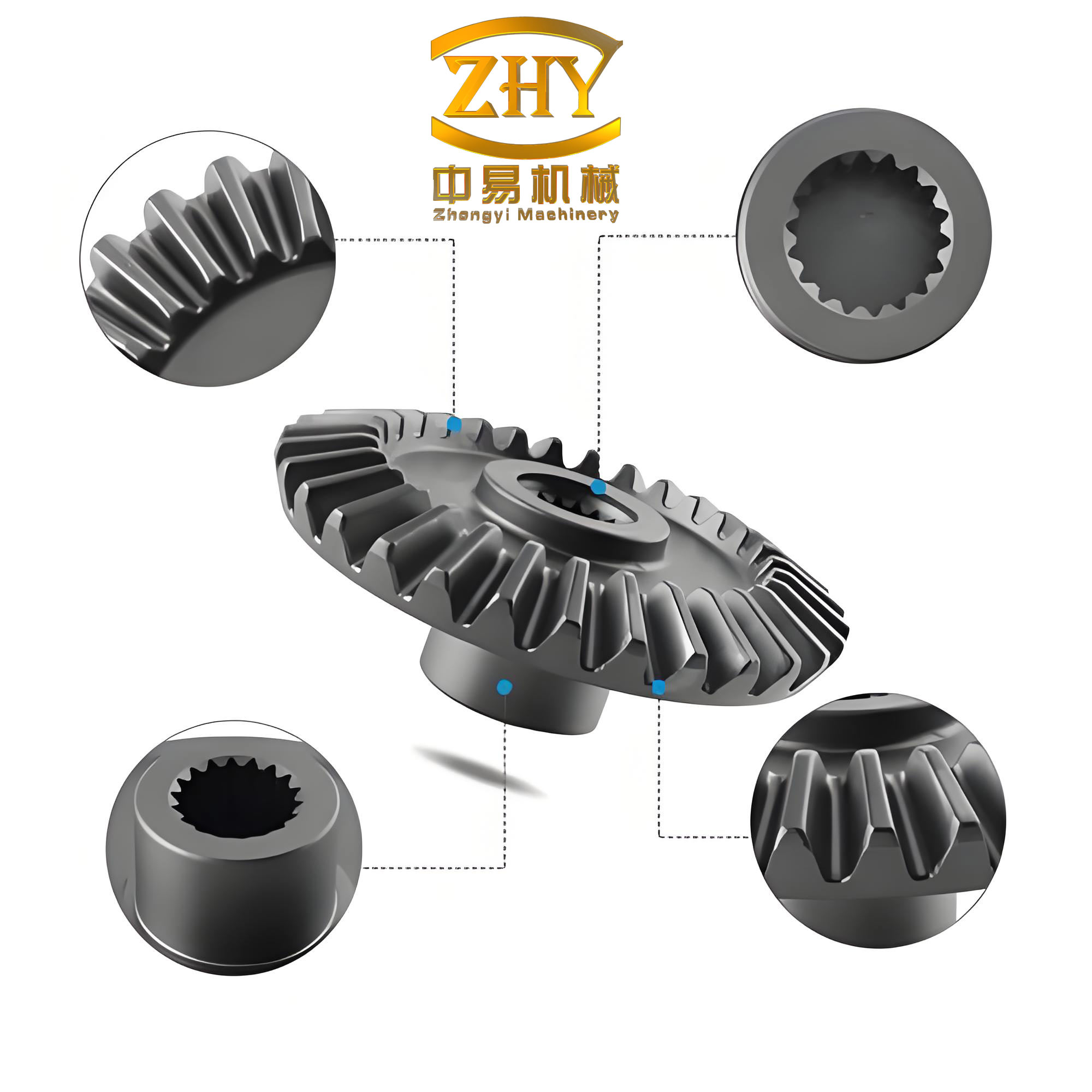
In the realm of precision mechanical transmission, the straight bevel gear holds a position of critical importance, especially in applications demanding compact design, high efficiency, and precise motion transfer, such as in aerospace, automotive differentials, and sophisticated instrumentation. However, the manufacturing of these components, particularly small module variants, has long been hampered by traditional methods that are often synonymous with low efficiency and complex setup. My work focuses on addressing this very challenge by re-purposing a modern CNC spiral bevel gear milling machine for the high-speed hobbing of small module straight bevel gears, leveraging the power of carbide single-position hobs and advanced simulation to achieve a dramatic leap in productivity.
The conventional landscape for machining a straight bevel gear is populated by methods like gear planing, which is based on the generating principle using a simulated crown gear, and form milling. While generating methods offer high theoretical accuracy, they are inherently discontinuous—involving cycle times for cutting, retraction, indexing, and re-engagement—which fundamentally limits their throughput. Form milling methods, including the use of a single-position hob, offer the potential for continuous cutting but were historically confined to simpler mechanical machines. The advent of multi-axis CNC technology, however, opens a new frontier. My approach was to develop a dedicated hobbing-milling CNC program for the H120C CNC spiral bevel gear milling machine. This transforms the machine from a dedicated generator of curved teeth into a versatile, high-speed platform for producing straight bevel gears.
The Principle of High-Speed Hobbing for Straight Bevel Gears
The core of this method is the use of a carbide-tipped single-position hob in a continuous indexing process. Unlike a generating hob for spur gears, the single-position hob for a straight bevel gear is a form tool. Its tooth profile is designed based on the expanded profile of the gear’s back cone at the large end. Consequently, only the large-end tooth profile of the manufactured straight bevel gear is theoretically perfect; the profile at the small end deviates, becoming slightly fuller. This deviation, often termed “under-cutting” at the toe, is a characteristic of the form-cutting process. For small module straight bevel gears where the face width is typically less than 25% of the outer cone distance, this error is acceptably small and has negligible impact on the meshing performance of the gear pair in practical applications.
The kinematics of the process are elegantly simple and continuous, which is the source of its high efficiency. The hob rotates continuously at a high speed (n_c). The workpiece, mounted on the machine’s A-axis, rotates synchronously at a speed (n_w) dictated by the gear ratio:
$$ n_w = \frac{n_c}{Z} $$
where \( Z \) is the number of teeth of the straight bevel gear. This continuous rotation constitutes the indexing motion. Simultaneously, a compound linear feed motion is executed by the machine’s linear axes (X, Y, Z) to guide the hob through the gear blank. This feed typically consists of two phases: a radial infeed to full depth, followed by a feed along the length of the tooth (parallel to the root cone element) to complete the face width. A typical single-position hob for a straight bevel gear has a limited number of gashes (e.g., 5 or 7) arranged in an alternate pattern to cut both the left and right flanks.
Platform: The H120C CNC Spiral Bevel Gear Milling Machine
The successful implementation of this strategy hinges on the capabilities of the machine tool. The H120C is a 6-axis CNC machine, with five axes capable of simultaneous interpolation. Its configuration is ideal for adapting to the hobbing kinematics of a straight bevel gear.
The key axes involved are:
- C-axis (Spindle): Drives the single-position hob.
- A-axis (Workpiece): Rotates the gear blank for indexing.
- B-axis (Workpiece Tilt): Adjusts the angle between the workpiece and tool axes, setting the root angle of the straight bevel gear.
- X, Y, Z Linear Axes: Provide the necessary linear motions for positioning, infeed, and traverse along the tooth length.
The machine’s robust construction and high-speed spindle are crucial for utilizing carbide hobs effectively. The table below summarizes its critical specifications relevant to machining small module straight bevel gears.
| Parameter Category | Parameter | Specification |
|---|---|---|
| Workpiece Capacity | Maximum Gear Diameter | 120 mm |
| Maximum Module | 4 mm | |
| Maximum Face Width | 30 mm | |
| Number of Teeth Range | 1 – 200 | |
| Tool Spindle | Maximum Speed | 3500 rpm |
| Tool Diameter Range | 25.4 – 101.6 mm | |
| CNC Capability | Linear Axes (X, Y, Z) | Fully programmable |
| Rotary Axes (A, B, C) | Fully programmable, synchronized | |
| Control System | Open-architecture CNC suitable for custom kinematic programming |
CNC Program Development and Kinematic Model
The transformation of the H120C into a straight bevel gear hobber required the development of a specialized post-processor and cycle program. This software component translates the geometric parameters of the desired straight bevel gear and the tool data into the coordinated motion commands for all five active axes.
The mathematical foundation involves calculating the precise tool center point (TCP) trajectory relative to the workpiece coordinate system. The key parameters include the gear’s pitch angle (\( \delta \)), outer cone distance (\( R_e \)), face width (\( F \), and the hob’s diameter and initial position. The coordinated motion can be broken down into a sequence. First, positioning: the hob is moved to a safe start point relative to the gear blank, with the B-axis set to the complement of the pitch angle (\( 90^\circ – \delta \)) for a typical setup where the hob axis is perpendicular to the root cone element. Then, the synchronous hobbing phase begins, governed by the relationship:
$$ \theta_A(t) = \frac{360^\circ}{Z} \cdot \frac{\theta_C(t)}{360^\circ} = \frac{1}{Z} \cdot \theta_C(t) $$
where \( \theta_C(t) \) is the angular position of the C-axis (hob) and \( \theta_A(t) \) is the angular position of the A-axis (workpiece).
Simultaneously, the linear axes execute the feed profile. The radial infeed distance (\( D_{radial} \)) to reach full depth (\( h \)) can be calculated based on the initial offset and the gear geometry. The subsequent longitudinal feed along the face width (\( F \)) is a linear move. The resultant tool path is a smooth, continuous helix relative to the workpiece. The CNC program automates all these calculations, allowing the user to simply input gear data as shown in the interface concept below.
The development cycle followed a rigorous path: 1) Analysis of hobbing kinematics for a straight bevel gear, 2) Mathematical modeling and post-processor coding, 3) Virtual verification via CNC simulation, and 4) Physical trial and optimization. This process ensured the correctness and collision-free nature of the generated G-code before any metal was cut.
Verification Through Virtual Machining Simulation
Prior to actual machining, a comprehensive digital twin of the entire process was created using VERICUT simulation software. This step was indispensable for validating the custom post-processor, checking for axis travel limits, and preventing potential collisions between the hob, tool holder, and machine components.
The simulation environment was built with the following components:
- Machine Model: A precise 3D model of the H120C machine, including all moving components (slides, heads, tables) and their kinematic chain (tree structure), was imported and configured.
- Tool Assembly Model: A detailed model of the single-position hob, its holder, and the machine spindle nose was created and assembled in the tool library.
- Workpiece Model: A blank representing the forged or turned gear pre-form was defined.
- CNC Program: The G-code program generated by the new post-processor for a specific straight bevel gear was loaded.
Running the simulation provided a visual and analytical verification. The virtual material removal process could be observed in real-time. The simulation confirmed that the synchronized motion of the A and C axes produced continuous indexing, while the linear axes executed the correct compound feed path to fully form the tooth space of the straight bevel gear. Any errors in axis coordination or motion limits would be immediately apparent, allowing for correction in the software phase, thus saving significant time and cost associated with physical trial-and-error.
Actual Machining and Performance Validation
Following successful simulation, physical cutting trials were conducted. A pair of small module straight bevel gears was selected for testing, with parameters as follows: Pinion teeth (Z_p)=37, Gear teeth (Z_g)=74, Module (m)=0.5 mm, Pressure angle=20°, Face width=5 mm. A carbide-tipped single-position hob with a diameter of 25.4 mm was used at a spindle speed of 1500 rpm.
The results were transformative, particularly regarding efficiency. A direct comparison was made with the traditional method of machining the same gears on a conventional mechanical planing machine (e.g., a HARBECK 12H type). The table below starkly illustrates the difference.
| Machine & Method | Machining Time per Gear (minutes) | Efficiency Gain Factor | |
|---|---|---|---|
| Gear (74 teeth) | Pinion (37 teeth) | ||
| H120C with High-Speed Hobbing | 6 | 6 | Reference (1x) |
| Conventional Mechanical Planer | 60 | 45 | 7.5x – 10x slower |
The data shows that the high-speed hobbing process reduced machining time to merely 10% to 13.3% of the time required by planing. This order-of-magnitude improvement is primarily due to the elimination of non-cutting time (retraction, indexing, re-approach) and the ability to use high cutting speeds afforded by the carbide hob and rigid CNC platform.
Furthermore, the quality of the produced straight bevel gears was meticulously inspected on a gear measuring center (e.g., a Klingelnberg P series or similar). The critical quality metrics assessed were:
- Pitch Accuracy: Both single pitch deviation (f_p) and total cumulative pitch deviation (F_p) were measured. The results consistently met the DIN 3965 quality grade 4 standard, indicating very high indexing accuracy from the CNC-controlled synchronous motion.
- Profile Deviation: The actual tooth flank was compared against the theoretical form-cutter generated profile. The maximum profile form error (F_fα) was found to be less than 7.4 μm for the tested gears. This confirms that the errors inherent to the form-hobbing process for a straight bevel gear are within acceptable limits for small module applications.
The inspection results can be summarized by the following conceptual metrics table:
| Quality Parameter | Standard / Measure | Achieved Result | Assessment |
|---|---|---|---|
| Indexing Accuracy | DIN 3965 Grade | Grade 4 | High Precision |
| Tooth-to-Tooth Spacing | Single Pitch Deviation, f_p | < 5 μm | Excellent Consistency |
| Overall Spacing | Total Pitch Deviation, F_p | < 15 μm | High Accuracy |
| Tooth Form Accuracy | Profile Form Error, F_fα | < 7.4 μm | Well within functional limits for small module gears |
Advantages, Limitations, and Future Perspectives
The implementation of high-speed hobbing for small module straight bevel gears on a CNC platform like the H120C presents a compelling set of advantages:
- Dramatically Increased Productivity: As evidenced, 10x faster cycle times are achievable.
- Simplified Setup: Elimination of complex mechanical gear trains and change gears. Setup is done through CNC program input.
- High Accuracy & Consistency: CNC-controlled motions ensure repeatable, high-precision results batch after batch.
- Flexibility: The same machine can be quickly reprogrammed to produce different straight bevel gears, or even switch back to its original function of cutting spiral bevel gears.
- Modern Tooling: Enables the use of state-of-the-art carbide hobs, further pushing the boundaries of cutting speed and tool life.
The primary limitation remains the inherent form-cutter error, especially towards the toe of the tooth. Therefore, this method is most suitable and highly recommended for small module straight bevel gears with a limited face-width-to-cone-distance ratio. For large, high-precision straight bevel gears, generating methods like CNC planing or face milling may still be preferable for optimal conjugate flank geometry.
Future work can extend this paradigm further. The integration of on-machine probing for adaptive setup and in-process compensation could enhance accuracy. Developing more sophisticated hob design algorithms to minimize form error across the entire face width is another promising research direction. Furthermore, the concept validates the potential of multi-tasking CNC gear machining centers, where a single machine can perform hobbing, shaping, grinding, and deburring on a variety of gear types, including the straight bevel gear, dramatically simplifying the production floor.
In conclusion, the adaptation of a CNC spiral bevel gear milling machine for the high-speed hobbing of small module straight bevel gears represents a significant technological advancement. By marrying the principles of form-hobbing with the flexibility and precision of modern CNC, it successfully breaks the efficiency bottleneck of traditional methods. The process, verified through rigorous simulation and physical testing, delivers superior productivity while maintaining the gear quality required for demanding applications, establishing a new, efficient manufacturing route for this fundamental mechanical component.