
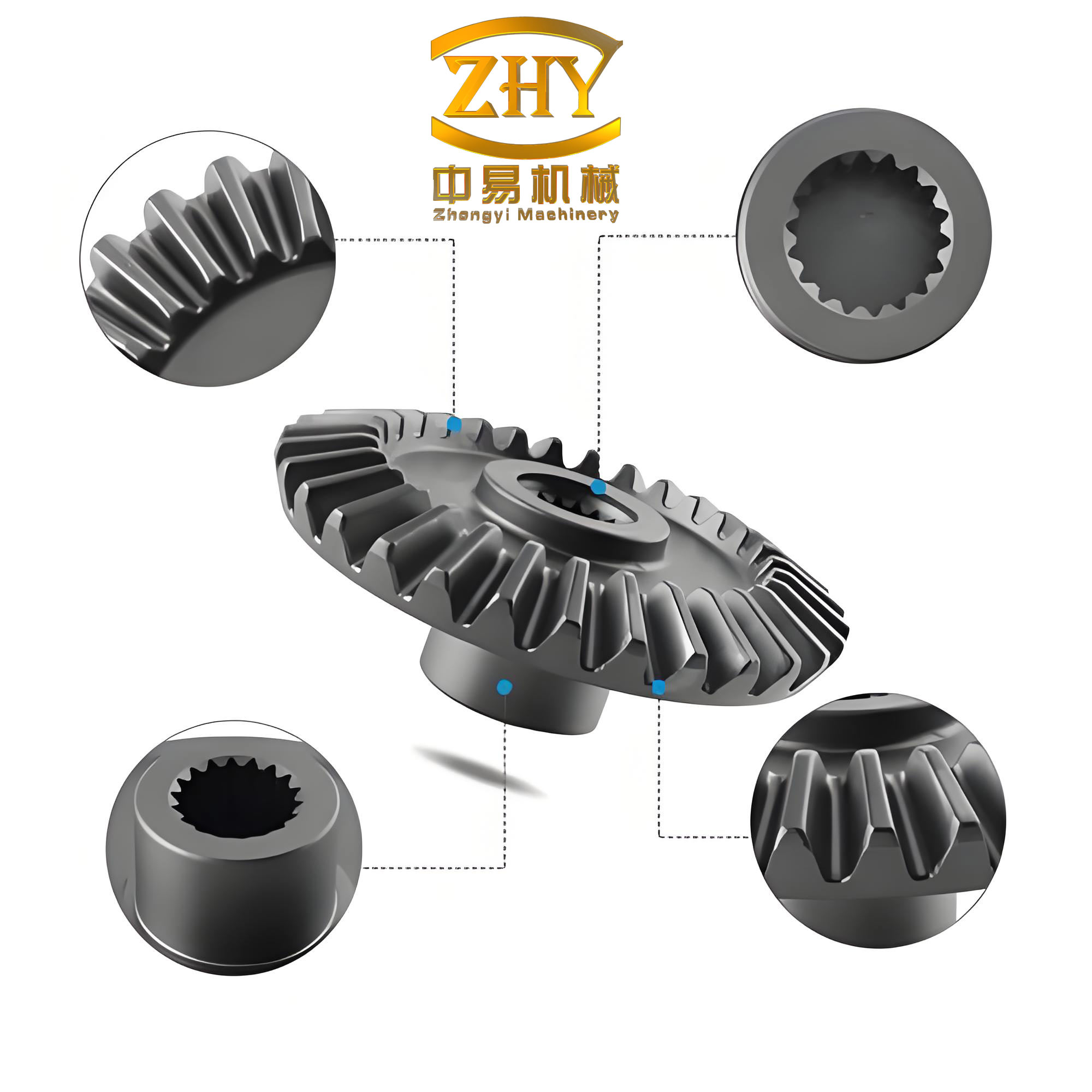
In my extensive experience working with gear manufacturing, I have often encountered the challenge of producing straight bevel gears with non-standard pressure angles. These straight bevel gears are crucial components in many mechanical systems, enabling power transmission between intersecting shafts. The process of machining these straight bevel gears requires precise adjustments, especially when dealing with various pressure angles. In this article, I will delve into the methodology I employ on a gear planing machine, utilizing the generating cutting method to achieve accurate profiles for straight bevel gears. The focus will be on the theoretical foundations, practical calculations, and machine adjustments necessary for successful production of straight bevel gears.
The generating method, commonly referred to as the roll-cutting process, involves simulating the meshing of the workpiece with an imaginary crown gear. This imaginary crown gear, often called a planing gear, has its cone vertex coinciding with that of the workpiece straight bevel gear. During the cutting process, two planing tools, which represent a single tooth of this imaginary crown gear, progressively cut each tooth of the straight bevel gear while undergoing a rolling motion without backlash. This simulation ensures that the tooth profile of the straight bevel gear is accurately generated according to the desired specifications. The key to this process lies in maintaining the correct meshing condition between the workpiece and the imaginary crown gear.
The meshing condition can be expressed mathematically. Let me define the parameters: for the imaginary crown gear, the diametral pitch is denoted as \( P_{\text{crown}} \) and the pressure angle (or tool profile angle) as \( \alpha_{\text{crown}} \). For the workpiece straight bevel gear, the diametral pitch is \( P_{\text{work}} \) and the pressure angle is \( \alpha_{\text{work}} \). The fundamental relationship for proper meshing in the generating process is given by:
$$ P_{\text{crown}} = P_{\text{work}} \cdot \frac{\cos \alpha_{\text{crown}}}{\cos \alpha_{\text{work}}} $$
This equation ensures that the virtual gear pair operates correctly during the roll-cutting action. When the pressure angle of the straight bevel gear differs from that of the tool (i.e., \( \alpha_{\text{work}} \neq \alpha_{\text{crown}} \)), adjustments must be made to the machine setup. Specifically, the included angle between the two planing tool holders is modified so that the effective diametral pitch of the imaginary crown gear satisfies the above equation. This adjustment is critical for achieving the correct tooth form on the straight bevel gear. It is important to note that the value of \( P_{\text{crown}} \) derived from this formula is used solely for setting the machine’s generating motion and tooth angle adjustments. For calculating the total depth of the tooth on the straight bevel gear, the workpiece diametral pitch \( P_{\text{work}} \) is still employed. This distinction is vital to avoid errors in gear geometry.
To elaborate, let me discuss the pressure angle in more detail. The pressure angle, often denoted by \( \alpha \), is a key parameter influencing the tooth strength, contact ratio, and meshing behavior of straight bevel gears. Common pressure angles include 14.5°, 20°, and 25°, but custom angles may be required for specific applications. When machining straight bevel gears with non-standard pressure angles, the tool’s pressure angle might not match. For instance, if using a standard 20° pressure angle planing tool to cut a straight bevel gear with a 25° pressure angle, the meshing condition formula must be applied to determine the required adjustments. This flexibility allows for the production of a wide range of straight bevel gears without needing specialized tools for every pressure angle.
The machine adjustments on a gear planer, such as the model referenced, differ from conventional setups in two main aspects: the generating motion and the tooth angle setting. I will break down the calculations involved.
First, the generating motion adjustment ensures that the relative rolling between the workpiece and the imaginary crown gear is correct. The generating ratio is tied to the diametral pitches. Since \( P_{\text{crown}} \) is derived from the meshing condition, it directly influences the generating mechanism’s settings. The machine’s change gears or electronic controls must be configured to achieve this ratio. In practice, I compute \( P_{\text{crown}} \) using the formula above, then use it to determine the appropriate gear train or programming parameters for the generating motion. This step is crucial for accurately forming the tooth profile of the straight bevel gear.
Second, the tooth angle adjustment, often referred to as the setting angle for the tool slide, is calculated using the following relation:
$$ \theta = \frac{\pi}{P_{\text{crown}} \cdot R} $$
Where \( \theta \) represents the angular adjustment for the tool holders, \( R \) is the cone distance (or pitch cone radius) of the workpiece straight bevel gear, and \( P_{\text{crown}} \) is as previously defined. The cone distance \( R \) is a fundamental geometric parameter for straight bevel gears, calculated from the pitch diameter and pitch angle. For a straight bevel gear, the cone distance from the apex to the pitch circle at the large end is given by:
$$ R = \frac{D}{2 \sin \gamma} $$
Here, \( D \) is the pitch diameter at the large end, and \( \gamma \) is the pitch angle of the straight bevel gear. This value is essential for multiple calculations in the machining process.
Additionally, the tooth depth calculation for the straight bevel gear remains based on the workpiece diametral pitch \( P_{\text{work}} \). The full depth \( h \) of the tooth typically includes the addendum and dedendum. For straight bevel gears, the addendum \( a \) and dedendum \( b \) are often calculated using standard formulas, but they must be adjusted for the straight bevel gear’s conical geometry. A common approach is:
$$ a = \frac{1}{P_{\text{work}}}, \quad b = \frac{1.25}{P_{\text{work}}} $$
However, these values may vary based on the tooth system (e.g., 20° stub tooth). The total depth \( h = a + b \). It is critical to use \( P_{\text{work}} \) here, not \( P_{\text{crown}} \), to ensure the correct tooth dimensions for the straight bevel gear.
To illustrate the adjustments for different pressure angles, I have compiled a table showing example calculations. This table compares various scenarios for machining straight bevel gears with pressure angles of 14.5°, 20°, and 25°, using a standard 20° pressure angle tool. The workpiece diametral pitch is assumed to be 10 in-1 for consistency.
| Workpiece Pressure Angle, \( \alpha_{\text{work}} \) (degrees) | Tool Pressure Angle, \( \alpha_{\text{crown}} \) (degrees) | Workpiece Diametral Pitch, \( P_{\text{work}} \) (in-1) | Calculated Crown Diametral Pitch, \( P_{\text{crown}} \) (in-1) | Cone Distance \( R \) (inches) | Tooth Angle Adjustment \( \theta \) (radians) |
|---|---|---|---|---|---|
| 14.5 | 20 | 10 | $$ P_{\text{crown}} = 10 \cdot \frac{\cos 20^\circ}{\cos 14.5^\circ} \approx 10.34 $$ | 5.0 | $$ \theta = \frac{\pi}{10.34 \times 5.0} \approx 0.0607 $$ |
| 20 | 20 | 10 | $$ P_{\text{crown}} = 10 \cdot \frac{\cos 20^\circ}{\cos 20^\circ} = 10.00 $$ | 5.0 | $$ \theta = \frac{\pi}{10.00 \times 5.0} = 0.0628 $$ |
| 25 | 20 | 10 | $$ P_{\text{crown}} = 10 \cdot \frac{\cos 20^\circ}{\cos 25^\circ} \approx 9.57 $$ | 5.0 | $$ \theta = \frac{\pi}{9.57 \times 5.0} \approx 0.0656 $$ |
This table demonstrates how \( P_{\text{crown}} \) varies with pressure angle differences, affecting the machine settings. Note that the cone distance \( R \) is held constant for simplicity; in practice, it depends on the gear design. Such tables are invaluable for quick reference when setting up the machine for different straight bevel gears.
Beyond these calculations, the actual machining process involves several steps. First, the workpiece straight bevel gear blank is mounted on the machine spindle, aligned correctly with the cone vertex. The planing tools are set at the calculated included angle, which corresponds to the tooth angle adjustment. The generating motion is then engaged, allowing the tools to cut the tooth spaces while the workpiece rotates in synchrony. Each tooth of the straight bevel gear is formed by the reciprocal motion of the tools, combined with the rolling action. I always ensure that the tool geometry is sharp and accurate, as any wear can lead to deviations in the tooth profile of the straight bevel gear.
Another critical aspect is the calculation of the root angle and face angle for straight bevel gears. These angles determine the geometry at the heel and toe of the tooth. The root angle \( \gamma_f \) is typically the pitch angle minus the dedendum angle, while the face angle \( \gamma_a \) is the pitch angle plus the addendum angle. For straight bevel gears, these angles are derived from the pitch cone and the tooth dimensions. Formulas include:
$$ \gamma_f = \gamma – \delta_b, \quad \gamma_a = \gamma + \delta_a $$
Where \( \delta_b \) is the dedendum angle and \( \delta_a \) is the addendum angle, calculated as:
$$ \delta_b = \arctan\left(\frac{b}{R}\right), \quad \delta_a = \arctan\left(\frac{a}{R}\right) $$
Here, \( a \) and \( b \) are the addendum and dedendum at the large end of the straight bevel gear. These angles are essential for setting the cutting depth and tool path during machining.
To further explore the influence of pressure angle on straight bevel gear performance, consider the contact ratio and bending strength. The contact ratio \( m_c \) for straight bevel gears can be approximated using formulas that involve the pressure angle. A higher pressure angle generally increases the bending strength but may reduce the contact ratio, affecting smoothness of operation. For straight bevel gears, the transverse contact ratio is given by:
$$ m_c = \frac{\sqrt{R_{a1}^2 – R_{b1}^2} + \sqrt{R_{a2}^2 – R_{b2}^2} – C \sin \alpha_{\text{work}}}{\pi m_t \cos \alpha_{\text{work}}} $$
Where \( R_a \) and \( R_b \) are the tip and base radii, \( C \) is the center distance, and \( m_t \) is the transverse module. This formula highlights how \( \alpha_{\text{work}} \) directly impacts the meshing characteristics of straight bevel gears. In machining, ensuring the correct pressure angle is vital for achieving the desired performance.
Now, let me discuss the tooling considerations. The planing tools used for generating straight bevel gears have a specific profile angle, which is typically standard (e.g., 20°). When machining straight bevel gears with different pressure angles, the tool profile does not change; instead, the machine adjustments compensate for the difference. This is achieved by altering the effective diametral pitch of the imaginary crown gear via the tool holder angle. I have found that this method is highly efficient, as it reduces the need for multiple tool sets. However, it requires precise calculations and machine calibration. The tool material should be hard and wear-resistant, such as high-speed steel or carbide, to maintain accuracy over multiple production runs of straight bevel gears.
In practice, I often encounter straight bevel gears with module systems rather than diametral pitch. The conversion is straightforward: diametral pitch \( P \) (in-1) and module \( m \) (mm) are related by \( P = 25.4 / m \). The meshing condition formula can be adapted accordingly. For module-based straight bevel gears, the crown module \( m_{\text{crown}} \) is:
$$ m_{\text{crown}} = m_{\text{work}} \cdot \frac{\cos \alpha_{\text{work}}}{\cos \alpha_{\text{crown}}} $$
This flexibility allows the same methodology to be applied to metric straight bevel gears. I frequently work with both systems, so having these conversions at hand is essential.
To summarize the key formulas in one place, here is a comprehensive list:
- Meshing condition: $$ P_{\text{crown}} = P_{\text{work}} \cdot \frac{\cos \alpha_{\text{crown}}}{\cos \alpha_{\text{work}}} $$
- Tooth angle adjustment: $$ \theta = \frac{\pi}{P_{\text{crown}} \cdot R} $$
- Cone distance: $$ R = \frac{D}{2 \sin \gamma} $$
- Addendum and dedendum: $$ a = \frac{1}{P_{\text{work}}}, \quad b = \frac{k}{P_{\text{work}}} $$ where \( k \) is a constant (often 1.25).
- Root and face angles: $$ \gamma_f = \gamma – \arctan\left(\frac{b}{R}\right), \quad \gamma_a = \gamma + \arctan\left(\frac{a}{R}\right) $$
- Contact ratio approximation: $$ m_c \approx \frac{\text{Length of path of contact}}{\pi m_t \cos \alpha_{\text{work}}} $$
These equations form the backbone of the machining process for straight bevel gears with various pressure angles.
In addition to the technical calculations, practical experience plays a significant role. For instance, when setting up the machine, I always perform a trial cut on a scrap blank to verify the tooth profile of the straight bevel gear. This step helps identify any errors in the adjustments before machining the final workpiece. I also pay close attention to the lubrication and cooling during cutting, as straight bevel gear materials like steel can generate heat, affecting tool life and surface finish. The use of cutting fluids is recommended to extend tool life and improve the accuracy of the straight bevel gear teeth.
Moreover, the quality inspection of machined straight bevel gears is crucial. I employ gear measurement tools such as gear checkers or coordinate measuring machines (CMMs) to verify the pressure angle, tooth thickness, and profile deviations. For straight bevel gears, the pressure angle can be checked using a vernier gear tooth caliper or specialized software that analyzes the tooth form. Ensuring that the machined straight bevel gear meets the design specifications is paramount for its performance in application.
To provide a broader perspective, let me compare the generating method with other machining techniques for straight bevel gears, such as milling or shaping. While milling can be used for prototyping, the generating method offers higher accuracy and better surface finish for production runs. The roll-cutting process simulates continuous meshing, which results in a theoretically perfect tooth profile for straight bevel gears. This is why it is preferred for high-precision applications. However, it requires more complex machine setup and calculations, as detailed earlier.
Another important consideration is the design of the straight bevel gear blank. The blank dimensions, including the pitch diameter, face width, and back angle, must be accurately manufactured before gear cutting. Any errors in the blank can propagate to the finished straight bevel gear. I often collaborate with design engineers to ensure that the blank specifications are compatible with the machining process. For straight bevel gears, the face width should not exceed one-third of the cone distance to avoid undercutting and ensure proper tooth engagement.
Now, let me present another table that summarizes the typical parameters for straight bevel gears with different pressure angles, based on standard diametral pitches. This table can serve as a quick reference for designers and machinists.
| Diametral Pitch \( P_{\text{work}} \) (in-1) | Pressure Angle \( \alpha_{\text{work}} \) (degrees) | Addendum \( a \) (inches) | Dedendum \( b \) (inches) | Total Depth \( h \) (inches) | Recommended Face Width (inches) |
|---|---|---|---|---|---|
| 8 | 14.5 | 0.1250 | 0.1563 | 0.2813 | 1.0 |
| 10 | 20 | 0.1000 | 0.1250 | 0.2250 | 0.8 |
| 12 | 25 | 0.0833 | 0.1042 | 0.1875 | 0.6 |
| 6 | 20 | 0.1667 | 0.2083 | 0.3750 | 1.5 |
This table illustrates how key dimensions vary with diametral pitch and pressure angle for straight bevel gears. Note that these values are based on standard tooth proportions; custom designs may differ.
In conclusion, machining straight bevel gears with various pressure angles using the generating method is a sophisticated process that relies on precise mathematical relationships and careful machine adjustments. The core principle involves simulating meshing with an imaginary crown gear, and the meshing condition formula allows for flexibility in pressure angles. By adjusting the tool holder angle and generating motion based on calculated parameters, I can produce accurate straight bevel gears without needing specialized tools for each pressure angle. This methodology has proven effective in my work, enabling the production of high-quality straight bevel gears for diverse applications. The straight bevel gear remains a vital component in power transmission, and mastering its machining techniques is essential for any gear manufacturer. Through continuous practice and refinement of these calculations, I have achieved consistent results in producing straight bevel gears that meet stringent requirements.
Finally, I encourage practitioners to deeply understand the underlying geometry and formulas. The straight bevel gear’s conical nature adds complexity, but with systematic approach, it can be mastered. Always verify settings with trial cuts and inspect the final straight bevel gears thoroughly. The integration of modern CNC technology can further enhance accuracy and efficiency, but the fundamental principles discussed here remain applicable. Whether for automotive differentials, industrial machinery, or aerospace systems, the straight bevel gear continues to be a cornerstone of mechanical design, and its proper machining is key to reliable performance.