
In our manufacturing facility, we encountered the recurring need to produce large straight bevel gears for heavy-duty mechanical systems. The specific challenge was the absence of dedicated, large-scale gear-cutting machinery, which is typically cost-prohibitive for occasional production runs. Faced with this constraint, we developed and refined a method utilizing a standard shaping machine (commonly referred to as a bull-nose planer or shaper) to machine these straight bevel gear components. This approach has proven to be remarkably effective, economical, and capable of meeting the technical specifications for applications where ultra-high precision is not the paramount requirement. The successful machining of several large straight bevel gear rings, with outer diameters up to significant dimensions and modules, validates the practicality of this technique. This article details our first-hand experience, methodologies, and the technical considerations involved in adapting a shaping machine for straight bevel gear manufacture.
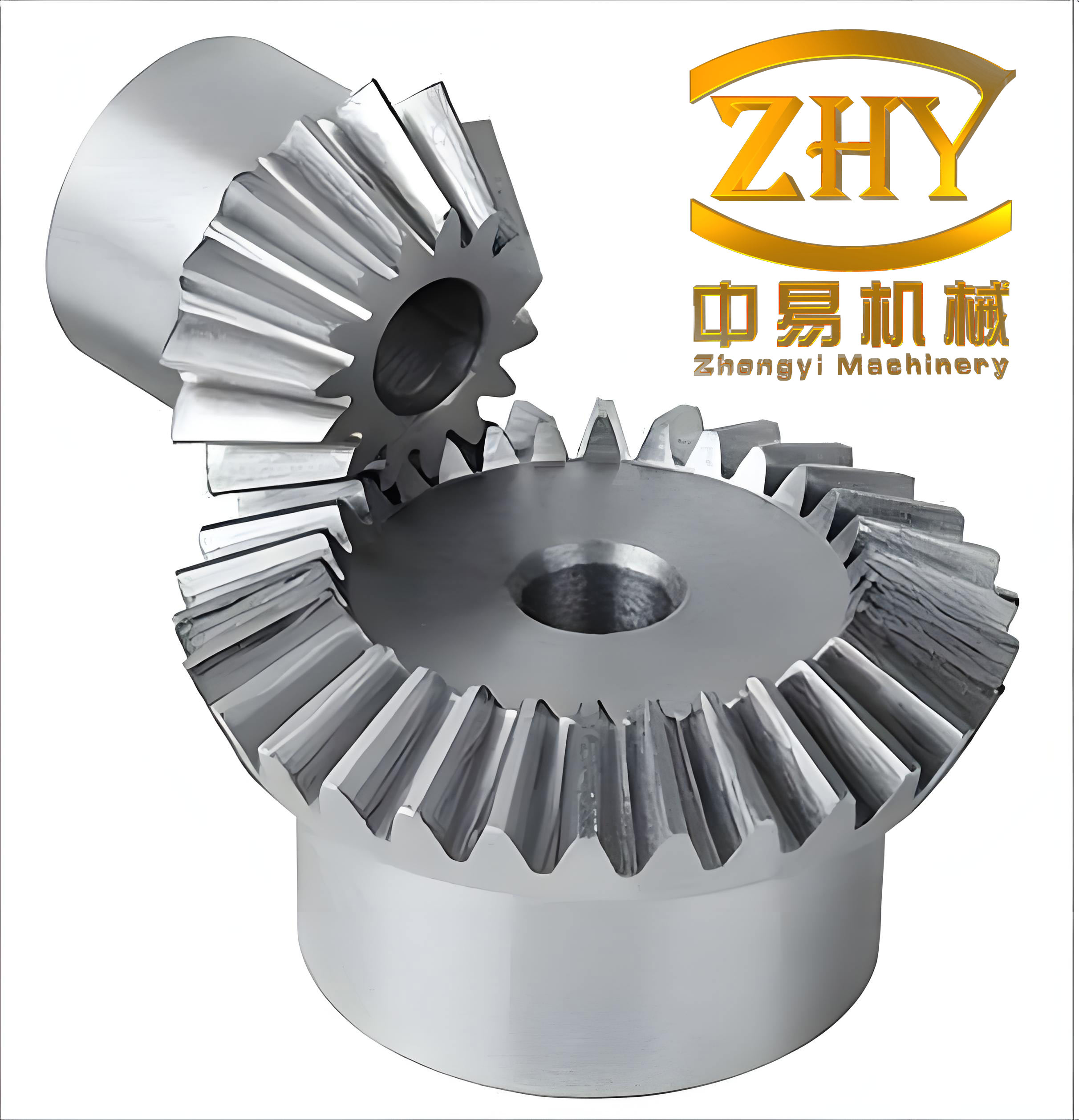
The fundamental geometry of a straight bevel gear is crucial for understanding the machining setup. A straight bevel gear is a conical gear with straight teeth tapering towards the apex. Key parameters include the pitch diameter (D), module (m), number of teeth (z), pitch cone angle (δ), and face width (b). The relationship between the module and the pitch diameter is given by $$ D = m \cdot z $$. For a straight bevel gear operating in a 90-degree shaft arrangement, the pitch cone angles for the pinion and gear are related by $$ \delta_1 = \arctan\left(\frac{z_1}{z_2}\right) $$ and $$ \delta_2 = 90^\circ – \delta_1 $$. However, for a single gear ring machined independently, the primary focus is on its individual cone angle. The addendum (ha) and dedendum (hf) are typically defined by the module: $$ h_a = m $$ and $$ h_f = 1.25m $$ for a basic full-depth tooth system. The total tooth depth (h) at the large end is $$ h = h_a + h_f = 2.25m $$. The tooth thickness (s) at the pitch circle is approximately $$ s = \frac{\pi m}{2} $$. These formulas guide the tool design and inspection processes for the straight bevel gear.
The core of our method lies in the design and construction of a specialized fixture that transforms the linear motion of the shaping machine into precise gear tooth generation. The fixture must account for the root angle (γ) of the straight bevel gear, which is essentially equal to the pitch cone angle for standard designs. The fixture assembly is directly mounted onto the machine’s ram or slide, replacing the standard worktable. This setup creates an inclined plane corresponding to the gear’s pitch cone, allowing the cutting tool to generate the tapered tooth profile. The design involves a main fixture frame, a backing plate (or弯板), and supporting rollers that both support and facilitate the rotation of the gear blank. The entire assembly is welded into a rigid unit to minimize vibrations during the cutting of the large straight bevel gear.
Tooling is another critical aspect. We employ four distinct types of shaping tools: a roughing or grooving tool for initial stock removal, a right-hand side profile finishing tool, a left-hand side profile finishing tool, and a root radius finishing tool. These tools are ground to the exact profile of the straight bevel gear tooth space, considering the taper. The tool geometry must compensate for the fact that the tooth profile is not identical at the large and small ends due to the conical nature; the tool is typically designed for the large-end profile, and the setup ensures proper generation along the face width. The selection of tool material, such as high-speed steel or carbide, depends on the gear material and size. For large straight bevel gears made from medium-carbon steels, high-speed steel tools with proper heat treatment have served well.
Pre-machining layout and marking are vital for accuracy control, especially to prevent cumulative pitch error across the many teeth of a large straight bevel gear. The gear blank is first precisely divided into equal segments, with each segment containing an equal number of tooth spaces. Centerlines for each tooth crest and each tooth space are radially marked from the gear’s theoretical apex. A master template, manufactured to the exact large-end tooth profile of the straight bevel gear, is then used to scribe the tooth form onto the large-end face of the blank, aligning the template’s crosshairs with the tooth crest centerlines. This visual guide is indispensable for subsequent machining and inspection.
The setup and alignment procedure on the shaping machine is meticulous. The fixture is bolted securely to the machine slide. The gear blank is then lifted and positioned onto the fixture, supported at the calculated inclined plane. A critical adjustment involves leveling the bottom of the tooth space (roughly corresponding to the root line) at the large end. This is achieved by calculating the difference in total tooth depth between the large and small ends: $$ \Delta h = h_{large} – h_{small} = (2.25m_{large}) – (2.25m_{small}) $$. Since the module effectively changes along the cone, $$ m_{small} = m_{large} \cdot \frac{R_{small}}{R_{large}} $$, where R is the pitch cone radius. Shim blocks of thickness Δh are used under the small-end support to achieve this level condition. The blank is then finely aligned using a dial indicator or scribe mounted on the tool head, ensuring that the marked tooth space centerlines are perfectly parallel to the tool’s stroke direction. After alignment, the blank is firmly clamped using pressure plates and bolts.
The actual shaping process for the straight bevel gear is performed in distinct stages. First, the grooving tool is used to rough out the tooth space, starting from the marked centerline and working symmetrically outward and downward. The depth and width are gradually increased until about 1 to 2 millimeters of stock remains for finishing. Careful coordination between the cross-feed and vertical feed handles is required to follow the tapered path. Next, the finishing process begins. The appropriate side profile tool (right or left) is mounted. The tool is fed carefully, “touching” the pre-formed groove and gradually profiling the flank until the full depth and correct form are achieved at the large end. Continuous verification is performed using gear tooth vernier calipers and various templates.
| Parameter / Tool | Symbol / Name | Description / Purpose | Typical Value/Note |
|---|---|---|---|
| Gear Outer Diameter | Da | Maximum diameter of the straight bevel gear blank | Up to several meters, as required |
| Module (Large End) | m | Defines tooth size; ratio of pitch diameter to teeth number | e.g., 10 mm, 12 mm, etc. |
| Number of Teeth | z | Total teeth on the straight bevel gear | Depends on design ratio |
| Pitch Cone Angle | δ | Angle of the pitch cone relative to gear axis | Calculated from gear pair design |
| Tooth Depth Difference (Δh) | Δh | Difference in total depth between large and small ends | $$ \Delta h = 2.25(m_{large} – m_{small}) $$ |
| Grooving Tool | – | Roughing tool for initial stock removal in tooth space | Wide, robust tool for heavy cuts |
| Side Profile Tools | – | Left and right finishing tools for tooth flanks | Precision ground to large-end tooth profile |
| Root Radius Tool | – | Finishing tool for fillet at tooth root | Ground to specified radius |
| Inspection Template | – | Master template for large-end tooth profile | Used for layout and final check |
In-process inspection is continuous. We use a variety of gauges: a tooth space template to check the correctness of the machined groove, a span-measuring template that engages two teeth to check tooth form and cumulative pitch error, and gear tooth vernier calipers to measure chordal tooth thickness at both large and small ends. The allowable errors for these large straight bevel gears are relatively generous. For instance, the maximum error in chordal tooth thickness at the large end is kept within a few tenths of a millimeter, and the cumulative pitch error is controlled similarly. The surface roughness on the tooth flanks of the straight bevel gear typically achieves values between Ra 3.2 and Ra 6.3 micrometers, sufficient for many industrial applications. The relationship for chordal tooth thickness (s_c) measurement is given by $$ s_c = D \sin\left(\frac{90^\circ}{z}\right) $$ for a spur gear approximation, but for a straight bevel gear, corrections for the cone angle must be applied, making template-based verification more practical in a shop-floor setting.
Theoretical analysis of errors in this shaping method provides insight into its limitations and capabilities. The primary sources of error in machining a straight bevel gear this way include: 1) Fixture alignment error, leading to incorrect root angle (Δγ). This directly affects the conjugate action of the gear pair. The resulting error in the pitch cone angle can be expressed as a function of the misalignment. 2) Tool profile error (Δp), which is replicated on every tooth flank. 3) Indexing error (Δθ), which accumulates as the gear is rotated for each tooth. The total cumulative pitch error (F_p) can be modeled as a root-sum-square of individual tooth spacing errors: $$ F_p \approx \sqrt{\sum_{i=1}^{z} (\Delta \theta_i \cdot R_{avg})^2 } $$, where R_avg is the average pitch radius. 4) Machine deflection and vibration during cutting, which can cause form errors and poor surface finish. For the large straight bevel gears we produce, these errors are managed to within acceptable limits through rigid fixture construction, careful setup, and conservative cutting parameters.
The machining sequence for a single tooth space on the straight bevel gear is methodical. After roughing, the finishing cut with the profile tool requires precise feed calculation. The feed per stroke (f) is kept low to ensure good surface finish and profile accuracy. The total number of strokes (N) required to finish one flank from the rough state can be estimated by $$ N = \frac{t}{f} $$, where t is the finishing stock allowance. The cutting speed (v) is determined by the material and tool life considerations. For a shaping machine, the cutting speed during the forward stroke is given by $$ v = 2L n $$ for a double-stroke machine, where L is stroke length and n is strokes per minute. However, for our large straight bevel gear setup, the effective cutting speed varies along the tooth due to the inclined plane, requiring careful selection of n to avoid chatter.
| Step No. | Process Stage | Key Actions | Tools / Equipment Used | Quality Checks |
|---|---|---|---|---|
| 1 | Fixture Preparation | Design and fabricate fixture based on gear root angle. Weld components into a rigid assembly. | Welding equipment, measuring tools | Check angle accuracy, rigidity |
| 2 | Tool Preparation | Grind four types of shaping tools to required profiles (grooving, left/right profile, root radius). | Tool grinder, profile templates | Verify tool profile against master template |
| 3 | Gear Blank Layout | Divide blank into equal tooth segments. Mark tooth crest and space centerlines. Scribe large-end tooth profile using master template. | Dividing head, scribe, master template | Verify division accuracy, profile marking |
| 4 | Machine Setup & Alignment | Mount fixture to shaper slide. Position gear blank on fixture using shims to level root line. Align using marked centerlines. | Shims, dial indicator, clamps | Check levelness of root line, alignment of marks |
| 5 | Rough Machining | Use grooving tool to remove bulk material from tooth space, working symmetrically from centerline. | Grooving tool, shaper machine | Monitor depth and width relative to marks |
| 6 | Finish Machining | Use profile tools to finish left and right flanks. Use root radius tool for fillet. Light, incremental feeds. | Profile tools, root radius tool | Frequent checks with tooth calipers and templates |
| 7 | Indexing | Loosen, rotate gear blank to next tooth space, re-align using space centerline, re-clamp. Repeat steps 5-6. | Manual rotation, alignment tools | Check index accuracy against division marks |
| 8 | Final Inspection | Measure chordal tooth thickness at both ends, cumulative pitch error, surface roughness, and tooth form. | Gear tooth calipers, templates, surface tester | Ensure all parameters meet drawing tolerances |
Economic and practical considerations heavily favor this method for low-volume production of large straight bevel gears. The capital investment is minimal compared to procuring a dedicated large gear generator or outsourcing. The lead time is also reduced as most work can be done in-house with standard machinery. The flexibility of the setup allows for machining straight bevel gears of various sizes and angles by modifying or adjusting the fixture. However, the method is labor-intensive and requires highly skilled operators for layout, setup, and in-process inspection. It is not suitable for high-precision gears (e.g., AGMA class 10 or above) or for high-volume production. The surface finish and profile accuracy are inherently limited by the forming action of the tool and the rigidity of the adapted setup. Nevertheless, for many industrial applications such as large mills, conveyors, or agricultural machinery, where the straight bevel gear operates at moderate speeds and loads, this approach provides a perfectly viable and cost-effective solution.
The success of this machining technique for straight bevel gears hinges on understanding and controlling the conical geometry throughout the process. The taper affects every dimension. For example, the chordal addendum (h_ca) for tooth caliper measurement at the large end differs from that at the small end. Approximate formulas for a straight bevel gear measured with gear tooth calipers involve the pitch cone distance (R) and the measuring point radius. A more precise control is achieved through the use of the custom templates mentioned earlier. The process also highlights the importance of metallurgy and heat treatment. Often, these large straight bevel gears are machined in the normalized or softened condition, and case hardening or through hardening is applied afterwards. The machining allowances must account for any subsequent distortion from heat treatment.
In conclusion, the adaptation of a standard shaping machine for manufacturing large straight bevel gears is a testament to practical engineering ingenuity. By designing a dedicated fixture, preparing appropriate tooling, and implementing a rigorous process of layout, setup, and incremental machining with continuous inspection, we have consistently produced functional and reliable straight bevel gear components. The method delivers adequate geometric accuracy, characterized by controlled tooth thickness, acceptable pitch cumulative error, and suitable surface finish for numerous non-critical power transmission applications. While not a replacement for dedicated gear cutting technology, this approach offers an invaluable alternative for job shops or factories facing intermittent needs for large straight bevel gears, effectively balancing technical requirements with economic feasibility. The knowledge gained from this process underscores the adaptability of basic machine tools and the enduring relevance of skilled machinist techniques in modern manufacturing, particularly for specialized components like the large straight bevel gear.
Further refinements to this method could involve incorporating digital readouts for more precise indexing, using improved tool materials for longer life and better finish, or even developing semi-automated cycles for the shaping strokes. However, the core principle remains: a deep understanding of the straight bevel gear geometry, married with a creative and disciplined use of available machine tools, can yield successful manufacturing outcomes without exorbitant investment. This experience reinforces the concept that for many engineering challenges, especially concerning large straight bevel gears, a well-engineered traditional method can be both effective and economically optimal.