
In my extensive career as a mechanical design engineer, I have encountered numerous gear types, but the straight bevel gear holds a special place due to its unique geometry and critical role in transmitting power between intersecting shafts. The straight bevel gear, characterized by its straight teeth that converge at the apex, is a fundamental component in many mechanical systems, from automotive differentials to industrial machinery. Throughout this discussion, I will delve into the intricacies of straight bevel gear design, analysis, and application, drawing from my firsthand experiences and technical knowledge. I aim to provide a comprehensive resource that leverages tables and formulas to encapsulate key concepts, ensuring that the term ‘straight bevel gear’ is thoroughly explored and emphasized.
The straight bevel gear operates on the principle of conical surfaces, with teeth cut along the pitch cone. Unlike helical or spiral bevel gears, the teeth of a straight bevel gear are straight and tapered, making them simpler to manufacture but subject to specific dynamic behaviors. In my work, I have often relied on geometric parameters to define these gears. The primary dimensions include the pitch diameter, cone distance, and face width. For instance, the pitch diameter (D) at the large end of the gear can be expressed in terms of the module (m) and number of teeth (z): $$ D = m \times z $$ This formula is foundational for sizing a straight bevel gear. Similarly, the cone distance (R) from the apex to the pitch circle is given by: $$ R = \frac{D}{2 \sin \delta} $$ where $\delta$ is the pitch cone angle. These relationships are crucial for initial design phases, and I frequently use tables to organize standard values. Consider Table 1, which summarizes typical geometric parameters for straight bevel gears based on common industrial standards.
| Parameter | Symbol | Typical Range | Unit |
|---|---|---|---|
| Module | m | 1 to 20 | mm |
| Number of Teeth | z | 10 to 100 | – |
| Pitch Cone Angle | $\delta$ | 15° to 75° | degrees |
| Face Width | b | 0.25R to 0.3R | mm |
| Pressure Angle | $\alpha$ | 20° (standard) | degrees |
Designing a straight bevel gear requires meticulous attention to tooth profile and strength. The tooth form is typically based on an involute curve projected onto a conical surface. In my analyses, I use the Lewis bending formula adapted for bevel gears to estimate tooth stress. The bending stress ($\sigma_b$) at the root of a straight bevel gear tooth can be approximated by: $$ \sigma_b = \frac{F_t}{b m_n Y} K_v K_o $$ where $F_t$ is the tangential force at the pitch circle, $b$ is the face width, $m_n$ is the normal module, $Y$ is the Lewis form factor, $K_v$ is the velocity factor, and $K_o$ is the overload factor. This equation highlights the load-bearing capacity of a straight bevel gear, which is essential for ensuring durability in high-torque applications. To complement this, I often refer to Table 2, which lists material properties commonly used for straight bevel gears, as material selection directly impacts performance.
| Material | Tensile Strength (MPa) | Hardness (HRC) | Typical Application |
|---|---|---|---|
| Carbon Steel | 600-800 | 20-30 | General machinery |
| Alloy Steel | 800-1200 | 30-45 | Automotive differentials |
| Cast Iron | 200-400 | 15-25 | Low-speed systems |
| Bronze | 300-500 | 10-20 | Corrosive environments |
Manufacturing straight bevel gears involves processes such as milling, shaping, and grinding. From my visits to production facilities, I have observed that the gear generation method often employs a planing tool that simulates the mating gear. The tooth depth (h) is critical and is calculated as: $$ h = 2.25 m $$ This ensures proper meshing and clearance. Quality control for straight bevel gears includes checking tooth contact patterns and noise levels. I have developed tables to track tolerances, such as Table 3, which outlines common manufacturing tolerances for straight bevel gears based on ISO standards. The straight bevel gear’s simplicity in design belies the precision required in production, and these tolerances are vital for smooth operation.
| Tolerance Type | Grade 5 | Grade 7 | Grade 9 | Unit |
|---|---|---|---|---|
| Tooth Profile Error | ±0.005 | ±0.01 | ±0.02 | mm |
| Pitch Error | ±0.002 | ±0.005 | ±0.01 | mm |
| Runout | ±0.01 | ±0.02 | ±0.05 | mm |
In terms of mechanical analysis, the straight bevel gear experiences complex loading due to the conical shape. I often perform finite element analysis (FEA) to model stress distributions. The contact stress ($\sigma_c$) between mating teeth can be estimated using the Hertzian contact theory modified for conical surfaces: $$ \sigma_c = \sqrt{\frac{F_t E^*}{\pi b \rho_e}} $$ where $E^*$ is the equivalent modulus of elasticity, and $\rho_e$ is the equivalent radius of curvature. This formula helps in predicting pitting and wear, which are common failure modes for straight bevel gears. Additionally, the efficiency ($\eta$) of a straight bevel gear pair is influenced by friction losses and can be expressed as: $$ \eta = 1 – \frac{P_f}{P_{in}} $$ where $P_f$ is the power lost to friction and $P_{in}$ is the input power. In practice, I have found that straight bevel gears typically achieve efficiencies of 95-98% under optimal conditions. To illustrate performance metrics, Table 4 provides a comparison of straight bevel gear characteristics against other bevel gear types, emphasizing the unique attributes of the straight bevel gear.
| Feature | Straight Bevel Gear | Spiral Bevel Gear | Zerol Bevel Gear |
|---|---|---|---|
| Tooth Orientation | Straight and tapered | Curved and angled | Curved with zero spiral angle |
| Manufacturing Complexity | Low | High | Moderate |
| Noise Level | Moderate to high | Low | Moderate |
| Load Capacity | Moderate | High | Moderate |
| Typical Applications | Differentials, low-speed drives | Aerospace, high-speed drives | Industrial machinery |
The application of straight bevel gears spans various industries. In my projects, I have integrated straight bevel gears into automotive differentials, where they transmit power at 90-degree angles. The design considerations for such applications include shock loads and thermal expansion. For instance, the torque capacity (T) of a straight bevel gear can be derived from the bending stress formula: $$ T = \frac{\sigma_b b m_n Y R}{K_v K_o} $$ This allows engineers to size gears appropriately. Another critical aspect is lubrication; I often specify oil bath or grease lubrication depending on the operating speed. Table 5 summarizes lubrication recommendations for straight bevel gears based on speed and load conditions, a table I frequently consult during design reviews.
| Speed Range (rpm) | Load Condition | Recommended Lubricant | Method |
|---|---|---|---|
| 0-500 | Heavy | High-viscosity oil | Oil bath |
| 500-2000 | Moderate | Medium-viscosity oil | Splash lubrication |
| 2000-5000 | Light | Low-viscosity oil | Jet lubrication |
Throughout my career, I have emphasized the importance of dynamic analysis for straight bevel gears. Vibration and noise are significant concerns, especially at high speeds. The natural frequency ($f_n$) of a straight bevel gear system can be estimated using: $$ f_n = \frac{1}{2\pi} \sqrt{\frac{k}{m_e}} $$ where $k$ is the mesh stiffness and $m_e$ is the equivalent mass. This helps in avoiding resonance conditions. I have also developed design guidelines to minimize backlash, which is critical for precision applications. The backlash (B) for a straight bevel gear pair is typically controlled through manufacturing tolerances and assembly adjustments: $$ B = \Delta D \tan \alpha $$ where $\Delta D$ is the variation in center distance. In practice, I recommend backlash values of 0.05-0.15 mm for general-purpose straight bevel gears. To aid in selection, Table 6 provides a checklist for designing straight bevel gear systems, a tool I have refined over years of experience.
| Design Aspect | Considerations | Typical Values |
|---|---|---|
| Geometry | Pitch cone angle, face width, module | $\delta = 30°$, $b = 0.3R$, $m = 4$ mm |
| Material | Strength, hardness, cost | Alloy steel, HRC 35 |
| Load Analysis | Bending and contact stress | $\sigma_b < 200$ MPa, $\sigma_c < 1000$ MPa |
| Manufacturing | Tolerances, surface finish | Grade 7, Ra 1.6 µm |
| Lubrication | Type, method, intervals | Oil bath, ISO VG 220 |
In visualizing a typical straight bevel gear, I often refer to technical diagrams that showcase its conical form and straight teeth. For instance, the following image provides a clear representation of a straight bevel gear, highlighting its key features.
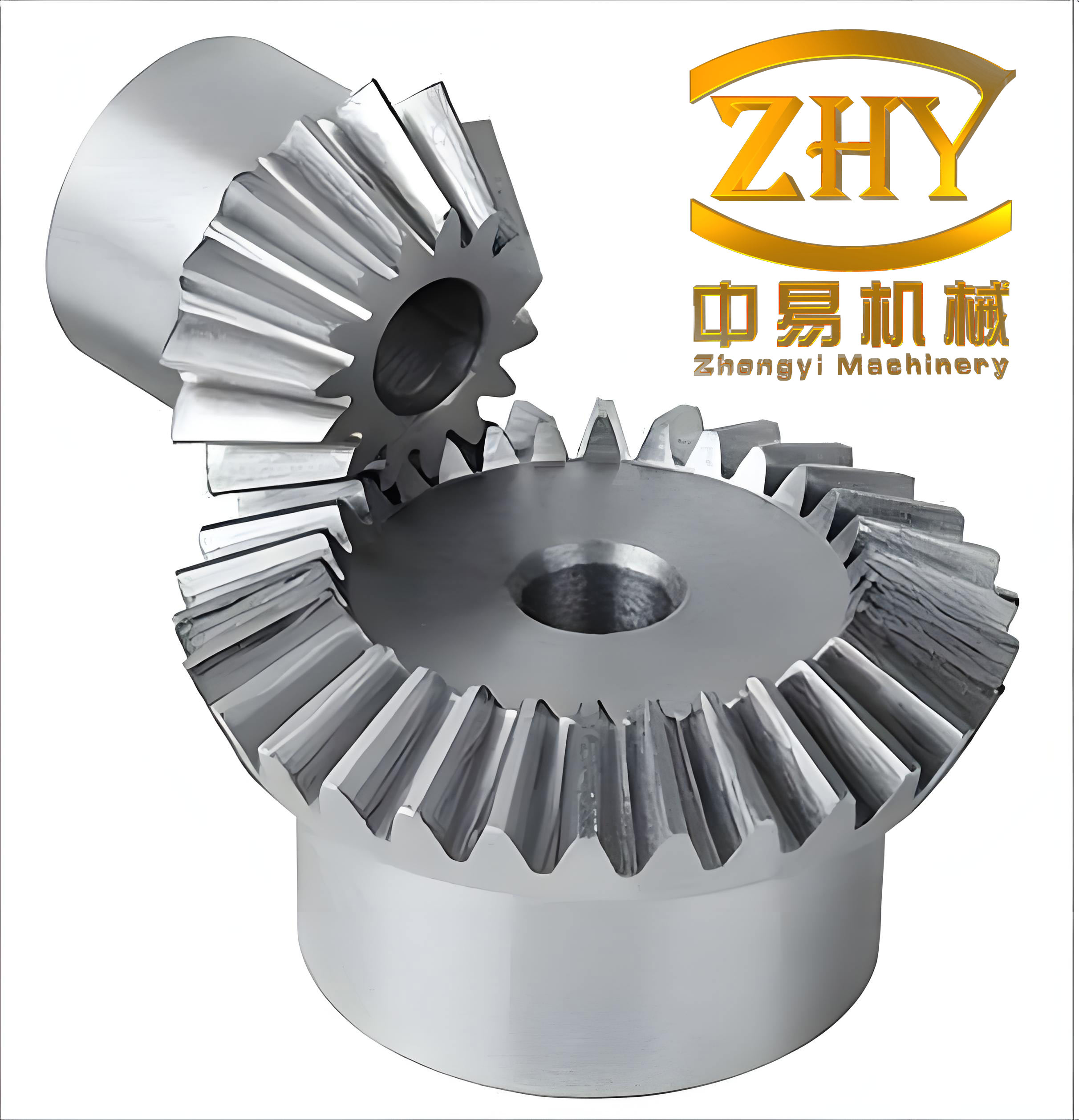
This visual aids in understanding the geometry discussed throughout this article. The straight bevel gear’s design allows for efficient power transmission in compact spaces, a reason I frequently specify it in projects requiring intersecting shaft configurations.
Further delving into advanced topics, I have researched the thermal effects on straight bevel gears. Operating temperature can affect clearances and material properties. The thermal expansion ($\Delta L$) of a straight bevel gear can be calculated using: $$ \Delta L = L \alpha_t \Delta T $$ where $L$ is a linear dimension, $\alpha_t$ is the coefficient of thermal expansion, and $\Delta T$ is the temperature change. This is crucial for high-temperature applications like engine components. Additionally, fatigue life prediction for straight bevel gears involves S-N curves and Miner’s rule. The fatigue strength ($S_f$) for a given life cycle (N) can be modeled as: $$ S_f = S_e \left(\frac{N}{N_e}\right)^{-b} $$ where $S_e$ is the endurance limit, $N_e$ is the endurance cycle, and $b$ is the fatigue exponent. I use such formulas to ensure the longevity of straight bevel gear systems, often compiling data into tables like Table 7, which shows fatigue properties for common gear materials.
| Material | Endurance Limit (MPa) | Fatigue Exponent (b) | Typical Life (cycles) |
|---|---|---|---|
| Carbon Steel | 300 | -0.1 | 10^6 |
| Alloy Steel | 450 | -0.12 | 10^7 |
| Cast Iron | 150 | -0.08 | 10^5 |
In terms of innovation, I have explored additive manufacturing for straight bevel gears. This allows for complex geometries and lightweight designs. The strength-to-weight ratio is a key metric, given by: $$ \text{Strength-to-weight ratio} = \frac{\sigma}{\rho} $$ where $\sigma$ is the material strength and $\rho$ is the density. For aerospace applications, I have designed straight bevel gears using titanium alloys, which offer high strength and low weight. The design process involves optimizing tooth profiles using computational tools, and I often validate prototypes through testing. Table 8 summarizes recent advancements in straight bevel gear technology, reflecting trends I have observed in the industry.
| Advancement | Description | Impact on Performance |
|---|---|---|
| Additive Manufacturing | 3D printing of metal gears | Reduced weight, custom designs |
| Surface Coatings | DLC (Diamond-Like Carbon) coatings | Improved wear resistance |
| Predictive Maintenance | IoT sensors for condition monitoring | Increased reliability and uptime |
Throughout this discussion, I have emphasized the multifaceted nature of straight bevel gear engineering. From basic geometry to advanced dynamics, every aspect requires careful consideration. The straight bevel gear remains a cornerstone in mechanical transmission systems, and its design principles are foundational for engineers. In my practice, I continually refine these principles through simulation and experimentation, ensuring that each straight bevel gear I design meets stringent performance criteria. The formulas and tables presented here are tools I rely on daily, and I hope they provide valuable insights for others working with straight bevel gears.
Looking ahead, the future of straight bevel gears lies in smart manufacturing and sustainability. I am investigating the use of recycled materials and energy-efficient production methods for straight bevel gears. The environmental impact can be assessed using life cycle analysis (LCA), which quantifies carbon footprints. Additionally, digital twins—virtual models of physical gear systems—allow for real-time optimization. I believe that integrating these technologies will enhance the reliability and efficiency of straight bevel gears in next-generation machinery. In conclusion, the straight bevel gear is a testament to mechanical ingenuity, and its continued evolution will drive innovation across industries. My experiences have taught me that a deep understanding of its design and analysis is essential for any engineer, and I encourage ongoing exploration of this vital component.