
In the field of mechanical engineering, the design of gear transmissions has historically relied on deterministic approaches, such as the safety factor method. These methods, while practical, often overlook the inherent randomness and uncertainty in load conditions, material properties, and operational environments. For straight bevel gears, which are crucial in applications requiring right-angle power transmission, this oversight can lead to either overdesign—resulting in unnecessary material waste and increased costs—or underdesign—compromising safety and reliability. My focus here is to introduce a more nuanced framework: fuzzy reliability optimization design for straight bevel gear systems. This approach integrates probability theory to handle random stress variations and fuzzy set theory to account for imprecise data, such as fatigue limits. By doing so, it allows designers to achieve optimal parameters under specified fuzzy reliability degrees, making the design process more aligned with real-world conditions.
The traditional design of straight bevel gears involves selecting parameters like number of teeth, module, and face width based on empirical formulas and conservative safety factors. However, these factors do not quantitatively address the probability of failure or the fuzzy nature of reliability assessments. In reality, stresses on gear teeth fluctuate randomly due to dynamic loads, while material strength data often come with uncertainties—for instance, fatigue limits derived from testing may not be precise values but ranges with gradual membership. Thus, treating reliability as a fuzzy concept, where boundaries between safe and failure states are not sharp, provides a more realistic model. This article delves into developing a comprehensive optimization model that minimizes the volume of straight bevel gear transmissions while ensuring a predefined fuzzy reliability level against both contact and bending fatigue failures.
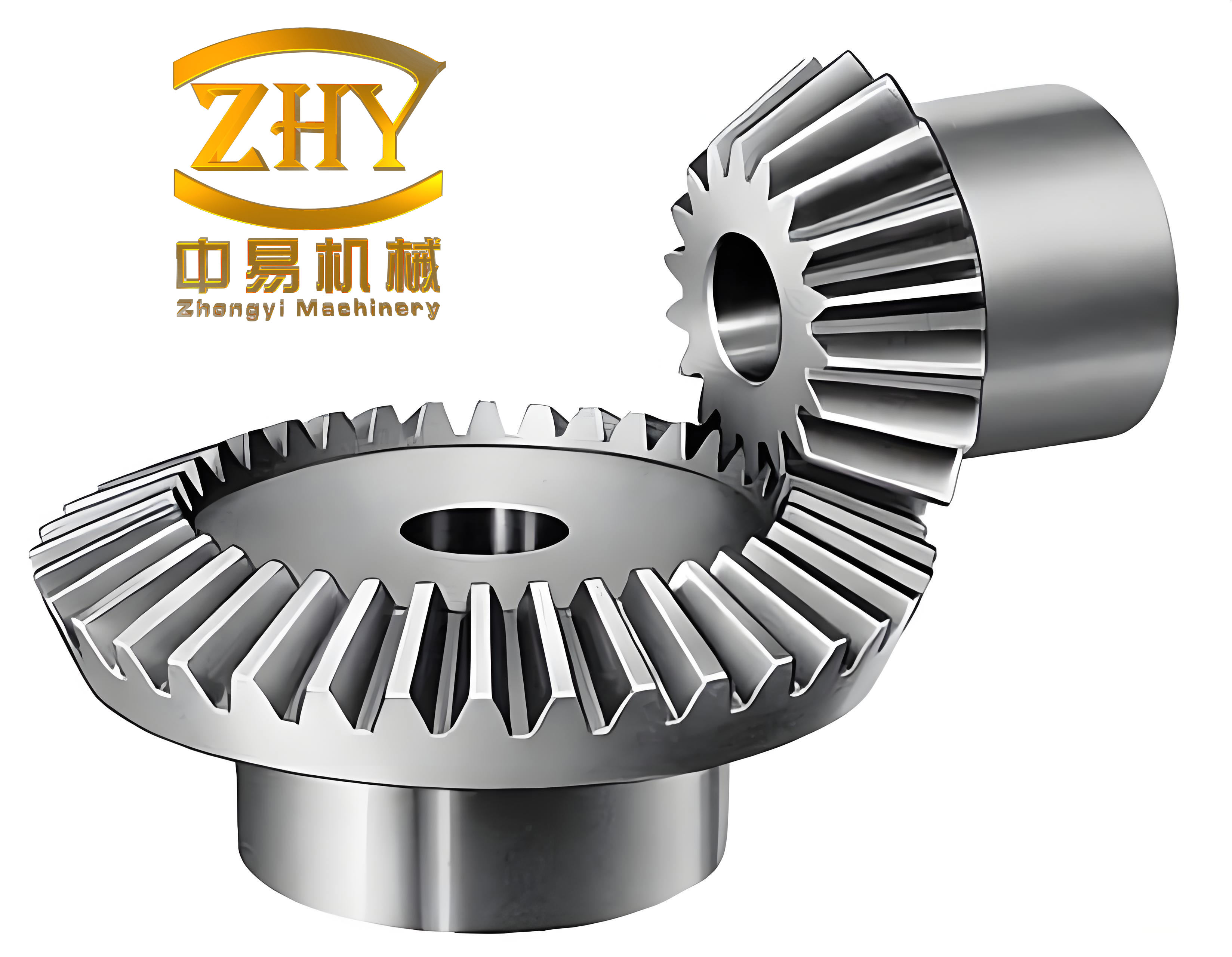
To ground this discussion, consider the fundamental geometry of straight bevel gears. These gears have teeth that are straight and tapered, converging at a common apex, making them ideal for transmitting motion between intersecting shafts, typically at 90 degrees. The design parameters significantly influence performance, durability, and efficiency. In optimization, we aim to find the best combination of these parameters to meet reliability targets without excess material. The fuzzy reliability approach acknowledges that in engineering practice, data incompleteness—such as for fatigue limits—makes it difficult to assign exact probabilities; instead, we use membership functions to represent how likely a value belongs to a fuzzy set like “acceptable strength.” This shift from crisp to fuzzy reliability enables more flexible and robust designs for straight bevel gear systems.
Mathematical Foundation of Fuzzy Reliability for Straight Bevel Gears
Before diving into the optimization model, it’s essential to establish the mathematical underpinnings of fuzzy reliability. In probabilistic terms, the stress experienced by a straight bevel gear tooth, whether from contact or bending, can be modeled as a random variable. For many engineering applications, the normal distribution is a reasonable assumption due to the central limit theorem and empirical evidence. Thus, let the stress \(\sigma\) be a normally distributed random variable with probability density function (PDF):
$$ f(\sigma) = \frac{1}{\sqrt{2\pi}\sigma_s} \exp\left(-\frac{(\sigma – \mu_s)^2}{2\sigma_s^2}\right) $$
where \(\mu_s\) is the mean stress and \(\sigma_s\) is the standard deviation. On the other hand, the fatigue strength limit of the material, denoted as \(S\), is often imprecise. We treat it as a fuzzy variable with a continuous membership function \(\mu_A(S)\), which describes the degree to which a particular strength value belongs to the fuzzy set \(A\) of “acceptable fatigue limits.” A common choice is the normal-type membership function:
$$ \mu_A(S) = \exp\left(-\frac{(S – a)^2}{D}\right) $$
where \(a\) is the central value (most likely strength) and \(D\) controls the spread or fuzziness. The domain of \(\mu_A(S)\) is typically an interval \([c_1, c_2]\), representing the plausible range of fatigue limits. For straight bevel gears, these parameters can be derived from material tests or handbook data, adjusted via Gerber or other fatigue life equations.
The fuzzy reliability \(R_f\) is defined as the probability that the fuzzy event “strength is greater than stress” occurs. Mathematically, this involves integrating over the joint possibility-probability space. The fuzzy failure probability \(P_f(A)\) for a given failure mode (e.g., contact or bending) can be expressed as:
$$ P_f(A) = \int_{-\infty}^{\infty} f(\sigma) \cdot [1 – \mu_A(\sigma)] \, d\sigma $$
However, with the normal assumptions for both stress and the membership function, a closed-form solution exists. Let the stress \(\sigma\) have mean \(\mu_s\) and variance \(\sigma_s^2\), and the fuzzy strength have parameters \(a\) and \(D\). Then, the fuzzy failure probability for a straight bevel gear tooth is:
$$ P_x(A) = \sqrt{\frac{D}{2\sigma_s^2 + D}} \cdot \exp\left(-\frac{(a – \mu_s)^2}{2\sigma_s^2 + D}\right) \cdot \left[\Phi(y_1) + \Phi(y_2)\right] $$
where \(\Phi(\cdot)\) is the cumulative distribution function of the standard normal distribution, and:
$$ y_1 = \left(\frac{2\sigma_s^2 + D}{D\sigma_s^2}\right)^{1/2} \left(c_1 – \frac{2a\sigma_s^2 + D \cdot \mu_s}{2\sigma_s^2 + D}\right), \quad y_2 = \left(\frac{2\sigma_s^2 + D}{D\sigma_s^2}\right)^{1/2} \left(c_2 – \frac{2a\sigma_s^2 + D \cdot \mu_s}{2\sigma_s^2 + D}\right) $$
Here, \(c_1\) and \(c_2\) are the lower and upper bounds of the fuzzy strength domain. The fuzzy reliability \(R_f\) is then \(1 – P_x(A)\). For design purposes, we impose a constraint that \(R_f \geq R’\), where \(R’\) is the target fuzzy reliability degree, say 0.9995. This formulation is central to optimizing straight bevel gear systems under uncertainty.
Optimization Model for Straight Bevel Gear Transmission
We now construct a fuzzy reliability optimization model for a straight bevel gear pair with shaft angle \(\Sigma = 90^\circ\). The known inputs typically include: power \(P\), gear ratio \(u\), pinion speed \(n_1\), material properties, and design life. The goal is to determine optimal design parameters that minimize transmission volume while meeting fuzzy reliability constraints for contact and bending fatigue.
Design Variables
The independent design variables for a straight bevel gear transmission are:
- \(z_1\): Number of teeth on the pinion (integer).
- \(m\): Module at the large end (discrete, from standard series).
- \(\varphi_R\): Face width coefficient (continuous, defined as \(b/R_e\), where \(b\) is face width and \(R_e\) is outer cone distance).
Thus, the design vector is:
$$ \mathbf{X} = [x_1, x_2, x_3]^T = [z_1, m, \varphi_R]^T $$
with practical bounds: \(z_1 \in [13, 36]\) (to avoid undercutting and ensure smooth operation), \(\varphi_R \in [0.25, 0.3333]\) (common range for straight bevel gears to balance strength and manufacturability). The module \(m\) is selected from standard values (e.g., 1, 1.25, 1.5, 2, 2.5, 3, …).
Objective Function
The objective is to minimize the total volume of the straight bevel gear pair, approximated as the sum of volumes of the frustum cones representing the gear bodies. For a gear \(i\) (with \(i=1\) for pinion, \(i=2\) for gear), the volume \(V_i\) is:
$$ V_i = \frac{\pi}{3} b \cos\delta_i \left[ \left(\frac{m z_i}{2}\right)^2 + \left(\frac{m z_i}{2} – \frac{b}{2}\right)^2 + \left(\frac{m z_i}{2}\right)\left(\frac{m z_i}{2} – \frac{b}{2}\right) \right] $$
where \(\delta_i\) is the pitch cone angle (\(\delta_1 = \arctan(1/u)\), \(\delta_2 = 90^\circ – \delta_1\) for \(\Sigma=90^\circ\)), and \(b = \varphi_R R_e = \varphi_R \cdot \frac{m z_1}{2 \sin\delta_1}\). Substituting and simplifying, the total volume \(F(\mathbf{X})\) becomes:
$$ F(\mathbf{X}) = \sum_{i=1}^{2} \frac{\pi \cos\delta_i}{24 \sin\delta_i} x_1^2 x_2^2 x_3 \left[1 + (1 – x_3)^2 + (1 – x_3)\right] $$
This function aims to reduce material usage, directly impacting cost and weight, which is critical in applications like automotive differentials or industrial machinery where straight bevel gears are prevalent.
Constraints
The constraints ensure the straight bevel gear system operates reliably under specified conditions. They include fuzzy reliability constraints for strength and practical geometric limits.
1. Fuzzy Reliability Constraints for Fatigue Strength
For straight bevel gears, primary failure modes are contact fatigue (pitting) and bending fatigue (tooth breakage). We derive stress formulas based on standard AGMA or similar approaches. The contact stress \(\sigma_H\) and bending stresses \(\sigma_{F1}, \sigma_{F2}\) (for pinion and gear) are computed as:
$$ \sigma_H = Z_E Z_H Z_\varepsilon \sqrt{\frac{4.7 K T_1}{\varphi_R (1 – 0.5\varphi_R)^2 d_1^3 u}} $$
$$ \sigma_{Fi} = \frac{4.7 K T_1}{\varphi_R (1 – 0.5\varphi_R)^2 d_1^3 u} Y_{Fa_i} Y_{Sa_i} Y_\varepsilon \quad (i=1,2) $$
where:
– \(Z_E\), \(Z_H\), \(Z_\varepsilon\) are factors for elastic coefficient, zone geometry, and contact ratio, respectively.
– \(Y_{Fa_i}\), \(Y_{Sa_i}\), \(Y_\varepsilon\) are factors for form factor, stress correction, and bending contact ratio.
– \(K\) is the load factor (including application, dynamic, and size effects).
– \(T_1\) is the pinion torque, \(T_1 = \frac{P}{\omega_1} = \frac{9.55 \times 10^6 P}{n_1}\) (in N·mm for \(P\) in kW, \(n_1\) in rpm).
– \(d_1 = m z_1\) is the pinion pitch diameter at large end.
– \(u = z_2/z_1\) is the gear ratio.
These stresses are treated as random variables with normal distributions. Their means and standard deviations can be estimated from load spectra or using coefficients of variation (e.g., 5-10% for stress). The fatigue strength limits for contact and bending, denoted \(S_H\) and \(S_F\), are fuzzy variables with membership functions as described earlier. For a straight bevel gear made of steel, the Gerber equation might relate endurance limits to ultimate strength, introducing fuzziness.
The fuzzy reliability constraints are then:
$$ g_1(\mathbf{X}) = R’ – [1 – P_H(A)] \leq 0 \quad \text{(for contact fatigue)} $$
$$ g_2(\mathbf{X}) = R’ – [1 – P_{F1}(A)] \leq 0 \quad \text{(for pinion bending fatigue)} $$
$$ g_3(\mathbf{X}) = R’ – [1 – P_{F2}(A)] \leq 0 \quad \text{(for gear bending fatigue)} $$
where \(P_H(A)\), \(P_{F1}(A)\), \(P_{F2}(A)\) are computed using the formula for \(P_x(A)\) above, with appropriate parameters for each failure mode. This ensures the straight bevel gear design meets the target fuzzy reliability \(R’\).
2. Geometric and Practical Constraints
To ensure manufacturability and prevent interference, additional constraints are imposed:
- Module constraint: The module at the small end should not be too small to avoid weak teeth. A common rule is \(m (1 – 0.5\varphi_R) \geq 1.5\). In terms of design variables:
$$ g_4(\mathbf{X}) = 1.5 – x_2 (1 – 0.5 x_3) \leq 0 $$
- Face width constraint: Already implied by \(\varphi_R\) bounds.
- Tooth number constraint: \(z_1 \geq 13\) to avoid undercutting in straight bevel gears, handled in variable bounds.
The complete optimization model for straight bevel gears is:
$$ \begin{aligned}
&\text{minimize} \quad F(\mathbf{X}) = \sum_{i=1}^{2} \frac{\pi \cos\delta_i}{24 \sin\delta_i} x_1^2 x_2^2 x_3 \left[1 + (1 – x_3)^2 + (1 – x_3)\right] \\
&\text{subject to} \quad g_j(\mathbf{X}) \leq 0 \quad (j=1,2,3,4) \\
&\quad \mathbf{X} = [x_1, x_2, x_3]^T, \quad x_1 \in \mathbb{Z}^+, \quad x_2 \in \mathcal{M}_{\text{std}}, \quad x_3 \in \mathbb{R}
\end{aligned} $$
where \(\mathcal{M}_{\text{std}}\) is the set of standard module values. This is a mixed-discrete nonlinear programming problem, suitable for algorithms like mixed-discrete particle swarm optimization or genetic algorithms.
Computational Methodology and Detailed Example
Solving the fuzzy reliability optimization model requires a numerical approach. The steps involve: (1) defining input parameters and distributions, (2) computing stress statistics and fuzzy strength parameters, (3) evaluating constraints via fuzzy reliability formulas, and (4) applying an optimization algorithm to find the optimal design variables. Given the mixed-discrete nature, we use a hybrid method that handles integer and discrete variables efficiently.
To illustrate, consider a detailed design case for a straight bevel gear transmission:
- Inputs: Shaft angle \(\Sigma = 90^\circ\), power \(P = 9.8 \, \text{kW}\), pinion speed \(n_1 = 960 \, \text{rpm}\), gear ratio \(u = 3\). The driver is an electric motor, and the driven machine has steady loads. Pinion is overhung, gear is straddle-mounted. Design life \(L_h = 15,000 \, \text{hours}\).
- Materials: Pinion: 40Cr steel, tempered, hardness HB = 260; Gear: 42SiMn steel, tempered, hardness HB = 230.
- Fuzzy reliability target: \(R’ = 0.9995\).
- Load factor: \(K = 1.3\) (estimated from application factors).
- Stress parameters: Assume coefficients of variation for stresses: 8% for contact, 10% for bending. Mean stresses computed from formulas.
- Fuzzy strength parameters: For contact fatigue, based on material hardness, let \(S_H\) have central value \(a_H = 950 \, \text{MPa}\), spread \(D_H = 5000 \, \text{MPa}^2\), domain \([800, 1100] \, \text{MPa}\). For bending fatigue, \(S_F\) has \(a_F = 450 \, \text{MPa}\), \(D_F = 3000 \, \text{MPa}^2\), domain \([350, 550] \, \text{MPa}\). These are derived from Gerber-like relations with fuzziness.
- Other factors: \(Z_E = 189.8 \, \sqrt{\text{MPa}}\), \(Z_H = 2.5\), \(Z_\varepsilon = 0.85\), \(Y_{Fa1} = 2.8\), \(Y_{Sa1} = 1.55\), \(Y_{Fa2} = 2.2\), \(Y_{Sa2} = 1.78\), \(Y_\varepsilon = 0.7\).
The optimization was performed using a mixed-discrete algorithm, comparing three design approaches: traditional safety factor design, ordinary optimization (deterministic), and fuzzy reliability optimization. Results are summarized in the table below.
| Design Method | Gear Parameters | Key Dimensions (mm) | Volume \(F(\mathbf{X})\) (mm³) |
|---|---|---|---|
| \(z_1\), \(m\) (mm), \(\varphi_R\) | \(d_1\), \(d_2\), \(b\) | ||
| Traditional Design | 24, 4, 0.3 | 96, 288, 46 | 1.8421 × 10⁶ |
| Ordinary Optimization | 16, 6, 0.25 | 96, 288, 37 | 2.6286 × 10⁵ |
| Fuzzy Reliability Optimization | 13, 2.5, 0.253 | 32.5, 97.5, 48 | 1.0735 × 10⁴ |
This table highlights that the fuzzy reliability optimization for straight bevel gears yields a significantly smaller volume—by orders of magnitude—while meeting the high reliability target. The optimal design uses a lower tooth count and module, but a slightly higher face width coefficient, balancing the fuzzy constraints effectively. In contrast, traditional design is overly conservative, and ordinary optimization, while better, does not account for the fuzzy nature of strength, leading to a larger volume than necessary.
To further analyze the impact of fuzzy parameters, we can vary the target reliability \(R’\) and observe changes in optimal design. The following table shows results for different \(R’\) values, keeping other inputs constant, for the straight bevel gear system:
| Target Fuzzy Reliability \(R’\) | Optimal \(z_1\) | Optimal \(m\) (mm) | Optimal \(\varphi_R\) | Volume \(F(\mathbf{X})\) (mm³) |
|---|---|---|---|---|
| 0.9990 | 14 | 2.0 | 0.260 | 8.942 × 10³ |
| 0.9995 | 13 | 2.5 | 0.253 | 1.074 × 10⁴ |
| 0.9999 | 15 | 3.0 | 0.270 | 2.156 × 10⁴ |
As expected, higher reliability demands lead to larger modules or more teeth, increasing volume. However, the fuzzy approach provides a smooth transition, avoiding abrupt changes seen in deterministic methods.
Discussion on Fuzzy Reliability in Straight Bevel Gear Design
The integration of fuzzy reliability into straight bevel gear optimization offers several advantages over conventional methods. First, it explicitly handles uncertainties in both loading and material properties, which are omnipresent in engineering practice. For instance, fatigue data for steels used in straight bevel gears often come with scatter; treating strength as a fuzzy variable with a membership function captures this imprecision better than a single deterministic value. Second, the fuzzy reliability constraint allows designers to specify a target like \(R’ = 0.9995\) with a clear interpretation: the design has a high likelihood (subject to fuzziness) of surviving the design life. This is more informative than a safety factor of, say, 2.0, which does not quantify failure probability.
Moreover, the optimization model reveals trade-offs between parameters. For straight bevel gears, increasing tooth number \(z_1\) improves smoothness but may reduce module for a given volume, affecting strength. The face width coefficient \(\varphi_R\) influences both stress and volume nonlinearly. Fuzzy reliability constraints guide these trade-offs by penalizing designs that push stress distributions too close to fuzzy strength boundaries. Computationally, the challenge lies in evaluating the fuzzy failure probability \(P_x(A)\), but with closed-form expressions under normal assumptions, it is efficient for iterative optimization.
Another aspect is the applicability to real-world straight bevel gear systems, such as in automotive differentials, where loads are highly variable. The fuzzy model can incorporate load spectra by adjusting stress statistics. For example, if torque follows a Weibull distribution, the stress mean and variance can be derived accordingly. The fuzzy strength parameters can also be updated based on manufacturing tolerances—e.g., hardness variations in heat treatment, which add fuzziness to endurance limits.
Extensions and Future Directions
While this article focuses on straight bevel gears, the fuzzy reliability optimization framework can be extended to other gear types, such as spiral bevel or hypoid gears, where design complexities are higher. Additionally, multi-objective optimization could include goals like minimizing noise or maximizing efficiency, alongside volume and reliability. For straight bevel gears, noise is often related to tooth modifications, which could be added as design variables with fuzzy constraints on vibration levels.
Further, the fuzzy sets used here assume normal-type membership functions. In practice, other shapes—like triangular or trapezoidal—might better represent expert knowledge or test data. The mathematical formulation can be adapted accordingly, though integrals may require numerical methods. Also, correlation between failure modes (e.g., contact and bending fatigue in straight bevel gears) could be considered using joint fuzzy-probabilistic models for system reliability.
From a computational standpoint, advances in metaheuristic algorithms make it feasible to handle large-scale problems with multiple fuzzy constraints. For straight bevel gear design in industries, software tools integrating this approach could automate the process, allowing designers to quickly explore trade-offs under uncertainty.
Conclusion
In summary, fuzzy reliability optimization design for straight bevel gear transmissions represents a significant advancement over traditional methods. By modeling stresses as random variables and fatigue strengths as fuzzy variables, it captures the uncertainties inherent in gear operation and material behavior. The optimization model minimizes volume—a proxy for cost and weight—while ensuring a specified fuzzy reliability degree against contact and bending fatigue. The example demonstrates substantial savings in material compared to conventional designs, without compromising safety. This approach not only makes straight bevel gear design more economical but also provides a transparent measure of reliability that aligns with real-world data imperfections. As engineering systems demand higher efficiency and reliability, such fuzzy-probabilistic methods will become increasingly vital for optimal design of components like straight bevel gears.