
The pursuit of high-power, high-reliability, and low-noise mechanical transmissions has positioned the herringbone gear as a critical component in industries such as marine propulsion, heavy machinery, and power generation. The unique double-helical configuration offers significant advantages, including high contact ratios, smooth torque transmission, exceptional load-carrying capacity, and the inherent cancellation of net axial thrust forces. However, the dynamic performance of a herringbone gear transmission system in service is a complex interplay between the gear mesh excitations, the flexibility of supporting shafts and housings, and the presence of inevitable manufacturing and assembly errors. A comprehensive understanding of this dynamic response is paramount for achieving optimal design, ensuring operational longevity, and mitigating vibration and noise. This article presents a detailed investigation into the dynamics of a herringbone gear system, employing a multi-body dynamics approach to construct a high-fidelity model and analyze the influence of key factors on its vibrational characteristics.
The core of this analysis lies in the development of a sophisticated “housing-bearing-shaft-gear mesh” rigid-flexible coupling dynamic model. Traditional lumped-parameter models often overlook the flexibility of critical components like shafts and the housing, which can significantly influence the system’s dynamic signature. In contrast, the methodology adopted here treats the gearbox housing as a flexible body represented by its modal coordinates, the shafts as discretized finite element beam models, and the gear pairs through a detailed slicing contact formulation that captures time-varying mesh stiffness. This approach allows for an accurate simulation of the force transmission path from the gear teeth, through the bearings and shafts, to the housing where vibration is ultimately measured and perceived.
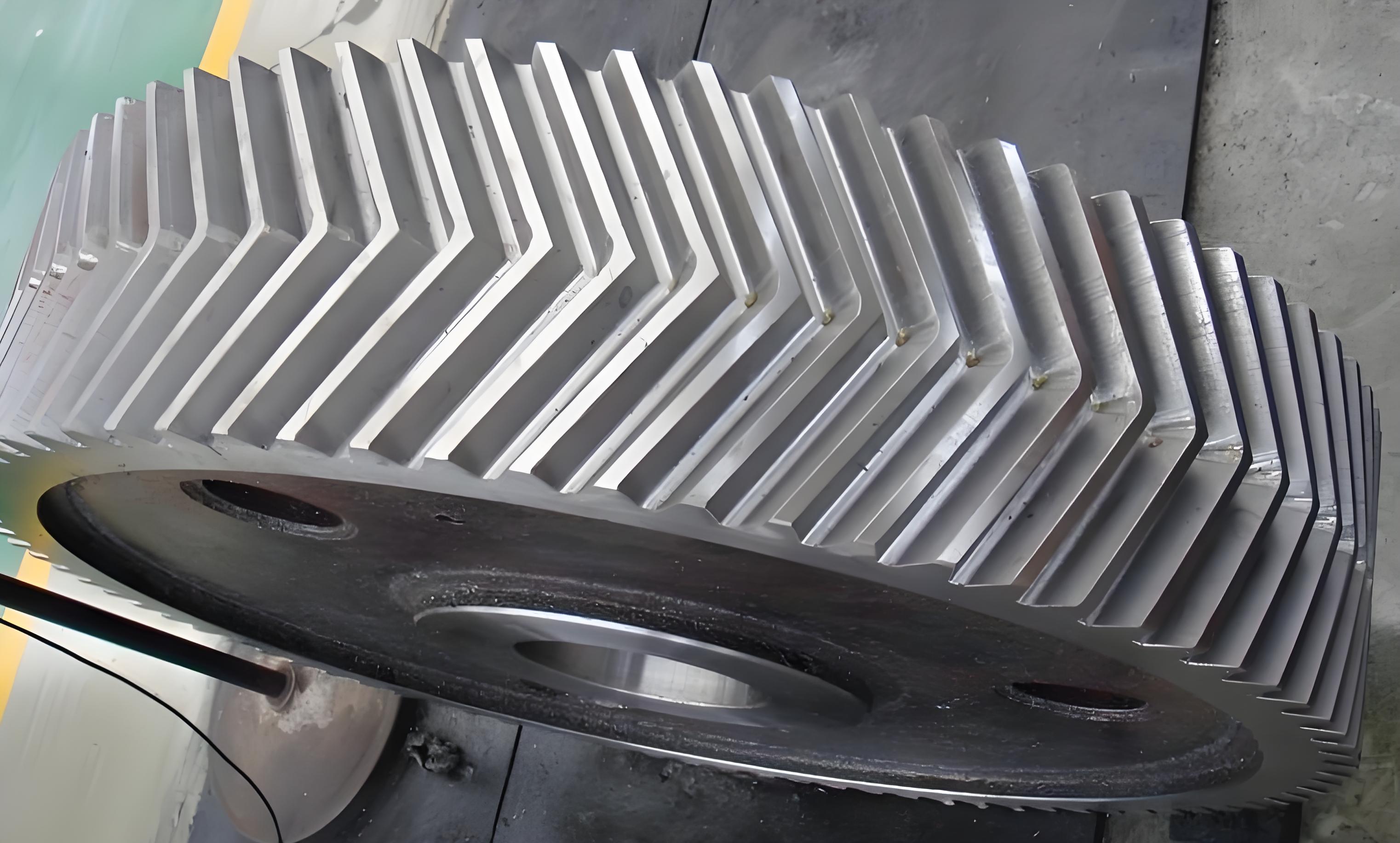
The specific herringbone gearbox under study is a single-stage, high-torque unit. The fundamental parameters defining the herringbone gear pair are summarized in the table below. It is crucial to note that in the dynamic model, the left-hand and right-hand helical halves of the herringbone gear are treated as distinct but connected entities, enabling the analysis of their individual and coupled behavior under load.
| Parameter | Symbol / Unit | Value |
|---|---|---|
| Number of Teeth (Pinion / Gear) | Z1 / Z2 | 25 / 32 |
| Module | mn (mm) | 25 |
| Helix Angle | β (°) | 26 |
| Pressure Angle | αn (°) | 20 |
| Face Width (per helix) | b (mm) | 240 |
| Center Distance | a (mm) | Calculated |
The kinematic and kinetic formulation for each gear, considered as a rigid rotor, forms the basis of the dynamic equations. The angular velocity vector for a gear (denoted with subscript i, where i = p for pinion, g for gear) including small rotational oscillations can be expressed as:
$$
\vec{\omega}_i = \left[ \cos(\Omega_i t + \dot{\theta}_{zi}) \dot{\theta}_{yi} + \sin(\Omega_i t + \dot{\theta}_{zi}) \dot{\theta}_{xi} \right] \hat{i} + \left[ \sin(\Omega_i t + \dot{\theta}_{zi}) \dot{\theta}_{yi} – \cos(\Omega_i t + \dot{\theta}_{zi}) \dot{\theta}_{xi} \right] \hat{j} + \left[ \Omega_i + \dot{\theta}_{zi} + \frac{\theta_{xi}\dot{\theta}_{yi} – \theta_{yi}\dot{\theta}_{xi}}{2} \right] \hat{k}
$$
Here, $\Omega_i$ is the constant rotational speed, and $\theta_{xi}, \theta_{yi}, \theta_{zi}$ represent small angular displacements about the respective axes. The total kinetic energy $T_i$ of the gear includes translational and rotational components:
$$
T_i = \frac{1}{2} m_i (\dot{x}_i^2 + \dot{y}_i^2 + \dot{z}_i^2) + \frac{1}{2} J_{Di}(\dot{\theta}_{yi}^2 + \dot{\theta}_{xi}^2) + \frac{1}{2} J_{Pi}(\Omega_i + \dot{\theta}_{zi})(\theta_{xi}\dot{\theta}_{yi} – \theta_{yi}\dot{\theta}_{xi}) + \frac{1}{2} J_{Pi}(\Omega_i + \dot{\theta}_{zi})^2
$$
where $m_i$ is the mass, $J_{Di}$ is the diametral moment of inertia, and $J_{Pi}$ is the polar moment of inertia. Applying Lagrange’s equations leads to the matrix form of the equations of motion for the gear rotor:
$$
\mathbf{M}^d_i \ddot{\mathbf{q}}_i + \Omega_i \mathbf{G}^d_i \dot{\mathbf{q}}_i = \mathbf{F}^d_i
$$
where $\mathbf{q}_i = [x_i, y_i, z_i, \theta_{xi}, \theta_{yi}, \theta_{zi}]^T$ is the displacement vector, $\mathbf{M}^d_i$ is the mass matrix, $\mathbf{G}^d_i$ is the gyroscopic matrix, and $\mathbf{F}^d_i$ is the force vector containing mesh forces and bearing reactions. The overall system equation for the entire herringbone gear transmission, assembling all components (gears, shafts, bearings), takes the classic form:
$$
\mathbf{M} \ddot{\mathbf{x}} + \mathbf{C} \dot{\mathbf{x}} + \mathbf{K} \mathbf{x} = \mathbf{P}(t)
$$
The excitation vector $\mathbf{P}(t)$ is dominated by the time-varying mesh stiffness $k_m(t)$ of the herringbone gear contacts, which can be expressed as a Fourier series:
$$
k_m(t) = k_{m0} + \sum_{n=1}^{N} k_{mn} \cos(n\omega_m t + \phi_n)
$$
where $k_{m0}$ is the average mesh stiffness, $\omega_m$ is the gear mesh frequency (GMF), and $k_{mn}$ are the harmonic amplitudes. The dynamic mesh force $F_{dyn}$ for a single helical mesh path is then:
$$
F_{dyn}(t) = k_m(t) \cdot \delta(t) + c_m \cdot \dot{\delta}(t)
$$
where $\delta(t)$ is the dynamic transmission error (DTE) and $c_m$ is the mesh damping coefficient.
To validate the constructed multi-body dynamics model of the herringbone gear system, a simulation was performed under specified operating conditions: an input speed of 300 rpm (5 Hz) and a steadily applied output torque of 560 kNm. The resulting vibration acceleration at a selected point on the bearing housing (a typical monitoring location) was analyzed. The frequency spectrum from the simulation revealed dominant peaks at the Gear Mesh Frequency (GMF = 250 Hz) and its harmonics, with the fundamental mesh frequency being the most prominent. This aligns perfectly with theoretical expectations for gearbox vibration, where the periodic impact of tooth engagement is the primary excitation source.
This simulation result was rigorously compared against field data acquired from an identical herringbone gearbox deployed in a heavy-duty industrial application. The operational spectra from the field, captured during stable load conditions, exhibited a richer content of background frequencies due to other machinery and complex boundary conditions. However, the fundamental characteristic remained unequivocal: the most significant peaks consistently occurred at the operating GMF and its multiples. The close correlation between the simulated and measured spectral signatures, particularly in identifying the dominant excitation frequencies, confirms the accuracy and predictive capability of the developed “housing-bearing-shaft-gear mesh” dynamic model for the herringbone gear transmission system.
A critical application of a validated model is to investigate the impact of imperfections. In real-world herringbone gear systems, manufacturing and installation errors are unavoidable. Two of the most consequential errors for herringbone gears are axis misalignment (tilt) and eccentricity. These errors break the ideal symmetry of the herringbone gear and can induce unique dynamic phenomena. Our analysis introduces these errors selectively into one helical half of the herringbone gear to isolate their effects, while the other half remains theoretically perfect. The system’s floating bearing arrangement and component flexibilities allow for load sharing, meaning the error-free side will adapt to the misaligned side’s condition.
1. Axis Tilt Error: A small axis tilt angle (e.g., 0.03°) was introduced to one helix. Analysis of the dynamic mesh forces on the left and right helical halves revealed a crucial finding: while the magnitude of the forces remained equalized due to system compliance, a low-frequency fluctuation appeared in-phase on both helices in the radial (X, Y) directions. The key observation was that these fluctuations were 180 degrees out of phase between the two sides. The spectral content of the mesh force showed a powerful new peak at the output shaft’s rotational frequency (RPM = 7.81 Hz), which was negligible in the error-free case. The GMF peak remained strong, now accompanied by sidebands due to the modulation from the rotational frequency.
2. Eccentricity Error: A parallel offset or eccentricity (e.g., 0.2 mm) was introduced to one helix. Similar to the tilt case, the mesh forces equalized in magnitude but exhibited low-frequency fluctuations that were 180 degrees out of phase between the two herringbone halves. However, the spectral signature differed notably. The most dominant peak in the mesh force spectrum appeared not at the shaft rotational frequency, but at a distinct frequency of 26.91 Hz. This frequency was also present, though less prominent, in the error-free and tilt-error cases. Further parametric studies indicated this frequency is intimately linked to the contact ratio (εγ) of the herringbone gear pair. Its relationship can be conceptually linked to a “load-sharing modulation frequency” influenced by the periodic variation in the number of tooth pairs in contact. An empirical observation suggests an inverse relationship with contact ratio.
| Error Condition | Primary Low-Freq Peak in Mesh Force | Phase Relationship of Fluctuation (L vs. R Helix) | Notable Spectral Feature |
|---|---|---|---|
| Perfect Alignment | Very low at Shaft RPM | N/A (negligible fluctuation) | Peak at ~26.91 Hz related to contact ratio. |
| Axis Tilt | Shaft Rotational Frequency | 180° out of phase | Strong RPM peak; GMF has sidebands. |
| Eccentricity | ~26.91 Hz (Contact Ratio related) | 180° out of phase | Dominant peak at contact-ratio frequency. |
A pivotal discovery from both error analyses concerns the housing vibration response. Despite the significant low-frequency modulation introduced into the herringbone gear mesh forces, the vibration spectrum measured on the gearbox housing showed no substantial increase in amplitude at these low frequencies (7.81 Hz or 26.91 Hz). The housing response remained overwhelmingly dominated by the GMF (250 Hz) and its harmonics. This can be attributed to two primary mechanisms: first, the low-frequency content is below the first major natural frequencies of the housing structure, preventing resonant amplification; second and more specific to the herringbone gear, the 180-degree out-of-phase fluctuation on the two helical halves creates opposing force vectors on the housing structure. Through the system’s compliance, these forces partially cancel each other out, effectively filtering the low-frequency error-induced excitation from being transmitted to the housing in a significant radial vibration mode. This demonstrates a inherent robustness of the herringbone gear configuration against certain static errors.
To mitigate the dominant GMF vibration, tooth surface modification is a well-established technique. We applied a lead crown (barrel shape) modification of 0.02 mm to both flanks of the herringbone gear teeth. The modification profile aims to compensate for elastic deflections and minor misalignments under load, promoting a more uniform pressure distribution along the tooth face width. The effect was evaluated quantitatively under both error conditions.
| Performance Metric | Axis Tilt Error (No Crown) | Axis Tilt Error (With Crown) | Eccentricity Error (No Crown) | Eccentricity Error (With Crown) |
|---|---|---|---|---|
| Mesh Force at GMF (N) | ~7,019 | ~5,411 | ~6,371 | ~5,273 |
| Housing Accel. at GMF (mm/s²) | 1,433 | 1,207 | 1,444 | 1,218 |
| Reduction in GMF Vibration | – | ~15.8% | – | ~15.6% |
The results are clear: lead crowning significantly reduces the amplitude of the dynamic mesh force at the Gear Mesh Frequency. Consequently, the housing vibration response at the GMF is reduced by approximately 16% in both error scenarios. This confirms that while the herringbone gear design is resilient to the low-frequency transmission of error-induced forces, the high-frequency vibration caused by the mesh impact itself is effectively tamed by proper tooth surface modification. The modification has minimal effect on the low-frequency mesh force peaks caused by errors, as those are governed by kinematic displacement errors rather than localized contact deflection.
In conclusion, this detailed dynamic analysis of a herringbone gear transmission system, based on a validated rigid-flexible coupling multi-body model, provides profound insights into its vibration behavior. The herringbone gear configuration demonstrates a remarkable inherent tolerance to certain assembly errors like axis tilt and eccentricity. Although these errors induce significant low-frequency modulation in the gear mesh forces, the anti-phase relationship between the two helical halves, coupled with system compliance, leads to partial force cancellation. This prevents these error frequencies from manifesting strongly in the radial vibration of the gearbox housing. The dominant housing vibration remains steadfastly linked to the gear mesh frequency. Furthermore, the study identifies a distinct vibrational frequency component related to the contact ratio of the herringbone gear pair, which becomes pronounced under eccentricity errors. Finally, the critical importance of deliberate tooth surface modifications, such as lead crowning, is quantitatively proven. These modifications are highly effective in reducing the primary mesh-frequency vibration by improving the load distribution, thereby lowering dynamic mesh forces and resulting housing acceleration. This comprehensive understanding equips engineers with the knowledge to design more robust, quiet, and reliable herringbone gear transmission systems, optimizing performance from the drawing board through to field operation.