
In high-precision mechanical transmission systems used in critical applications such as aviation and marine propulsion, herringbone gear systems are widely employed due to their advantages of high load capacity, smooth operation, and self-balancing axial forces. However, under high-speed and heavy-load conditions, these herringbone gear systems often experience issues like impact vibration, sudden load changes, and increased noise, which can reduce transmission accuracy and service life. To address these challenges, tooth surface modification techniques, including profile and lead corrections, have been developed to improve meshing performance, reduce impact, and enhance load distribution. This study focuses on the implementation of a three-dimensional tooth surface modification approach for herringbone gears, analyzing its effects on vibration excitation factors, and optimizing modification parameters through multi-objective dynamic criteria. Experimental validation is conducted using a closed power flow test rig, with vibration measurements obtained via high-precision encoders.
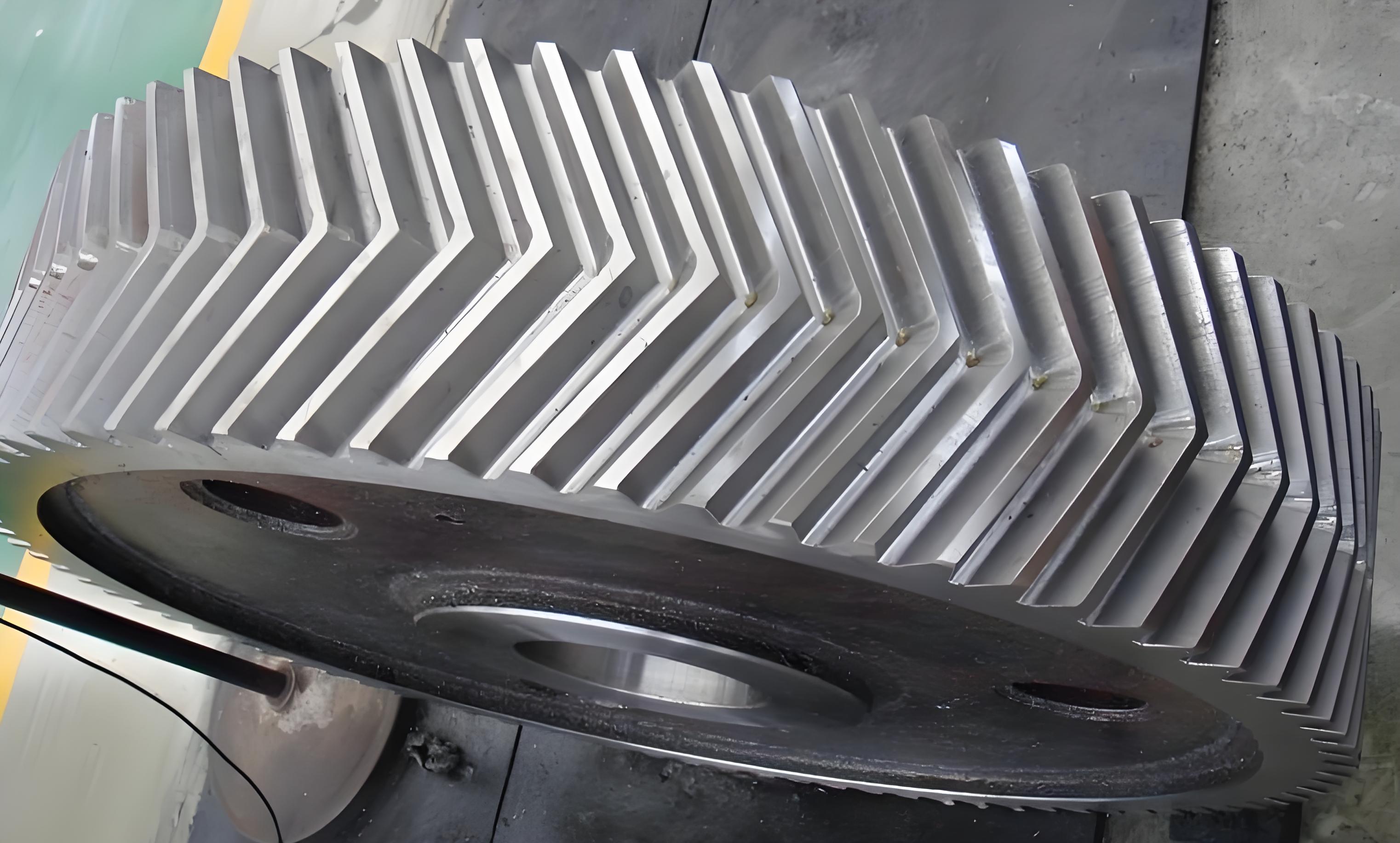
The herringbone gear configuration consists of double helical gears with opposite hand orientations, which cancel out axial thrust forces. The dynamic behavior of herringbone gear systems is influenced by internal excitation sources such as transmission error, time-varying mesh stiffness, and corner contact impact forces. Tooth surface modification, which involves intentional deviations from the ideal conjugate surface, can mitigate these excitations. Traditional methods often apply profile and lead modifications separately, but for herringbone gears, a combined three-dimensional modification is proposed to achieve better vibration and noise reduction. This modification is applied to the pinion tooth surface using a fourth-order parabolic function, and the actual tooth surface, including manufacturing errors, is modeled using cubic B-spline curves for high accuracy.
The tooth surface modification model involves both profile and lead corrections. Profile modification, also known as tip and root relief, compensates for base pitch deviations and reduces meshing impact. Lead modification addresses misalignments and deformations to ensure uniform load distribution across the face width. For herringbone gears, a three-dimensional modification is defined by eight parameters: four for profile modification (magnitudes and lengths at tip and root) and four for lead modification (magnitudes and lengths at both ends of the tooth). The modification amounts are described by fourth-order parabolic curves, and the deviated surface is represented using cubic B-spline interpolation to ensure smoothness and accuracy. The B-spline surface is expressed as:
$$ \mathbf{r}(u,v) = \begin{bmatrix} 1 & u & u^2 & u^3 \end{bmatrix} \mathbf{M}_B \mathbf{V} \mathbf{M}_B^T \begin{bmatrix} 1 \\ v \\ v^2 \\ v^3 \end{bmatrix}, \quad 0 \leq u, v \leq 1 $$
where \( u \) and \( v \) are parametric coordinates, \( \mathbf{M}_B \) is the B-spline basis matrix, and \( \mathbf{V} \) is the control point matrix representing deviation values. This approach allows for precise modeling of modification and errors, critical for high-precision herringbone gear applications.
| Modification Parameter | Symbol | Description | Typical Range |
|---|---|---|---|
| Tip Relief Magnitude | \( y_1 \) | Deviation at tooth tip (μm) | 10–20 μm |
| Tip Relief Length | \( y_2 \) | Length from tip (mm) | 1.5–2.5 mm |
| Root Relief Magnitude | \( y_3 \) | Deviation at tooth root (μm) | 10–20 μm |
| Root Relief Length | \( y_4 \) | Length from root (mm) | 2.5–3.5 mm |
| Lead Crown Magnitude (End A) | \( y_5 \) | Deviation at one end (μm) | 10–20 μm |
| Lead Crown Length (End A) | \( y_6 \) | Length from end (mm) | 10–12 mm |
| Lead Crown Magnitude (End B) | \( y_7 \) | Deviation at other end (μm) | 10–20 μm |
| Lead Crown Length (End B) | \( y_8 \) | Length from end (mm) | 10–12 mm |
The dynamic model of the herringbone gear system considers bending, torsion, and axial coupling vibrations. A 12-degree-of-freedom lumped parameter model is established, including support stiffness and damping from rolling bearings. The model accounts for excitation from transmission error and corner mesh impact forces. The equations of motion are derived using Newton’s second law:
$$ m_{p1} \ddot{y}_{p1} + c_{p1y} \dot{y}_{p1} + k_{p1y} y_{p1} = -F_{y1} + m_{p1} g $$
$$ m_{p1} \ddot{z}_{p1} + c_{p12z} (\dot{z}_{p1} – \dot{z}_{p2}) + k_{p12z} (z_{p1} – z_{p2}) = -F_{z1} $$
$$ I_{p1} \ddot{\theta}_{p1} = -F_{y1} R_p + T_{p1} – F_{s1} R_p $$
Similar equations apply for the driven gear and the opposite helix. Here, \( m \) denotes mass, \( c \) damping, \( k \) stiffness, \( I \) moment of inertia, \( F_y \) and \( F_z \) dynamic mesh forces in the line-of-action and axial directions, \( F_s \) corner impact force, \( R \) base radius, and \( T \) torque. The system is solved numerically using the Runge-Kutta method to obtain steady-state responses.
The effect of three-dimensional modification on internal excitation factors is analyzed through transmission error and corner impact force. Transmission error, calculated via loaded tooth contact analysis (LTCA), represents the deviation from ideal motion due to deformations and modifications. For a herringbone gear pair, the transmission error fluctuation amplitude is a key indicator of vibration excitation. With modification, the transmission error waveform can be smoothed, reducing higher harmonics. The corner impact force arises when teeth engage outside the theoretical line-of-action due to base pitch errors. The impact velocity \( v_s \) at the modified contact start point is computed geometrically:
$$ v_s = \frac{2\pi n}{60} \left( O_1 M_1 \cdot i – O_2 M_2 \right) $$
where \( n \) is the pinion speed, \( i \) is the gear ratio, and \( O_1 M_1 \), \( O_2 M_2 \) are distances from gear centers to the impact point. The impact force magnitude \( F_s \) is derived from energy conservation:
$$ F_s = v_s \left\{ \frac{b J_1 J_2}{\left[ J_1 (O_2 M_2)^2 + J_2 (O_1 M_1)^2 \right] (q_s + \cos^2 \theta \cdot q_p) } \right\}^{1/2} $$
with \( b \) as face width, \( J \) inertia, \( q_s \) and \( q_p \) compliance coefficients, and \( \theta \) the angle between impact and normal lines. Modification reduces the load sharing at the contact start, thereby lowering the impact force.
| Case | Transmission Error Fluctuation (arcsec) | Corner Impact Force Amplitude (N) | Load Sharing at Start Point |
|---|---|---|---|
| Unmodified | 2.9 | 1160 | 0.032 |
| Modification A | 2.2 | 786 | 0.016 |
| Modification B | 2.3 | 435 | 0.000 |
To optimize the three-dimensional modification for herringbone gears, a multi-objective dynamic optimization is performed. The objectives are to minimize the transmission error fluctuation amplitude, corner impact force amplitude, and root mean square (RMS) of the line-of-action relative vibration acceleration. The optimization considers multiple load conditions to ensure robustness. The objective function is formulated as:
$$ f_C(\mathbf{y}) = \min \left[ w_1 f_e(\mathbf{y}) + w_2 f_I(\mathbf{y}) + w_3 f_a(\mathbf{y}) \right] $$
subject to constraints on modification parameters: \( |y_1 – y_3| \leq Q_{y0} \), \( |y_2 – y_4| \leq l_{y0} \), \( Q_{y \min} \leq y_1, y_3 \leq Q_{y \max} \), \( l_{y \min} \leq y_2, y_4 \leq l_{y \max} \), and similar for lead parameters. Here, \( \mathbf{y} = [y_1, y_2, \dots, y_8]^T \) is the modification parameter vector, \( f_e \), \( f_I \), \( f_a \) are normalized objective functions for transmission error, impact force, and acceleration, and \( w_1 \), \( w_2 \), \( w_3 \) are weighting factors. An improved adaptive genetic algorithm is employed for optimization, which adjusts crossover and mutation probabilities dynamically to enhance convergence.
| Parameter | Value | Unit |
|---|---|---|
| Tip Relief Magnitude \( y_1 \) | 16 | μm |
| Tip Relief Length \( y_2 \) | 1.6 | mm |
| Root Relief Magnitude \( y_3 \) | 18 | μm |
| Root Relief Length \( y_4 \) | 3.2 | mm |
| Lead Crown Magnitude \( y_5 \) | 14 | μm |
| Lead Crown Length \( y_6 \) | 11.2 | mm |
| Lead Crown Magnitude \( y_7 \) | 14 | μm |
| Lead Crown Length \( y_8 \) | 11.2 | mm |
The optimization results show that after modification, the RMS of line-of-action relative vibration acceleration decreases by 20.42% compared to the unmodified herringbone gear, indicating significant vibration reduction. Frequency domain analysis reveals that higher harmonic components are suppressed, confirming the effectiveness of three-dimensional modification in mitigating corner impact excitations.
Experimental validation is conducted using a closed power flow test rig for herringbone gears. The rig consists of a drive motor, test gearbox, torque loader, and energy recirculation system to minimize power consumption. Vibration measurement is performed using Heidenhain rotary encoders (ROD280, 18,000 lines per revolution) mounted on both pinion and gear shafts. The encoders output sinusoidal signals, which are sampled at high frequency (40 MHz) to capture angular displacements. The relative vibration acceleration in the line-of-action direction is derived from the angular data:
$$ a_{12}(t) = \frac{\pi}{180} \left[ (\phi_2 – \phi_{20}) r_{b1} – (\phi_1 – \phi_{10}) r_{b2} \right]” $$
where \( \phi_1 \), \( \phi_2 \) are actual rotation angles, \( \phi_{10} \), \( \phi_{20} \) initial angles, and \( r_{b1} \), \( r_{b2} \) base radii. Time-domain synchronous averaging is applied to improve signal-to-noise ratio by averaging over multiple meshing cycles. The processed signals are compared with theoretical predictions.
| Load Torque (N·m) | Unmodified Theoretical RMS (m/s²) | Unmodified Experimental RMS (m/s²) | Modified Theoretical RMS (m/s²) | Modified Experimental RMS (m/s²) | Reduction Percentage |
|---|---|---|---|---|---|
| 414 | 25.1 | 27.3 | 26.5 | 28.9 | -5.9% |
| 828 | 29.4 | 32.1 | 23.4 | 25.1 | 20.4% |
| 1035 | 33.2 | 36.0 | 27.8 | 30.2 | 16.1% |
The experimental results align well with theoretical predictions, showing maximum deviations within 14.5%. The modification effectively reduces vibration, especially under design load conditions. At light loads, modification may slightly increase vibration due to reduced contact ratio, highlighting the importance of load-specific optimization for herringbone gears.
In conclusion, three-dimensional tooth surface modification for herringbone gears, combining profile and lead corrections, significantly improves dynamic performance by reducing transmission error fluctuations, corner impact forces, and overall vibration levels. The use of cubic B-spline surfaces ensures accurate modeling of modification and errors. A multi-objective optimization framework based on an improved genetic algorithm yields optimal modification parameters that minimize key excitation factors. Experimental validation on a closed power flow test rig confirms the theoretical findings, demonstrating vibration reduction up to 20.42% under rated conditions. This approach provides a practical method for enhancing the reliability and noise performance of herringbone gear systems in high-precision applications.
The study underscores the importance of integrated modification design for herringbone gears, as separate profile and lead corrections may not achieve optimal results. Future work could explore adaptive modification strategies for varying operational conditions or incorporate more detailed thermal and wear effects. Overall, three-dimensional modification represents a powerful tool for advancing the dynamic performance of herringbone gear transmissions.