
The analysis of time-varying meshing stiffness is fundamental for understanding the dynamic behavior, vibration, and noise generation in gear transmission systems. The herringbone gear, with its characteristic symmetric ‘V’ shape, offers inherent axial force cancellation, making it suitable for high-power, high-torque applications. However, the meshing stiffness of a standard herringbone gear exhibits significant periodic fluctuations, which can be a primary source of vibration and acoustic emissions. A design modification known as “staggering tooth” or axial phasing is introduced to mitigate this issue. This article provides a detailed, first-person analysis of the meshing process and presents a quantitative methodology for calculating the meshing stiffness of a double circular-arc herringbone gear with this staggering tooth design. The results are systematically compared with those of a conventional, non-staggered herringbone gear.
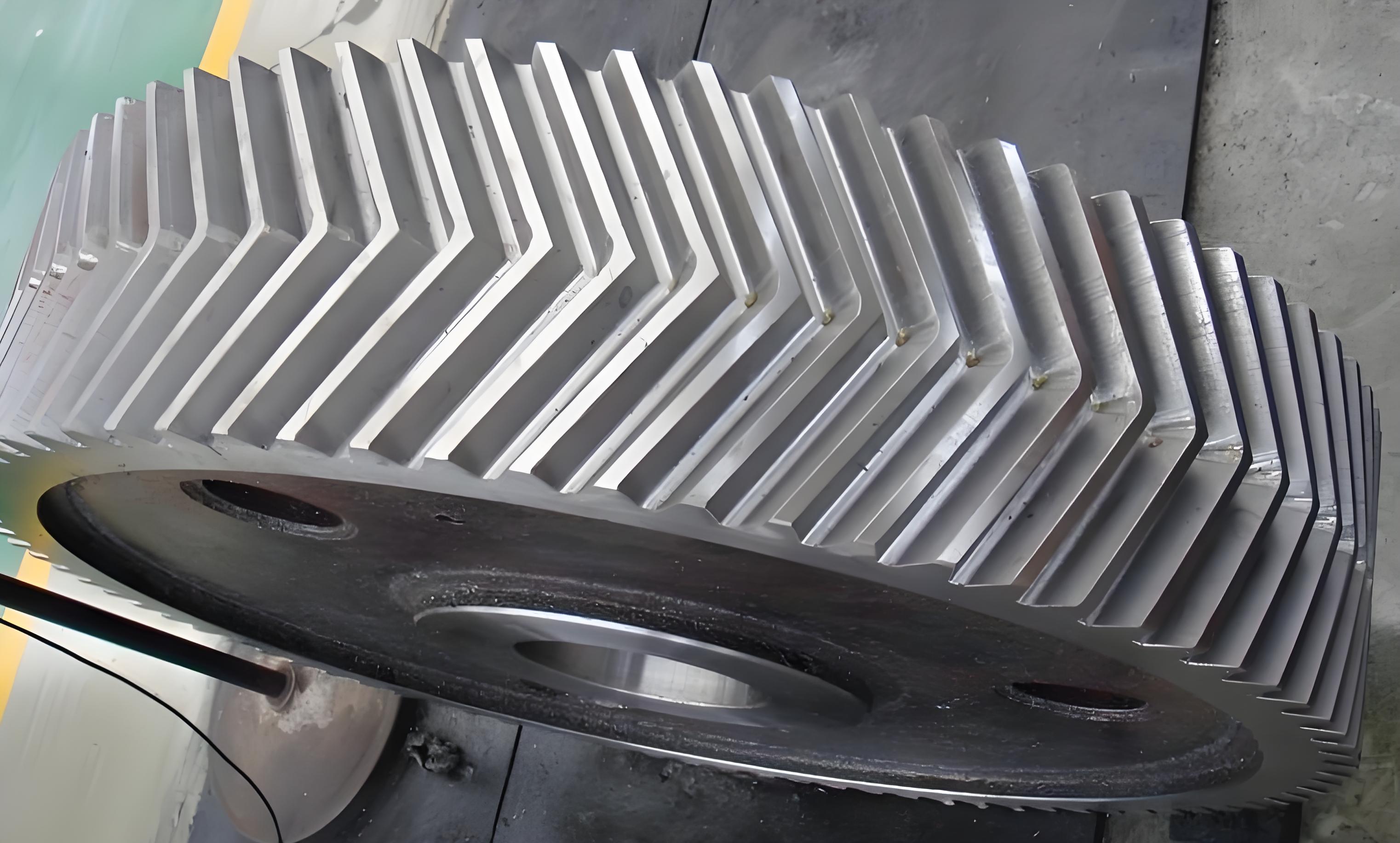
The core principle of the staggering tooth design involves a deliberate axial offset between the two helical halves of the herringbone gear. This offset alters the sequencing and overlap of tooth engagements across the face width. For a double circular-arc profile gear, where convex and concave arc segments mate, the engagement involves multiple concurrent contact points along the tooth trace. The staggering disrupts the simultaneous entry and exit of all contact pairs on both flanks, effectively smoothing the transition of load sharing between successive teeth.
To quantify this, let’s define the key geometric parameters. For a single flank of the herringbone gear, let $B$ be the axial face width. The axial pitch, the distance between corresponding points on adjacent teeth, is denoted as $P_x$. The contact pattern analysis reveals two critical distances: $q_t a$, the axial distance between the two contact points (convex and concave) on the same tooth, and $q’_t a$, the axial distance between contact points on the convex flank of one tooth and the concave flank of the adjacent tooth. The fractional part of the contact ratio, expressed as an axial length, is $\Delta b$.
The complete meshing cycle can be categorized into four distinct cases based on the relationship between $\Delta b$, $q’_t a$, $P_x/2$, and $q_t a$. For the purpose of this detailed exposition, I will focus on the case where $\Delta b \leq q’_t a$, which is common in many practical designs. The engagement sequence is best visualized by dividing a single axial pitch length into eight distinct intervals (I through VIII), as determined by the changing number and axial position of active contact points on both the driving and driven gears’ convex (T) and concave (A) flanks.
The analysis reveals a distinct pattern for the staggered herringbone gear. The number of active contact points cycles through the sequence 6–5–4–5–6–5–4–5 across the eight intervals. Correspondingly, the number of tooth pairs in contact follows the sequence 4–4–3–4–4–4–3–4. In stark contrast, a non-staggered, standard herringbone gear of the same geometry exhibits a much more abrupt pattern: the contact point count alternates as 6–4–6–4, and the tooth pair count alternates as 8–6–8–6 over just four intervals within one axial pitch. This visual and quantitative comparison immediately suggests that the staggering tooth design leads to more frequent but smaller changes in the load-bearing structure, which is hypothesized to reduce the amplitude of stiffness fluctuation.
The frequency of this stiffness variation is directly related to the rotational speed and tooth count. For a gear with $z$ teeth rotating at $n$ rpm, the stiffness fluctuation frequency $f$ is given by:
$$ f = \frac{z n}{60} \quad \text{(Hz)} $$
This excitation frequency is a critical parameter in torsional vibration analysis of the gear system.
Methodology for Meshing Stiffness Calculation
The time-varying meshing stiffness $K_{mesh}(t)$ is obtained by summing the individual stiffness contributions $K_j$ from all concurrent contact points at any given instant. The axial position of each contact point changes linearly with time (or angular rotation), allowing us to map the engagement intervals from the geometric analysis onto a time-domain stiffness function.
Single-Point Contact Stiffness
The foundation of the calculation is the stiffness at a single point of contact between a convex and a concave arc. Based on extensive nonlinear finite element analysis and curve fitting for the GB12759-91 double circular-arc tooth profile, the relationship between applied normal load $F_n$ and the resulting comprehensive deformation can be expressed in a piecewise power-law form. The non-dimensional maximum composite deformation $\bar{\omega}$ (deformation divided by normal module $M_n$) is related to load and geometry as follows:
$$
\bar{\omega} = \alpha_i \left[ \frac{F_n \bar{\rho}}{E’ M_n^2} \right]^{\beta_i} \quad (i = 1, 2, 3)
$$
where $\bar{\rho}$ is the relative radius of curvature coefficient at the contact point, and $E’$ is the equivalent elastic modulus. The coefficients $\alpha_i$ and $\beta_i$ depend on the axial location $b$ of the contact point measured from the start of the active tooth face:
- Region 1 ($0 < b \leq 2M_n$): Near the tooth entry edge.
$$\alpha_1 = (b + 1.88)[0.3462(b + 1.88) – 0.4183]^{-1}$$
$$\beta_1 = (b + 0.49)[1.1278(b + 0.49) + 0.2081]^{-1}$$ - Region 2 ($2M_n < b \leq B – 2M_n$): The middle portion of the tooth.
$$\alpha_2 = 3.0873, \quad \beta_2 = 0.8797$$ - Region 3 ($B – 2M_n < b \leq B$): Near the tooth exit edge.
$$\alpha_3 = (b – B + 4.224)[0.3465(b – B + 4.224) – 0.4439]^{-1}$$
$$\beta_3 = 0.80936 – 0.0033(b – B)$$
The single-point meshing stiffness $K_j(b_j)$ is defined as the load $F_n$ required to produce a unit non-dimensional deformation ($\bar{\omega}=1$). Solving the above equation for $F_n$ under this condition yields:
$$
K_j(b_j) = F_n = E’ M_n^{2\beta_i – 1} \left( \frac{1}{\alpha_i \bar{\rho}^{\beta_i}} \right)^{1/\beta_i}
$$
This formula provides the stiffness contribution of one contact point located at axial position $b_j$, considering the appropriate region ($i$) based on $b_j$.
Total Meshing Stiffness for Staggered Herringbone Gear
The total stiffness is the superposition of all active $K_j$ values at a given meshing position $x$, where $x$ is the axial distance from a reference starting point in the engagement cycle (e.g., the beginning of Interval I). The axial coordinates of engagement transition points for both the primary and the opposing tooth flank are derived from the geometric model. Let $C_1$ to $C_{24}$ and $C’_1$ to $C’_{24}$ denote these critical axial distances for the two flanks, respectively. Their values are functions of $P_x$, $q_t a$, $q’_t a$, and $\Delta b$.
For the herringbone gear with $\Delta b \leq q’_t a$, the meshing stiffness function $K_{mesh}(x)$ over one complete axial pitch $P_x$ is piecewise-defined across the eight intervals:
Interval I ($0 < x \leq P_x/2 – q_t a + \Delta b$):
$$ K_1(x) = K_{2A}(C_1+x) + K_{2T}(C_3+x) + K_{3A}(C_{10}+x) + K_{1’T}(C’_1+x) + K_{2’A}(C’_4+x) + K_{2’T}(C’_{10}+x) $$
Interval II ($P_x/2 – q_t a + \Delta b < x \leq \Delta b$):
$$ K_2(x) = K_{2T}(C_3+x) + K_{3A}(C_{10}+x) + K_{1’T}(C’_1+x) + K_{2’A}(C’_4+x) + K_{2’T}(C’_{10}+x) $$
Interval III ($\Delta b < x \leq P_x – q_t a$):
$$ K_3(x) = K_{2T}(C_3+x) + K_{3A}(C_{10}+x) + K_{2’A}(C’_4+x) + K_{2’T}(C’_{10}+x) $$
Interval IV ($P_x – q_t a < x \leq P_x/2$):
$$ K_4(x) = K_{2T}(C_3+x) + K_{3A}(C_{10}+x) + K_{2’A}(C’_4+x) + K_{2’T}(C’_{10}+x) + K_{3’A}(C’_{19}+x – q’_t a) $$
Interval V ($P_x/2 < x \leq q’_t a + \Delta b$):
$$ K_5(x) = K_{2T}(C_3+x) + K_{3A}(C_{10}+x) + K_{3T}(C_{19}+x – P_x/2) + K_{2’A}(C’_4+x) + K_{2’T}(C’_{10}+x) + K_{3’A}(C’_{19}+x – q’_t a) $$
Interval VI ($q’_t a + \Delta b < x \leq P_x/2 + \Delta b$):
$$ K_6(x) = K_{2T}(C_3+x) + K_{3A}(C_{10}+x) + K_{3T}(C_{19}+x – P_x/2) + K_{2’T}(C’_{10}+x) + K_{3’A}(C’_{19}+x – q’_t a) $$
Interval VII ($P_x/2 + \Delta b < x \leq P_x/2 + q’_t a$):
$$ K_7(x) = K_{3A}(C_{10}+x) + K_{3T}(C_{19}+x – P_x/2) + K_{2’T}(C’_{10}+x) + K_{3’A}(C’_{19}+x – q’_t a) $$
Interval VIII ($P_x/2 + q’_t a < x \leq P_x$):
$$ K_8(x) = K_{3A}(C_{10}+x) + K_{3T}(C_{19}+x – P_x/2) + K_{4A}(C_{24}+x – P_x/2 – q’_t a) + K_{2’T}(C’_{10}+x) + K_{3’A}(C’_{19}+x – q’_t a) $$
In these equations, subscripts like $2A$ denote the stiffness function for a contact point on a concave flank in a specific state of engagement. By substituting the specific gear parameters into the formulas for $C_i$, $C’_i$, and $K_j(b_j)$, the exact time-varying stiffness curve for the staggered double circular-arc herringbone gear can be computed.
Quantitative Comparison and Results
To illustrate the impact of the staggering tooth design, a detailed calculation was performed for a specific GB12759-91 type herringbone gear with parameters: $B = 70\, \text{mm}$ and $\Delta b = 6.85\, \text{mm}$. The meshing stiffness was calculated at the boundaries of the engagement intervals, where step changes occur. The results for the staggered gear are summarized in Table 1, and the corresponding results for an otherwise identical non-staggered herringbone gear are shown in Table 2.
| Transition Point | Axial Position 1 (mm) | Stiffness Value 1 (kN/mm) | Axial Position 2 (mm) | Stiffness Value 2 (kN/mm) | Absolute Step $\Delta K$ (kN/mm) | Relative Step $|\Delta K|/K_1$ (%) |
|---|---|---|---|---|---|---|
| 1 | 63.1129 | 2068.87 | 0.06311 | 2530.00 | 461.13 | 22.32 |
| 2 | 5.9326 | 2756.16 | 5.9957 | 3234.85 | 478.69 | 17.37 |
| 3 | 6.8790 | 3202.54 | 6.9420 | 2487.59 | -714.95 | 28.74 |
| 4 | 12.8120 | 2623.23 | 12.8750 | 1907.67 | -715.56 | 27.28 |
| 5 | 31.5560 | 2068.87 | 31.6200 | 2530.70 | 461.83 | 22.32 |
| 6 | 37.4891 | 2756.16 | 37.5521 | 3234.85 | 478.69 | 17.37 |
| 7 | 38.4360 | 3202.54 | 38.4990 | 2487.59 | -714.95 | 28.74 |
| 8 | 44.3684 | 2623.23 | 44.4314 | 1907.67 | -715.56 | 27.28 |
| Transition Point | Axial Position 1 (mm) | Stiffness Value 1 (kN/mm) | Axial Position 2 (mm) | Stiffness Value 2 (kN/mm) | Absolute Step $\Delta K$ (kN/mm) | Relative Step $|\Delta K|/K_1$ (%) |
|---|---|---|---|---|---|---|
| 1 | 63.1129 | 2218.17 | 0.06311 | 3141.83 | 923.66 | 41.64 |
| 2 | 5.9326 | 3592.75 | 5.9957 | 4550.13 | 957.38 | 26.65 |
| 3 | 6.8790 | 4485.51 | 6.9420 | 3055.60 | -1429.91 | 31.88 |
| 4 | 12.8120 | 3326.85 | 12.8750 | 1895.77 | -1431.08 | 43.10 |
The data in these tables lead to a compelling conclusion. For the staggered herringbone gear, the maximum absolute stiffness step $|\Delta K|_{max}$ is approximately 715.56 kN/mm, and the maximum relative step is about 28.74%. For the non-staggered herringbone gear, these values are dramatically higher: $|\Delta K|_{max} \approx 1431.08$ kN/mm and a maximum relative step of 43.10%. This demonstrates that the staggering tooth design reduces the magnitude of the meshing stiffness jumps by approximately 50%, and the relative fluctuation amplitude by about 10 percentage points. The physical implication is profound: the dynamic excitation force originating from the time-varying stiffness, which is proportional to the stiffness fluctuation under constant load, is significantly attenuated in the staggered herringbone gear.
The benefits can be further summarized by comparing key dynamic indicators derived from the stiffness functions:
| Parameter | Non-Staggered Herringbone Gear | Staggered Herringbone Gear | Improvement |
|---|---|---|---|
| Number of Stiffness Steps per $P_x$ | 4 | 8 | More frequent, smaller steps |
| Max Absolute Stiffness Step, $|\Delta K|_{max}$ | ~1431 kN/mm | ~716 kN/mm | Reduced by ~50% |
| Max Relative Stiffness Step | ~43.1% | ~28.7% | Reduced by ~14.4 p.p. |
| Peak-to-Peak Stiffness Variation* | Very High | Substantially Lower | Smoothed Load Transition |
*Based on the calculated step values and engagement sequences.
Conclusions and Implications
This detailed analysis leads to several important conclusions regarding the design and performance of the double circular-arc herringbone gear with a staggering tooth configuration:
1. The meshing process of a staggered herringbone gear is characterized by a more complex but smoother sequence of contact point engagement compared to the standard design. The load is transferred through a sequence involving 6, 5, and 4 contact points, as opposed to an abrupt alternation between 6 and 4 points.
2. A comprehensive methodology has been established to calculate the time-varying meshing stiffness. This method integrates a piecewise, power-law-based single-point contact stiffness model with a geometric superposition principle that accounts for the axial phasing of the herringbone gear halves.
3. The quantitative results are unequivocal. The staggering tooth design effectively halves the maximum absolute step change in meshing stiffness and reduces the maximum relative fluctuation by approximately one-third (from 43.1% to 28.7%). The relationship can be conceptually summarized as:
$$ \frac{|\Delta K|_{max, \text{staggered}}}{|\Delta K|_{max, \text{non-staggered}}} \approx \frac{1}{2} $$
$$ \frac{(\Delta K/K)_{max, \text{staggered}}}{(\Delta K/K)_{max, \text{non-staggered}}} \approx \frac{2}{3} $$
4. The primary engineering benefit of this reduction in stiffness fluctuation amplitude is the attenuation of dynamic excitations within the gear mesh. This directly translates to lower vibration levels, reduced impact forces during tooth engagement/disengagement, and consequently, lower operating noise. This makes the staggered double circular-arc herringbone gear a superior choice for applications where reliability, smooth operation, and noise control are critical, such as in high-power industrial drives, marine propulsion, and precision machinery.
5. The analysis framework presented here provides a solid foundation for subsequent dynamic modeling of the gear system. The calculated stiffness function $K_{mesh}(t)$ serves as a key parametric excitation input for torsional and lateral vibration models, enabling the prediction of dynamic response and the optimization of the staggering amount $\Delta b$ for specific operational requirements. Future work could involve extending this model to include the effects of manufacturing errors, shaft misalignment, and elastohydrodynamic lubrication on the effective meshing stiffness of the herringbone gear.