
In my extensive experience with heavy machinery components, the herringbone gear shaft stands out for its critical role in applications like rolling mills. Characterized by its large module, typically $m_n \ge 20$ mm, this component is notoriously difficult and time-consuming to manufacture, leading to high costs and, unfortunately, a disappointingly short service life. Therefore, finding a reliable method to extend the operational lifespan of large module herringbone gear shafts is a pressing economic and technical challenge. While numerous factors influence longevity, my focus here is on exploring a novel production process: forge-quenching after rough tooth slotting to achieve high hardness.
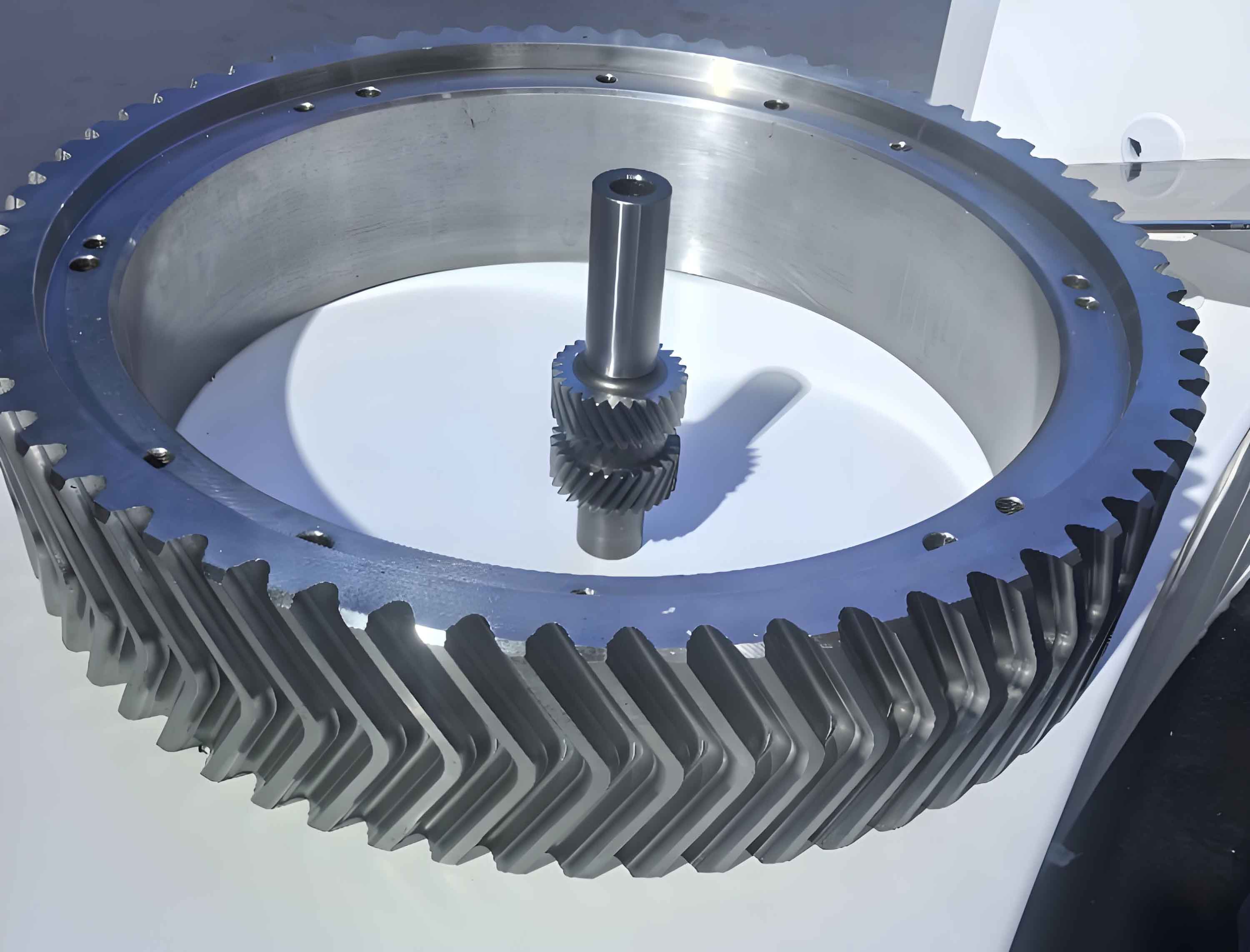
To understand the innovation, we must first examine the limitations of conventional processes. There are two predominant methods for manufacturing these large herringbone gear shafts.
| Process | Key Steps | Resulting Tooth Surface | Major Drawbacks |
|---|---|---|---|
| Process A: Bulk Quenching & Tempering | 1. Rough Turn 2. Quench & Temper (Hardness $\le$ 300 HB) 3. Semi-Finish Turn 4. Mill Teeth 5. Finish Turn |
“Soft” tooth surface (~300 HB). Hardness gradient from tooth tip to root, with the root area potentially as low as 200 HB. | Low contact strength, poor wear resistance, high susceptibility to scoring and pitting. |
| Process B: Bulk QT + Surface Hardening | 1. Rough Turn 2. Quench & Temper ($\le$ 300 HB) 3. Semi-Finish Turn & Mill Teeth 4. Finish Turn 5. Tooth Surface Induction Hardening |
“Hard” tooth surface (~50-55 HRC / ~500-550 HV). Thin hardened case (2-4 mm) over a softer core. | Heat treatment distortion ruins tooth profile accuracy, leading to poor contact. Hard, thin case is prone to spalling and premature fatigue failure. No post-hardening grinding is possible. |
Process A yields a gear with good initial conjugate action but insufficient durability. Process B improves wear resistance but introduces destructive distortion and a fragile case-core interface. The common failure modes—scoring, pitting, and severe spalling—stem directly from these shortcomings. It became clear that a new approach was needed: one that could provide high, uniform hardness through the tooth cross-section while maintaining precise, machined tooth geometry.
The proposed solution is the Forge-Quenching After Slotting process. The core idea is to rough mill the herringbone gear teeth first, then subject the entire shaft to a high-hardness quench and temper (QT) treatment. This sequence offers several theoretical advantages:
- Uniform Hardness Profile: Since the quenching medium contacts the entire tooth form during heat treatment, the hardness from the tip to the root is significantly more uniform compared to Process A.
- High Achievable Hardness: The aim is to achieve a bulk tooth hardness of 45-50 HRC (approx. 450-500 HV), rivaling surface-hardened gears.
- Precision Geometry: Because the high-hardness QT is performed *before* the final tooth milling, the final machining step can generate a precise, undistorted tooth profile with excellent surface finish.
- Deep Hardened Zone: Unlike the thin case of induction hardening, the hardened zone from bulk forging-quenching is much deeper, providing better support against subsurface fatigue and spalling.
The primary challenge in implementing this for a slotted herringbone gear shaft is cracking. The complex geometry with deep slots creates severe stress concentrations during rapid cooling. To mitigate this, a modified quenching medium and precise process control are essential. We moved away from plain water or oil. Instead, we adopted a polymer quenchant—a water solution with added Polyvinyl Alcohol (PVA). This medium provides a cooling rate between water and oil, reducing thermal gradients and transformation stresses. The cooling process follows a “water-oil” sequence, but with precisely controlled times in each medium.
Mechanical preparation is equally critical to prevent cracking. All sharp corners on the gear blank must be chamfered or rounded. The surface finish on the rough-milled teeth should be better than $\Ra 3.2 \mu m$ to eliminate notches that could initiate cracks.
Controlling distortion, particularly bending and twist of the tooth slots, is paramount for the subsequent finishing operation. To minimize bending:
- The part must be charged into a pre-heated furnace to ensure uniform, rapid heating and prevent “bellying” from uneven thermal expansion.
- Heating and soaking must be as uniform as possible.
The target maximum bending deformation after QT must be kept within 1 mm to ensure the final tooth milling is feasible.
The heart of the process lies in the precise calculation of heat treatment parameters. For a material like 34CrNi3Mo, we derived the following empirical formulas:
1. Austenitizing (Soaking) Time ($t_s$):
The goal is to austenitize the tooth section fully while minimizing decarburization. The time is based on the tooth thickness.
$$ t_s = K_s \cdot S $$
where:
- $t_s$ = Soaking time (minutes)
- $S$ = Arc tooth thickness at the pitch circle (mm). For a spur gear approximation: $S \approx \frac{\pi m_n}{2 \cos \beta}$, where $m_n$ is normal module and $\beta$ is helix angle.
- $K_s$ = Empirical coefficient (min/mm). We found $K_s = 0.8 \text{ to } 1.0$ suitable for our furnace and part size.
2. Quenching Cooling Time in Polymer Solution ($t_{q-p}$):
This must be sufficient to harden the teeth but not so long as to cause cracking.
$$ t_{q-p} = K_q \cdot d_p $$
where:
- $t_{q-p}$ = Cooling time in polymer quenchant (seconds)
- $d_p$ = Pitch diameter of the herringbone gear (mm)
- $K_q$ = Empirical coefficient (s/mm). We use $K_q = 0.4 \text{ to } 0.6$.
Immediately after the polymer quench, the part is transferred to an oil bath for slower cooling to around $150-200^\circ$C to prevent tempering by residual core heat. The oil cooling time is approximately $t_{q-oil} = 0.8 \cdot d_p$ seconds.
3. Tempering:
A double temper is typically performed to ensure complete transformation of retained austenite and stress relief. The temperature is selected based on the desired final hardness (e.g., $560-580^\circ$C for ~45-48 HRC for 34CrNi3Mo).
Based on this methodology, we developed a detailed heat treatment cycle for a trial herringbone gear shaft (Module $m_n=22$, 34CrNi3Mo). A schematic of the cycle is represented below by the key parameters:
| Process Stage | Temperature | Time Calculation | Key Objective |
|---|---|---|---|
| Preheat | $550-600^\circ C$ | ~1.5 min/mm (max section) | Reduce thermal shock |
| Austenitize | $840-850^\circ C$ | $t_s = 0.9 \times S$ | Full austenitization of teeth |
| Quench (Polymer) | $840^\circ C \to \sim 250^\circ C$ | $t_{q-p} = 0.5 \times d_p$ | Martensite transformation, minimize crack risk |
| Quench (Oil) | ~$250^\circ C \to 150^\circ C$ | $t_{q-oil} = 0.8 \times d_p$ | Control cooling, prevent self-tempering |
| Temper (1st) | $570^\circ C$ | 3-4 hours | Primary tempering, stress relief |
| Temper (2nd) | $570^\circ C$ | 3-4 hours | Secondary tempering, stabilize structure |
The successful implementation of this high-hardness QT necessitates specific adaptations in the machining sequence for the herringbone gear shaft. The complete manufacturing workflow is as follows:
- Rough Turning of Blank: All non-tooth diameters are machined with a 10-12 mm machining allowance. The herringbone gear journal diameter is left with a 5-6 mm allowance.
- Rough Milling of Tooth Slots: The herringbone gear teeth are milled to the nominal parameters but with a unilateral finishing allowance of 1.5-2.0 mm on the tooth flanks. This accounts for potential distortion and provides stock for the final cut.
- High-Hardness Quench & Temper: The shaft undergoes the detailed heat treatment process described above, aiming for a final tooth bulk hardness of 45-50 HRC.
- Semi-Finish Turning: The gear journal and other non-tooth diameters are turned, leaving a final finishing allowance (e.g., 0.5 mm).
- Precision Finishing Milling of Teeth: This is the critical step. Using a high-performance tool (e.g., aluminum high-speed steel form cutter, possibly nitrided), the final tooth profile is generated by removing the 1.5-2.0 mm allowance. This ensures excellent geometry and surface finish.
- Final Finishing: All remaining diameters are finish-turned and ground as required.
The allowance on the rough-milled teeth is a critical variable. It is governed by the formula:
$$ A_{total} = A_{distortion} + A_{oxidation} + A_{machining} $$
where $A_{distortion}$ is the anticipated thermal distortion (target <1 mm), $A_{oxidation}$ is the scale layer to be removed (~0.2-0.3 mm), and $A_{machining}$ is the minimum safe stock for the finishing cut considering machine tool and alignment repeatability (~0.3-0.5 mm). Our chosen 1.5-2.0 mm allowance safely encompasses these factors.
The advantages of this integrated “slot then forge-quench” process for a large herringbone gear shaft are substantial when compared to traditional methods. The benefits can be summarized as follows:
| Aspect | Traditional Soft Gear (Process A) | Traditional Case-Hardened Gear (Process B) | Slot & Forge-Quenched Gear (New Process) |
|---|---|---|---|
| Tooth Hardness | Low (~300 HB), Non-uniform | High Case (~550 HV), Soft Core | High & Uniform Bulk (450-500 HV) |
| Hardened Depth | Full section, but low hardness | Shallow (2-4 mm) | Deep (Through tooth section) |
| Tooth Geometry Accuracy | Excellent (Machined after QT) | Poor (Distorted by surface hardening) | Excellent (Final machined after QT) |
| Primary Failure Mode | Scoring, Wear, Pitting | Spalling, Case Crushing, Pitting | Significantly improved resistance to all above modes |
| Running-in & Contact | Good conjugate action after run-in | Poor local contact, cannot improve | Excellent conjugate action from start |
| Process Complexity/Cost | Low | Medium-High | Higher due to extra machining on hardened blank, but lifespan benefit outweighs cost. |
The increase in manufacturing cost for this new process is attributed to the need for machining (rough milling) before the final heat treatment and the more challenging task of finish-milling a high-hardness (45-50 HRC) material. However, this is counterbalanced by a dramatic increase in service life. The elimination of premature failure, reduced downtime, and lower total cost of ownership for the machinery make this a highly valuable advancement. The process ensures that the demanding power transmission tasks handled by large module herringbone gear shafts are met with unparalleled reliability and durability.
In conclusion, the integration of precise rough tooth slotting followed by a meticulously controlled high-hardness forge-quenching and tempering process presents a transformative solution for manufacturing large module herringbone gear shafts. It successfully marries the high wear resistance of a hard tooth with the geometric precision and favorable stress state of a machined, through-hardened component. By directly addressing the core weaknesses of both traditional soft and case-hardened gears—namely, non-uniform hardness, distortion, and shallow case depth—this method unlocks a significant extension in service life. While it demands careful attention to detail in process design, crack prevention, and distortion control, the result is a superior herringbone gear shaft capable of withstanding the extreme demands of heavy industrial applications, thereby delivering substantial long-term economic and operational benefits.