
In my extensive work within precision manufacturing and metrology, I have encountered numerous complex components, but few present as unique a challenge as the herringbone gear. This specialized gear type, effectively a fusion of two opposing helical gears, is a cornerstone of high-power, high-speed transmission systems found in marine propulsion, heavy industrial machinery, and aerospace applications. Its primary advantage lies in its innate ability to cancel out the substantial axial thrust forces generated by single helical gears, thereby increasing bearing life and system reliability. However, this very design, which eliminates axial thrust, introduces a critical manufacturing and inspection criterion: the symmetry of the left-hand and right-hand tooth flanks relative to the gear’s central reference plane. The precision of this symmetry is paramount; excessive deviation can lead to residual lateral forces, accelerated wear, noise, vibration, and potentially catastrophic shaft failure. This article details my analytical approach and a novel methodology for accurately measuring this crucial symmetry error on a Coordinate Measuring Machine (CMM).
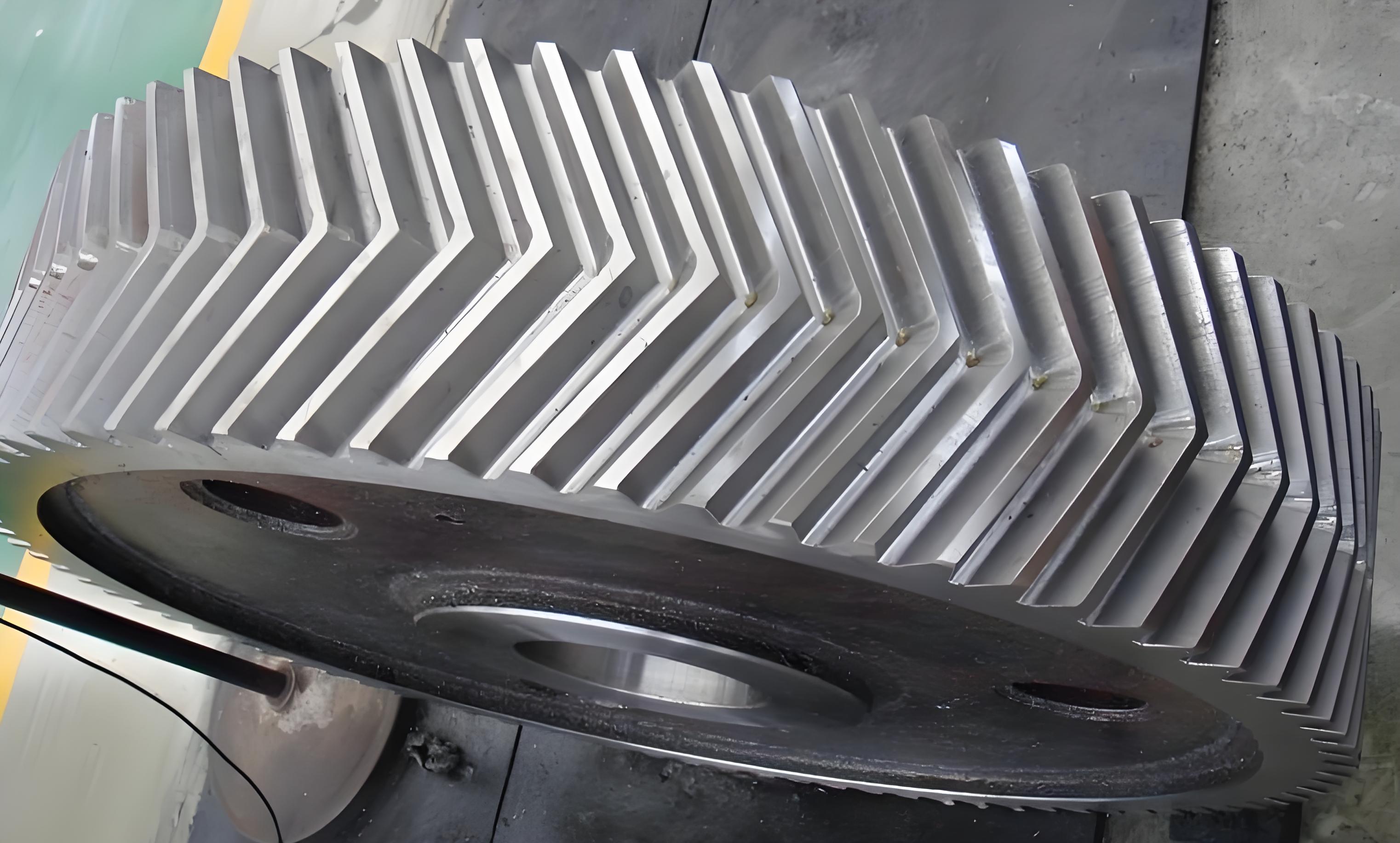
The core challenge in inspecting a herringbone gear stems from interpreting the drawing callout. Typically, the requirement is stated as a symmetry tolerance of the tooth flanks with respect to the central datum plane. According to geometric dimensioning and tolerancing standards (such as ISO 1101 or ASME Y14.5), the symmetry tolerance zone for a derived median plane (in this case, the plane defined by corresponding points on both flanks) is the area between two parallel planes spaced apart by the tolerance value t, centered on the datum plane. For a herringbone gear, this translates to a requirement that the physical mid-point between any corresponding pair of points on the left-hand and right-hand flanks must lie within this bounded zone.
My analysis involves a fundamental transformation of the problem from a vague “flank symmetry” to a precise, measurable parameter. Consider a point A on the left-hand flank of a specific tooth and its intended symmetric counterpart point B on the right-hand flank of the same tooth location. In an ideal herringbone gear, if we establish a coordinate system with the Z-axis normal to the central datum plane and the origin on the gear’s axis, point A at coordinates (X, Y, Z) should have its mirror at point B at (X, Y, -Z). The deviation from perfection manifests primarily as a circumferential misalignment—an angular offset—while the radial distance (from the gear axis) and the absolute axial height |Z| can be machined consistently. Therefore, the dominant factor contributing to symmetry error is the polar angle deviation (ξα) between these corresponding points. The midpoint C of line segment AB will consequently be offset from the central datum plane by a distance ΔTh. The total symmetry error f is defined as twice this offset: f = 2ΔTh.
The relationship between the measured polar angle deviation and the final symmetry error is governed by the helix angle β of the herringbone gear. The circumferential distance error ΔTs corresponding to the small angle ξα (in radians) at a measurement radius R is:
$$ \Delta T_s = R \cdot \xi_{\alpha} $$
This circumferential misalignment projects onto the axial direction (the direction of the symmetry tolerance zone) via the tangent of the helix angle. Thus, the axial offset of the midpoint and the total symmetry error are calculated as:
$$ \Delta T_h = \frac{\Delta T_s}{\tan \beta} $$
$$ f = 2\Delta T_h = \frac{2 \cdot \Delta T_s}{\tan \beta} = \frac{2 \cdot R \cdot \xi_{\alpha}}{\tan \beta} $$
This formula is the cornerstone of my measurement methodology. It allows me to convert a precise angular measurement from the CMM into the actionable symmetry error value specified on the herringbone gear drawing.
Selecting the appropriate equipment is critical. The complex, doubly curved surface of a gear flank necessitates a measurement system capable of probing from multiple directions. A Coordinate Measuring Machine equipped with a touch-trigger probe or a scanning probe is the ideal solution. The probe must be small enough to access the tooth space; a 1 mm diameter stylus is often suitable. The precision of a modern CMM, with volumetric length measurement uncertainties often within a few micrometers, comfortably satisfies the “Rule of 10” (measurement uncertainty ≤ 1/10 of tolerance) for typical herringbone gear symmetry tolerances ranging from 0.05 mm to 0.2 mm.
Establishing the measurement coordinate system is the next crucial step. A herringbone gear shaft is typically a rotational body without obvious planar datum features for radial alignment. My approach is to construct a polar coordinate system directly. I use the gear’s central datum plane (often defined by a specific shoulder or machined face) as the primary datum for leveling, aligning the Z-axis normal to it. I then establish the origin of the coordinate system on the theoretical axis of rotation by best-fitting measurements from the journal bearings or other cylindrical features. This creates a stable reference frame where points are defined by their radius R, polar angle α, and height Z.
The measurement process is a targeted, iterative probing routine:
- Point Selection: I select a representative tooth on the herringbone gear. The goal is to measure a corresponding point pair on the left-hand (LH) and right-hand (RH) flanks of this same tooth index.
- Coordinate Constraint: For a valid comparison, the two points must share identical radial and axial coordinates in the ideal mirrored sense. I fix the target polar radius R and the absolute axial height |Z|. The sign of Z will be positive for one flank and negative for the other.
- Iterative Probing: Using the CMM’s manual or programmable point-capturing routine, I probe a point on, for example, the LH flank. I note its actual R and Z coordinates. I then navigate to the RH flank and probe, aiming for the mirror coordinates (same R, -Z). The CMM software reports the actual achieved coordinates. I adjust the probe target position slightly and re-probe until the radial values match within a tight threshold (e.g., 0.001 mm) and the Z values are equal in magnitude and opposite in sign. This typically requires only 3-5 iterations per point.
- Data Capture: Once the points are successfully paired, I record the polar angle coordinate (αLH and αRH) for each. The polar angle deviation is ξα = |αLH – αRH|.
- Sampling Strategy: To ensure the measured symmetry is representative of the entire herringbone gear, I repeat this process for multiple teeth (e.g., 4 teeth spaced 90° apart) and at multiple height levels on each tooth (e.g., near the tip, pitch line, and root). The maximum calculated symmetry error f from all sample points is reported as the final result.
When measuring points on a curved surface with a spherical probe tip, cosine error must be considered. This error arises because the machine registers the center of the probe sphere, not the actual contact point on the surface. For a herringbone gear flank, the error magnitude depends on the local surface normal (related to the helix angle β and pressure angle) and the probe radius r. The potential difference in cosine error between the LH and RH flank points could falsely contribute to the measured angular deviation.
However, my analysis shows this effect is negligible for this application. Since both flanks of the herringbone gear are machined in relation to the same central datum, their nominal helix angles are virtually identical. Any minor discrepancy (Δβ) is typically within a few arc-minutes. The difference in cosine error δ between flanks can be approximated as:
$$ \Delta \delta \approx r \cdot |\cos(\beta_2) – \cos(\beta_1)| \approx r \cdot \sin(\beta) \cdot \Delta \beta $$
With a probe radius r = 0.5 mm, β ≈ 30°, and Δβ ≈ 0.01° (0.00017 rad), the error difference Δδ is on the order of 0.00004 mm. This is significantly smaller than the resolution and uncertainty of the overall measurement and can be safely disregarded.
The following table illustrates a sample calculation from a measurement on a typical herringbone gear:
| Parameter | Symbol | Value | Units |
|---|---|---|---|
| Measured Polar Angle Deviation | ξα | 0.002 | ° |
| Polar Angle Deviation (Radians) | ξα | 3.49E-05 | rad |
| Measurement Radius | R | 300.000 | mm |
| Circumferential Error | ΔTs = R · ξα | 0.0105 | mm |
| Helix Angle | β | 30.0 | ° |
| Tangent of Helix Angle | tan(β) | 0.5774 | – |
| Calculated Symmetry Error | f = 2ΔTs / tan(β) | 0.036 | mm |
A rigorous measurement is incomplete without an uncertainty budget. For a symmetry error measurement f of approximately 0.036 mm on a herringbone gear, I evaluate the main uncertainty contributors:
| Source of Uncertainty | Type | Estimate (μm) | Distribution | Divisor | Std. Uncertainty ui (μm) |
|---|---|---|---|---|---|
| CMM Probing Error (from calibration) | B | 1.3 | Rectangular | √3 | 0.75 |
| Measurement Repeatability (experimental std dev) | A | 1.6 | Normal | 1 | 1.60 |
| Workpiece Form Error (flank profile deviation) | B | 2.0 | Rectangular | √3 | 1.15 |
| Thermal Effects (controlled environment) | B | Negligible | – | – | 0.00 |
| Combined Standard Uncertainty uc | 2.1 μm | ||||
| Expanded Uncertainty (k=2) U | 4.2 μm (0.0042 mm) | ||||
The expanded uncertainty U = 0.0042 mm is well below one-tenth of a typical tolerance of 0.05 mm, confirming the high reliability and suitability of this CMM-based method for inspecting herringbone gear symmetry.
In conclusion, the symmetry of tooth flanks is a non-negotiable quality parameter for the reliable function of a herringbone gear. While in-process gauging methods exist, final validation requires high-precision, flexible measurement. The methodology I have developed transforms the geometric tolerance requirement into a direct measurement of polar angle deviation between meticulously aligned corresponding points on the opposing flanks. By leveraging the precision of a CMM and applying the derived relationship $$f = \frac{2 \cdot R \cdot \xi_{\alpha}}{\tan \beta}$$, this approach provides a quantitative, traceable, and highly accurate assessment of symmetry. My uncertainty analysis validates that the method is more than capable of verifying even the tightest tolerances specified for these critical components. This systematic approach not only solves a persistent metrological challenge but also provides a robust framework for quality assurance in the manufacturing of high-performance herringbone gears.