
In the realm of mechanical power transmission, gear mechanisms stand as the most critical and widely employed form of传动. Their primary advantages include the ability to maintain a constant transmission ratio, transmit substantial power, and offer high运动精度, transmission efficiency, reliability, longevity, and compact design. Based on the spatial relationship between the axes of meshing gears,传动 can be categorized into parallel-axis传动 (spur and helical gears), intersecting-axis传动 (bevel gears), and non-parallel, non-intersecting axis传动 (such as hypoid gears). From the perspective of tooth profile geometry, we have involute, cycloidal, and circular arc profiles. Considering factors like load capacity, manufacturability, and sensitivity to center distance errors, the involute profile possesses superior advantages over alternatives like cycloidal or circular arcs. Consequently, involute cylindrical gears are the most prevalent in engineering applications. Involute cylindrical gear传动 primarily encompass three types: spur gears, single helical gears, and the focus of this discussion, herringbone gears.
The formation of the involute tooth surface is fundamental. Mathematically, an involute curve is generated when a straight line rolls without slipping on the circumference of a base circle. Extending this principle to three dimensions, when a plane rolls without slipping on a base cylinder, the locus of any line within that plane traces an involute surface. If the generating line in the plane is parallel to the axis of the base cylinder, the resulting surface is that of a spur gear tooth. When this line is inclined at an angle β (the helix angle) relative to the base cylinder axis, it generates the tooth surface of a single helical gear. This helicoidal surface is key to understanding the evolution towards herringbone gear designs.
The pursuit of smoother and more continuous power transmission led to the development of helical gears and subsequently, the herringbone gear. Transmission continuity requires that before one pair of teeth disengages, the next pair must begin contact. The measure of this overlap is the contact ratio (ε). For theoretical continuity, ε=1 suffices, but practical manufacturing tolerances necessitate ε>1. A higher contact ratio enhances both smoothness and load-carrying capacity. Here, helical gears exhibit a distinct advantage over spur gears. The total contact ratio (ε_γ) for a helical gear is the sum of the transverse contact ratio (ε_α), akin to that of a spur gear, and the axial or face contact ratio (ε_β), unique to helical gears.
$$ \epsilon_{\gamma} = \epsilon_{\alpha} + \epsilon_{\beta} $$
$$ \epsilon_{\beta} = \frac{b \cdot \sin \beta}{\pi m_n} $$
In these formulas, b represents the face width, β is the helix angle, and m_n is the normal module. As Equation (2) shows, ε_β is always positive and increases with both face width and helix angle. While theoretically unbounded, practical constraints from manufacturing, structural integrity, and system dynamics limit these parameters. For single helical gears, helix angles typically range from 8° to 17°, and the face width must satisfy $ b \geq \frac{0.9 \pi m_n}{\sin \beta} $ to ensure sufficient overlap.
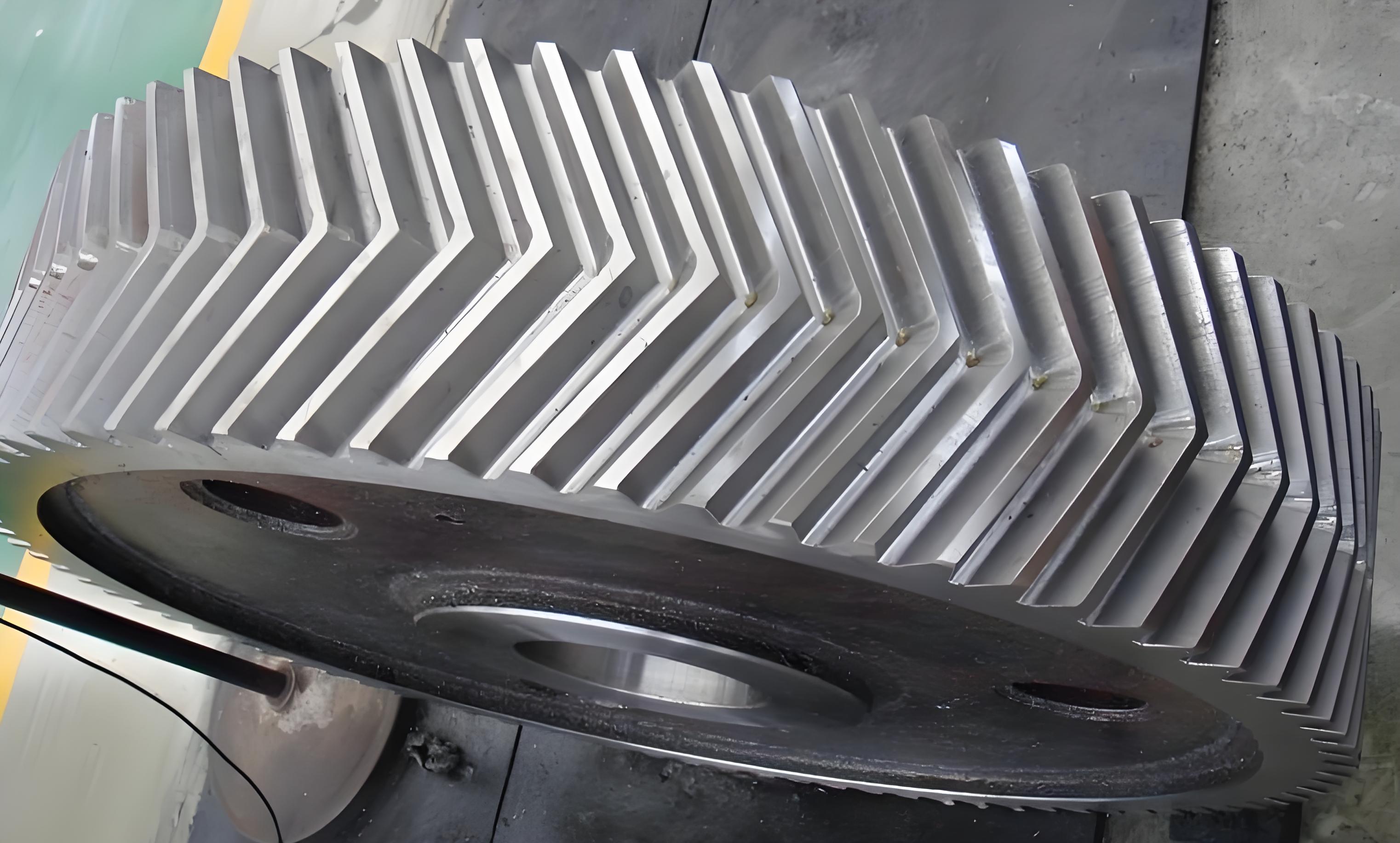
The herringbone gear was conceived to leverage the benefits of a high helix angle without its principal drawback: significant axial thrust. A herringbone gear is essentially a symmetrical assembly of two helical gear segments with equal but opposite helix angles. This ingenious configuration allows the axial forces generated by each segment to cancel each other out internally within the gear itself. Consequently, the helix angle in a herringbone gear assembly can be dramatically increased—typically to values between 25° and 40°—to achieve a much larger total contact ratio without imposing detrimental axial loads on bearings and shafts. This results in exceptionally smooth, quiet, and powerful传动 capable of handling very high loads. The primary trade-off is increased manufacturing complexity, especially when high precision is required.
The following table summarizes the key comparative aspects of spur, helical, and herringbone gears, highlighting the unique position of the herringbone gear.
| Gear Type | Typical Helix Angle (β) | Axial Force | Contact Ratio (ε_γ) | Transmission Smoothness & Noise | Manufacturing Complexity |
|---|---|---|---|---|---|
| Spur Gear | 0° | Negligible | ε_α only (Lower) | Moderate, can be noisy at high speed | Lowest |
| Single Helical Gear | 8° – 17° | Significant (requires thrust bearings) | ε_α + ε_β (Higher) | Good, quieter than spur | Moderate |
| Herringbone Gear | 25° – 40° | Self-cancelling (Net ~0) | ε_α + ε_β (Very High) | Excellent, very quiet | High |
The manufacturing of herringbone gears is inherently more complex than that of standard helical gears due to their symmetrical double-helix structure. A critical technical requirement, beyond standard gear accuracy grades, is the precise alignment of the “herringbone centerline.” This is the theoretical intersection point of the left and right-hand tooth flanks, which ideally must lie on the axial mid-plane of the gear’s mounting faces. Achieving this定位 is a central challenge in herringbone gear production. Methods vary significantly based on whether the gear is designed as a soft or hard齿面 component.
For soft齿面 herringbone gears (where the齿面 hardness of the mating pair is less than 350 HB), two primary machining methods are employed: form cutting and generation.
1. Form Cutting (Milling): This method utilizes CNC machining centers equipped with finger-type milling cutters that mimic the gear tooth space. While this approach can accurately control the herringbone centerline position, the final gear accuracy is heavily dependent on the cutter profile and machine rigidity. Typically, achieving a精度等级 better than DIN 8 is challenging. The process is also relatively slow, making it less suitable for high-volume production but有时 used for large模数 gears or prototypes.
2. Generating (Hobbing): This is the more common and efficient method for soft齿面 herringbone gears, performed on CNC hobbing machines. The process can be categorized further:
* With Dedicated Herringbone Software: Modern CNC hobbing machines often have specialized software cycles for machining herringbone gears. The operator inputs the correct installation height, and the machine automatically coordinates the hob’s axial and rotational movements for both helix directions, ensuring accurate herringbone centerline位置.
* Without Dedicated Software: For older or less equipped machines, the process requires manual intervention. Prior to hobbing, the workpiece is marked to indicate the target herringbone centerline. The operator then aligns the hob separately for the left and right helices based on these marks. This method heavily relies on the精度 of the marking and the operator’s skill, making the centerline position less reliably guaranteed. However, hobbing本身 generally yields higher齿部精度 (up to DIN 7级) and better productivity compared to form milling.
The table below provides a concise comparison of these common soft齿面 herringbone gear machining methods.
| Method | Primary Equipment | Typical Achievable Accuracy (DIN) | Herringbone Centerline Control | Process Efficiency | Key Limitations |
|---|---|---|---|---|---|
| Form Cutting (Milling) | CNC Machining Center with Finger Cutter | ~8级 | Generally Good | Low | Tool dependency, lower accuracy, slow. |
| Generating (Hobbing) – Dedicated Cycle | CNC Hobber with Herringbone Software | 6-7级 | Excellent (software-controlled) | High | Requires advanced machine capability. |
| Generating (Hobbing) – Manual Setup | CNC or Conventional Hobber | 7级 | Moderate (depends on marking/skill) | High | Prone to centerline alignment errors. |
For hard齿面 herringbone gears (typically case-hardened via carburizing or nitriding to表面 hardness around 60 HRC), the post-heat-treatment finishing process is crucial. Gears that undergo nitriding are usually finish-machined (hobbed) before heat treatment, using the methods described above. The hardening process then increases wear resistance without significantly distorting the already-cut teeth.
Carburized gears, however, require a different approach. The carburizing process creates a hard case but also induces distortion. Therefore, the final tooth geometry must be achieved after hardening, most commonly through grinding. Gear grinding machines, especially continuous generating grinders, can finish herringbone gear teeth to very high精度 (DIN 5级 or better). During the磨齿 process, slight adjustments to the tooth flank geometry and potentially the herringbone centerline are possible. However, these adjustments are limited by the amount of stock left from the pre-grind (soft) machining operation. Consequently, the ultimate精度 and centerline accuracy of a ground herringbone gear are fundamentally determined by the quality of the pre-heat-treatment machining. The capability to precision-grind large, high-helix-angle herringbone gears is a specialized and costly endeavor, possessed by only a limited number of manufacturers worldwide.
The advantages of using herringbone gears are substantial. The self-canceling axial force characteristic liberates the design from the thrust-bearing constraints associated with single helical gears. This allows the exploitation of very high helix angles, which in turn maximizes the contact ratio according to the formula $ \epsilon_{\beta} = \frac{b \cdot \sin \beta}{\pi m_n} $. A direct comparison illustrates the potential: for a given face width (b) and normal module (m_n), a herringbone gear with β=35° will have an ε_β more than double that of a single helical gear with β=17° (since sin(35°)/sin(17°) ≈ 2.0). This dramatic increase in contact ratio translates directly into superior performance.
We can formalize the relationship for design purposes. For a herringbone gear, the total contact ratio is exceptionally high:
$$ \epsilon_{\gamma\text{(herringbone)}} = \epsilon_{\alpha} + 2 \cdot \left( \frac{b/2 \cdot \sin \beta}{\pi m_n} \right) = \epsilon_{\alpha} + \frac{b \cdot \sin \beta}{\pi m_n} $$
Note that while the physical face width is b, each helix segment has an effective width of approximately b/2. The axial forces (F_a) for each segment are equal in magnitude but opposite in direction: $ F_{a,\text{left}} = -F_{a,\text{right}} \propto \tan \beta $. Therefore, the net axial thrust on the gear shaft is theoretically zero: $ \sum F_a = 0 $.
In conclusion, the herringbone gear represents a pinnacle in parallel轴齿轮传动 design, offering an unmatched combination of smooth operation, high load capacity, compactness, and quietness. Its unique ability to neutralize轴向力 through对称 helical design unlocks the performance benefits of extremely high contact ratios. While the manufacturing hurdles for high-precision herringbone gears are significant—involving precise control of the herringbone centerline and often requiring advanced grinding technology—the performance gains in critical applications like high-speed turbines, marine propulsion, and heavy-duty industrial gearboxes justify the effort. The ongoing advancement in multi-axis CNC machining, precision grinding, and metrology will continue to push the boundaries of what is achievable with herringbone gear technology, solidifying its role as a vital and evolving solution in the landscape of power transmission.