
As a technical team deeply embedded in gear manufacturing, I have witnessed the rapid evolution of the automotive industry, where the demand for high-performance transmission components has surged. Among these, straight bevel gears stand out as critical elements for power transfer between intersecting shafts, particularly in differential systems and steering mechanisms. The chamfering of straight bevel gears—a process of removing sharp edges from tooth ends—is essential to enhance fatigue resistance, reduce stress concentrations, and prevent premature failure. Traditionally, this was a manual or semi-automatic operation, plagued by inefficiencies and inconsistencies. To address these challenges, we designed a novel semi-automatic circulating chamfering machine that leverages chain-conveyor dynamics, achieving a tenfold increase in productivity for processing straight bevel gears. This article delves into the technical intricacies of our innovation, emphasizing the geometric principles, mechanical design, and operational parameters that make it effective. Throughout, I will highlight the significance of straight bevel gears, using formulas and tables to encapsulate key insights, while ensuring that the content is comprehensive and accessible from a first-person perspective.
The importance of chamfering straight bevel gears cannot be overstated. In automotive applications, these gears endure high loads and dynamic conditions; without proper chamfering, tooth ends act as stress risers, leading to cracks and eventual failure. Moreover, chamfering facilitates smoother assembly by easing meshing with mating gears. Our goal was to automate this process while ensuring precision and repeatability. The result is a machine that processes approximately 300 straight bevel gears per hour, compared to 30 with conventional methods. This breakthrough stems from integrating a rotating ring-rack tool with a synchronized workpiece transport system, all tailored for straight bevel gears. Let me walk you through the design and operation.
The chamfering process hinges on the geometric interaction between the tool and the gear tooth. In our setup, the tool’s outer circle intersects the gear’s root circle at a specific point. The distance from this point to the large end of the straight bevel gear equals the chamfer height, denoted as \( h \). The chamfer angle at the tooth base, \( \beta \), is determined by the tool’s installation angle, \( \gamma \). This relationship is fundamental for consistent chamfer dimensions. From trigonometric analysis, we derive the following formula linking these parameters for straight bevel gears:
$$ h = R_t \left(1 – \cos\left(\frac{\pi}{2} – \gamma\right)\right) $$
where \( R_t \) is the tool radius. Alternatively, the chamfer angle \( \beta \) can be expressed as:
$$ \beta = \gamma + \arctan\left(\frac{h}{L}\right) $$
with \( L \) being the distance from the intersection point to the gear axis. For practical purposes, we have tabulated typical values based on gear module and tool specifications:
| Gear Module (mm) | Chamfer Height \( h \) (mm) | Tool Installation Angle \( \gamma \) (degrees) | Resulting Chamfer Angle \( \beta \) (degrees) | Applicable to Straight Bevel Gears |
|---|---|---|---|---|
| 2.0 | 0.5 | 15 | 20 | Yes, for light-duty automotive |
| 3.0 | 0.8 | 18 | 23 | Yes, for medium-duty applications |
| 4.0 | 1.0 | 20 | 25 | Yes, for heavy-duty transmissions |
| 5.0 | 1.2 | 22 | 27 | Yes, for industrial straight bevel gears |
This table summarizes critical parameters for chamfering straight bevel gears, derived from empirical testing. Note that these values assume standard pressure angles (e.g., 20°) and gear materials like case-hardened steel. Adjustments may be needed for custom straight bevel gears.
The tool itself is a ring-rack configuration, designed for continuous engagement with the teeth of straight bevel gears. Crafted from high-speed steel or carbide, its diameter is selected based on gear size and desired chamfer profile. The tool rotates at speeds between 500 to 1000 rpm, optimizing material removal without excessive heat generation. The selection criteria for tool diameter \( D_t \) relate to the gear’s pitch diameter \( D_p \) through:
$$ D_t = k \cdot D_p $$
where \( k \) ranges from 0.8 to 1.2 for straight bevel gears, ensuring adequate coverage. To visualize this arrangement, consider the following image, which depicts a typical straight bevel gear in a chamfering context.
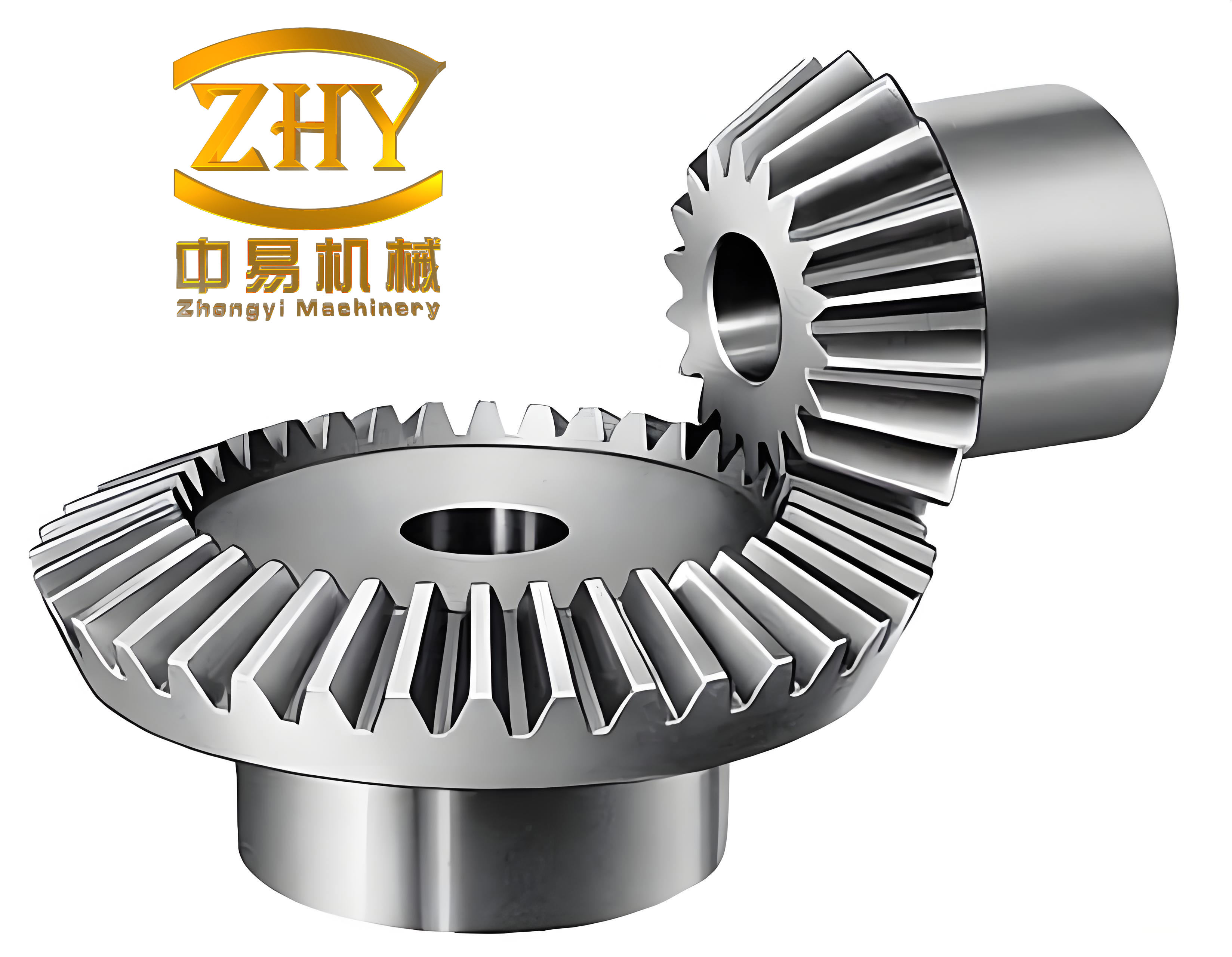
This representation aids in understanding the spatial relationship between the tool and the straight bevel gear. Our machine employs a dedicated fixture to hold the gear securely, guaranteeing accuracy across all teeth during chamfering. The fixture includes a mandrel and spherical washer, which accommodate minor misalignments common in straight bevel gears.
The machine’s transmission system is bifurcated into two independent subsystems: workpiece conveyance and tool rotation. This dual-system approach enables synchronized operation, where straight bevel gears are fed continuously while the tool actively chamfers them. The workpiece conveyance is driven by an electric motor (Motor A) through a reducer, powering sprockets that move a chain. Special long chain pins attach sliders to the chain, and these sliders carry mandrels holding the straight bevel gears. As the chain progresses, gears traverse a guide rail into the machining zone. Key parameters for this subsystem are:
| Parameter | Symbol | Value | Remarks for Straight Bevel Gears |
|---|---|---|---|
| Motor Speed | \( N_{m1} \) | 1440 rpm | Standard induction motor |
| Reducer Ratio | \( i_r \) | 20:1 | Worm gear reducer |
| Sprocket Teeth | \( Z_s \) | 20 | Chain pitch of 12.7 mm |
| Sprocket Speed | \( N_s \) | 72 rpm | Calculated as \( N_{m1} / i_r \) |
| Conveyance Speed | \( v_c \) | 0.3 m/s | Adaptable for straight bevel gear sizes |
The speed ratio for conveyance is computed as:
$$ i_c = \frac{N_{m1}}{N_s} = \frac{1440}{72} = 20 $$
This ratio ensures the chain moves at a controlled pace, allowing sufficient dwell time for chamfering each straight bevel gear. In practice, we adjust the motor speed via a variable frequency drive to fine-tune \( v_c \) based on gear dimensions. The conveyance time \( T_c \) per gear is:
$$ T_c = \frac{L_c}{v_c} $$
where \( L_c \) is the center distance between mandrels, typically set at 150 mm for standard straight bevel gears. For our machine, \( T_c \approx 0.5 \) seconds, aligning with the chamfering cycle.
For the tool rotation system, a separate electric motor (Motor B) drives the tool through a series of pulleys and chains. The tool spindle is mounted on a vertical slide attached to a column, which can be adjusted horizontally to align the tool center with the gear center. This adjustability is vital for accommodating straight bevel gears of varying dimensions. The tool rotation parameters are:
| Parameter | Symbol | Value | Remarks for Straight Bevel Gears |
|---|---|---|---|
| Motor Speed | \( N_{m2} \) | 1440 rpm | Identical to Motor A for simplicity |
| Pulley Ratio | \( i_p \) | 1:2 | Step-down for torque |
| Chain Ratio | \( i_{ch} \) | 1:1.5 | Further speed reduction |
| Tool Speed | \( N_t \) | 480 rpm | Calculated as \( N_{m2} \times i_p \times i_{ch} \) |
The tool speed derives from the combined ratios:
$$ N_t = N_{m2} \times i_p \times i_{ch} = 1440 \times \frac{1}{2} \times \frac{1}{1.5} = 480 \text{ rpm} $$
However, for different tool diameters, we select speeds in the 500-1000 rpm range to maintain optimal cutting conditions. The relationship between tool diameter \( D_t \) and cutting speed \( v_t \) is:
$$ v_t = \pi D_t N_t $$
For straight bevel gears, we target a cutting speed of 50-100 m/min, depending on material (e.g., steel or alloy). Thus, the tool speed can be adjusted as:
$$ N_t = \frac{v_t}{\pi D_t} $$
This formula allows customization for various straight bevel gear applications. For instance, with \( D_t = 100 \) mm and \( v_t = 60 \) m/min, \( N_t \approx 191 \) rpm, but we often increase it for efficiency.
Beyond the mechanical systems, our machine incorporates a hydraulic clamping mechanism to secure straight bevel gears during chamfering. This system uses a pump to deliver oil from a tank through a pressure relief valve to two swing cylinders. A manual directional valve controls clamping and unclamping. When the valve shifts right, high-pressure oil enters the left chambers, causing jaws to clamp the gear; shifting left releases it. This ensures firm holding without damaging tooth profiles, crucial for precision components like straight bevel gears. The hydraulic pressure \( P \) is set at 5 MPa, providing a clamping force \( F_c \) calculated as:
$$ F_c = P \times A \times n $$
where \( A \) is the cylinder area and \( n \) is the number of cylinders. For our design, \( F_c \approx 5000 \) N, sufficient for most straight bevel gears.
To optimize the chamfering process for straight bevel gears, we developed empirical formulas. For example, the chamfer depth \( d \) relative to tooth thickness \( s \) is:
$$ d = k \cdot s $$
where \( k \) is a coefficient ranging from 0.1 to 0.2, based on gear application (e.g., 0.15 for automotive straight bevel gears). Additionally, the feed rate per tooth \( f_t \) is critical for surface finish:
$$ f_t = \frac{v_c}{Z_g N_t} $$
where \( Z_g \) is the number of teeth on the straight bevel gear. This ensures uniform chamfering across all teeth. For a gear with \( Z_g = 20 \), \( v_c = 0.3 \) m/s, and \( N_t = 480 \) rpm, \( f_t \approx 0.0019 \) mm/tooth, yielding a smooth finish.
Production efficiency is paramount. Our machine processes straight bevel gears in a continuous loop: loading, machining, and unloading. Gears are loaded onto mandrels at the entry point, conveyed through the machining zone where the rotating tool chamfers tooth ends, and removed at the exit. This cycle repeats automatically, minimizing manual intervention. The throughput of 300 gears per hour implies a cycle time \( T_{cycle} \) of:
$$ T_{cycle} = \frac{3600 \text{ s/hour}}{300} = 12 \text{ s/gear} $$
This includes conveyance, chamfering, and idle times. Comparatively, manual methods might take 120 seconds per straight bevel gear, highlighting our tenfold improvement.
Quality control is integral. We inspect chamfer dimensions using coordinate measuring machines (CMM) and optical comparators. For straight bevel gears, we measure chamfer height and angle at multiple points, ensuring consistency. Statistical process control (SPC) charts monitor variations. Our data indicates tolerances of ±0.05 mm for height and ±1° for angle, meeting automotive standards. The process capability index \( C_p \) for chamfer height on straight bevel gears exceeds 1.33, denoting high reliability.
The adoption of precision forging for straight bevel gears synergizes with our chamfering process. Forged gears exhibit better material integrity and closer net shapes, reducing chamfering material removal. This allows faster processing and higher quality. We conducted trials comparing forged versus cut straight bevel gears; forged versions show improved chamfer consistency due to homogeneous grain flow. The material savings \( \Delta m \) per gear can be estimated as:
$$ \Delta m = \rho \cdot V_r $$
where \( \rho \) is material density and \( V_r \) is the reduced volume from forging. For steel straight bevel gears, \( \Delta m \approx 10\% \), lowering costs.
Looking ahead, we explore automation enhancements like robotic loading/unloading and Industry 4.0 integration for real-time monitoring. The vision is a fully automated line for straight bevel gear production, from forging to chamfering to inspection. This will further reduce costs and boost reliability. Potential upgrades include adaptive control systems that adjust tool paths based on gear geometry, using sensors to detect variations in straight bevel gears.
In summary, our semi-automatic circulating chamfering machine represents a leap forward in processing straight bevel gears. By leveraging chain conveyance, precise tooling, and synchronized drives, we achieve high efficiency and consistency. The formulas and tables herein guide implementation. As demand for straight bevel gears grows in automotive and industrial sectors, such innovations will be pivotal. I am proud of our contribution and anticipate ongoing advancements in straight bevel gear technology, driven by relentless optimization and a deep understanding of gear mechanics.
Throughout this article, I have emphasized the centrality of straight bevel gears, from geometric principles to mechanical design. Every aspect is tailored to optimize their performance. I encourage fellow engineers to build upon this work, exploring new materials, tool coatings, and control algorithms for straight bevel gears. The journey toward perfecting chamfering continues, and with each iteration, we enhance the durability and efficiency of these indispensable components. The future of straight bevel gear manufacturing is bright, and I am excited to be part of it.