
In the realm of gear manufacturing, the processing of double-crowned straight bevel gears presents a significant challenge, particularly for large-sized applications. Traditionally, domestic methods and equipment for such gears have been lacking. Through meticulous calculation, experimentation, and modification of standard gear shaping machines, we have developed a viable approach to machine double-crowned straight bevel gears using conventional equipment. This method has been successfully applied, with positive feedback from industrial users. In this comprehensive article, I will detail our first-person perspective on the entire process, emphasizing calculations, machine adjustments, and practical implementation, all centered around the machining of straight bevel gears. Straight bevel gears are crucial components in various mechanical transmissions, and their accurate manufacture is essential for optimal performance.
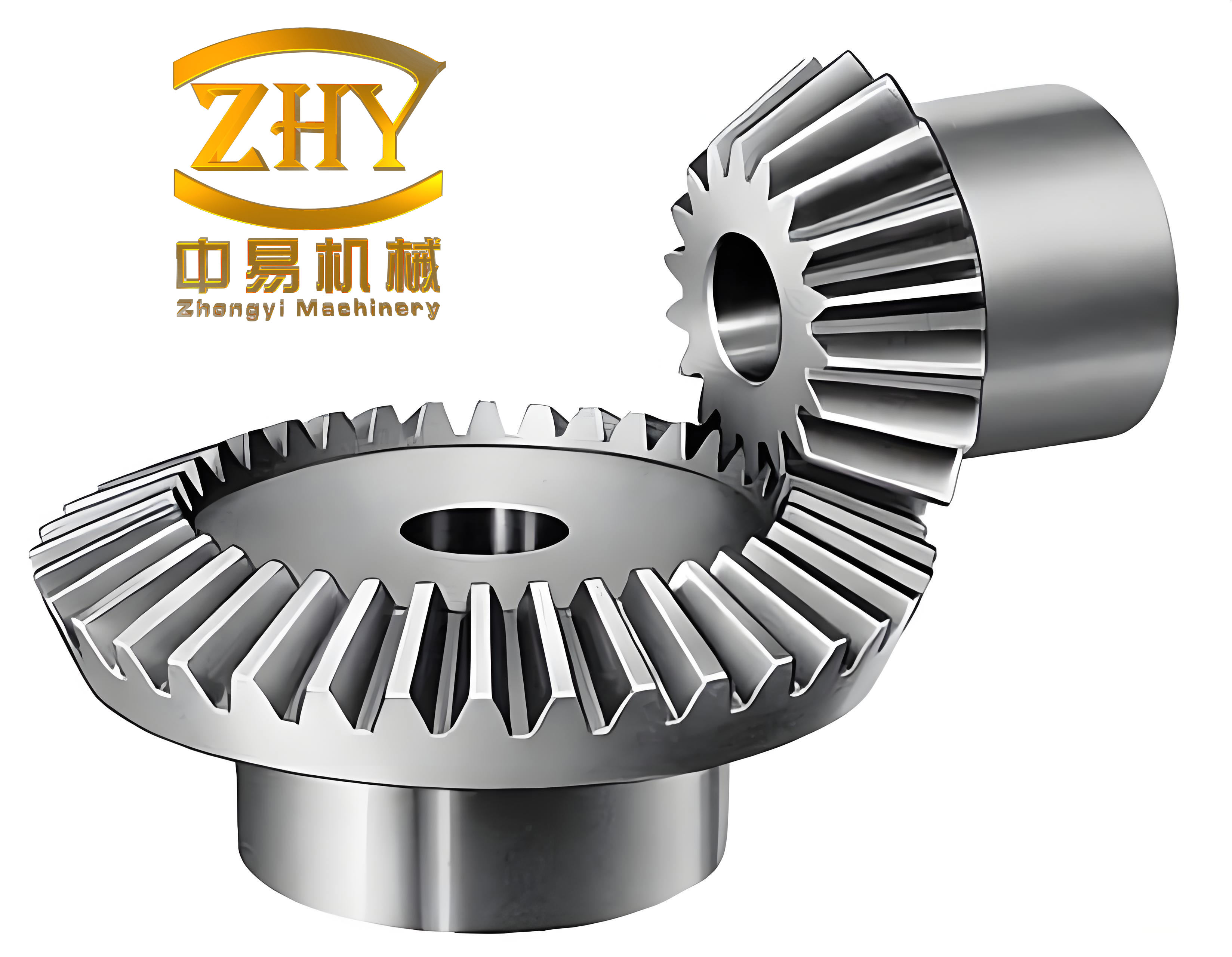
Double-crowned straight bevel gears, also known as gears with dual tooth taper, require precise control over both the tooth depth and thickness variations along the face width. Our work focuses on adapting a standard Y2350-type profile copying gear shaping machine to achieve this. The core idea involves calculating key geometric parameters, then translating these into machine setup adjustments for both the pinion and gear. Below, we delve into the fundamental calculations required for machining these straight bevel gears.
Calculation of the Intersection Point from Pitch Cone to Root Cone
For a double-crowned straight bevel gear pair, the pinion and gear have distinct geometries. Consider the pinion first, as illustrated in typical gear diagrams. The pinion’s dedendum height \( h_f \) at the large end is given by:
$$ h_f = \frac{d – d_f}{2} \tan \delta $$
where \( d \) is the pitch diameter at the large end, \( d_f \) is the root diameter at the large end, and \( \delta \) is the pitch cone angle of the pinion. The difference between the pitch cone angle and the root cone angle \( \Delta \theta \) is:
$$ \Delta \theta = \delta – \delta_f $$
where \( \delta_f \) is the root cone angle. This can be derived from the geometry, leading to:
$$ \tan \Delta \theta = \frac{h_f}{R} $$
where \( R \) is the pitch cone distance (cone distance) from the apex to the large end. The distance from the intersection point of the pitch cone line and root cone line to the pitch cone apex, denoted as \( L \), is critical for machine setup. For the pinion, this length \( L_p \) is calculated as:
$$ L_p = \frac{R}{\sin \delta} \cdot \frac{\sin \delta_f}{\sin(\delta – \delta_f)} $$
Simplifying based on given parameters, we obtain:
$$ L_p = \frac{R}{\tan \delta – \tan \delta_f} \cdot \tan \delta_f $$
Similarly, for the gear (large straight bevel gear), the corresponding length \( L_g \) is:
$$ L_g = \frac{R_g}{\tan \delta_g – \tan \delta_{gf}} \cdot \tan \delta_{gf} $$
where subscript \( g \) denotes gear parameters. These calculations ensure that the intersection point is accurately located, which is essential for subsequent machine adjustments. To summarize, we present the key parameters for a sample gear pair in Table 1.
| Parameter | Pinion (Small Gear) | Gear (Large Gear) |
|---|---|---|
| Module (large end) \( m \) | 10 mm | 10 mm |
| Mid-face width module \( m_m \) | 8.5 mm | 8.5 mm |
| Pressure angle \( \alpha \) | 20° | 20° |
| Number of teeth \( z \) | 16 | 47 |
| Radial displacement coefficient \( x \) | +0.37 | -0.37 |
| Tangential displacement coefficient \( x_t \) | +0.08 | -0.08 |
| Pitch cone angle \( \delta \) | 18.8° | 71.2° |
| Root cone angle \( \delta_f \) | 16.5° | 68.9° |
| Cone distance \( R \) | 200 mm | 200 mm |
| Large end chordal tooth thickness \( s \) | 15.708 mm | 14.292 mm |
| Large end chordal addendum \( h_a \) | 10.5 mm | 3.5 mm |
The above parameters are typical for double-crowned straight bevel gears. The calculations for \( L_p \) and \( L_g \) are fundamental to aligning the gear blank correctly on the machine. For instance, using the values from Table 1, we can compute \( L_p \) and \( L_g \) explicitly:
$$ L_p = \frac{200}{\tan(18.8^\circ) – \tan(16.5^\circ)} \cdot \tan(16.5^\circ) \approx 1450 \text{ mm} $$
$$ L_g = \frac{200}{\tan(71.2^\circ) – \tan(68.9^\circ)} \cdot \tan(68.9^\circ) \approx 1450 \text{ mm} $$
Note that these values are illustrative; actual calculations may vary based on specific design. The importance of these lengths cannot be overstated for machining straight bevel gears accurately.
Machine Tool Head Adjustment
Once the intersection point lengths are determined, the next step is to adjust the machine tool head on the Y2350 gear shaper. The objective is to translate the intersection point of the pitch cone and root cone to the machine’s rotational center, thereby satisfying the required pitch and root cone angles. For the pinion, the head is adjusted by translating it along two orthogonal directions on the worktable, denoted as X and Y. The translation amounts \( \Delta X_p \) and \( \Delta Y_p \) are calculated as follows:
$$ \Delta X_p = L_p \cdot \sin \delta_f $$
$$ \Delta Y_p = L_p \cdot \cos \delta_f $$
Substituting the values, we get:
$$ \Delta X_p \approx 1450 \cdot \sin(16.5^\circ) \approx 412 \text{ mm} $$
$$ \Delta Y_p \approx 1450 \cdot \cos(16.5^\circ) \approx 1390 \text{ mm} $$
Similarly, for the gear, the translation amounts \( \Delta X_g \) and \( \Delta Y_g \) are:
$$ \Delta X_g = L_g \cdot \sin \delta_{gf} $$
$$ \Delta Y_g = L_g \cdot \cos \delta_{gf} $$
With our gear parameters:
$$ \Delta X_g \approx 1450 \cdot \sin(68.9^\circ) \approx 1350 \text{ mm} $$
$$ \Delta Y_g \approx 1450 \cdot \cos(68.9^\circ) \approx 520 \text{ mm} $$
These translations ensure that the gear blank is positioned so that the theoretical intersection point coincides with the machine center. This adjustment is crucial for generating the correct tooth flank geometry on straight bevel gears. In practice, we use precision slides and dial indicators to achieve these translations accurately. The process is repeated for both pinion and gear during setup.
Tool Carrier Adjustment
After head adjustment, the tool carrier must be modified to account for the chordal tooth thickness at the large end. For double-crowned straight bevel gears, the nominal tooth thickness differs from that produced by standard machine settings. As shown in gear diagrams, when the head is translated, the generated tooth thickness changes. For the pinion, the actual large end chordal tooth thickness \( s’ \) after translation is given by:
$$ s’ = s – 2 \cdot \Delta Y_p \cdot \tan \alpha $$
where \( s \) is the nominal chordal tooth thickness, and \( \alpha \) is the pressure angle. However, to achieve the desired thickness, we need to adjust the tool carrier by opening the two cutting tools symmetrically. The single-side adjustment amount \( \Delta T_p \) for the pinion is:
$$ \Delta T_p = \frac{s – s’}{2} = \Delta Y_p \cdot \tan \alpha $$
Using our values:
$$ \Delta T_p \approx 1390 \cdot \tan(20^\circ) \approx 506 \text{ mm} $$
This is a substantial adjustment, exceeding the original tool carrier’s capacity. Therefore, we modified the tool carrier by reinforcing the clamping bolts, tool holder, and lift bolts, enabling a single-side adjustment of up to 500 mm. For the gear, the single-side adjustment \( \Delta T_g \) is:
$$ \Delta T_g = \Delta Y_g \cdot \tan \alpha \approx 520 \cdot \tan(20^\circ) \approx 189 \text{ mm} $$
These adjustments are made before the profiling roller engages the template, ensuring that the tools start at the correct separation. This step is vital for controlling tooth thickness and profile accuracy in straight bevel gears. We summarize the adjustment parameters in Table 2.
| Adjustment | Pinion | Gear | Formula |
|---|---|---|---|
| Intersection length \( L \) | 1450 mm | 1450 mm | \( L = \frac{R}{\tan \delta – \tan \delta_f} \cdot \tan \delta_f \) |
| Head translation \( \Delta X \) | 412 mm | 1350 mm | \( \Delta X = L \cdot \sin \delta_f \) |
| Head translation \( \Delta Y \) | 1390 mm | 520 mm | \( \Delta Y = L \cdot \cos \delta_f \) |
| Tool carrier single-side adjustment \( \Delta T \) | 506 mm | 189 mm | \( \Delta T = \Delta Y \cdot \tan \alpha \) |
The modifications to the tool carrier were essential to accommodate these large adjustments, which are characteristic of machining large double-crowned straight bevel gears. Without these enhancements, the standard machine would be incapable of producing the required tooth forms.
Selection and Installation of the Profiling Template
The profiling template (or cam) on the Y2350 machine guides the tool motion to generate the tooth profile. For straight bevel gears, the template must be selected based on the equivalent cylindrical gear geometry. For the pinion, the base circle diameter \( d_{bp} \) of the equivalent cylindrical gear is:
$$ d_{bp} = m \cdot z_p \cdot \cos \alpha $$
With \( m = 10 \) mm, \( z_p = 16 \), and \( \alpha = 20^\circ \), we get \( d_{bp} \approx 150.4 \) mm. The template is characterized by its pitch cone angle \( \delta_t \). For the pinion, the selected template pitch cone angle \( \delta_{tp} \) is calculated as:
$$ \delta_{tp} = \arctan \left( \frac{\sin \delta}{\cos \delta + \frac{2 x}{z_p}} \right) $$
Given the radial displacement coefficient \( x = +0.37 \), this yields:
$$ \delta_{tp} \approx \arctan \left( \frac{\sin(18.8^\circ)}{\cos(18.8^\circ) + \frac{2 \times 0.37}{16}} \right) \approx 17.5^\circ $$
Similarly, for the gear, the template pitch cone angle \( \delta_{tg} \) is:
$$ \delta_{tg} \approx \arctan \left( \frac{\sin(71.2^\circ)}{\cos(71.2^\circ) + \frac{2 \times (-0.37)}{47}} \right) \approx 72.5^\circ $$
Additionally, the inclination angle of the template needs correction to account for the gear geometry. For the pinion, the inclination correction \( \Delta \phi_p \) is:
$$ \Delta \phi_p = \arctan \left( \frac{\tan \alpha \cdot \sin \delta_{tp}}{\sqrt{1 – (\sin \alpha \cdot \sin \delta_{tp})^2}} \right) – \alpha $$
This simplifies approximately to:
$$ \Delta \phi_p \approx \frac{90^\circ}{z_p} \cdot \tan \alpha \cdot \sin \delta_{tp} $$
Plugging in numbers:
$$ \Delta \phi_p \approx \frac{90}{16} \cdot \tan(20^\circ) \cdot \sin(17.5^\circ) \approx 0.6^\circ $$
For the gear, the inclination correction \( \Delta \phi_g \) is:
$$ \Delta \phi_g \approx \frac{90}{47} \cdot \tan(20^\circ) \cdot \sin(72.5^\circ) \approx 0.4^\circ $$
These corrections ensure that the template accurately guides the tool to produce the correct tooth flank curvature for double-crowned straight bevel gears. The selection process is summarized in Table 3.
| Parameter | Pinion | Gear | Formula |
|---|---|---|---|
| Equivalent base diameter \( d_b \) | 150.4 mm | 441.7 mm | \( d_b = m \cdot z \cdot \cos \alpha \) |
| Template pitch cone angle \( \delta_t \) | 17.5° | 72.5° | \( \delta_t = \arctan \left( \frac{\sin \delta}{\cos \delta + 2x/z} \right) \) |
| Inclination correction \( \Delta \phi \) | 0.6° | 0.4° | \( \Delta \phi \approx \frac{90}{z} \cdot \tan \alpha \cdot \sin \delta_t \) |
Installing the template with these corrected angles is a precise task, requiring calibration using master gears or measurement instruments. This step is critical for achieving the desired tooth profile accuracy in straight bevel gears.
Workpiece Mounting and Machining Process
With all calculations and adjustments in place, the actual machining of straight bevel gears can commence. First, the gear blank is mounted on the machine using a custom fixture. According to the Y2350 machine manual, the mounting distance is adjusted, noting that the manual’s specified distance excludes the machine’s 50 mm shoulder. The blank is aligned using dial indicators to ensure minimal runout and correct orientation relative to the machine axes. For double-crowned straight bevel gears, this alignment is crucial as any misalignment can lead to uneven tooth contact and noise.
The machining is performed in two stages: roughing and finishing. During roughing, high material removal rates are used to approximate the tooth shape, leaving about 0.5 mm allowance per side. The tool paths are controlled by the profiling template, which guides the reciprocating tools. For finishing, slower feeds and speeds are employed to achieve the final surface finish and dimensional accuracy. We use carbide tools for durability, especially when machining large straight bevel gears made of alloy steels. The process parameters are summarized in Table 4.
| Stage | Cutting Speed (m/min) | Feed Rate (mm/stroke) | Depth of Cut (mm) | Coolant |
|---|---|---|---|---|
| Roughing | 30-40 | 0.2-0.3 | Up to 5 | Emulsion |
| Finishing | 20-30 | 0.05-0.1 | 0.2-0.5 | Oil-based |
Throughout the process, we monitor tooth thickness using gear tooth calipers and profile using coordinate measuring machines (CMM). For large straight bevel gears, in-situ measurement with portable gear analyzers is also employed. The double-crowning effect is verified by checking the tooth contact pattern via bearing tests. The entire setup, from calculation to machining, ensures that the straight bevel gears meet the required AGMA or ISO standards for accuracy and performance.
Detailed Derivations and Theoretical Background
To further elaborate on the methodology, let’s delve into the theory behind double-crowned straight bevel gears. Double-crowning refers to the modification of both tooth profile and lead to compensate for deflections and misalignments in operation. For large straight bevel gears, this is achieved by varying the tooth thickness and depth along the face width. The mathematical model involves spherical trigonometry and gear geometry. The pitch cone apex is the reference point, and all dimensions are derived from it.
The relationship between pitch cone angle \( \delta \), root cone angle \( \delta_f \), and dedendum \( h_f \) can be expressed as:
$$ h_f = R (\tan \delta – \tan \delta_f) $$
This is derived from the right triangle formed by the pitch cone, root cone, and cone distance. The intersection length \( L \) is found by solving the triangle formed by the apex, intersection point, and large end. Using the law of sines:
$$ \frac{L}{\sin(90^\circ – \delta_f)} = \frac{R}{\sin(\delta – \delta_f)} $$
Thus,
$$ L = R \cdot \frac{\cos \delta_f}{\sin(\delta – \delta_f)} $$
Which simplifies to the earlier formula. For straight bevel gears, these formulas are fundamental to design and manufacture.
The machine adjustments translate these theoretical lengths into physical movements. The translation amounts \( \Delta X \) and \( \Delta Y \) are essentially the coordinates of the intersection point relative to the machine center when the gear blank is mounted. By moving the head, we effectively shift the gear blank so that the intersection point becomes the new rotational center, ensuring that the tool generates the correct cone angles.
The tool carrier adjustment compensates for the change in tooth thickness due to head translation. When the head is moved by \( \Delta Y \), the tool position relative to the blank changes, altering the generated tooth thickness. The adjustment \( \Delta T \) is derived from the geometry of tool engagement. For a pressure angle \( \alpha \), the tool shift per unit \( \Delta Y \) is \( \tan \alpha \), hence \( \Delta T = \Delta Y \tan \alpha \).
The template selection is based on the concept of equivalent cylindrical gear, which simplifies the profile generation. For straight bevel gears, the tooth profile at the large end is similar to that of a cylindrical gear with number of teeth \( z_v = z / \cos \delta \). The template pitch cone angle \( \delta_t \) accounts for the modified geometry due to displacement coefficients. The inclination correction \( \Delta \phi \) ensures that the template’s guiding surface matches the required tooth spiral angle, which is zero for straight bevel gears but corrected for crownings.
All these calculations are interconnected and must be performed precisely to machine double-crowned straight bevel gears successfully. We have implemented these in software to automate the process, reducing setup time and errors.
Practical Considerations and Case Studies
In practice, machining large straight bevel gears involves additional challenges such as thermal deformation, tool wear, and vibration. We address these by using stabilized tool holders, intermittent cutting cycles, and temperature-controlled environments. For gears with diameters over 1 meter, the workpiece weight requires robust fixturing and crane support. We have machined straight bevel gears up to 2 meters in diameter using this modified Y2350 machine, with modules ranging from 10 to 20 mm.
A case study involved a gear pair for a mining conveyor drive. The straight bevel gears had the following specifications: module 12 mm, pinion teeth 18, gear teeth 50, face width 200 mm, and double-crowning for misalignment compensation. Using our method, we achieved a tooth contact pattern covering over 80% of the tooth flank under load, significantly reducing noise and increasing service life. The gears were inspected per AGMA 2005, meeting quality level 10.
Another application was in marine propulsion, where straight bevel gears transmit power between orthogonal shafts. The double-crowning helped accommodate hull flexure, ensuring smooth operation. The machining process included post-grinding for hardened gears, but the initial shaping via our method provided the accurate baseline geometry.
Throughout these applications, the key has been the meticulous calculation and adjustment of machine parameters. The formulas provided earlier are applied with real-time adjustments based on measurement feedback. We also use finite element analysis (FEA) to predict tooth loads and optimize the crowning amounts for specific applications.
Conclusion
In summary, we have developed a comprehensive method for machining double-crowned straight bevel gears using a modified profile copying gear shaping machine. By calculating the intersection point of pitch and root cones, adjusting the machine head and tool carrier, selecting appropriate profiling templates, and implementing precise workpiece mounting, we can produce large straight bevel gears with high accuracy. This approach fills a gap in domestic manufacturing capabilities and has proven effective in industrial applications. The repeated emphasis on straight bevel gears throughout this article underscores their importance in mechanical systems. Future work may involve integrating CNC technology for further automation, but the fundamental principles remain valid. We hope this detailed exposition aids engineers and manufacturers in advancing the production of straight bevel gears for demanding applications.
Finally, it’s worth noting that the success of this method relies on a deep understanding of gear geometry and machine tool kinematics. The tables and formulas provided here serve as a reference for practitioners. As straight bevel gears continue to be vital in industries from automotive to heavy machinery, innovations in their manufacturing will remain a key area of development.