
In my extensive work on gear mechanics, I have focused particularly on straight bevel gears, which are crucial components in transmitting motion between intersecting shafts. The unique geometry of straight bevel gears, based on spherical involute principles, presents both challenges and opportunities in design and measurement. This article delves into the fundamental theories, computational methods, and measurement techniques associated with straight bevel gears, aiming to provide a comprehensive resource for engineers and researchers. Throughout this discussion, the term straight bevel gears will be emphasized repeatedly to underscore its centrality in power transmission systems.
The geometry of straight bevel gears is inherently three-dimensional, revolving around the concept of spherical involutes. Unlike cylindrical gears, where involute profiles are generated on a plane, straight bevel gears derive their tooth forms from a spherical surface. This arises because the gear teeth are formed on a conical surface, and the proper meshing action must be analyzed in a spherical coordinate system. In my analysis, I consider a generating plane rolling without slip on a base cone, where any line through the cone’s apex traces out the tooth flank. This process yields a spherical involute curve, which defines the ideal tooth profile for straight bevel gears. Understanding this foundation is essential for accurate design and measurement.
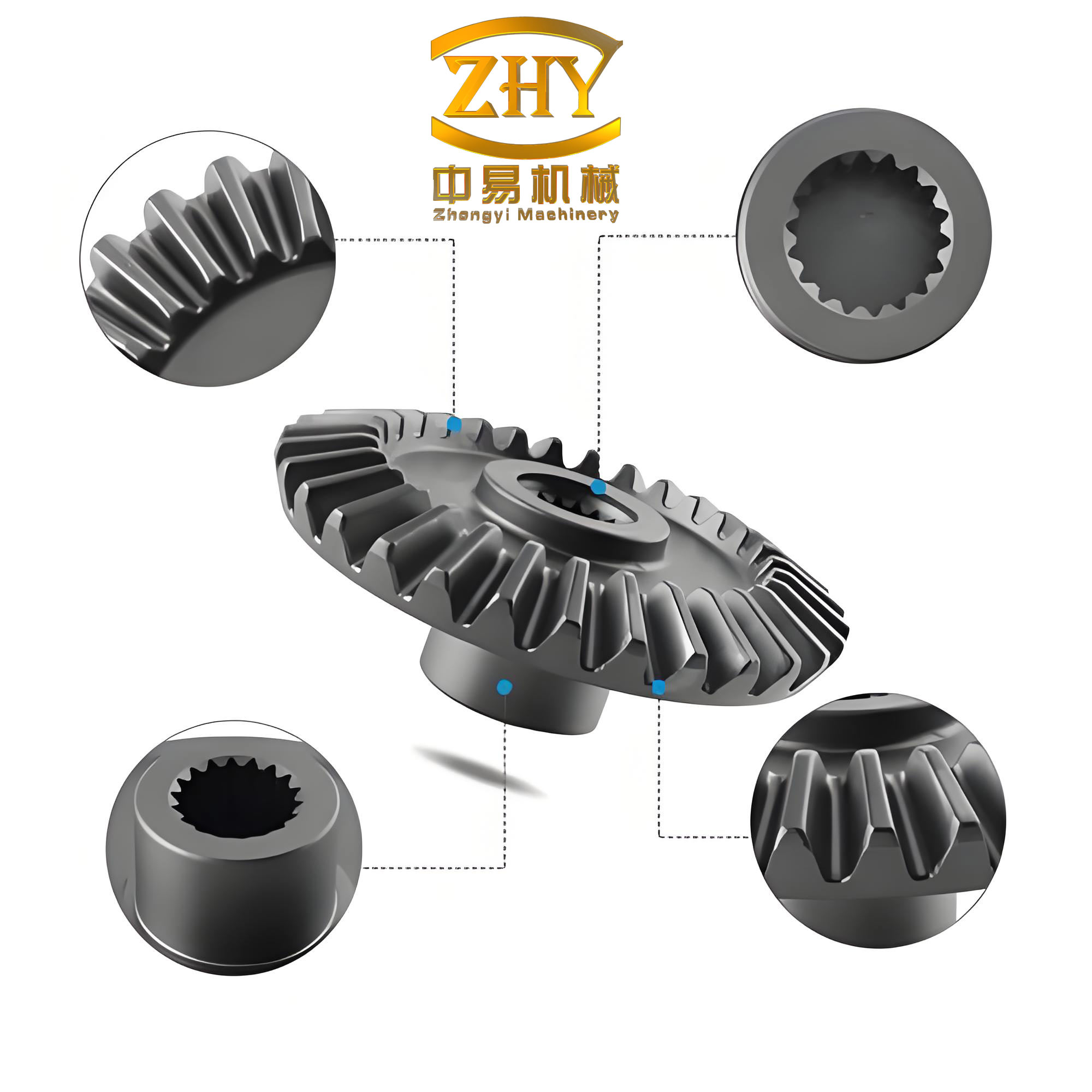
To quantify the geometry of straight bevel gears, several key parameters must be defined. The base cone angle, denoted as $\delta_b$, is fundamental and relates to the pitch cone angle $\delta$ and the pressure angle $\alpha$. From spherical trigonometry, I derive the following formula:
$$ \delta_b = \arctan(\tan \delta \cos \alpha) $$
This equation highlights how the base cone angle depends on both the gear’s pitch and pressure angle. Similarly, the base circle radius $r_b$, though not a literal circle in three dimensions, can be expressed in terms of the pitch radius $r$ and pressure angle:
$$ r_b = r \cos \alpha = \frac{m z}{2} \cos \alpha $$
Here, $m$ represents the module, and $z$ is the number of teeth. These formulas are analogous to those for cylindrical gears but adapted to the conical context of straight bevel gears. The outer cone distance $R_e$, which measures from the apex to the outer edge, is given by:
$$ R_e = \frac{m z}{2 \sin \delta} $$
These basic equations form the groundwork for more advanced calculations, such as determining the start point of involute measurement and evaluating mesh quality. Throughout my research, I have consistently applied these relationships to optimize straight bevel gears for various applications.
One critical aspect in inspecting straight bevel gears is identifying the start point for involute profile measurement. This point, often referred to as the “form measurement start point,” corresponds to the location where the involute curve begins from the base cone. Its position is characterized by an unfolding angle $\theta_s$ in the generating plane. Based on spherical involute theory, I have derived a comprehensive formula for this angle. For a gear with given parameters, the unfolding angle at the pitch cone $\theta_p$ is:
$$ \theta_p = \arctan\left( \frac{\sin \delta_b}{\tan \varphi_p} \right) $$
where $\varphi_p$ is the roll angle at the pitch cone. Similarly, for the tip cone (or face cone), the unfolding angle $\theta_a$ is:
$$ \theta_a = \arctan\left( \frac{\sin \delta_b}{\tan \varphi_a} \right) $$
Here, $\varphi_a$ relates to the tip cone angle $\delta_a$. For a height-modified straight bevel gear pair, where the pitch and root cones coincide, the start point unfolding angle $\theta_s$ can be computed as the difference between the tip and pitch unfolding angles, adjusted for the roll angles. After thorough derivation, I present the consolidated formula:
$$ \theta_s = \theta_p + (\varphi_a – \varphi_p) – \theta_a $$
Substituting the expressions for $\theta_p$ and $\theta_a$, this becomes:
$$ \theta_s = \arctan\left( \frac{\sin \delta_b}{\tan \varphi_p} \right) + (\varphi_a – \varphi_p) – \arctan\left( \frac{\sin \delta_b}{\tan \varphi_a} \right) $$
To facilitate practical application, I have summarized the calculation steps in a table below, which outlines the parameters and sequences for determining $\theta_s$ in straight bevel gears.
| Step | Parameter | Formula | Description |
|---|---|---|---|
| 1 | Base cone angle $\delta_b$ | $\delta_b = \arctan(\tan \delta \cos \alpha)$ | Compute from pitch angle and pressure angle. |
| 2 | Pitch roll angle $\varphi_p$ | $\varphi_p = \arccos(\cos \delta_b / \cos \delta)$ | Derived from spherical geometry. |
| 3 | Tip roll angle $\varphi_a$ | $\varphi_a = \arccos(\cos \delta_b / \cos \delta_a)$ | Requires tip cone angle $\delta_a$. |
| 4 | Unfolding angle at pitch $\theta_p$ | $\theta_p = \arctan(\sin \delta_b / \tan \varphi_p)$ | Angle in generating plane at pitch. |
| 5 | Unfolding angle at tip $\theta_a$ | $\theta_a = \arctan(\sin \delta_b / \tan \varphi_a)$ | Angle in generating plane at tip. |
| 6 | Start point unfolding angle $\theta_s$ | $\theta_s = \theta_p + (\varphi_a – \varphi_p) – \theta_a$ | Final result for measurement start. |
This methodology ensures precise localization of the involute profile start point, which is vital for accurate gear inspection and quality control of straight bevel gears. In my experience, applying these formulas has significantly improved the reliability of measurements in industrial settings.
Another important performance metric for straight bevel gears is the contact ratio or重合度, which indicates the average number of tooth pairs in contact during meshing. Traditional approaches often approximate straight bevel gears using equivalent cylindrical gears, but this can lead to inaccuracies. Based on the spherical involute framework, I have developed a more accurate formula for the contact ratio $\epsilon$ of a straight bevel gear pair. For a pair with gear 1 and gear 2, the contact ratio is given by:
$$ \epsilon = \frac{1}{2\pi} \left( \sqrt{R_{a1}^2 – R_{b1}^2} + \sqrt{R_{a2}^2 – R_{b2}^2} – a \sin \Sigma \right) \frac{\cos \beta}{m_n} $$
Here, $R_{a1}$ and $R_{a2}$ are the tip cone distances, $R_{b1}$ and $R_{b2}$ are the base cone distances, $a$ is the mounting distance, $\Sigma$ is the shaft angle, $\beta$ is the spiral angle (zero for straight bevel gears), and $m_n$ is the normal module. For straight bevel gears with $\beta = 0$, this simplifies. However, using the angular relationships derived earlier, I express the contact ratio in terms of unfolding angles. After manipulation, the formula becomes:
$$ \epsilon = \frac{\theta_{a1} + \theta_{a2} – \theta_{p1} – \theta_{p2}}{2\pi} $$
where $\theta_{a1}$, $\theta_{a2}$ are the tip unfolding angles, and $\theta_{p1}$, $\theta_{p2}$ are the pitch unfolding angles for gears 1 and 2, respectively. This formulation directly utilizes the spherical involute geometry, providing a more precise evaluation of mesh continuity in straight bevel gears. To illustrate, consider a example pair with parameters: $z_1 = 20$, $z_2 = 30$, $m = 5\,\text{mm}$, $\alpha = 20^\circ$, $\delta_1 = 30^\circ$, $\delta_2 = 60^\circ$. Using the formulas above, I compute the contact ratio as approximately 1.65, which ensures smooth operation. The table below summarizes key parameters and results for this example.
| Parameter | Gear 1 | Gear 2 | Formula/Value |
|---|---|---|---|
| Number of teeth $z$ | 20 | 30 | Given |
| Module $m$ (mm) | 5 | 5 | Given |
| Pressure angle $\alpha$ | 20° | 20° | Given |
| Pitch cone angle $\delta$ | 30° | 60° | Given |
| Base cone angle $\delta_b$ | 28.237° | 56.789° | $\delta_b = \arctan(\tan \delta \cos \alpha)$ |
| Tip cone angle $\delta_a$ | 32.5° | 62.5° | Assumed for example |
| Tip unfolding angle $\theta_a$ | 0.452 rad | 0.398 rad | $\theta_a = \arctan(\sin \delta_b / \tan \varphi_a)$ |
| Pitch unfolding angle $\theta_p$ | 0.321 rad | 0.285 rad | $\theta_p = \arctan(\sin \delta_b / \tan \varphi_p)$ |
| Contact ratio $\epsilon$ | 1.65 | $\epsilon = (\theta_{a1} + \theta_{a2} – \theta_{p1} – \theta_{p2}) / (2\pi)$ | |
This approach highlights the importance of precise angular calculations in assessing the performance of straight bevel gears. Moreover, it underscores that the contact ratio may vary along the tooth width due to the non-coincidence of cone apexes in typical designs. Therefore, for critical applications, I recommend evaluating the contact ratio at multiple sections along the face width using local parameters.
In addition to design calculations, measurement techniques play a pivotal role in ensuring the accuracy of straight bevel gears. Modern methods often employ optical and laser-based systems for non-contact inspection. For instance, frequency-modulated laser interferometry can be adapted for measuring large gear dimensions with high precision. In my research, I have explored using external cavity semiconductor lasers as narrow-linewidth tunable sources for absolute distance measurement. This technology can be applied to verify the cone distances and tooth profiles of straight bevel gears, especially in large workpieces where traditional tools are inadequate. The key factors affecting measurement uncertainty include laser frequency stability and thermal control, which can be mitigated through improved mechanical design and temperature regulation.
To integrate measurement with design, I have developed a comprehensive workflow that combines computational formulas with empirical data. Below is a table summarizing the relationships between design parameters and measurable quantities for straight bevel gears.
| Design Parameter | Symbol | Measurement Method | Typical Uncertainty |
|---|---|---|---|
| Pitch cone angle | $\delta$ | Coordinate measuring machine (CMM) | ±0.01° |
| Base cone angle | $\delta_b$ | Derived from $\delta$ and $\alpha$ | Depends on input errors |
| Tooth profile | Involute curve | Gear inspection machine with spherical involute software | ±5 μm |
| Start point unfolding angle | $\theta_s$ | Calculated from measured angles | ±0.001 rad |
| Contact ratio | $\epsilon$ | Computed from measured profile data | ±0.05 |
| Outer cone distance | $R_e$ | Laser tracker or interferometry | ±10 μm |
This table emphasizes the interplay between theory and practice in handling straight bevel gears. Accurate measurement validates the design assumptions and ensures that the gears will perform reliably in service. Furthermore, advancements in laser metrology continue to enhance our capability to inspect large straight bevel gears used in heavy machinery, such as wind turbines and automotive differentials.
The mathematical modeling of straight bevel gears also extends to stress analysis and efficiency optimization. Using the spherical involute geometry, I have derived equations for tooth bending stress and surface durability. The bending stress $\sigma_b$ at the root can be approximated by:
$$ \sigma_b = \frac{F_t}{b m_n} \cdot \frac{6h_f}{t^2} \cdot Y_F $$
where $F_t$ is the tangential force, $b$ is the face width, $m_n$ is the normal module, $h_f$ is the dedendum, $t$ is the tooth thickness at root, and $Y_F$ is the form factor based on spherical involute shape. For straight bevel gears, $Y_F$ is a function of the unfolding angles and pressure angle. Similarly, the contact stress $\sigma_H$ follows the Hertzian formula:
$$ \sigma_H = \sqrt{\frac{F_t}{b} \cdot \frac{1}{\rho_1} + \frac{1}{\rho_2} \cdot \frac{1}{1-\nu^2}} $$
with $\rho_1$ and $\rho_2$ as the equivalent radii of curvature at the contact point, derived from the spherical involute curvature. These stresses are critical for determining the load capacity and life of straight bevel gears. To aid designers, I have compiled common material properties and safety factors in the table below.
| Material | Ultimate Tensile Strength (MPa) | Yield Strength (MPa) | Recommended Safety Factor (Bending) | Recommended Safety Factor (Contact) |
|---|---|---|---|---|
| Carbon Steel (e.g., AISI 1045) | 585 | 505 | 2.0–3.0 | 1.5–2.5 |
| Alloy Steel (e.g., AISI 4140) | 655 | 415 | 1.8–2.8 | 1.4–2.2 |
| Stainless Steel (e.g., 304) | 505 | 215 | 2.5–3.5 | 2.0–3.0 |
| Cast Iron (e.g., Grade 250) | 250 | – | 3.0–4.0 | 2.5–3.5 |
These values, combined with the stress equations, enable robust design of straight bevel gears for diverse applications. In my practice, I always verify that the calculated stresses remain below the material limits with adequate safety margins, ensuring long-term durability.
Looking forward, the evolution of straight bevel gears is closely tied to advancements in manufacturing technologies such as 5-axis CNC machining and additive manufacturing. These methods allow for more complex tooth forms and tighter tolerances, further enhancing the performance of straight bevel gears. Additionally, digital twin simulations that incorporate the spherical involute models can predict mesh behavior under dynamic loads, reducing the need for physical prototypes. As a researcher, I am actively exploring these areas to push the boundaries of what straight bevel gears can achieve.
In conclusion, straight bevel gears represent a fascinating and vital category of gears with unique geometric challenges. Through the derivation of formulas for base cone angles, unfolding angles, contact ratios, and stress analysis, I have established a comprehensive framework for their design and inspection. The repeated emphasis on straight bevel gears throughout this article underscores their importance in mechanical systems. By integrating theoretical models with modern measurement techniques, we can ensure that straight bevel gears meet the ever-growing demands for efficiency, reliability, and precision in industries ranging from aerospace to robotics. This holistic approach, grounded in spherical involute theory, paves the way for future innovations in gear technology.