
In my extensive experience with gear manufacturing, the form milling process for straight bevel gears remains a critical technique, especially for small-batch or single-piece production where dedicated bevel gear equipment is unavailable. Straight bevel gears are widely used in various mechanical transmissions, and their accurate machining is essential for smooth operation and longevity. However, I have observed significant confusion in existing literature and practices regarding the correct milling methods, particularly concerning the cutter tooth form and associated process parameters. This article aims to clarify these issues, drawing on the design principles of standard bevel gear milling cutters produced domestically, and to provide detailed calculations and recommendations to enhance the quality of milled straight bevel gears.
The form milling of straight bevel gears involves using a disc-shaped milling cutter to generate the tooth profile. While this method is relatively simple in terms of tooling, machine tools, and fixtures, achieving precision is challenging due to the complex geometry of straight bevel gears. The tooth profile of a straight bevel gear is a spherical involute, varying along the tooth length in both shape and thickness. Therefore, the milling process must account for these variations to produce accurate gears. Many technical resources describe form milling processes, but they often mix up different cutting methods and cutter tooth forms, leading to inaccuracies when using standard cutters. I will explore the correct cutting schemes, parameter calculations, and quality improvement pathways based on the design logic of standard cutters.
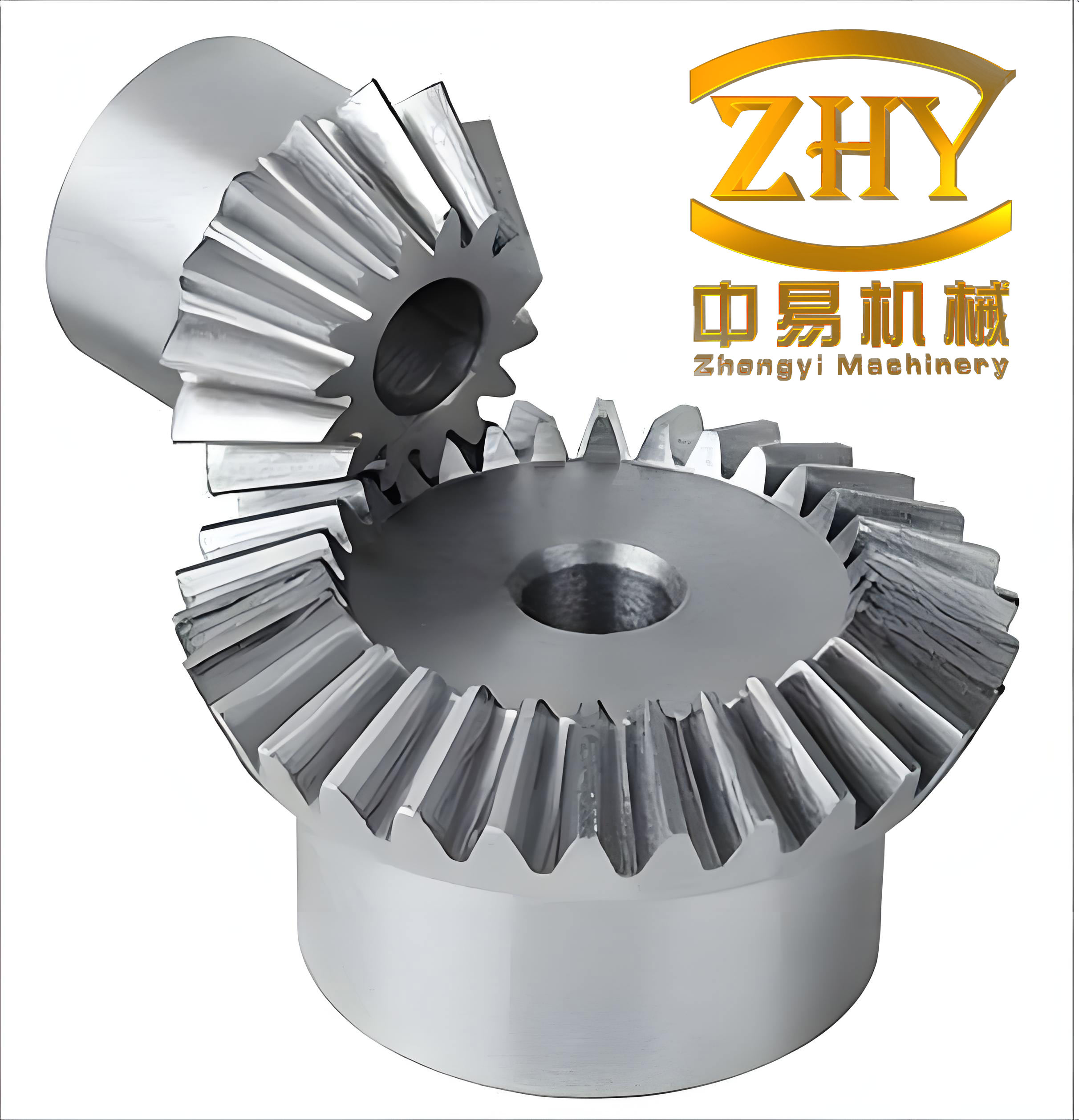
Firstly, let’s discuss the cutting methods for straight bevel gears. There are multiple approaches to finish-cutting the tooth surfaces of straight bevel gears with a disc milling cutter, but each requires a cutter with a specific tooth form to ensure part qualification. Standard straight bevel gear milling cutters, commonly available, are designed based on the tooth curve at the large end of the gear. This design is denoted by a specific mark on the cutter face. When using such cutters, the correct cutting method involves a sequence of adjustments after rough milling the tooth slot. Specifically, after aligning the gear blank and cutter for rough milling, the transverse table of the milling machine is moved to shift the blank along the cutter axis by an offset distance \(S\). Then, using a dividing head, the blank is rotated about its own axis by an angle \(\omega\) to orient one side of the tooth slot toward the cutter edge for finish cutting. This process is repeated for the opposite side by reversing the shift and rotation. The angle \(\omega\) is adjusted based on the semi-value of the tooth thickness allowance at the large end.
Unfortunately, many references incorrectly suggest using these marked cutters with alternative methods, such as tilting the dividing head around an axis perpendicular to the worktable. This ignores the relationship between cutting method and cutter tooth form, theoretically leading to errors. For straight bevel gears, using a cutter designed for one method with another increases cutting inaccuracies. Alternative methods require cutters with corresponding tooth forms, which are impractical for general factories to procure or manufacture. The perceived inaccuracy in large-end tooth curve position when using the correct method often stems from miscalculations of the offset \(S\), not the method itself.
Now, let’s delve into the correct calculation method for the offset \(S\). When using a marked cutter for finish cutting, the relative position between the cutter and gear blank must be adjusted so that the cutter tooth profile aligns with the designed curve position (Curve 1 in the reference diagram). This ensures accuracy of the large-end tooth form. The distance \(e\) from the pitch point at the large end to the symmetry axis in the projection plane perpendicular to the root cone generatrix is key. It is not equal to the semi-value of the cutter tooth thickness \(T/2\), but rather determined by the design parameters of the cutter. The offset \(S\) is the distance between the cutter’s symmetric radial plane and the gear blank’s axial section when the cutter profile is in position.
The standard cutter design parameters include the nominal module \(m_0\), the equivalent tooth number \(z_v\), and the angle \(\lambda\). From geometric relations, we can derive \(e\) as:
$$e = r_{ev} \sin(\eta – \lambda) = \frac{m_0 z_v}{2} \sin\left(\frac{90^\circ}{z_v} – \lambda\right)$$
Here, \(r_{ev}\) is the equivalent pitch radius, and \(\eta\) is related to the tooth geometry. Since the relative position remains constant for different gear tooth numbers within the cutter’s range, \(e\) is fixed for a given cutter. Therefore, by measuring the actual cutter tooth thickness \(T\) (at a distance of 1.2\(m_0\) from the cutter tip), we can compute the offset \(S\) as:
$$S = \frac{T}{2} – e = \frac{T}{2} – \frac{m_0 z_v}{2} \sin\left(\frac{90^\circ}{z_v} – \lambda\right)$$
Defining the offset coefficient \(Y = \frac{z_v}{2} \sin\left(\frac{90^\circ}{z_v} – \lambda\right)\), the formula simplifies to:
$$S = \frac{T}{2} – Y m_0 \tag{1}$$
The angle \(\lambda\) in standard cutters is determined based on a tooth width coefficient \(\phi_R = b / R\) (where \(b\) is face width and \(R\) is cone distance) of 1/3. The offset \(S\) should not vary with changes in \(\phi_R\) for the gear being cut, as this would compromise large-end tooth accuracy. Common alternative methods compute \(S\) based on the tooth line passing through the cone apex, but this does not align with the design principle of these cutters, resulting in an overestimated offset that affects large-end form and increases small-end tip thickness error. Similarly, calculating \(S\) based on small-end tip thickness underestimates it, thinning the small-end tooth and reducing strength and contact accuracy.
Below is a table of offset coefficients \(Y\) for standard straight bevel gear milling cutters, applicable for \(m_0 = 0.3\) to 10 mm, based on design handbooks. This table is crucial for accurate offset calculation.
| Cutter Number | \(\lambda\) (degrees) | \(Y\) |
|---|---|---|
| 1 | 3°44′ | 0.3942 |
| 2 | 3°14′ | 0.3902 |
| 3 | 2°40′ | 0.3897 |
| 4 | 2°12′ | 0.3821 |
| 5 | 1°47′ | 0.3807 |
| 6 | 1°21′ | 0.3730 |
| 7 | 0°52′ | 0.3694 |
| 8 | 0°22′ | 0.3534 |
Next, consider the gear blank installation angle \(\delta_f\), also known as the cutting angle. This angle sets the tooth slot bottom parallel to the milling machine worktable. Some sources incorrectly use the root cone angle that intersects the pitch cone apex, but this does not match the design of standard marked cutters. These cutters are designed with a constant radial clearance of 0.2\(m\) (where \(m\) is the large-end module) at both ends, so the slot bottom does not pass through the pitch cone apex. The correct installation angle \(\delta_f\) is given by:
$$\delta_f = \delta – \arctan\left(\frac{m}{R}\right) \tag{2}$$
Here, \(\delta\) is the pitch cone angle of the straight bevel gear. Using an installation angle that is too small, as per erroneous methods, leads to insufficient cutting depth from large to small end, affecting accuracy and contributing to small-end tip thickening. This is a common issue in traditional milling processes for straight bevel gears.
Regarding the small-end tip thickness, it is important to note that cutters designed for the large-end tooth form cannot perfectly match the theoretical small-end form, resulting in thickened small-end tips. However, the design of marked cutters (Curve 1) minimizes this error’s impact on meshing. With correct offset and installation angle adjustments, the small-end of straight bevel gears can often be used without manual filing. For gears with small pitch angles or low tooth counts, the small-end form error is more pronounced, and the tip thickening may exceed the corresponding root thinning in the mating gear. In such cases, manual filing has been traditionally required, but this is labor-intensive and inconsistent.
To avoid filing, some practitioners reduce the offset \(S\) to thin the small-end tooth, but this compromises contact precision, tooth form accuracy, and strength. From my practice, a more effective approach is to increase the addendum angle \(\theta_a\) of the pinion, appropriately reducing the small-end addendum height. This controls the actual small-end tip thickness error and eliminates the need for filing. While reducing small-end addendum slightly affects the meshing overlap ratio, it is less detrimental than thinning the tooth thickness. The formula for adjusted addendum can be derived based on gear geometry, but often empirical adjustments suffice for small straight bevel gears.
Moreover, the quality of straight bevel gears depends heavily on precise parameter selection. For instance, the module \(m\), tooth number \(z\), and pressure angle \(\alpha\) must be consistent with cutter specifications. The cone distance \(R\) and face width \(b\) influence the tooth length curvature. I recommend using the following relations for verification:
$$R = \frac{m z}{2 \sin \delta}$$
$$b \leq 0.3 R \quad \text{(typical for form milling)}$$
These ensure that the gear dimensions are within the cutter’s capability. Additionally, the equivalent tooth number \(z_v\) for cutter selection is calculated as:
$$z_v = \frac{z}{\cos \delta}$$
This accounts for the conical geometry when simulating a virtual spur gear. Tables for cutter selection based on \(z_v\) are available in handbooks, but I emphasize that the marked cutters require the specific cutting method described.
To further explore process optimization, consider the influence of machine setup. The milling machine must have precise transverse and longitudinal feeds, and the dividing head should allow fine angular adjustments. The rotation angle \(\omega\) for finish cutting is typically small, often less than 1 degree, and can be calculated based on the desired tooth thickness reduction. If \(\Delta s\) is the semi-value of tooth thickness allowance at the large end, then:
$$\omega \approx \frac{\Delta s}{r} \quad \text{(in radians)}$$
where \(r\) is the pitch radius at the large end. For straight bevel gears, \(r = \frac{m z}{2}\). This ensures controlled material removal during finish milling.
Another aspect is the cutter wear and regrinding. Standard straight bevel gear milling cutters lose their original tooth form after regrinding, affecting accuracy. Therefore, it’s advisable to use new or minimally used cutters for critical straight bevel gears. The cutter material should be high-speed steel for durability, and cutting speeds and feeds must be optimized to minimize heat generation and tool wear. For steel straight bevel gears, a cutting speed \(V_c\) of 20-30 m/min and feed per tooth \(f_z\) of 0.05-0.1 mm are common starting points.
In terms of quality assurance, measuring straight bevel gears post-milling is challenging without specialized instruments. However, simple checks like using gear tooth calipers for large-end tooth thickness or blueing tests for contact pattern can help. The contact pattern should be centered on the tooth flank; deviations indicate errors in offset or installation angle. For straight bevel gears, the pattern length should cover 50-70% of the tooth length for optimal load distribution.
Now, let’s discuss some advanced considerations. For high-precision straight bevel gears, such as those used in automotive differentials, form milling might be insufficient, but for many industrial applications, it remains viable. Research shows that modifying the cutter tooth form via software-based design can reduce errors, but this is costly. Alternatively, using multi-step milling—roughing with a standard cutter and finishing with a custom-ground cutter—can improve accuracy. The economics of this depend on batch size; for single pieces, it’s often impractical.
I also want to address common misconceptions. Some believe that form milling straight bevel gears is obsolete due to CNC grinding, but in resource-limited settings, it’s essential. The key is adhering to correct principles. For example, the offset \(S\) must be calculated precisely using Equation (1), and the installation angle from Equation (2). Ignoring these leads to gears that fail prematurely. From my observations, improperly milled straight bevel gears exhibit noise, vibration, and accelerated wear due to poor tooth contact.
To reinforce the importance of correct parameters, here’s a summary table of key formulas for straight bevel gear form milling:
| Parameter | Formula | Description |
|---|---|---|
| Offset \(S\) | \(S = \frac{T}{2} – Y m_0\) | Ensures large-end tooth form accuracy |
| Offset coefficient \(Y\) | \(Y = \frac{z_v}{2} \sin\left(\frac{90^\circ}{z_v} – \lambda\right)\) | From cutter design; use table values |
| Installation angle \(\delta_f\) | \(\delta_f = \delta – \arctan\left(\frac{m}{R}\right)\) | Sets correct tooth slot depth |
| Equivalent tooth number \(z_v\) | \(z_v = \frac{z}{\cos \delta}\) | For cutter selection |
| Cone distance \(R\) | \(R = \frac{m z}{2 \sin \delta}\) | Geometric parameter |
| Rotation angle \(\omega\) | \(\omega \approx \frac{\Delta s}{r}\) (radians) | For finish cutting adjustment |
Furthermore, the tooth width coefficient \(\phi_R\) influences design but not offset for standard cutters. For straight bevel gears with \(\phi_R \neq 1/3\), the same cutter can be used, as the design already accounts for this via fixed \(\lambda\). However, if extreme \(\phi_R\) values are used, custom cutters may be needed, but this is rare in practice.
In conclusion, the form milling process for straight bevel gears is a valuable technique when executed correctly. The confusion in literature stems from mixing different cutter tooth forms and cutting methods. Standard marked cutters require a specific method involving offset and rotation of the gear blank. Key parameters like offset \(S\) and installation angle \(\delta_f\) must be calculated accurately using the provided formulas, not based on erroneous assumptions. The small-end tip thickness issue can be mitigated by adjusting the addendum angle rather than thinning the tooth, preserving strength and accuracy. Straight bevel gears milled with proper technique can meet functional requirements for many applications, providing a cost-effective solution in the absence of specialized gear-cutting machinery. I urge practitioners to revisit their milling processes, verify calculations, and adopt these principles to improve the quality of straight bevel gears in their production.
Finally, continuous learning and sharing of experiences are vital. As manufacturing evolves, so should our understanding of traditional processes like form milling for straight bevel gears. By focusing on accuracy and adherence to design principles, we can ensure that these gears perform reliably in transmissions, machinery, and other mechanical systems. The journey to perfecting straight bevel gear milling is ongoing, but with careful attention to detail, significant improvements are achievable.