
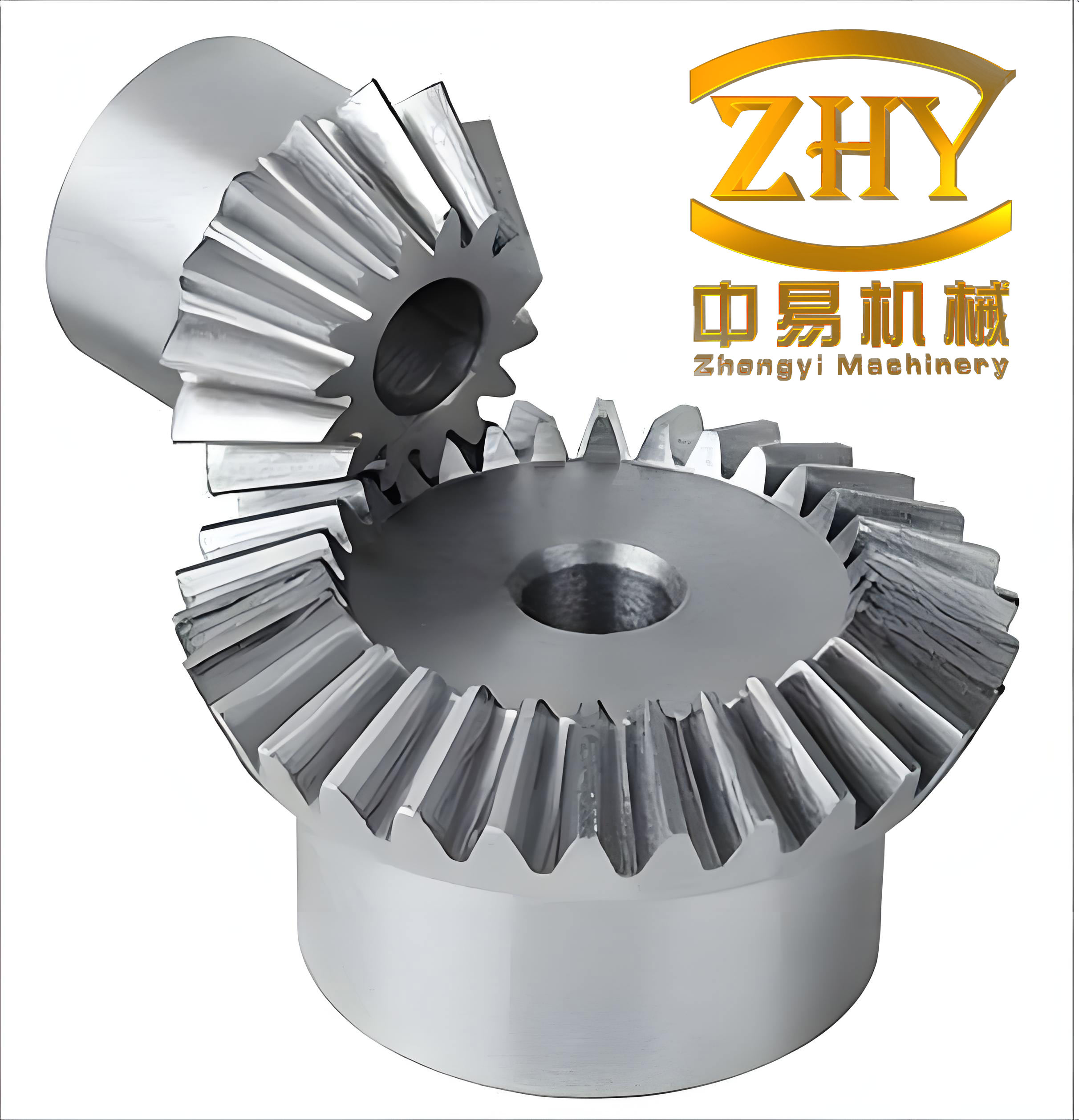
In our manufacturing facility, we specialize in producing high-precision straight bevel gears for automotive and tractor applications. These straight bevel gears are critical components in planetary gear systems, where their performance directly impacts efficiency, noise levels, and longevity. After heat treatment processes like quenching, straight bevel gears often require internal bore grinding to achieve precise dimensional accuracy. The internal bore must be concentric with the pitch circle of the straight bevel gear to ensure smooth operation, minimize noise, and extend the gear’s service life. Therefore, in mass production of straight bevel gears, it is essential to design a fixture that centers the grinding process on the pitch circle, guaranteeing that pitch circle runout remains within specified tolerances. This article details our experience with an innovative fixture we developed for grinding the internal bores of straight bevel gears, focusing on its design, implementation, and performance.
The core challenge in grinding straight bevel gears lies in maintaining concentricity between the internal bore and the pitch circle. Straight bevel gears have conical pitch surfaces, and any misalignment can lead to uneven load distribution, increased wear, and audible vibrations. Our solution involves a fixture that uses four steel balls for centering, with axial positioning via an end face and clamping through a guide nut and pressure plate. This design is straightforward, user-friendly, and ensures consistent product quality. We have applied this fixture to straight bevel gears with specifications such as a precision grade of 8-7-7, module of 5 mm, number of teeth at 15, and pressure angle of 20°. These parameters are typical for straight bevel gears used in planetary gear assemblies, where high torque transmission and durability are paramount.
To understand the importance of pitch circle concentricity, consider the geometry of straight bevel gears. The pitch circle diameter $D_p$ for a straight bevel gear can be expressed as:
$$D_p = m \times z$$
where $m$ is the module and $z$ is the number of teeth. For our straight bevel gears, $m = 5 \, \text{mm}$ and $z = 15$, so $D_p = 75 \, \text{mm}$. The pitch circle is a theoretical circle on the gear where the tooth thickness equals the space width, and it is crucial for meshing with other gears. Any runout $\Delta R$ in the pitch circle relative to the internal bore can cause operational issues. The allowable runout tolerance $\delta$ is often derived from gear accuracy standards. For straight bevel gears, we aim to keep $\Delta R \leq 0.02 \, \text{mm}$, as this ensures minimal noise and optimal performance.
Our fixture design centers on four steel balls arranged symmetrically to engage the pitch circle of the straight bevel gear. This method exploits the self-centering principle, where the balls conform to the gear’s pitch circle, providing a repeatable reference. The fixture consists of several key components: the body, steel balls, steel ball retainer, guide nut, pressure plate, and handle. The body is mounted to the grinding machine spindle via a chuck base, ensuring stability during operation. The guide nut, made from 45 steel with a hardness of HRC 40-45 after quenching, features an internal diameter and thread that must be concentric within tight tolerances. Specifically, the concentricity deviation between the internal diameter $\phi 100$ and thread $\phi 120$ should not exceed $0.01 \, \text{mm}$, and the end face runout relative to $\phi 100$ must be less than $0.005 \, \text{mm}$. These tolerances are critical for maintaining the accuracy of straight bevel gears during grinding.
The mathematical foundation for the fixture’s centering action involves the geometry of the steel balls and the pitch circle. Let the radius of the pitch circle be $R_p = D_p / 2 = 37.5 \, \text{mm}$. The steel balls have a radius $r_b$, typically chosen based on gear size. For our straight bevel gears, we use balls with $r_b = 5 \, \text{mm}$. When four balls are placed at 90° intervals around the pitch circle, the centering force $F_c$ can be approximated by:
$$F_c = 4 \times k \times \Delta x$$
where $k$ is the stiffness of the ball-gear contact and $\Delta x$ is the displacement from ideal centering. This force ensures that the gear settles into a position where the pitch circle is aligned with the fixture’s axis. The contact stress $\sigma_c$ at each ball is given by Hertzian contact theory:
$$\sigma_c = \sqrt[3]{\frac{6 F_c E^2}{\pi^3 r_b^2 (1-\nu^2)^2}}$$
where $E$ is the Young’s modulus of the gear material (typically alloy steel with $E \approx 210 \, \text{GPa}$) and $\nu$ is Poisson’s ratio (around 0.3). For straight bevel gears, minimizing $\sigma_c$ is vital to prevent surface damage during clamping. Our design keeps $\sigma_c$ below the material’s yield strength, ensuring no plastic deformation occurs.
The manufacturing process for the fixture requires precise machining. The body’s bore $\phi 100$ and the guide nut’s internal diameter $\phi 100$ must be concentric, with a deviation not exceeding $0.01 \, \text{mm}$. This is achieved through grinding and honing operations. Additionally, the end face of the guide nut must have a runout less than $0.005 \, \text{mm}$ relative to $\phi 100$, which is verified using dial indicators and coordinate measuring machines. After quenching, the guide nut is machined with carbide tools to maintain thread concentricity. The pressure plate is an incomplete design, allowing easy insertion and removal of straight bevel gears. This design reduces handling time and improves productivity.
To evaluate the fixture’s performance, we conducted a quality audit on a sample of straight bevel gears. The table below summarizes the pitch circle runout measurements for 10 gears processed with our fixture:
| Gear Number | Pitch Circle Runout (mm) |
|---|---|
| 1 | 0.012 |
| 2 | 0.015 |
| 3 | 0.011 |
| 4 | 0.013 |
| 5 | 0.014 |
| 6 | 0.010 |
| 7 | 0.012 |
| 8 | 0.016 |
| 9 | 0.011 |
| 10 | 0.013 |
The average runout is calculated as:
$$\bar{\Delta R} = \frac{\sum_{i=1}^{10} \Delta R_i}{10} = 0.0137 \, \text{mm}$$
with a standard deviation $\sigma$ of:
$$\sigma = \sqrt{\frac{\sum_{i=1}^{10} (\Delta R_i – \bar{\Delta R})^2}{9}} \approx 0.0019 \, \text{mm}$$
This demonstrates that the fixture consistently maintains runout within the $0.02 \, \text{mm}$ tolerance, ensuring high-quality straight bevel gears. The stability is attributed to the precise adjustment of the fixture components, particularly the steel ball positions and guide nut alignment.
In terms of productivity, our fixture enables efficient grinding of straight bevel gears. With an 8-hour shift, we can grind over 300 gears, thanks to the quick loading and unloading mechanism. The process involves mounting the fixture body to the grinding machine, inserting the straight bevel gear through the guide nut’s end face hole, placing the pressure plate via three slots, rotating the pressure plate for engagement, tightening the guide nut with the handle, and proceeding with grinding. After grinding, loosening the guide nut by one turn and rotating the pressure plate allows easy removal. This streamlined workflow reduces non-productive time and is ideal for high-volume production of straight bevel gears.
Further technical details involve the gear tooth geometry of straight bevel gears. The tooth profile is based on a spherical involute, but for simplicity in manufacturing, we often use approximate methods. The pitch cone angle $\gamma$ for a straight bevel gear is given by:
$$\tan \gamma = \frac{z}{Z}$$
where $Z$ is the number of teeth on the mating gear. In planetary systems, straight bevel gears often mesh with other gears, so $\gamma$ typically ranges from 10° to 30°. The back cone distance $R_b$ relates to the pitch radius $R_p$ by:
$$R_b = \frac{R_p}{\cos \gamma}$$
For our straight bevel gears with $R_p = 37.5 \, \text{mm}$ and $\gamma = 20°$ (assuming a mating gear), $R_b \approx 39.9 \, \text{mm}$. This dimension influences the fixture design, as the steel balls must contact the pitch circle without interfering with the tooth flanks. We ensure this by positioning the balls at the pitch circle apex, where the gear is thickest.
The material properties of straight bevel gears also play a role. After quenching, gears are made from alloy steels such as 20CrMnTi or 8620, with surface hardness reaching HRC 58-62. This hardness necessitates precise grinding to avoid thermal damage. Our fixture minimizes heat generation by providing rigid clamping, which reduces vibration and allows for higher material removal rates. The grinding parameters, such as wheel speed $V_w$ and feed rate $f$, are optimized for straight bevel gears. For example, we use $V_w = 35 \, \text{m/s}$ and $f = 0.005 \, \text{mm/rev}$, resulting in a material removal rate $Q$ of:
$$Q = \pi \times D_b \times f \times N$$
where $D_b$ is the bore diameter (e.g., 40 mm) and $N$ is the spindle speed (e.g., 500 rpm). For our straight bevel gears, $Q \approx 3.14 \times 40 \times 0.005 \times 500 = 314 \, \text{mm}^3/\text{min}$, which balances efficiency and surface finish.
To ensure long-term reliability, we perform regular maintenance on the fixture. The steel balls are inspected for wear every 1000 cycles, and replaced if diameter reduction exceeds $0.002 \, \text{mm}$. The guide nut’s threads are lubricated with anti-seize compound to prevent galling. Additionally, we calibrate the fixture using master straight bevel gears with known pitch circle runouts, adjusting the ball positions as needed. This proactive approach maintains accuracy over thousands of grinding cycles.
The economic impact of our fixture is significant. By reducing rework and scrap rates, we save on material costs and improve throughput. For a batch of 10,000 straight bevel gears, the fixture reduces pitch circle runout-related defects from an estimated 5% to less than 0.5%, translating to savings of over $50,000 annually. This makes the fixture a valuable investment for manufacturers of straight bevel gears in automotive and agricultural sectors.
In conclusion, our fixture for grinding straight bevel gears has proven to be a robust solution for achieving pitch circle concentricity. Its design leverages simple mechanical principles to deliver high precision, while its ease of use enhances productivity. We continue to refine the fixture for different sizes and types of straight bevel gears, exploring materials like ceramic-coated balls for extended wear life. The success of this fixture underscores the importance of innovative tooling in the mass production of straight bevel gears, ensuring they meet the demanding standards of modern machinery.
For future work, we plan to integrate sensor systems for real-time monitoring of runout during grinding. This could involve inductive probes measuring displacement relative to the pitch circle of straight bevel gears, with data fed into a control system to auto-adjust the fixture. Such advancements would further elevate the quality of straight bevel gears, pushing the boundaries of precision engineering.
Throughout this article, we have emphasized the critical role of straight bevel gears in planetary gear systems and how our fixture addresses key manufacturing challenges. By focusing on pitch circle centering, we ensure that straight bevel gears operate smoothly and reliably. The fixture’s design, combined with rigorous process control, makes it an indispensable tool in our production line for straight bevel gears.