
In my extensive experience within a repair and manufacturing workshop, I have frequently encountered the challenge of producing straight bevel gears. These components are essential for right-angle power transmission in numerous agricultural and custom-built applications, such as small tractors, threshers, and various tooling fixtures. However, the reality of small-batch or single-piece production, coupled with the lack of dedicated bevel gear cutting equipment and specialized gear cutters, necessitates an alternative approach. Over several years, I have successfully adapted the use of a standard universal milling machine equipped with ordinary involute gear milling cutters for this purpose. For straight bevel gears used in general power transmission—where extreme precision is not the paramount concern—this method has proven highly effective and reliable. The following is a detailed exposition of the principles, calculations, and procedures I employ.
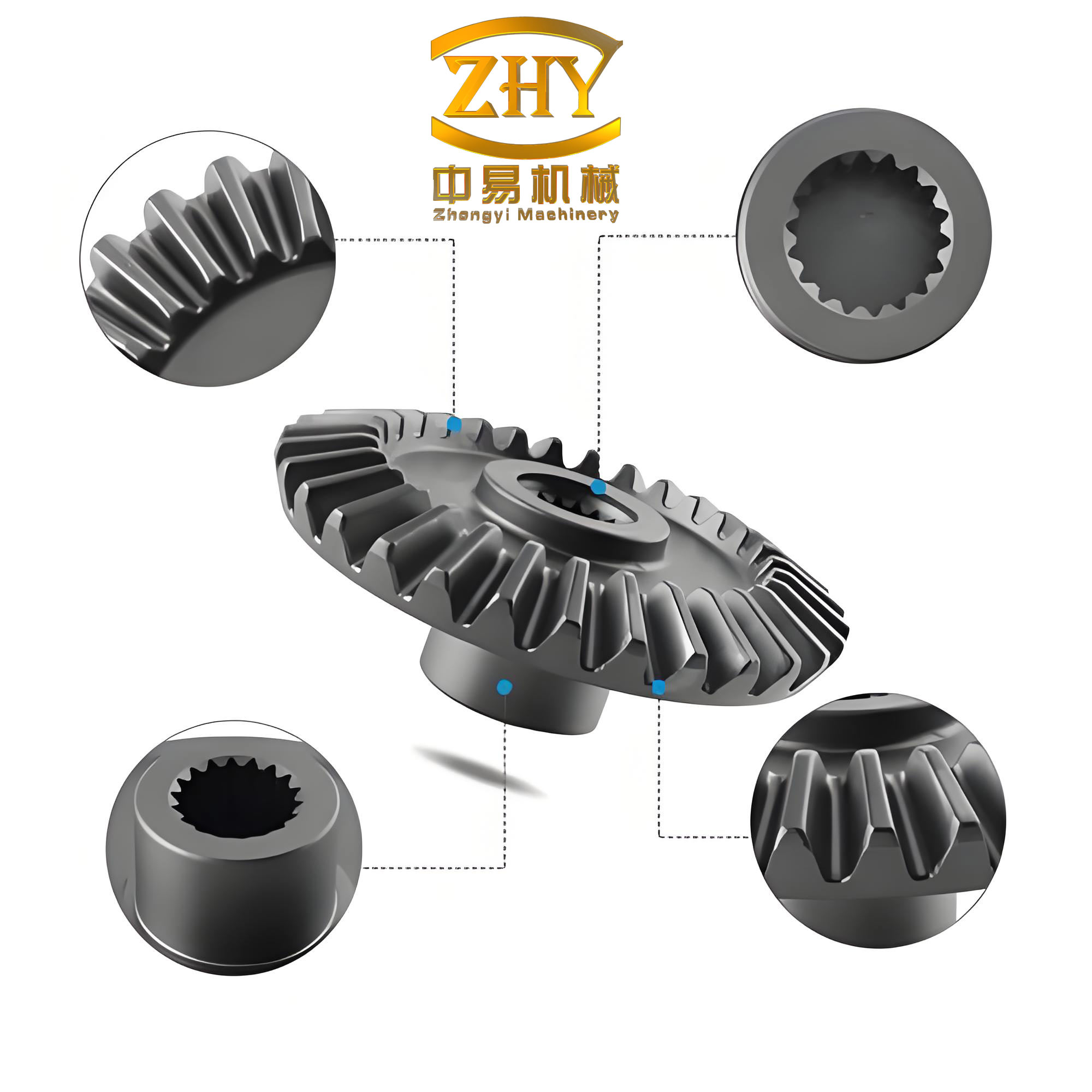
The core principle of machining straight bevel gears on a universal mill is an approximation based on the geometry of the gear tooth. A true bevel gear has a tooth profile that changes continuously from the large end (the heel) to the small end (the toe). A standard involute gear cutter, however, is designed for spur gears with a constant profile. The workaround lies in the fact that for gears where the face width \( b \) is less than or equal to one-third of the cone distance \( L \) (i.e., \( b \leq L/3 \)), the variation in tooth form across the face is manageable. By carefully selecting a standard cutter and manipulating the workpiece position, we can generate a tooth form that is functionally acceptable for many applications. The cone distance \( L \) is calculated from the pitch diameter \( d \) and the pitch cone angle \( \delta \):
$$ L = \frac{d}{2 \sin \delta} $$
The first and most critical step is the selection of the correct milling cutter. Two parameters must be determined: the module and the cutter number (which corresponds to the tooth shape for a specific range of virtual tooth counts).
1. Cutter Module Selection
To prevent the small end of the tooth from becoming too thin when milling to the full depth at the large end, the module of the selected cutter \( m_c \) must be less than or equal to the computed module at the small end \( m_{s} \). The module at the small end is derived from the gear’s large end (standard) module \( m \), the cone distance \( L \), and the face width \( b \):
$$ m_{s} = m \frac{L – b}{L} $$
The selection rule is straightforward:
- If \( m_{s} \) is a standard module, then \( m_c = m_{s} \).
- If \( m_{s} \) is not a standard module, choose the standard module \( m_c \) that is the nearest value less than \( m_{s} \).
This conservative choice ensures adequate tooth strength at the critical small end.
2. Cutter Number (Tooth Form) Selection
The cutter number is chosen based on an equivalent or “virtual” number of teeth \( z_v \). For a spur gear, the cutter number is selected based on the actual tooth count. For a bevel gear, we must consider the tooth form in a plane perpendicular to the tooth at the large end. This leads to the concept of the virtual spur gear. The standard formula for the virtual number of teeth for a bevel gear is:
$$ z_v’ = \frac{z}{\cos \delta} $$
Where \( z \) is the actual number of teeth on the straight bevel gear and \( \delta \) is the pitch cone angle. However, to better approximate the tooth profile towards the larger end of the gear, I apply a corrective factor by using the geometry at a section slightly inboard from the large end. A practical and effective formula I use is:
$$ z_v = \frac{z \cdot L}{\cos \delta \cdot (L – b)} $$
This slightly increases \( z_v \) compared to \( z_v’ \), effectively selecting a cutter number that would be used for a spur gear with more teeth, resulting in a slightly less curved tooth profile that better suits the bevel gear’s tapered form. The cutter number is then chosen from standard involute gear cutter tables based on this calculated \( z_v \). The table below summarizes the standard cutter numbering system based on tooth ranges.
| Cutter Number | Range of Virtual Teeth \( z_v \) |
|---|---|
| 1 | 135 teeth to a rack (including rack) |
| 2 | 55 to 134 teeth |
| 3 | 35 to 54 teeth |
| 4 | 26 to 34 teeth |
| 5 | 21 to 25 teeth |
| 6 | 17 to 20 teeth |
| 7 | 14 to 16 teeth |
| 8 | 12 to 13 teeth |
With the correct cutter (\( m_c \), Cutter #) mounted on the arbor, the workpiece must be set up on the milling machine table using a dividing head. The axis of the gear blank must be tilted relative to the table. The required angle \( \alpha \) for the dividing head setting depends on the direction of feed.
| Feed Direction | Dividing Head Tilt Angle \( \alpha \) | Diagram Reference & Rationale |
|---|---|---|
| Horizontal Feed (Along table) | \( \alpha = \delta_f = \delta – \gamma \) | The tool travels parallel to the root line (root cone generatrix). \( \delta_f \) is the root cone angle, and \( \gamma \) is the dedendum (root) angle. |
| Vertical Feed (Cross-slide) | \( \alpha = 90^\circ – \delta_f \) | Used when the workpiece clamping nut obstructs the horizontal path of the arbor. The tool feed is then perpendicular to the root line. |
Where the dedendum angle \( \gamma \) is calculated from the cone distance \( L \) and the dedendum \( h_f \): $$ \gamma = \arctan\left(\frac{h_f}{L}\right) $$ Typically, \( h_f = (1 + c^*) m \), with the clearance factor \( c^* \) being 0.2 or 0.25.
Alignment and Initial Positioning (Tooth Slotting)
After tilting the dividing head to angle \( \alpha \), the gear blank is mounted. The centerline of the blank must be aligned with the symmetry line of the cutter’s tooth profile. This is a critical alignment step. Following this, the initial depth of cut is set based on the large end of the gear. The total depth \( H_{large} \) to plunge is the full depth of tooth at the large end: \( h = (2 + c^*) m \). The table is then raised until the cutter just touches the blank, and from that zero point, it is raised by the full amount \( h \). With this depth set, the dividing head is used to index through all \( z \) teeth, milling a series of uniform, shallow slots around the blank. These slots are not the final tooth spaces but initial grooves that define the approximate centers of the teeth and remove the bulk of the material.
The Precision Machining: Cutting the Tooth Flanks
The initial slotting operation leaves a tooth profile that is vastly oversized. The true shape of the tooth space is achieved by two subsequent precision machining passes: one for the left flank and one for the right flank of each tooth. This requires a compound relative movement between the workpiece and the cutter for each pass, involving both a linear offset (\( \Delta E \)) and a rotational offset (\( \Delta \alpha \)).
The objective is to position the cutter so that its cutting edge contacts the desired point on the tooth flank at both the large and small ends simultaneously. Analysis shows this requires the following two coordinated adjustments from the centered slotting position:
- Linear Workpiece Offset (\( \Delta E \)): The worktable (and thus the gear blank) is moved laterally, perpendicular to the direction of the initial slot. This offset is calculated based on the chordal thickness of the tooth space. A simplified and practical formula I derive is:
$$ \Delta E \approx \frac{S_{large}}{4} + \frac{m_c z \cdot b}{4L} $$
Where \( S_{large} \) is the circular tooth thickness at the large end pitch circle, typically \( S_{large} = \frac{\pi m}{2} \).
- Rotational Workpiece Offset (\( \Delta \alpha \)): Simultaneously, the dividing head (and thus the gear blank) is rotated by a small angle. This rotation is necessary because the tooth space is tapered in both width and depth. The relationship between the linear offset and the required angular correction, derived from the geometry of the cone, is given by:
$$ \Delta \alpha \text{ (in degrees)} = \frac{360 \cdot \Delta E}{\pi \cdot d_{s}} $$
Where \( d_{s} \) is the pitch diameter at the small end: \( d_{s} = m \cdot z \cdot \frac{L-b}{L} \).
A more direct operational formula combining these relationships is:
$$ \Delta \alpha \approx 57.2958 \times \frac{m_c \cdot z \cdot b}{2 L \cdot d_{s}} \text{ radians} = 57.2958 \times \frac{ b}{2 L (L – b)} \text{ radians} $$
The procedure for machining one flank (e.g., the left flank) is as follows:
- From the centered slotting position, move the table by \( +\Delta E \) and rotate the dividing head by \( -\Delta \alpha \).
- Take a cut along the length of the tooth space. This will machine the left flank of all teeth indexed in that position.
- Index to the next tooth and repeat until the left flank of every tooth on the straight bevel gear has been cut.
To machine the opposite (right) flank:
- Return to the original centered position.
- Move the table in the opposite direction by \( -\Delta E \) and rotate the dividing head by \( +\Delta \alpha \).
- Take a cut to machine the right flank of all teeth.
It is absolutely crucial to perform test cuts and measurements. After the first flank is cut, the chordal tooth thickness at the small end should be measured with a gear tooth vernier caliper. The values of \( \Delta E \) and \( \Delta \alpha \) are iterative starting points. If the small-end tooth is too thick, the offsets need to be increased slightly for the next test piece. Conversely, if it is too thin, the offsets must be decreased. This trial-and-error process, guided by the formulas, quickly converges on the correct settings for a specific gear geometry.
Final Considerations and Finishing
After the milling operations are complete, a small remnant of material often remains at the large-end tip of the tooth, known as the “toe crest.” This is because the path of the standard spur gear cutter cannot perfectly generate the converging apex of the bevel gear tooth. This excess material must be removed manually by careful filing to achieve the correct tip contour and clean edges. While this adds a manual finishing step, it is a small trade-off for the ability to produce functional straight bevel gears without capital investment in specialized machinery.
The table below provides a concise summary of the entire process and the key formulas for a typical gear where \( b = L/3 \), module \( m=3 \), teeth \( z=20 \), and pitch cone angle \( \delta = 45^\circ \).
| Parameter | Symbol | Formula | Example Calculation |
|---|---|---|---|
| Cone Distance | \( L \) | \( \frac{m z}{2 \sin \delta} \) | \( \frac{3 \times 20}{2 \times \sin 45^\circ} \approx 42.43 \text{ mm} \) |
| Face Width | \( b \) | \( \leq L/3 \) | \( 14.14 \text{ mm} \) |
| Small-End Module | \( m_s \) | \( m \frac{L – b}{L} \) | \( 3 \times \frac{42.43-14.14}{42.43} \approx 2.0 \) |
| Selected Cutter Module | \( m_c \)** | \( m_c \leq m_s \)** | \( 2.0 \text{ mm} \)** |
| Virtual Tooth Count | \( z_v \) | \( \frac{z \cdot L}{\cos \delta \cdot (L – b)} \) | \( \frac{20 \times 42.43}{\cos 45^\circ \times (28.29)} \approx 42.4 \) |
| Selected Cutter Number | # | From Table (Range for \( z_v \)) | #3 (for 35-54 teeth) |
| Dividing Head Tilt (Horizontal Feed) | \( \alpha \) | \( \delta – \arctan((1+c^*)m / L) \) | \( 45^\circ – \arctan( (1.2 \times 3) / 42.43 ) \approx 40.4^\circ \) |
| Estimated Linear Offset | \( \Delta E \) | \( \frac{\pi m}{8} + \frac{m_c z b}{4L} \) | \( \frac{\pi \times 3}{8} + \frac{2 \times 20 \times 14.14}{4 \times 42.43} \approx 1.18 + 3.33 \approx 4.51 \text{ mm} \) |
| Estimated Angular Offset | \( \Delta \alpha \) | \( 57.2958 \times \frac{ b}{2 L (L – b)} \) rad | \( 57.2958 \times \frac{14.14}{2 \times 42.43 \times 28.29} \approx 0.084^\circ \) |
In conclusion, the fabrication of straight bevel gears on a universal milling machine is a viable and economically sound technique for low-volume production and repair work. Its success hinges on a deep understanding of bevel gear geometry, precise calculations for cutter selection and workpiece positioning, and a methodical, iterative approach to the machining process. While the resulting gears may not match the precision of those produced on dedicated gear generators, they are entirely suitable for a vast array of mechanical power transmission applications. This method empowers workshops to become self-sufficient in producing these essential components, eliminating downtime while waiting for specialized external suppliers. The mastery of this technique is a testament to practical engineering ingenuity, transforming standard workshop equipment into a versatile tool for creating complex geometries like straight bevel gears.