
The finishing of hardened straight bevel gears presents a significant challenge in precision manufacturing. Traditional gear-cutting methods struggle with the distortions and hardness introduced by processes like quenching or carburizing. This is where the scraping process, and the specialized tool that enables it, becomes critical. From my extensive experience, the scraping of straight bevel gears is not merely an alternative but a necessary step for achieving the required accuracy and surface integrity in high-performance applications. The core of this process lies in the scraping planer tool, a meticulously engineered instrument whose successful manufacture and maintenance dictate the entire feasibility of the scraping operation.
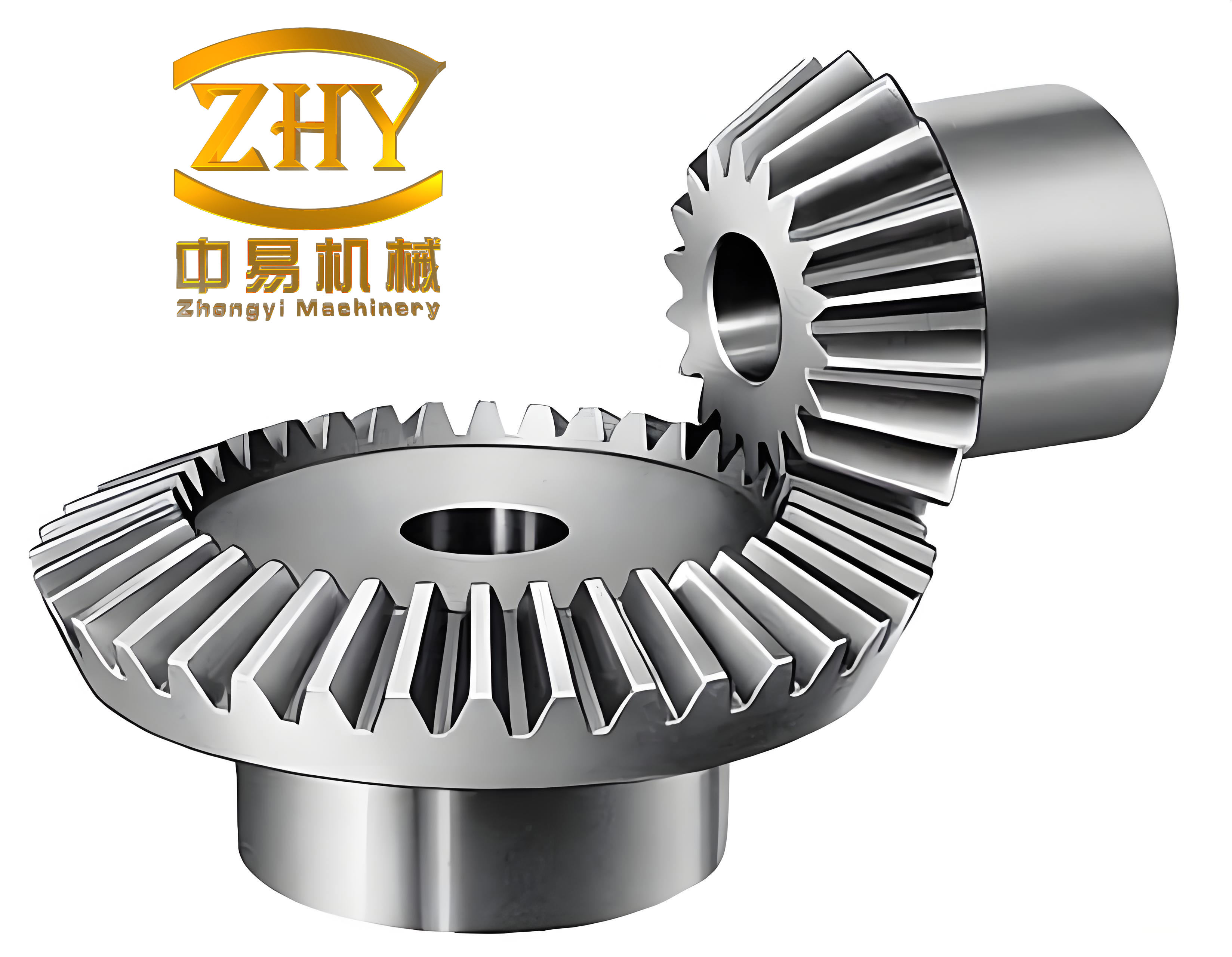
Scraping, as applied to straight bevel gears, is a precision finishing technique. Its primary purpose is to eliminate heat treatment distortion and improve the final gear accuracy by removing a minimal, controlled amount of material from the hardened flank surfaces. The tool designed for this task is fundamentally different from a standard gear planer. Its geometry is optimized for the extreme conditions of cutting high-hardness materials. The most common construction involves a body made from carbon structural steel for toughness and shock absorption, onto which inserts of high-hardness, high-strength cemented carbide are precisely brazed. While the overall structural dimensions (excluding the carbide tips) can often follow standard fine-planing tool designs, the cutting geometry is uniquely tailored for scraping straight bevel gears.
The cutting angles of the scraping tool are its most defining features. The primary cutting edge is not aligned with the tool’s top surface. As I have designed and verified in practice, the wedge angle ($\beta$) at the tip is typically 90°. When this tool is mounted in the machine, the cutting edge gains a distinct orientation relative to the workpiece. The relationship between the installed angles is crucial for performance and can be expressed as:
$$ \beta = 90^\circ $$
$$ \lambda = 4^\circ $$
$$ \gamma = – (90^\circ – \beta – \lambda) = -4^\circ $$
Where $\beta$ is the wedge angle, $\lambda$ is the cutting edge inclination angle (obtained after installation), and $\gamma$ is the effective rake angle measured in a section perpendicular to the cutting edge. This combination of a negative rake angle ($\gamma$) and a positive inclination angle ($\lambda$) is not arbitrary. The negative rake dramatically increases the strength of the cutting edge, which is paramount when engaging with a hardened straight bevel gear surface, preventing immediate chipping or fracture. Simultaneously, the positive inclination angle improves chip flow and can modify the cutting mechanics beneficially under such high-pressure conditions. This geometry is essential for any tool intended to scrape hard-faced straight bevel gears successfully.
A fundamental consideration is the tool’s nominal pressure angle ($\alpha$). It is typically manufactured to the standard value (e.g., 20°). However, due to the presence of the inclination angle $\lambda$, the effective pressure angle in the direction of cutting changes slightly. For most applications involving paired straight bevel gears that are scraped together, this minor deviation is functionally acceptable. If extreme precision in the pressure angle is required, the tool’s nominal angle $\alpha_t$ can be compensated during manufacture according to the formula:
$$ \alpha_t = \arctan(\frac{\tan \alpha}{\cos \lambda}) $$
Where $\alpha$ is the desired working pressure angle. The tool’s flank and face must have a surface roughness no worse than 0.8 µm Ra after grinding, and the cutting edge must be absolutely free of cracks, chips, or other defects.
The manufacture of a scraping planer tool is a multi-stage process requiring high precision at each step. It can be broken down into four core areas: body machining, carbide tip brazing, body finishing, and cutting edge grinding. While brazing techniques are well-documented elsewhere, the machining and grinding stages, particularly for resharpening, are where the tool’s performance is locked in.
The following table summarizes the key stages and their critical parameters in the manufacturing process for a scraping tool used on straight bevel gears:
| Manufacturing Stage | Key Processes & Objectives | Primary Equipment & Tools | Critical Parameters & Tolerances | Notes for Straight Bevel Gears |
|---|---|---|---|---|
| 1. Tool Body Machining | Milling of overall form, drilling mounting holes, milling precise carbide insert pockets. | Milling machine with dedicated fixtures for gear tool profiles. | Insert pocket fit to match carbide tip; surface finish ≤ 1.6 µm Ra; hole location via drill jig for interchangeability. | Form milling must leave no grinding allowance on specific surfaces to protect the body during subsequent diamond grinding of carbide. |
| 2. Carbide Tip Brazing | Permanent joining of high-hardness carbide inserts to the steel body. | Controlled atmosphere or induction brazing setup. | Avoid thermal cracks in carbide; ensure full, void-free braze joint; maintain geometric alignment. | Critical for tool life when scraping hardened straight bevel gears; stress-relieving may be required post-braze. |
| 3. Body Finishing & Carbide Grinding | Final grinding of steel body surfaces; rough and finish grinding of carbide profile. | Surface grinder or universal tool grinder with magnetic/chucking fixtures; Diamond wheels. | Rough grind carbide (leave ~0.1mm); Finish grind to final form and $\alpha$; Surface finish on carbide ≥ 0.8 µm Ra. | Fixtures are essential for accuracy. Diamond wheels (resin bond, 100-150 grit for finish) are mandatory for carbide. Coolant use on surface grinders improves finish. |
| 4. Cutting Edge Grinding (Rake Face) | Grinding the $-4^\circ$ rake face ($\gamma$) relative to the cutting edge plane. | Universal tool grinder with precision vise or dedicated fixture. | Grind only a narrow land (~1mm wide); Regrind depth ≤ 0.05mm; Maintain edge perpendicularity to tool base. | Most sensitive regrinding operation. Fixture or precise vise setting ($\theta_1$) is required to maintain correct tooth profile for straight bevel gears. |
During the finishing grind, precise measurement is vital. Using a magnetic fixture on a surface grinder, the measurement is performed in-process with a dial indicator and a specialized gauge block. The required gauge block height ($H_g$) for setting the tool form is calculated based on the fixture’s design geometry. If we define the following variables for a typical setup:
- $H_f$: The theoretical mounting height of the fixture’s reference plane.
- $h$: The vertical offset from the reference plane to the center of the measuring cylinder.
- $D$: Diameter of the precision measuring cylinder (pin).
- $\alpha$: The tool’s pressure angle.
- $\delta$: The tool’s clamping angle in the fixture.
The measured height ($H_m$) on the dial indicator when touching the measuring pin should correspond to a gauge block of thickness $H_g$ calculated as:
$$ H_g = H_f – \left( h + \frac{D}{2} \cdot \sec(\alpha) \cdot \sin(\delta) \right) $$
This method ensures the precise generation of the pressure angle $\alpha$ on the carbide tip, which is fundamental for the correct conjugation of the scraped straight bevel gears.
For regrinding the critical rake face ($\gamma = -4^\circ$), the tool must be positioned so that the plane containing the cutting edge is perpendicular to the tool’s base during the grinding operation. If a universal vise is used, it must be precisely adjusted. The vise must be rotated around two axes to achieve the correct orientation for grinding the rake face in its true geometric plane. The required rotation angles ($\theta_1$ and $\theta_2$) for the vise can be derived from the tool angles:
$$ \theta_1 = \arctan\left(\frac{\tan \gamma}{\cos \alpha}\right) $$
$$ \theta_2 = \arcsin(\sin \gamma \cdot \sin \alpha) $$
Where $\theta_1$ is the rotation in the horizontal plane and $\theta_2$ is the tilt. Given the small scraping depth (typically 0.05–0.15 mm), it is neither necessary nor advisable to grind the entire front face. Instead, only a narrow land of about 1 mm width is reground. The grinding increment per resharpening should not exceed 0.03–0.05 mm to preserve edge integrity. A fine-grit diamond wheel (e.g., 200 grit, resin bond) is used with minimal feed to maintain the required surface finish. The small corner radius at the tool tip can be dressed with a fine silicon carbide wheel, again with very light pressure to avoid micro-chipping, which would be catastrophic when engaging the hard surface of a straight bevel gear.
In conclusion, the scraping of hardened straight bevel gears is enabled by a tool of sophisticated yet robust design. Its success hinges on the correct implementation of negative rake and positive inclination angles to marry strength with cutting action. The manufacturing and, more importantly, the consistent and accurate regrinding of this tool are processes that demand precision fixtures, diamond abrasive technology, and a deep understanding of spatial geometry. The formulas and parameters governing its angles, measurements, and setups are not merely guidelines but the essential recipes for replicating the precise flank geometry required for high-performance, quiet, and durable straight bevel gears. Mastering the scraping planer tool is, therefore, synonymous with mastering the final quality of the gear itself.