
The reliable and efficient production of straight bevel gears represents a significant challenge in modern powertrain and mechanical transmission systems. These components are ubiquitous in applications requiring the transmission of power between intersecting shafts, most notably in automotive differentials, industrial machinery, and aerospace systems. The primary manufacturing routes for high-volume production often involve precision forging, which offers superior material grain flow, enhanced mechanical properties, and reduced material waste compared to machining from solid stock. However, the very geometry that defines straight bevel gears—a conical pitch surface and linearly tapered teeth—introduces considerable complexity into the design and fabrication of the required forging dies and subsequent trimming tools. This article delves into two critical, synergistic technological advancements that address these challenges: an integrated heat treatment strategy for forging dies to drastically extend service life, and a novel computational method for defining the wire electrical discharge machining (WEDM) trajectory for the trimming die, enabling high-precision, low-cost manufacturing.
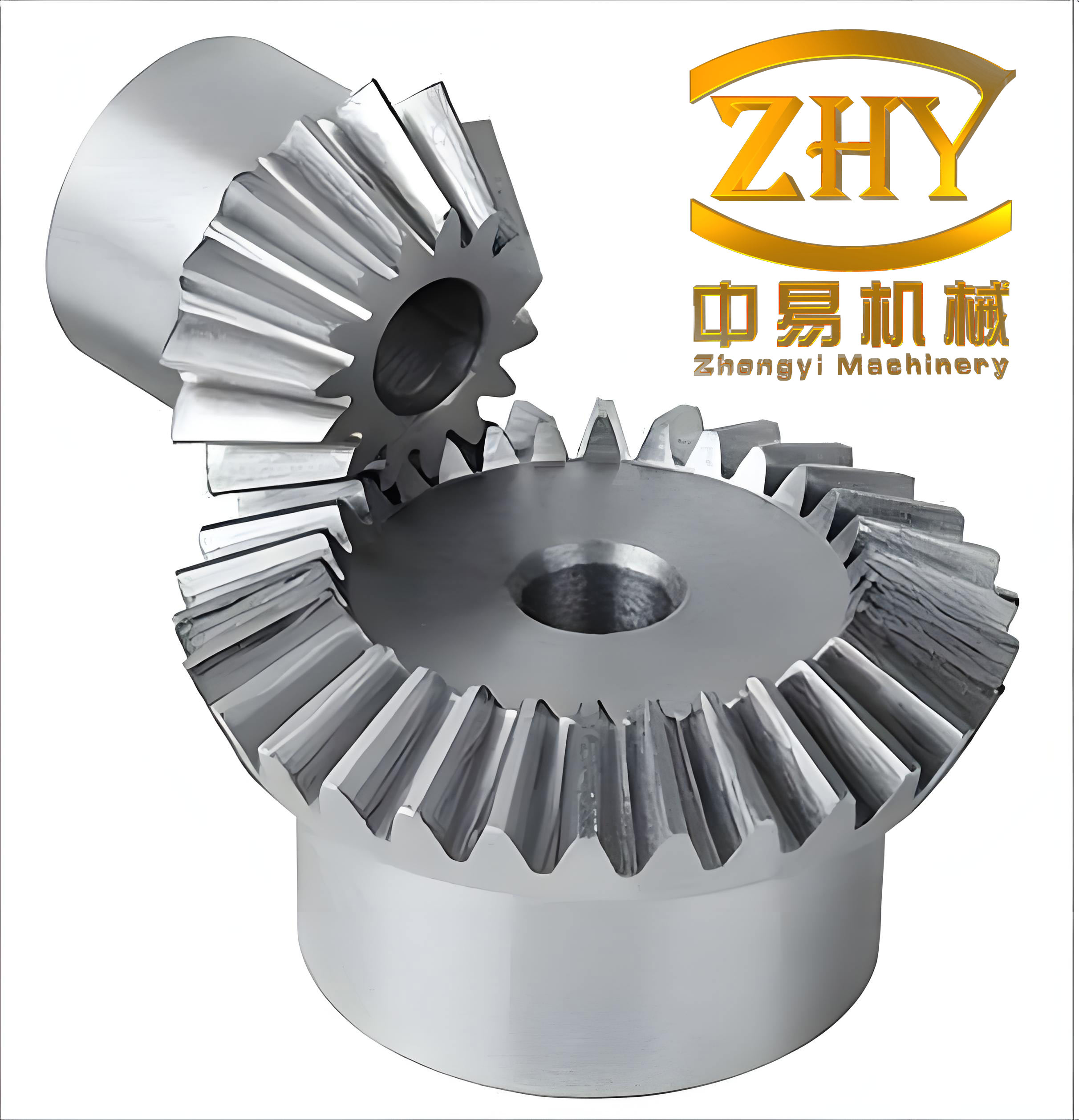
The forging process for straight bevel gears subjects the die cavities to extreme thermomechanical fatigue. Repeated cycles of rapid heating from contact with the hot billet (often exceeding 1100°C) followed by cooling with lubricants or in air create severe thermal stresses. This leads to common failure modes such as heat checking (networks of fine cracks), plastic deformation of the tooth profile, and abrasive wear. The traditional approach uses through-hardened tool steels like 5CrNiMo (a common Chinese designation, similar to AISI L6) for the hammer forging dies. While offering good bulk toughness, the uniform high hardness often compromises wear resistance at the critical working surface. Conversely, a very hard surface layer on a soft core risks spalling or catastrophic fracture. The solution lies in a composite treatment that marries a tough core with an exceptionally wear-resistant surface, specifically engineered for the demanding task of forging straight bevel gears.
The proposed composite treatment involves a two-stage process. First, the entire die block undergoes isothermal quenching and tempering. Isothermal quenching, often in a salt bath at a temperature just above the martensite start (Ms) point, allows the transformation of austenite to lower bainite throughout the component. This microstructure provides an excellent combination of strength and toughness, ideal for withstanding the shock loads and high core stresses encountered in forging. The resulting bulk hardness is moderate, providing the necessary resilience.
The second stage is a localized surface enhancement. Here, contour induction heating is employed to austenitize only the working surfaces of the die cavity—specifically, the intricate tooth profiles of the straight bevel gears. This is followed by immediate quenching. The key innovation is performing a pre-heat of the entire die to approximately 500°C prior to the induction hardening step. The reason is critical: during induction hardening, the rapid, localized heating and subsequent quenching create a steep thermal gradient. At the boundary of the hardened zone, a soft “tempered zone” or low-hardness region can form because the heat from the induction process tempers the previously hardened isothermal microstructure. Pre-heating the die to 500°C significantly reduces this thermal gradient during the final quench, thereby minimizing the extent and softening effect of this transition zone. The final structure is a deep, high-hardness martensitic case seamlessly integrated over a tough, lower bainitic core.
The benefits are quantified in the following comparative table, which contrasts the properties and performance of a conventionally heat-treated die with one subjected to the composite treatment for forging straight bevel gears.
| Property / Performance Metric | Conventional Through-Hardening | Composite Treatment (Isothermal + Contour Induction) |
|---|---|---|
| Core Microstructure | Tempered Martensite | Lower Bainite |
| Core Hardness (HRC) | 38-42 | 35-38 |
| Surface Hardness (HRC) | 38-42 (uniform) | 55-60 (case depth 2-5mm) |
| Transition Zone Hardness Drop | Not Applicable | Minimal (due to 500°C pre-heat) |
| Primary Failure Mode | Abrasive Wear, Plastic Deformation | Greatly Delayed; Minor Heat Checking |
| Estimated Service Life Improvement | Baseline (1x) | 3x to 5x |
Once the straight bevel gear forging is produced, it is surrounded by a flash or burr that must be cleanly removed in a trimming operation. The quality of this trim is paramount for gear performance, as ragged edges or deformed teeth can lead to stress concentrations, noise, and premature failure. The trimming die, specifically the female concave die that shears the flash from the gear profile, has traditionally been manufactured via sinker EDM (electrical discharge machining). This method involves eroding the cavity using a shaped electrode, which is costly to produce, wears during the process (affecting accuracy), and typically results in a die cavity with draft angles (a “trumpet shape”) that cannot be easily refurbished.
Wire EDM (WEDM) presents a far superior alternative: it uses a continuously fed thin wire as the electrode, capable of cutting complex, through profiles with exceptional accuracy and parallel sidewalls. This allows the die to be resharpened multiple times. The central obstacle for applying WEDM to straight bevel gear trimming dies has been the mathematical definition of the cutting path. The gear tooth profile exists on a conical surface, while the WEDM path must be defined in a single, flat plane perpendicular to the wire (the die’s exit plane). A direct projection or simple approximation is insufficient for precision. The breakthrough lies in a discrete point projection and curve-fitting methodology.
The foundational step involves defining the tooth profile of the forging in its “unwrapped” or developed form on the pitch cone. This is done using the concept of the equivalent spur gear. The parameters of the equivalent gear for the straight bevel gear are calculated first:
Number of teeth in equivalent gear: $$z_v = \frac{z}{\cos \delta}$$
Pitch radius of equivalent gear: $$r_v = \frac{m z_v}{2}$$
Base radius of equivalent gear: $$r_b = r_v \cos \alpha = \frac{m z_v \cos \alpha}{2}$$
Where \( z \) is the number of teeth on the straight bevel gear, \( m \) is the module, \( \alpha \) is the pressure angle, and \( \delta \) is the pitch cone angle.
Next, a series of discrete points are calculated along the involute profile of the equivalent gear’s tooth flank, from the root to the tip (including the flash land geometry). For any point \( i \) on the profile at a given radius \( r_{vi} \), its coordinates in the equivalent gear plane (\( x_{\nu}, y_{\nu} \)) are:
$$ \varphi_i = \frac{\pi}{2z_v} + \text{inv}\alpha – \text{inv}\alpha_i $$
$$ \alpha_i = \arccos\left(\frac{r_b}{r_{vi}}\right) $$
$$ x_{\nu} = r_{vi} \sin \varphi_i $$
$$ y_{\nu} = r_{vi} \cos \varphi_i $$
Here, \( \text{inv}\alpha = \tan\alpha – \alpha \) is the involute function.
The critical transformation is projecting these points from the conical development plane onto the flat plane of the trimming die. Assuming the die’s coordinate system (x, y) is aligned with the gear axis, the y-coordinate is compressed by a factor of \( \cos \delta \), while the x-coordinate remains unchanged:
$$ x_i = x_{\nu i} = r_{vi} \sin \varphi_i $$
$$ y_i = y_{\nu i} \cos \delta = r_{vi} \cos \varphi_i \cos \delta $$
This set of projected points \( P_i(x_i, y_i) \) represents the precise loci through which the WEDM wire center must pass to generate the correct die profile. However, WEDM machines are programmed with circular arcs and straight lines. Therefore, a piecewise circular curve fitting is performed. Consecutive triplets of points are used to define unique circular arcs. For points \( P_1, P_2, P_3 \), the equation of the circle passing through them is given by the determinant:
$$
\begin{vmatrix}
x^2+y^2 & x & y & 1\\
x_1^2+y_1^2 & x_1 & y_1 & 1\\
x_2^2+y_2^2 & x_2 & y_2 & 1\\
x_3^2+y_3^2 & x_3 & y_3 & 1\\
\end{vmatrix} = 0
$$
Solving this yields the center coordinates (\( x_0, y_0 \)) and radius \( R \) for the arc spanning from \( P_1 \) to \( P_3 \), with \( P_2 \) ensuring a best fit. The next arc uses points \( P_3, P_4, P_5 \) to define the path from \( P_3 \) to \( P_5 \), ensuring continuity at the shared point \( P_3 \). This process is repeated along the entire profile.
The general formulas derived from the determinant for the center and radius defined by points (\( x_1, y_1 \)), (\( x_2, y_2 \)), (\( x_3, y_3 \)) are:
$$ D = x_1(y_2 – y_3) – x_2(y_1 – y_3) + x_3(y_1 – y_2) $$
$$ A = \frac{ (x_1^2+y_1^2)(y_3-y_2) + (x_2^2+y_2^2)(y_1-y_3) + (x_3^2+y_3^2)(y_2-y_1) }{ D } $$
$$ B = \frac{ (x_1^2+y_1^2)(x_2-x_3) + (x_2^2+y_2^2)(x_3-x_1) + (x_3^2+y_3^2)(x_1-x_2) }{ D } $$
$$ C = \frac{ (x_1^2+y_1^2)(y_2x_3 – y_3x_2) + (x_2^2+y_2^2)(y_3x_1 – x_3y_1) + (x_3^2+y_3^2)(x_2y_1 – x_1y_2) }{ D } $$
Then, the arc center is \( ( -\frac{A}{2}, -\frac{B}{2} ) \) and its radius is \( R = \frac{1}{2}\sqrt{A^2 + B^2 – 4C} \).
To illustrate, consider the parameters for a differential side straight bevel gear: Module \( m = 6.35 \) mm, Teeth \( z = 22 \), Pressure Angle \( \alpha = 22.5^\circ \), Pitch Cone Angle \( \delta = 63^\circ 26′ \), Tip radius \( r_a = 72.09 \) mm, Root radius \( r_f = 67.05 \) mm. The calculation proceeds as follows, generating projected points which are then fitted with circular arcs.
The table below shows a sample of calculated discrete points and their projected coordinates onto the trimming die plane for the given straight bevel gear.
| Point i | Equivalent Radius \( r_{vi} \) (mm) | Projected X-coordinate \( x_i \) (mm) | Projected Y-coordinate \( y_i \) (mm) |
|---|---|---|---|
| 1 | 150.2711 | 6.9449 | 66.9790 |
| 2 | 152.1634 | 6.4522 | 67.8339 |
| 3 | 154.0657 | 5.8718 | 68.6849 |
| 4 | 155.5948 | 5.2108 | 69.5448 |
| 5 | 157.8403 | 4.4742 | 70.3997 |
| 6 | 159.7326 | 3.6657 | 71.2536 |
| 7 | 161.6249 | 2.7882 | 72.1059 |
Using these points, the piecewise circular fit is performed. The table below summarizes the resulting arc parameters that define the complete WEDM trajectory for one flank of the straight bevel gear trimming die cavity.
| Arc Segment | Defining Points | Arc Endpoints | Center Coordinates (\( x_0, y_0 \)) | Radius \( R \) (mm) |
|---|---|---|---|---|
| I | P1, P2, P3 | P1 to P3 | (-5.2383, 60.5274) | 13.7860 |
| II | P3, P4, P5 | P3 to P5 | (-10.8393, 56.4598) | 20.7081 |
| III | P5, P6, P7 | P5 to P7 | (-16.7681, 51.0953) | 28.7036 |
This data is fed directly into the WEDM machine’s controller. The benefits of this approach over conventional sinker EDM for manufacturing trimming dies for straight bevel gears are profound and are summarized in the following comparison.
| Aspect | Conventional Sinker EDM | WEDM with Calculated Trajectory |
|---|---|---|
| Die Cavity Walls | Tapered (for electrode release) | Perfectly Parallel |
| Refurbishment Potential | Very Limited or None | Multiple Re-sharpenings Possible |
| Profile Accuracy | Dependent on Electrode Wear & Accuracy | Very High, Direct from Digital Model |
| Manufacturing Lead Time | Long (Electrode Fabrication + EDM Time) | Shorter (Direct WEDM from Program) |
| Relative Tooling Cost | High (Electrode Cost + Wear) | Significantly Lower |
| Trimmed Gear Quality | Potential for Draft-Related Imperfections | Clean, Vertical Shear, High Precision |
| Estimated Die Life Multiplier | Baseline (1x) | 8x or More |
In conclusion, the advancement in manufacturing technology for straight bevel gears is a holistic one, addressing both the forming and finishing stages. The composite heat treatment of forging dies—integrating isothermal bulk treatment with contour induction hardening and a crucial pre-heat step—creates a robust tool capable of withstanding the brutal environment of hot forging, thereby extending life and improving forged gear quality. Simultaneously, the application of a sophisticated discrete projection and curve-fitting algorithm unlocks the power of wire EDM for producing trimming dies. This method replaces an expensive, low-precision, and non-repairable process with a highly accurate, cost-effective, and durable alternative. Together, these technologies form a powerful synergy. A longer-lasting forging die produces more precise forgings, and a high-precision, long-life trimming die ensures those forgings are finished to exacting standards. This integrated approach significantly reduces the total cost per gear, improves quality consistency, and enhances the reliability of the final straight bevel gear components in their demanding applications, pushing the boundaries of what is possible in gear manufacturing efficiency and performance.