
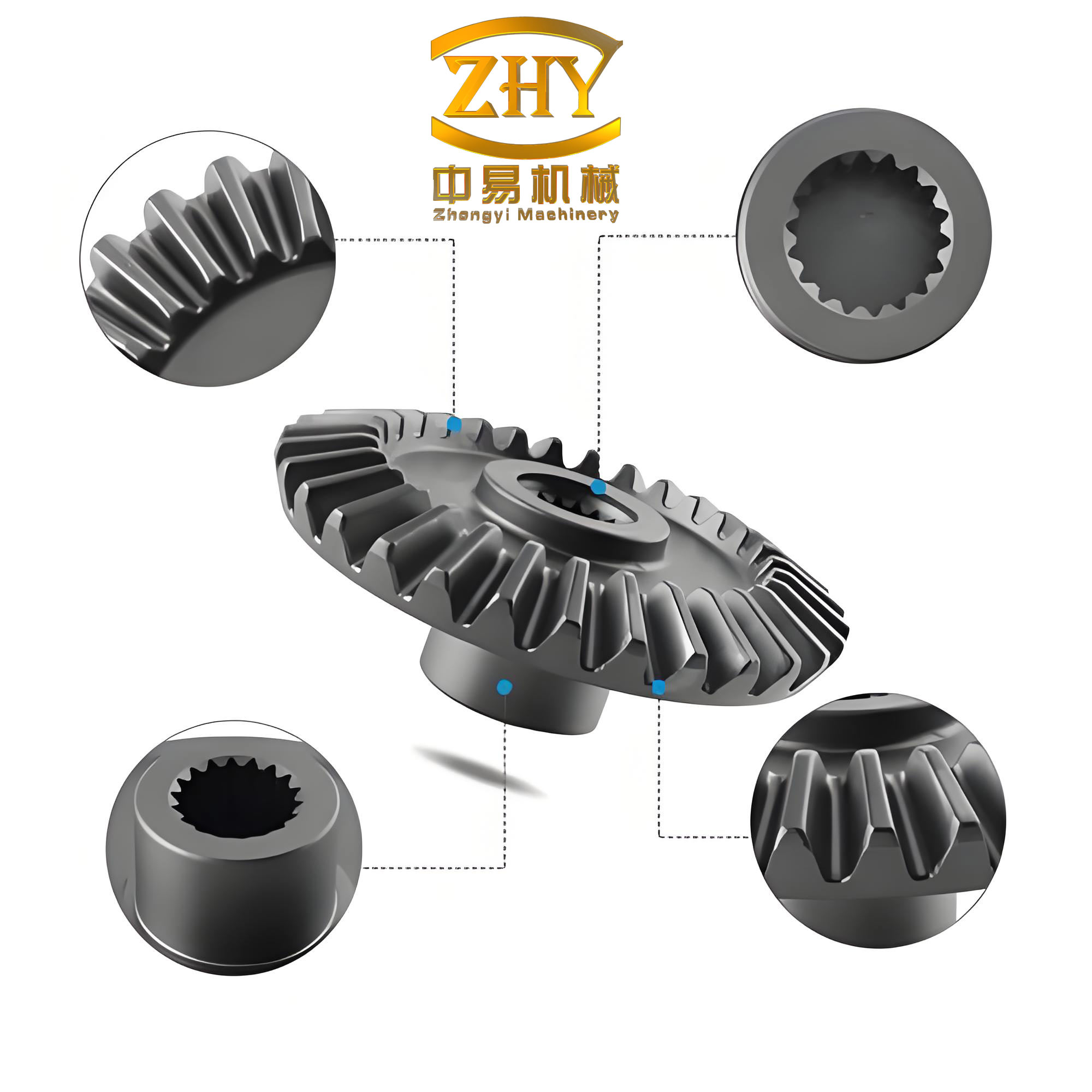
The manufacturing of straight bevel gears, especially for applications like automotive differentials, often encounters a significant challenge. While these gears frequently utilize non-standard pressure angles and tooth heights for optimal performance, the tooling available for their production on conventional planing machines is typically standardized. The standard planing cutter has a nominal pressure angle (blade angle) of \(\alpha_0 = 20^\circ\). When machining a gear with a nominal pressure angle that deviates from this standard, traditional methods lead to substantial errors in the generated tooth flank geometry and poor contact patterns, necessitating expensive, custom-made non-standard cutters. This paper presents a comprehensive study on a “Universal Planing Method” that overcomes this limitation. The core principle is to use a standard \(20^\circ\) pressure angle planing cutter to accurately generate straight bevel gears with any specified non-standard pressure angle, while simultaneously enabling precise control over the contact pattern’s location, size, and shape—effectively producing localized bearing contact akin to a crowned tooth surface on a standard machine.
1. Introduction and Problem Statement
In the production of straight bevel gears, the generating method on a bevel gear planer is common for small to medium batches. The process uses a simulated crown gear (generating gear) whose tooth profile is formed by the reciprocating motion of two planing tools. The fundamental issue arises from the mismatch between the cutter’s blade angle \(\alpha_0\) and the gear’s desired working pressure angle \(\alpha_n\). Using a \(20^\circ\) cutter for a gear designed with, for example, \(22.5^\circ\) or \(17.5^\circ\), without correction, results in a substantial deviation of the actual generated pressure angle from its nominal value on the pitch cone. Simple correction by modifying the machine’s roll ratio (gear train ratio between the workpiece and the generating gear) can adjust the pressure angle but fails to correct the resulting unfavorable contact pattern, which tends to be long and narrow, leading to high stress concentration and noise.
Advanced methods for producing localized contact on straight bevel gears exist but are generally restricted to cases where the cutter’s pressure angle matches the gear’s nominal pressure angle. This paper develops a universal methodology that removes this restriction. By introducing coordinated corrections to several key machine settings—namely, the machine center (workpiece axial setting), the sliding base setting, and the cutter tilt—it becomes possible to not only achieve the correct pressure angle with a standard cutter but also to prescriptively control the flank curvature. This allows for the generation of a predesigned elliptical contact area at a specified location on the tooth flank, significantly improving meshing quality, load distribution, and tolerance to misalignment.
2. Geometric and Kinematic Principles of the Universal Planing Method
The method is based on the theory of gearing and the generation of conjugate surfaces. The goal is to determine the precise machine settings such that a given point on the desired gear tooth flank becomes the point of tangency with the generating surface (the tool plane) at a specific instant during the generating roll, and such that the local curvatures of the generated flank meet specified targets.
2.1. Coordinate Systems and Reference Point
The analysis begins by defining coordinate systems. Let \(S_c(x_c, y_c, z_c)\) be a coordinate system fixed to the cradle (generating gear), with the \(z_c\)-axis aligned with the cradle’s axis of rotation. The tool plane, representing the generating surface \(\Sigma_c\), is fixed within \(S_c\). Let \(S_1(x_1, y_1, z_1)\) be a coordinate system fixed to the gear being cut (Gear 1), with its \(z_1\)-axis aligned with the gear’s axis. A fixed reference system \(S_m\) is also established.
A reference point \(M_1\) is chosen on the desired tooth flank of the theoretical straight bevel gear. This point is typically chosen as the intended center of the contact area. Its position is defined relative to the mid-point of the face width on the pitch cone. Let \(\Delta R\) be the displacement along the pitch cone generator from the mid-point to \(M_1\) (positive towards the toe), and \(\Delta h\) be the displacement along the tooth profile direction from the pitch cone to \(M_1\) (positive towards the root). The location of \(M_1\) is then characterized by its radial distance \(R_{M1}\) from the axis and its axial coordinate.
The unit normal vector \(\mathbf{n}_1^{(M1)}\) at point \(M_1\) on the theoretical gear flank can be calculated based on the gear’s basic geometry (pitch cone angle \(\delta_1\), pressure angle \(\alpha_n\), etc.). For a straight bevel gear approximated by its equivalent spur gear at the back cone, the pressure angle \(\alpha_{M1}\) at point \(M_1\) is given by:
$$\alpha_{M1} = \arctan\left( \frac{\tan \alpha_n}{1 \mp (\Delta h / R_{v1})} \right)$$
where \(R_{v1}\) is the equivalent pitch radius, and the sign depends on the direction of \(\Delta h\).
2.2. Condition of Conjugate Contact at the Reference Point
During generation, the generating surface \(\Sigma_c\) (the tool plane) and the gear flank \(\Sigma_1\) must satisfy the condition of continuous tangency along a line of contact. For a specific point \(M_1\) to be generated, there must exist a corresponding point \(M_c\) on the tool plane and specific rotation angles \(\phi_c\) (cradle) and \(\phi_1\) (gear) such that at that instant: 1) The position vectors of \(M_1\) and \(M_c\) coincide in the fixed space, and 2) Their unit normal vectors are collinear.
Let the initial position of the tool plane be defined. The unit normal \(\mathbf{n}_c\) to the tool plane is constant. The position vector of a point on the tool plane is \(\mathbf{r}_c^{(M_c)} = [0, y_c, z_c]^T\), assuming the plane contains the \(x_c=0\) line. The gear point \(M_1\) has position \(\mathbf{r}_1^{(M1)}\) and normal \(\mathbf{n}_1^{(M1)}\) in \(S_1\).
After rotations \(\phi_c\) and \(\phi_1\), the gear surface point moves to a new orientation. The condition for tangency (conjugacy) is expressed by the equation:
$$\mathbf{n}_c \cdot \mathbf{v}_{c1}^{(cw)} = 0$$
where \(\mathbf{v}_{c1}^{(cw)}\) is the relative velocity between the cradle and the gear at the potential contact point in the cradle system. Solving this equation, along with the condition of position vector equality, yields the required cradle angle \(\phi_c\) and an additional compensation rotation \(\Delta \phi_1\) for the gear needed due to the pressure angle mismatch:
$$\phi_c = \arctan\left( \frac{\sin \alpha_{M1} – \sin \alpha_0 \cos \theta_a}{\cos \alpha_0 \sin \theta_a} \right)$$
$$\Delta \phi_1 = \frac{\sin(\alpha_{M1} – \alpha_0)}{R_{M1} \cos \alpha_{M1}}$$
Here, \(\theta_a\) is related to the machine root angle and other settings. The total gear rotation from its initial position is \(\phi_1 = \phi_{1}^{(0)} + \Delta \phi_1\), where \(\phi_{1}^{(0)}\) is the nominal roll angle.
2.3. Control of Contact Pattern Size and Shape
The key to producing a localized contact area is controlling the principal curvatures and directions of the generated tooth flanks at the reference point. The tool plane \(\Sigma_c\) has zero curvature. The curvature of the generated flank \(\Sigma_1\) is induced by the generating motion. Using the theory of gearing, the normal curvature \(\kappa_c^{(v)}\) of the generated surface along the profile direction (relative to the instantaneous contact line) can be derived as a function of machine kinematics.
By introducing corrections—machine center adjustment \(\Delta X\), sliding base adjustment \(\Delta X_B\), and cutter tilt angle \(\lambda\)—the local curvatures of the generated straight bevel gear flank can be modified independently. The objective is to achieve a specific mismatch (gap) curvature between the pinion and gear flanks at the reference point. The contact ellipse dimensions are inversely related to the principal relative curvatures. The length \(2a\) and width \(2b\) of the contact ellipse are approximately given by:
$$a = \mu_a \sqrt[3]{\frac{W}{\kappa_{\Sigma}}}, \quad b = \mu_b \sqrt[3]{\frac{W}{\kappa_{\Sigma}}}$$
where \(W\) is the normal load, \(\kappa_{\Sigma}\) is the relative curvature in the principal direction, and \(\mu_a, \mu_b\) are coefficients. By prescribing a desired contact ellipse semi-length \(a_{des}\) and semi-width \(b_{des}\), the required principal relative curvatures \(\kappa_{I,rel}\) and \(\kappa_{II,rel}\) can be back-calculated. The machine adjustments are then solved to achieve the corresponding principal curvatures on the individual gear flanks.
The orientation of the contact ellipse is controlled by the angle \(\eta\) between the major axis of the instantaneous contact ellipse and the tooth trace direction. This angle is a function of the difference between the principal directions of the two mating flanks. The machine adjustments, particularly the cradle angle and cutter tilt, influence these principal directions, allowing control over \(\eta\) to align the contact pattern favorably along the desired path of contact.
The following table summarizes the primary machine adjustment parameters and their influence:
| Parameter Category | Symbol | Description | Primary Influence |
|---|---|---|---|
| Workpiece Positioning | \(\Delta X\) | Machine Center (Horizontal) | Pressure Angle, Location of Contact |
| \(\Delta X_B\) | Bed (Axial) Setting | Tooth Depth, Curvature (Lengthwise Crown) | |
| Cutter Positioning | \(\lambda\) | Cutter Tilt Angle | Tooth Profile Curvature, Pressure Angle Compensation |
| Motion Parameters | \(i_c\) | Machine Roll Ratio (Cradle/Gear) | Nominal Pressure Angle & Spiral |
| \(\phi_c^{(0)}\) | Initial Cradle Angle | Angular Position of Tool Stroke |
3. Mathematical Framework for Machine Setting Calculation
The calculation procedure involves solving a system of nonlinear equations derived from the geometry of generation. The inputs are the gear design parameters (module \(m\), number of teeth \(z_1, z_2\), shaft angle \(\Sigma\), pressure angle \(\alpha_n\), face width \(F\), etc.), the chosen reference point coordinates \((\Delta R, \Delta h)\), and the desired contact ellipse parameters (semi-length \(a\), semi-width \(b\), orientation \(\eta\)).
3.1. Equation System for Pinion Generation (Gear 1)
- Reference Point Conjugacy Equation: As derived in Section 2.2, this ensures point \(M_1\) is generated.
$$f_1(\Delta X, \Delta X_B, \lambda, \phi_c; \mathbf{r}_1^{M1}, \mathbf{n}_1^{M1}) = 0$$ - Position Equation: The coordinate transformation must place the generated point at the correct spatial location relative to the gear axis.
$$f_2(\Delta X, \Delta X_B, \lambda, \phi_c; \mathbf{r}_1^{M1}) = 0$$ - Curvature Equations (Two): These relate the machine settings to the generated principal curvatures \(\kappa_I^{(1)}\) and \(\kappa_{II}^{(1)}\) at \(M_1\).
$$f_3(\Delta X, \Delta X_B, \lambda; \kappa_I^{(1)}) = 0$$
$$f_4(\Delta X, \Delta X_B, \lambda; \kappa_{II}^{(1)}) = 0$$ - Transmission Ratio Condition at Reference Point: For the mating gear (Gear 2), an additional condition ensures that at the moment of contact at \(M_1\) and its conjugate point \(M_2\), the instantaneous gear ratio equals the theoretical ratio \(i_{12} = z_1 / z_2\). This involves ensuring the common surface normal at the contact point passes through the pitch line (instantaneous axis of rotation). This condition determines the initial rotational position \(\phi_1^{(0)}\) for generating Gear 2.
$$f_5(\phi_1^{(0)}; i_{12}, \mathbf{r}_1^{M1}, \mathbf{n}_1^{M1}) = 0$$
Solving equations \(f_1\) through \(f_4\) for the pinion yields its unique set of machine settings \((\Delta X_1, \Delta X_{B1}, \lambda_1, \phi_{c1})\). A similar but independent set of equations \(f_1’\) through \(f_4’\) is solved for the gear (Gear 2), using its own reference point \(M_2\) (conjugate to \(M_1\)) and its desired curvatures \(\kappa_I^{(2)}, \kappa_{II}^{(2)}\). The desired curvatures are not arbitrary but are derived from the target relative curvatures \(\kappa_{I,rel}, \kappa_{II,rel}\) for the contact ellipse. For example, if a “crowned” pinion flank is to mesh with a “straight” gear flank, the gear’s curvatures would be set close to its theoretical conjugate values, while the pinion’s curvatures would be modified to create the desired mismatch.
3.2. Calculation of Principal Curvatures and Directions
The principal curvatures of the generated flank are calculated from the second-order properties of the generating process. The generating surface (plane) has first and second fundamental form coefficients \(L_c = M_c = N_c = 0\). Using the kinematic relations of the generating motion, the second fundamental form coefficients \(L_1, M_1, N_1\) for the generated flank can be computed. The principal curvatures \(\kappa_{1,2}\) are the eigenvalues of the matrix \([\text{II}] \cdot [\text{I}]^{-1}\), where \([\text{I}]\) and \([\text{II}]\) are the matrices of the first and second fundamental forms, respectively.
$$\kappa_{1,2} = H \pm \sqrt{H^2 – K}$$
where \(H = (EN – 2FM + GL) / (2(EG – F^2))\) is the mean curvature and \(K = (LN – M^2) / (EG – F^2)\) is the Gaussian curvature. The principal directions are given by the eigenvectors. The relationship between these curvatures and the machine adjustments \(\Delta X, \Delta X_B, \lambda\) is complex and implicit, requiring numerical solution of the differential geometry system.
4. Computer Simulation and Numerical Example
To validate the Universal Planing Method, a comprehensive computer simulation software package (UPM-CAE) was developed. Its modules include: 1) Geometric parameter calculation and design, 2) Universal planing adjustment computation, 3) Undercut and pointing check, 4) Tooth contact analysis (TCA), 5) Contact pattern graphical output, and 6) Transmission error calculation.
4.1. Example Gear Set and Calculation Parameters
A sample straight bevel gear pair for an automotive differential is analyzed.
| Parameter | Pinion (Gear 1) | Gear (Gear 2) |
|---|---|---|
| Number of Teeth, \(z\) | 10 | 43 |
| Module (at outer end), \(m\) | 5.08 mm | |
| Shaft Angle, \(\Sigma\) | 90° | |
| Nominal Pressure Angle, \(\alpha_n\) | 22.5° (Non-Standard) | |
| Face Width, \(F\) | 28 mm | |
| Tool Pressure Angle, \(\alpha_0\) | 20° (Standard Cutter) / 22.5° (Matched Cutter for comparison) | |
| Reference Point | Mid-face width, mid-tooth height (\(\Delta R \approx 0\), \(\Delta h \approx 0\)) | |
| Desired Contact Ellipse | Length ~ 70% of face width, Width ~ 30% of tooth depth | |
4.2. Calculated Machine Settings
The UPM-CAE software computed the necessary adjustments for both the 20° universal method and the 22.5° matched-tool method for comparison.
| Machine Setting | Pinion (20° Cutter) | Gear (20° Cutter) | Pinion (22.5° Cutter) | Gear (22.5° Cutter) |
|---|---|---|---|---|
| Machine Center \(\Delta X\) (mm) | +0.152 | -0.068 | +0.118 | -0.042 |
| Bed Setting \(\Delta X_B\) (mm) | -0.225 | +0.101 | -0.205 | +0.089 |
| Cutter Tilt Angle \(\lambda\) (deg) | +1.85 | -1.85 | +1.20 | -1.20 |
| Calculated Roll Ratio \(i_c\) | 4.3872 | 4.2125 | 4.4125 | 4.1872 |
4.3. Simulation Results from Tooth Contact Analysis (TCA)
TCA was performed by numerically solving the meshing equation for the two generated flanks under lightly loaded conditions. The results for transmission error (TE) and contact patterns are summarized below.
Transmission Error (TE): The graph of TE (angular deviation of the driven gear from its theoretical position) versus pinion rotation angle shows a parabolic curve characteristic of localized bearing contact. For the universal method (20° cutter), the peak-to-peak transmission error was \(\Delta \phi_{2}^{max} = 12.5\) arc-seconds. For the matched-tool method, \(\Delta \phi_{2}^{max} = 13.8\) arc-seconds. The universal method produced slightly smoother motion transfer in this example.
Contact Pattern: The simulated contact patterns on the gear tooth flank were elliptical in shape. Both methods successfully produced a contact area centered at the designated reference point with the prescribed size and orientation. The pattern from the 20° cutter method was virtually indistinguishable from that of the 22.5° cutter method, confirming the effectiveness of the universal approach. The semi-length \(a\) was approximately 10 mm (~71% of half face width) and semi-width \(b\) was approximately 1.5 mm.
The major finding is that using a standard 20° pressure angle cutter to generate a 22.5° pressure angle straight bevel gear is not only feasible but can yield meshing quality (as measured by TE and contact pattern) equal to or even slightly better than using a specially ordered 22.5° cutter with conventional setup. This is attributed to the additional degrees of freedom provided by the \(\Delta X\), \(\Delta X_B\), and \(\lambda\) corrections, which allow for more optimal flank curvature modification.
5. Discussion, Applications, and Advantages
The Universal Planing Method fundamentally expands the capability of existing straight bevel gear planing machines. Its primary application is in the cost-effective, high-quality production of straight bevel gears with non-standard pressure angles without the need for special tooling. This is particularly valuable for small-batch production, prototyping, and aftermarket gear manufacturing, where ordering custom cutters is economically prohibitive or lead times are long.
The method’s ability to control the contact pattern is a significant advantage. By deliberately introducing a small, controlled mismatch in flank curvatures, it creates a localized elliptical contact area. This “crowning” effect makes the gear pair more tolerant to errors in assembly (misalignments such as offset and shaft angle errors) and deflections under load, leading to reduced noise, lower stress concentration, and improved durability. The technique allows engineers to prescriptively design the contact pattern for specific performance requirements, such as centering the contact under a given load or biasing it towards the heel or toe.
From a mathematical and manufacturing standpoint, the method demonstrates the power of integrated machine tool correction. It shows that multiple machine adjustments, traditionally used for basic setup, can be coordinated to solve a complex geometric problem—simultaneously correcting for a major tool parameter mismatch and applying sophisticated flank modification. The success of this method relies heavily on accurate computational models to solve the inverse problem: from desired gear flank characteristics to machine settings.
In conclusion, the Universal Planing Method for straight bevel gears provides a practical, sophisticated, and economical solution for manufacturing high-performance gears with non-standard geometry. It transforms the standard planing machine into a more flexible manufacturing system capable of producing optimized, localized-contact tooth flanks, bridging the gap between conventional generating and advanced CNC grinding/cutting for certain applications. This methodology underscores the potential for enhancing traditional gear manufacturing processes through the application of advanced geometric and kinematic analysis.