
In recent decades, significant advancements have been made in the optimal design of gear transmissions. Numerous studies have focused on maximizing specific performance metrics, such as bending strength or torque capacity, often yielding designs that enhance efficiency, precision, and reduce manual workload beyond the reach of traditional methods. However, a critical limitation pervades much of this research: the treatment of design parameters as deterministic, single-valued quantities. This conventional approach overlooks the inherent randomness or discreteness in material properties, manufacturing tolerances, and operational loads. Consequently, a design optimized under assumed nominal conditions may become suboptimal or even infeasible in real-world applications where these variabilities manifest. To address this gap, this article presents a robust optimization methodology for straight bevel gears that explicitly incorporates the stochastic nature of design parameters and imposes a reliability constraint on the gearset’s performance. This approach ensures the resulting design is not only optimal in a nominal sense but also possesses a quantifiable probability of success over its intended lifespan.
Stochastic Modeling of Strength and Stress in Straight Bevel Gears
The foundation of reliability-based design lies in characterizing the statistical distributions of a component’s strength (its capacity) and the stress (the demand placed upon it). For straight bevel gears, failure modes primarily considered are tooth bending fatigue and surface contact (pitting) fatigue.
Extensive experimental data and analysis indicate that the bending fatigue strength of gear teeth generally follows a normal (Gaussian) distribution. While the distribution of contact fatigue strength may be debated, the Central Limit Theorem supports its approximation as a normal distribution when the failure mechanism results from numerous micro-effects. Similarly, stress variations under specified operating conditions are largely influenced by dimensional tolerances, which are well-documented to follow normal distributions. Therefore, in the absence of specific experimental data for a given material and process, both strength and stress can be reasonably modeled as normally distributed random variables. This assumption allows for straightforward reliability calculation using the normal distribution coupling equation once the mean and standard deviation (or coefficient of variation) for strength and stress are determined.
The contact stress (s_H) and bending stress (s_F) for straight bevel gears are calculated using standard AGMA-derived formulas, modified to account for their conical geometry. The key is to treat the variables within these formulas—such as material properties, geometry factors, and load—as having random characteristics.
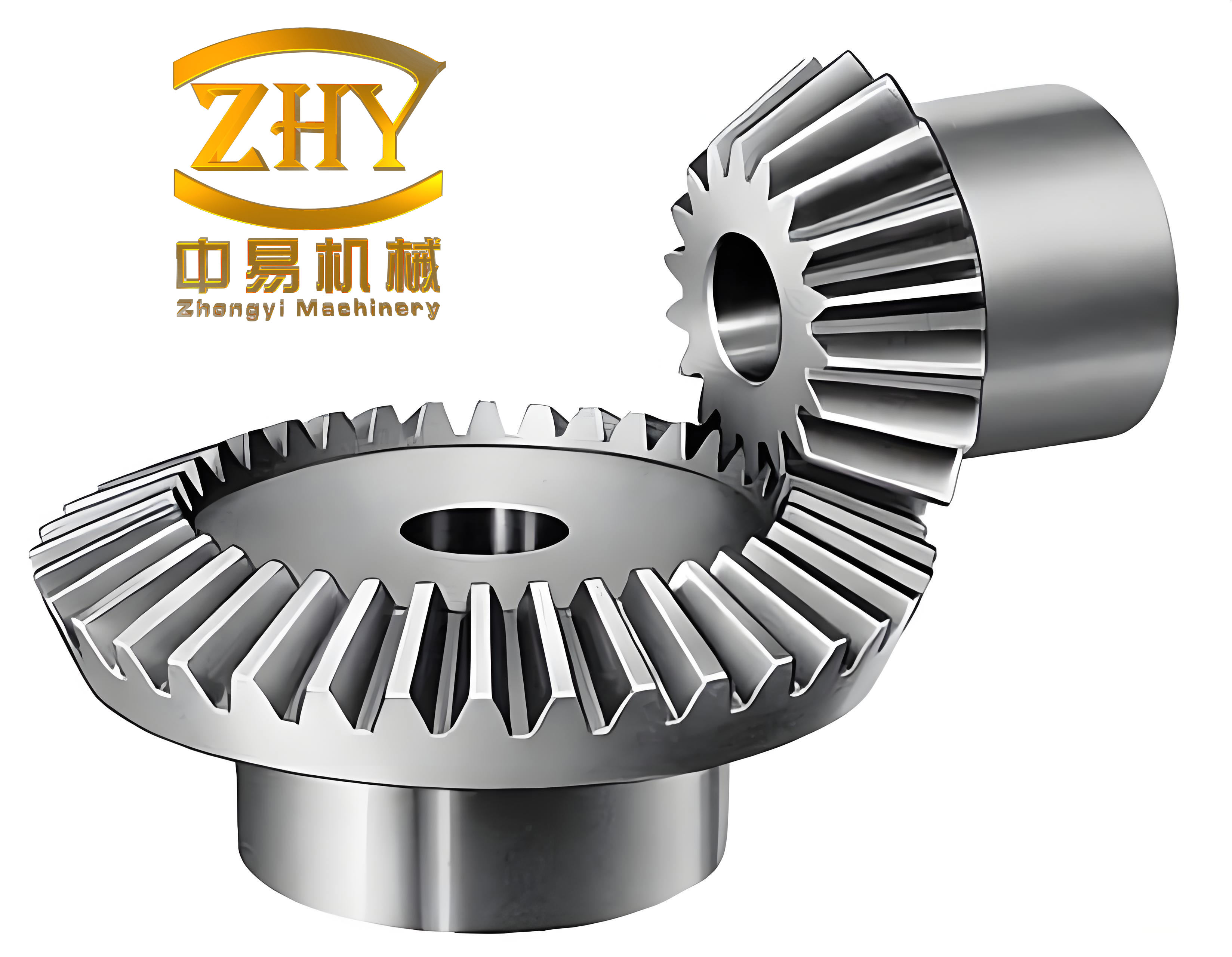
Formulation of the Reliability-Constrained Optimization Model
The optimization model seeks the best combination of gear parameters that minimizes a chosen objective while satisfying constraints related to gear strength, geometry, and, crucially, a specified reliability target.
Design Variables
For a typical straight bevel gear drive design problem, parameters like input torque (T_1), speed (n_1), gear ratio (u), and shaft angle (Σ) are predetermined. The fundamental geometric parameters are the pinion tooth count (z_1), the face width coefficient (φ_R), and the module at the large end (m). With Σ and u fixed, the independent design variables are therefore:
$$ \mathbf{X} = [x_1, x_2, x_3]^T = [z_1, φ_R, m]^T $$
Objective Function
A common and practical objective is to minimize the total material volume of the gear pair, which correlates strongly with weight and cost. The volume of a straight bevel gear is approximated as that of a frustum of a cone, bounded by the back cone and the front cone. The combined volume V_total is:
$$
V_{total} = V_1 + V_2 = \frac{\pi}{3} b \left[ \left( R_{m1} – \frac{b}{2} \tan δ_1 \right)^2 + \left( R_{m1} – \frac{b}{2} \tan δ_1 \right) \left( R_{m1} + \frac{b}{2} \tan δ_1 \right) + \left( R_{m1} + \frac{b}{2} \tan δ_1 \right)^2 \right] + \frac{\pi}{3} b \left[ \left( R_{m2} – \frac{b}{2} \tan δ_2 \right)^2 + \left( R_{m2} – \frac{b}{2} \tan δ_2 \right) \left( R_{m2} + \frac{b}{2} \tan δ_2 \right) + \left( R_{m2} + \frac{b}{2} \tan δ_2 \right)^2 \right]
$$
Where:
- V_1, V_2 are the volumes of the pinion and gear, respectively.
- b is the face width, calculated as b = φ_R * R_e, where R_e is the outer cone distance.
- R_m1, R_m2 are the mean cone distances for pinion and gear.
- δ_1, δ_2 are the pitch cone angles.
Thus, the objective function to minimize is: $$ f(\mathbf{X}) = V_{total}(\mathbf{X}) $$
Reliability-Based Constraints
The core innovation of this model is the formulation of strength constraints via a reliability index. For each failure mode, we enforce that the probability of stress exceeding strength is less than an allowable limit (or, equivalently, that the reliability is greater than a target R_t).
1. Contact Fatigue Reliability Constraint
The condition for contact stress not to exceed contact strength with a required reliability R_H can be expressed using the coupling equation. Let:
- μ_S_H, μ_s_H be the mean contact strength and mean contact stress.
- σ_S_H, σ_s_H be their standard deviations. Often, coefficients of variation C_S_H and C_s_H are used, where σ = C * μ.
The reliability index (standard normal variate) β_H is:
$$ β_H = \frac{μ_{S_H} – μ_{s_H}}{\sqrt{σ_{S_H}^2 + σ_{s_H}^2}} = \frac{μ_{S_H} – μ_{s_H}}{\sqrt{(C_{S_H} μ_{S_H})^2 + (C_{s_H} μ_{s_H})^2}} $$
The required reliability R_H corresponds to a target index β_H,t (e.g., for R=0.99, β≈2.326). Therefore, the constraint is:
$$ β_H(\mathbf{X}) \geq β_{H,t} $$
This can be reformulated as a deterministic, nonlinear constraint for the optimizer:
$$
g_1(\mathbf{X}) = β_{H,t} – \frac{μ_{S_H} – \overline{s_H}(\mathbf{X})}{\sqrt{(C_{S_H} μ_{S_H})^2 + (C_{s_H} \overline{s_H}(\mathbf{X}))^2}} \leq 0
$$
where \(\overline{s_H}(\mathbf{X})\) is the mean contact stress calculated from the design variables.
2. Bending Fatigue Reliability Constraint
A similar constraint is applied for the bending strength of both the pinion (i=1) and the gear (i=2). For each gear:
$$ β_{F,i} = \frac{μ_{S_{F,i}} – μ_{s_{F,i}}}{\sqrt{σ_{S_{F,i}}^2 + σ_{s_{F,i}}^2}} = \frac{μ_{S_{F,i}} – \overline{s_{F,i}}(\mathbf{X})}{\sqrt{(C_{S_F} μ_{S_{F,i}})^2 + (C_{s_F} \overline{s_{F,i}}(\mathbf{X}))^2}} $$
The constraint for a target bending reliability index β_F,t is:
$$
g_{2,i}(\mathbf{X}) = β_{F,t} – β_{F,i}(\mathbf{X}) \leq 0 \quad \text{for } i=1,2
$$
The mean bending stress \(\overline{s_F}\) is a function of geometry (form factor Y_F, stress correction factor Y_S, etc.), module, and load.
3. Geometrical and Practical Constraints
Additional standard constraints must be included:
- Pinion Tooth Count: z_{1,min} ≤ z_1 ≤ z_{1,max} (to avoid undercutting and ensure smooth operation).
- Face Width Limit: 0.25 ≤ φ_R ≤ 0.33 (typical range for straight bevel gears to maintain uniform load distribution).
- Module Discretization: The module m must be selected from a standard series. During optimization, it is treated as continuous but rounded post-optimization using an integer-rounding technique.
Complete Optimization Model
Summarizing, the nonlinear programming problem for the reliability-based design of straight bevel gears is:
Find X = [z_1, φ_R, m]T to
Minimize: f(X) = V_total(X)
Subject to:
1. Contact Reliability: g1(X) ≤ 0
2. Pinion Bending Reliability: g2,1(X) ≤ 0
3. Gear Bending Reliability: g2,2(X) ≤ 0
4. Geometry: z_{1,min} ≤ z_1 ≤ z_{1,max}
5. Practicality: φ_{R,min} ≤ φ_R ≤ φ_{R,max}
Optimization Algorithm and Computational Implementation
The formulated model is a constrained nonlinear optimization problem. The Complex (Box) method was selected for its robustness and suitability. This direct search method operates within the feasible region defined by the constraints. It initializes a “complex” of k > n+1 vertices (where n is the number of design variables) in the feasible space. The algorithm iteratively reflects the worst point (highest objective function value) through the centroid of the remaining points, replacing it if the new point is feasible and better. If not, it contracts towards the centroid. The process continues until convergence. The Complex method is advantageous as it does not require gradient information, handles inequality constraints naturally by maintaining feasibility, and is generally reliable for problems of moderate size, such as this three-variable straight bevel gear design problem.
For computational efficiency, all necessary coefficients (e.g., geometry factors Y_F, Y_S, zone factor Z_H, etc.) referenced from standard design handbooks were implemented not via look-up tables or charts, but through fitted empirical equations derived using the least-squares method. This allows for direct, rapid calculation within the optimization loop with an error margin reported to be under 1%.
Design Case Study and Comparative Results
To validate the proposed methodology, a practical design case was solved.
Given Parameters:
- Shaft angle, Σ = 90°
- Pinion torque, T_1 = 180 N·m
- Pinion speed, n_1 = 970 rpm
- Gear ratio, u = 3
- Driver: Electric motor; Load: Moderate shock
- Pinion mounting: Overhung
- Design life: 5 years, single-shift operation
- Pinion material: 40Cr steel, tempered (HRC 28-32)
- Gear material: 45 steel, normalized (HB 200-230)
- Required System Reliability: R_t = 0.99 (corresponding to β_t ≈ 2.326 for all constraints)
- Coefficients of Variation (from literature): C_S = 0.04~0.06, C_s = 0.02~0.04
The optimization was performed using the described Complex method algorithm. Since z_1 and m are inherently discrete, a post-processing integer-rounding technique was applied. The optimal continuous solution was identified, and then the nearest integer values for z_1 and standard values for m in the vicinity were evaluated against the constraints. The feasible combination yielding the smallest volume was selected as the final, manufacturable design.
The results of the proposed Reliability-Based Optimization (RBO) are compared against a conventional design obtained from standard handbook procedures (which do not account for randomness) in the table below.
| Design Method | Key Gear Parameters | Primary Gear Dimensions | Objective Function (Volume) (cm³) |
|---|---|---|---|
| Conventional Design | z1=20, φR=0.30, m=3.5 mm | de1=70.0 mm, b=18.9 mm, Re=63.0 mm | 1245 |
| Reliability-Based Optimization (RBO) | z1=22, φR=0.285, m=3.0 mm | de1=66.0 mm, b=16.7 mm, Re=58.5 mm | 1080 |
The optimization results demonstrate a clear improvement. The RBO design achieved a 13.3% reduction in total gear volume compared to the conventional design, leading to significant material savings and weight reduction. While the two designs are relatively close in parameter space—validating the empirical coefficients of variation used—the fundamental difference lies in the probabilistic assurance. The conventionally designed straight bevel gear set has an unknown probability of surviving its 5-year design life under the specified stochastic conditions. In contrast, the RBO-designed gearset is guaranteed, within the modeling assumptions, to have a reliability of at least 0.99 (99%) against both bending and pitting failure modes. This quantifiable reliability is a critical advantage for high-assurance applications.
Conclusions and Engineering Significance
This article has detailed a comprehensive methodology for the reliability-constrained optimal design of straight bevel gear drives. By explicitly modeling the randomness in material strength and operational stress, the proposed approach bridges the gap between deterministic optimization and real-world engineering variability. The key contributions and findings are:
- The established mathematical model successfully integrates probabilistic reliability constraints (for both contact and bending fatigue) with traditional geometric constraints within a volume-minimization framework for straight bevel gears.
- The use of the Complex method proved effective and robust for solving this constrained nonlinear problem, converging efficiently to a practical optimum.
- The case study confirms the method’s viability. The reliability-optimized design yielded a more material-efficient solution than the conventional design while providing a quantifiable reliability metric (R ≥ 0.99). The proximity of the two designs also serves as an indirect validation of the cited coefficients of variation for gear strength and stress.
- This methodology provides design engineers with a powerful tool. It moves beyond the question of “Is the safety factor greater than 1?” to answer “What is the probability of failure over the design life?” This shift enables more informed, economical, and risk-aware design decisions for straight bevel gear transmissions, which are ubiquitous in automotive, aerospace, and industrial machinery applications.
Future work could explore the extension of this model to include other sources of uncertainty, such as in the loading spectrum or in the coefficients of variation themselves, and to apply it to other gear types like helical or spiral bevel gears.